
Do I Need a Full-Time or Part-Time Fractional CRO in 2026?
 Curated byKory White · Fractional CRO · Maryland
 PULSEKNOWLEDGE LIBRARY
Quality
Certified

Whether you Need a Full-Time or Part-Time Fractional CRO depends on your company's stage, revenue scale, and sales complexity. For most B2B SaaS companies under $5M ARR with a single product line and mid-market focus, a part-time Fractional CRO delivering 15-20 hours weekly provides sufficient strategic leadership. You should transition to a Full-Time CRO when revenue exceeds $5-7M ARR, headcount surpasses 10-15 sales professionals, or your go-to-market expands into multiple products or enterprise segments.
The Decision Framework: A $3M ARR SaaS Company at the Crossroads
Imagine a B2B SaaS company generating $3.2M ARR with 88% net revenue retention. They sell a workforce compliance platform to mid-market organizations between 50 and 500 employees. Their average contract value lands around $28K annually, and the sales cycle stretches 60-75 days from first conversation to signed agreement. The founding team built the product, hired four account executives and two customer success managers, and now finds themselves buried in deal reviews, pipeline forecasting, and hiring decisions they never anticipated.
The CEO spends roughly 60% of her week on sales-related activities. She leads the weekly forecast call, jumps into late-stage negotiations, and personally closes the top three deals each quarter. Marketing generates qualified leads, but the conversion rate from marketing-qualified lead to opportunity sits at a disappointing 18%. The sales team misses their number two of the last four quarters, and the CEO cannot determine whether the problem is poor lead quality, weak execution, or the absence of a dedicated revenue leader.
This scenario captures the exact moment when founders begin asking whether they Need a Full-Time or Part-Time Fractional CRO. The answer rarely emerges from a simple job description comparison. Instead, it requires an honest assessment of where the company sits on the revenue maturity curve, what specific gaps exist in the current operation, and how much hands-on leadership the business can actually absorb at its present scale.
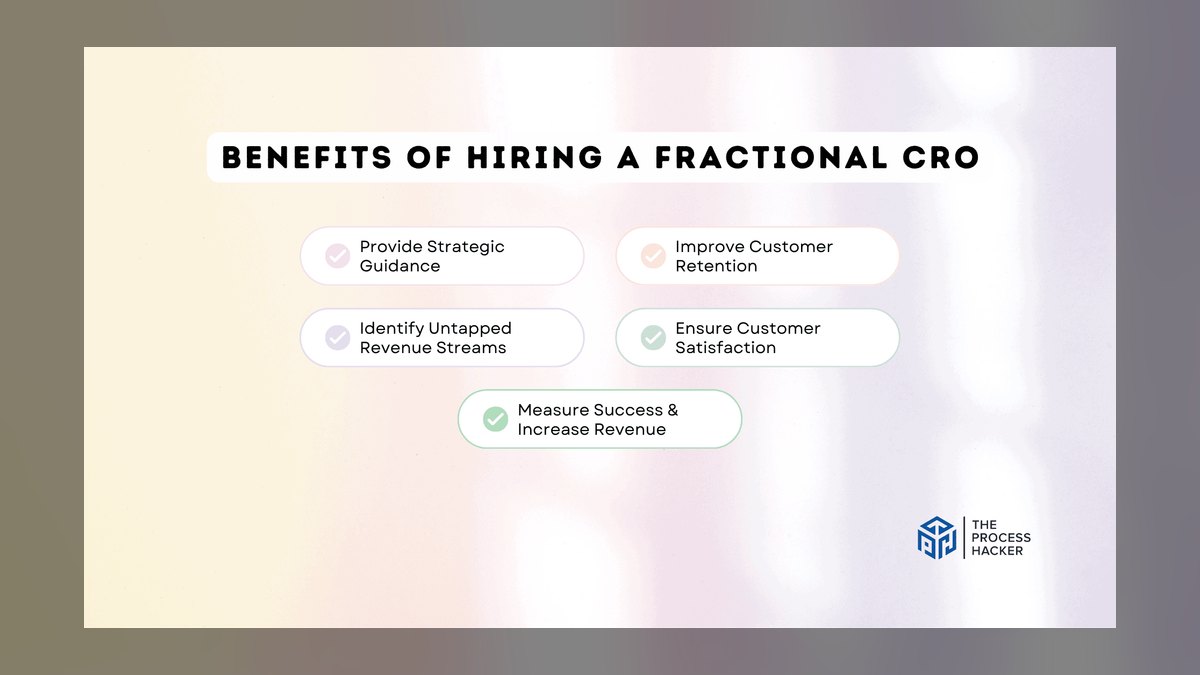
The $2-5M ARR range represents a critical inflection point. Companies below this threshold typically lack the revenue base to justify a six-figure executive salary. Companies above $7-10M ARR often find that part-time leadership creates bottlenecks in decision-making, rep coaching, and cross-functional alignment. The middle zone demands careful evaluation of revenue velocity, team size, and the founder's bandwidth constraints.
How Fractional and Full-Time CRO Engagements Actually Function
The operational mechanics of a Fractional CRO engagement differ fundamentally from a Full-Time executive hire. Understanding these differences helps founders make an informed choice rather than defaulting to whatever feels familiar.

A Fractional CRO typically commits to 10-25 hours per week, with 15-20 hours being the most common arrangement for companies in the $2-5M ARR range. Those hours concentrate on high-leverage activities: pipeline auditing, forecast accuracy improvement, sales process design, rep coaching, and executive-level strategic planning. The Fractional CRO does not embed in day-to-day operations. They do not attend every sales call, monitor every CRM update, or manage rep activity hour by hour. Instead, they work on the system rather than inside it.
The typical week for a Fractional CRO at a $3M ARR company might look like this: Monday morning they join a 90-minute pipeline review with the sales team. Tuesday they spend three hours analyzing CRM data, identifying stalled deals, and preparing coaching notes for individual reps. Wednesday they meet with the CEO for two hours to review forecast accuracy and discuss hiring plans. Thursday they run a discovery call training session for the sales team and spend two hours working with the customer success lead on expansion revenue strategies. Friday they block time for strategic deliverables like a revised compensation plan or a territory realignment proposal.
A Full-Time CRO, by contrast, owns the entire revenue organization. They manage sales, customer success, marketing alignment, and revenue operations. They sit on the leadership team, attend board meetings, and carry direct accountability for quarterly and annual revenue targets. They hire and fire sales professionals, design territories and quotas, negotiate enterprise agreements, and maintain constant visibility into pipeline health. The Full-Time CRO lives inside the business, and their success depends on the daily execution of the team they lead.

The engagement model also differs in how work gets prioritized. A Fractional CRO typically enters with a 90-day plan focused on quick wins: cleaning up the CRM, implementing a stage-gate process, improving forecast accuracy, and redesigning compensation to drive desired behaviors. A Full-Time CRO takes a longer view, building the revenue engine over multiple quarters and owning the outcomes of every hire, process change, and strategic pivot.
Real Numbers, Ranges, and Benchmarks for Your Decision
Concrete financial figures frame the Full-Time versus Fractional CRO decision more clearly than abstract advice. These numbers represent typical market ranges based on common compensation practices across the B2B SaaS industry.

A Full-Time CRO at a company in the $5-15M ARR range typically commands a base salary between $200,000 and $250,000. On top of that base, variable compensation adds 20-30% tied to ARR growth, net revenue retention, and other revenue KPIs. Total on-target earnings land between $240,000 and $325,000 annually. Equity compensation often adds another 0.5-1.5% of the company, vesting over four years. When you factor in benefits, payroll taxes, and administrative overhead, the fully loaded cost of a Full-Time CRO approaches $275,000 to $350,000 in year one.
A Fractional CRO engagement typically runs $6,000 to $15,000 per month, depending on the executive's experience level, the hours committed, and the scope of responsibilities. For a company at $3M ARR, a reasonable expectation lands between $8,000 and $12,000 monthly for 15-20 hours per week. Annualized, that represents $96,000 to $144,000 per year. The fractional model also offers flexibility: engagements can scale up during critical periods like fundraising, product launches, or sales team restructuring, then scale back during slower months.
The cost differential matters, but the value calculation extends beyond salary comparison. Consider what $200,000 in savings could fund elsewhere in the organization. Three additional sales development representatives at $55,000-65,000 fully loaded each. A marketing automation platform plus a dedicated campaign manager. Customer success headcount to improve onboarding and reduce churn. For a company at $2-4M ARR, the opportunity cost of a Full-Time CRO salary often outweighs the benefits of having a dedicated executive.

Benchmarks also help calibrate expectations. Companies with a Fractional CRO typically see forecast accuracy improve from 50-60% to 70-80% within 60-90 days of engagement. Pipeline coverage ratios move from 2x to 3x or higher as the Fractional CRO implements disciplined qualification criteria and purges stale opportunities. Sales rep productivity improves as coaching becomes consistent and process replaces improvisation.
The transition point to Full-Time leadership varies by company, but several signals indicate readiness. Revenue consistently exceeding $5-7M ARR creates enough complexity to demand daily executive attention. A sales organization of 10-15 or more reps requires more coaching hours than a part-time leader can provide. Multiple product lines or expansion into enterprise accounts with $100K+ ACV introduces selling motions that demand dedicated leadership. Geographic expansion, international sales, or channel partnerships add another layer of complexity that outstrips part-time capacity.

Trade-offs and Alternatives: Beyond the Binary Choice
The Full-Time versus Fractional CRO decision rarely presents itself as a clean binary. Several alternative structures and hybrid approaches deserve consideration, each with distinct trade-offs that may better match your company's specific circumstances.
The interim CRO represents one alternative worth understanding. Unlike a Fractional CRO who works part-time on an ongoing basis, an interim CRO commits full-time for a defined period, typically 3-6 months. This model fits companies facing a specific crisis: a sales team that missed quota for three consecutive quarters, a founder who burned out from carrying the entire revenue function, or a sudden leadership vacuum following a CRO departure. The interim CRO comes in, stabilizes the operation, implements necessary fixes, and exits once the company either hires a permanent leader or determines that a Fractional arrangement suffices. The cost runs higher than fractional because of the full-time commitment, but lower than a permanent hire when you consider the defined duration.
Another alternative involves promoting from within and supplementing with fractional expertise. If your current sales director or VP of Sales shows promise but lacks executive-level strategic experience, a Fractional CRO can mentor that individual while providing the strategic oversight the company needs. The internal leader handles daily operations, rep management, and deal execution. The Fractional CRO focuses on process design, forecast methodology, compensation architecture, and board-level reporting. This arrangement develops internal talent while accessing senior expertise, and it creates a natural succession path if the company eventually needs a Full-Time CRO.

Some companies explore engaging a Fractional CRO on a project basis rather than an ongoing retainer. A 60-90 day engagement focused on a specific deliverable, such as building a sales playbook, implementing a new CRM structure, or designing a compensation plan, can provide the expertise needed without the ongoing cost. Once the project completes, the internal team executes against the new framework. This approach works well for companies with strong operational leadership that simply needs expert guidance on a particular initiative.
The consulting and advisory model sits at the far end of the spectrum. Rather than engaging a Fractional CRO who works alongside your team, you hire a revenue consultant to assess your operation, deliver recommendations, and leave. This works for companies that need an objective outside perspective but have the internal capability to execute. The downside is the lack of accountability for implementation. Recommendations that look good on paper often fail without someone driving the change.

Each alternative carries trade-offs. The interim CRO provides intensive support but creates disruption when they exit. The mentor model develops talent but requires the internal leader to be coachable and the Fractional CRO to prioritize knowledge transfer over personal credit. The project-based approach delivers specific outcomes but lacks ongoing strategic partnership. The consulting model offers objectivity but struggles with follow-through.
Common Pitfalls and How to Avoid Them
Companies making the Full-Time versus Fractional CRO decision frequently stumble into predictable traps. Recognizing these pitfalls before they occur can save significant time, money, and organizational disruption.
The first pitfall involves hiring a Full-Time CRO too early. A company at $3M ARR with eight sales reps does not need a $250,000 executive to manage a team that size. The Fractional CRO can provide the same strategic guidance at a fraction of the cost. The Full-Time hire creates pressure to justify the expense, which often leads to over-hiring, premature expansion into new markets, or unnecessary process bureaucracy. Avoid this by honestly assessing whether your current revenue scale genuinely demands daily executive leadership or whether weekly strategic guidance suffices.

The second pitfall involves engaging a Fractional CRO with the wrong background. A Fractional CRO who spent their career at enterprise software companies selling $500K deals to Fortune 500 procurement departments will struggle to relate to your $30K mid-market sales cycle. Their playbook assumes resources, processes, and team structures that do not exist at your stage. Vet candidates for specific experience at companies between $2-15M ARR selling to mid-market buyers. Ask for case studies and references from CEOs at companies similar to yours.
The third pitfall involves unclear expectations and undefined success metrics. Companies often engage a Fractional CRO without specifying what success looks like. Does the Fractional CRO own the revenue number? Are they accountable for rep hiring? What happens if forecast accuracy does not improve? Define clear KPIs at the outset: pipeline coverage ratios, forecast accuracy percentages, sales cycle length, conversion rates, and revenue growth targets. Establish a 90-day review process to evaluate progress against these metrics and make adjustments as needed.

The fourth pitfall involves treating the Fractional CRO as a hands-off advisor rather than an embedded operator. A Fractional CRO provides the most value when they work directly with your sales team, coach individual reps, and participate in key deal reviews. If you expect them to simply deliver recommendations that your team then executes, you will likely see disappointing results. The Fractional CRO needs access to your CRM, your sales calls, your team meetings, and your strategic discussions to make a real impact.
The fifth pitfall involves ignoring the founder's role in revenue leadership. At $2-4M ARR, the founder often remains the de facto CRO, closing the largest deals and maintaining key customer relationships. A Fractional CRO cannot replace that founder involvement entirely. The best arrangement involves the Fractional CRO building systems and processes while the founder continues to leverage their relationships and industry expertise. Trying to completely offload revenue leadership to any external party, Full-Time or Fractional, rarely works at this stage.
The sixth pitfall involves failing to plan for the transition. Whether you start with a Fractional CRO and later convert to Full-Time, or you hire a Full-Time CRO from the outset, the transition requires deliberate planning. Document the processes, systems, and institutional knowledge created during the Fractional engagement. Ensure the Fractional CRO leaves behind a playbook, not just results. When hiring a Full-Time CRO, provide adequate overlap with the Fractional CRO to transfer context and relationships.
Related Questions
How do I vet a Fractional CRO for my specific situation?
Look for someone who has served as a Full-Time CRO at a company between $2-15M ARR in B2B SaaS. Ask for case studies showing forecast accuracy improvements, pipeline growth, or revenue acceleration. Request references from CEOs at companies with similar NRR and deal sizes. Avoid candidates whose only experience comes from enterprise organizations above $50M ARR.
What happens if the Fractional CRO does not deliver results in 90 days?
Your contract should include a 30-day termination clause. Conduct a formal 90-day review measuring pipeline coverage (should increase from 2x to 3x), forecast accuracy (should improve from 50% to 70%+), and rep confidence through anonymous surveys. If metrics have not moved, replace them with another Fractional CRO rather than jumping to a Full-Time hire.
Can a Fractional CRO fix an underperforming sales manager?
Yes, but only if you authorize them to coach or replace that manager. The Fractional CRO should assess the sales manager in the first 30 days and deliver a recommendation: retrain with a 60-day improvement plan or transition them out. If you resist this decision, the Fractional CRO cannot overcome the bottleneck.
How does a Fractional CRO integrate with my customer success team?
Schedule a weekly 30-minute handoff between the Fractional CRO and your CS lead to review at-risk accounts and expansion opportunities. The Fractional CRO advises on retention strategy, health score implementation, and QBR processes, but the CS lead retains ownership of day-to-day operations.
FAQ
How many hours per week does a Fractional CRO typically work?
Most Fractional CRO engagements run 15-20 hours per week for companies between $2-10M ARR. The hours concentrate on pipeline reviews, rep coaching, forecast analysis, and executive strategy sessions. Some engagements start at 10 hours weekly and scale up during critical periods. The key is matching hours to the complexity of your revenue operation rather than defaulting to a predetermined number.
What is the typical cost difference between a Fractional and Full-Time CRO?
A Fractional CRO costs between $6,000 and $15,000 monthly, or $72,000 to $180,000 annually. A Full-Time CRO commands $200,000-250,000 base salary plus 20-30% variable, totaling $240,000-325,000 in on-target earnings. Fully loaded with benefits and overhead, the Full-Time cost approaches $275,000-350,000. The Fractional model saves $100,000-200,000 annually while providing similar strategic expertise.
When should I convert from a Fractional to a Full-Time CRO?
Convert when your ARR exceeds $5-7M, your sales team grows beyond 10-15 reps, you launch a second product line, or you enter enterprise accounts above $100K ACV. Additional triggers include geographic expansion, channel partnerships, or when the Fractional CRO recommends the switch because the engagement has hit its ceiling. If none of these signals appear within 9-12 months, extend the Fractional arrangement.
What does a Fractional CRO do in the first 90 days?
The first 90 days follow a structured arc. Weeks 1-2 focus on auditing CRM hygiene, reviewing the sales playbook, and interviewing top and bottom performers. Weeks 3-4 map pipeline to buying committee dynamics and identify stalled deals. Weeks 5-8 implement weekly forecast reviews, pipeline generation meetings, and executive reporting. Weeks 9-12 redesign compensation, set revenue targets, and establish operating cadence.
Can a Fractional CRO also manage my marketing team?
Some Fractional CROs include marketing oversight in their scope, but this varies by engagement. At companies under $5M ARR, marketing often reports to the CEO or founder. A Fractional CRO can advise on marketing alignment, lead generation strategy, and campaign prioritization without formally managing the marketing team. Clarify reporting structures and scope before signing the engagement agreement.
What metrics should I track to evaluate a Fractional CRO's performance?
Track pipeline coverage ratio, forecast accuracy, sales cycle length, win rate by stage, average deal size, and new customer acquisition cost. Also monitor leading indicators like rep activity levels, discovery call quality, and proposal-to-close conversion. Review these metrics monthly and conduct a formal evaluation at the 90-day mark to determine whether the engagement is delivering expected value.
Sources
- https://www.saastr.com/the-fractional-cro-debate/
- https://www.forbes.com/sites/forbesbusinesscouncil/2023/01/17/fractional-executives/
- https://hbr.org/2022/03/when-to-hire-your-first-sales-leader
- https://www.gartner.com/en/sales/insights/revenue-leadership
- https://www.growthsandwich.com/resources/fractional-cro/
- https://www.linkedin.com/business/sales/blog/sales-best-practices/when-to-hire-a-cro
- https://www.forentrepreneurs.com/fractional-executives/
- https://www.saleshacker.com/fractional-cro/
Related on PULSE
- Revenue Operations Playbooks for Scaling SaaS Companies
- Building Your First Sales Compensation Plan
- Forecast Accuracy: Methods That Actually Work
- The Sales Manager's Guide to Pipeline Reviews
- Customer Success Handoff: Reducing Churn in the First 90 Days
This page will be disappearing soon. Save it to your device for $1 — or read it free while it is here.
@Kory-White- · if Venmo asks, the last 4 of my number are 2012
This page is gone.
This one is off the shelf now. $1 keeps it on your phone for good — the whole page, pictures and diagrams included.
 pulse-qHow Many Sales Reps Do I Need to Hire for My Hot Tub and Spa Retailer in 2026?
 pulse-qHow Many Sales Reps Do I Need to Hire for My Equipment Rental Company in 2026?
 pulse-qWhat Service Fees Should a Gym or Fitness Studio Charge in 2026?
 pulse-qHow Many Crew Members Should I Schedule Each Shift at My Hamburger Franchise in 2026?
 pulse-qHow Do I Get My Jewelry Staff to Offer Financing on Every Sale in 2026?
 pulse-qHow Many Employees Should I Schedule Each Shift at My Tutoring Center in 2026?
 pulse-qHow Many Baristas Should I Schedule Each Shift at My Coffee Drive-Thru in 2026?
 pulse-qWhat Service Fees Should a Locksmith Charge in 2026?
 pulse-qHow Many Agents Do I Need to Recruit for My Real Estate Brokerage to Grow Production in 2026?
 pulse-qHow Do I Figure Out How Many Reps to Schedule at Each of My Multi-Unit Cell Phone Stores in 2026?