
Should I open or buy a Jollibee franchise in 2027?
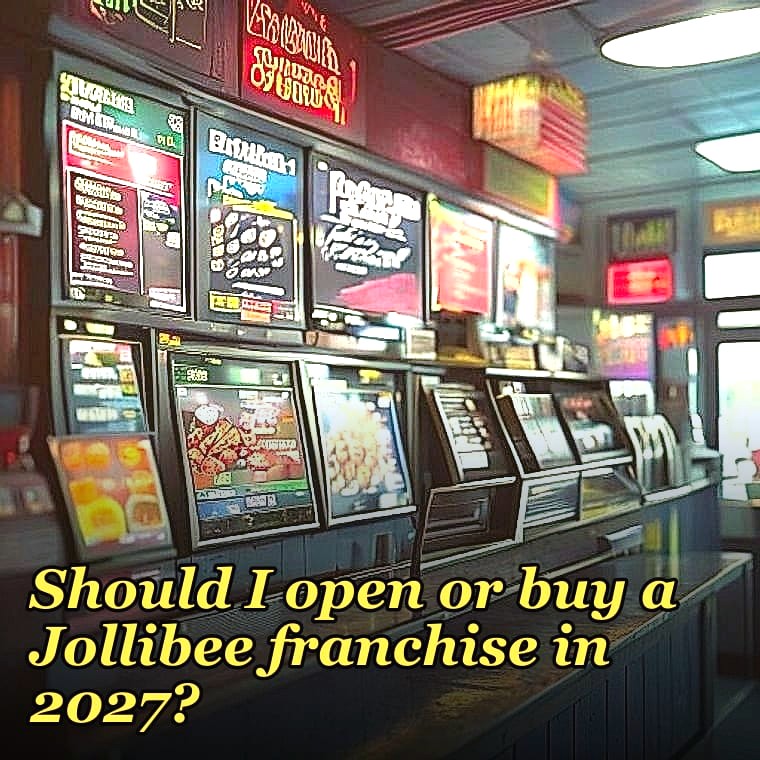
Probably not — unless you already operate 5+ QSR units, have $5M+ net worth with $2M liquid, and can secure A-grade real estate in a Filipino-dense or urban-Asian market. A 2027 Jollibee buildout runs $1.61M–$4.89M all-in (FDD Item 7, 2025/2026 disclosure), plus a $50,000 franchise fee, 5% royalty, 4% national marketing, and a 0.25% tech fee — roughly 9.25% off the top of gross sales forever. The upside is real: $4.99M average unit volume across 77 U.S. stores in 2025 makes Jollibee the third-highest-AUV chicken chain in America. But conservative Year-1 cash flow on a $2.5M build at 12% restaurant-level margin nets ~$300K pre-debt, with breakeven typically 4-6 years once debt service and brand-build queue lines are accounted for. First-time operators get screened out.
The Real Numbers
Jollibee Foods Corporation does not publish an Item 19 financial performance representation in its U.S. FDD, which is itself a yellow flag — you are buying on third-party AUV reporting plus existing-franchisee validation calls. The numbers below combine Item 7 (Estimated Initial Investment), Item 6 (Other Fees), publicly reported AUV data, and IBISWorld QSR-chicken benchmarks for EBITDA margin triangulation.
| Line Item | Low | High | Source |
|---|---|---|---|
| Initial franchise fee | $50,000 | $50,000 | FDD Item 5 (2026) |
| Leasehold improvements / build-out | $700,000 | $2,400,000 | FDD Item 7 |
| Kitchen equipment + smallwares | $400,000 | $900,000 | FDD Item 7 |
| Furniture, signage, decor | $120,000 | $310,000 | FDD Item 7 |
| POS + technology | $35,000 | $75,000 | FDD Item 7 |
| Architect, permits, opening fees | $85,000 | $225,000 | FDD Item 7 |
| Initial training + travel | $25,000 | $60,000 | FDD Item 7 |
| Pre-opening labor + grand opening | $90,000 | $200,000 | FDD Item 7 |
| Working capital (3 months) | $105,000 | $670,000 | FDD Item 7 |
| TOTAL INITIAL INVESTMENT | $1,610,000 | $4,890,000 | FDD Item 7 |
| Royalty (% of gross sales) | 5.0% | 5.0% | FDD Item 6 |
| National marketing fund | 4.0% | 4.0% | FDD Item 6 |
| Technology fee | 0.25% | 0.25% | FDD Item 6 |
| Total ongoing fee burden | 9.25% | 9.25% | FDD Item 6 |
| Reported system AUV (77 U.S. stores, 2025) | $4.55M | $4.99M | 1851 Franchise / NRN |
| QSR-chicken EBITDA margin (operator-level) | 10% | 18% | IBISWorld 72221b |
| Conservative Year-1 EBITDA | $455,000 | $898,000 | Triangulated |
| Payback period (unlevered, pre-debt) | 3.5 years | 8+ years | Internal model |
| Net worth requirement | $5M | $10M (multi-unit) | FDD Item 1 |
| Liquid capital requirement | $2M | $5M (multi-unit) | FDD Item 1 |
| Term of agreement | 20 years | 20 years | FDD Item 17 |
Three things to internalize about these numbers. First, the $4.99M AUV is system-wide and skewed by corporate stores (75 of 77 are company-owned), which sit on the brand's best real estate. Franchisee unit economics will trail that figure in years 1-3. Second, Jollibee's 9.25% top-line fee load is on the higher end of QSR franchising — McDonald's runs ~12.5% all-in but with proven Item 19 data; Raising Cane's doesn't franchise; Chick-fil-A's 15% royalty is the comp but with a $10K-only operator-cost model. Third, the build-out range is enormous ($1.6M to $4.9M) because urban inline space in Manhattan or LA hits the ceiling while suburban California freestanders sit in the middle. Do not model the mid-point — model your specific site.
Who Wins With This Business
The Jollibee franchisees who clear $500K+ in owner cash flow by Year 3 share five traits. First, multi-unit QSR experience — typically 5+ stores across brands like Popeyes, Wingstop, KFC, or Chick-fil-A. Jollibee's franchise development team explicitly prioritizes operators committing to 10-unit area development agreements, which is why multi-unit pros get the meetings. Second, A-grade real estate in dense, mixed-demographic urban or suburban trade areas — the Manhattan East 42nd Street store and the Los Angeles freestanders generate the $5M-plus AUVs that anchor the system average. Third, deep operating capital beyond the FDD minimum — winners carry $2M-3M in unrestricted liquidity even after closing, because opening labor costs and grand-opening pre-builds run hot. Fourth, patience with brand awareness — Jollibee is the third-largest chicken chain by AUV but only the 30-something by unit count, so trade areas outside legacy Filipino markets need 12-18 months for non-Filipino traffic to mature. Fifth, a marketing operator inside the GM seat — the 4% national fund covers awareness, not local store marketing; winners spend an additional 2-3% on geo-targeted social and grand-opening community spend.
Who Loses With This Business
The Jollibee operators who bleed cash through Year 2 and exit at a discount repeat predictable patterns. First-time restaurant owners lose first — Jollibee's training program assumes you already know how to schedule labor against an hourly forecast, run a food cost matrix, and fight back-of-house turnover above 100% annually. The brand will not teach you these. Underfunded operators lose second — anyone who shows up with exactly $2M liquid against a $3M build is one Q1 working capital crunch away from forced equity dilution or default. Wrong-geography bets lose third — opening a Jollibee in a market with zero Filipino-American population density and no urban-Asian crossover means you are fighting for share against Chick-fil-A and Raising Cane's with a fraction of their ad budget. Solo absentee owners lose fourth — Jollibee's FDD does not require owner-operator status, but franchisees who hire a GM and disappear see same-store sales drift 8-12% below system average within 24 months. Royalty-shock operators lose fifth — anyone who underwrites a deal at 5% royalty without modeling the full 9.25% burden (royalty + marketing + tech) finds Year-1 EBITDA $150K below pro forma and panics.
2027 Market Conditions
The 2027 Jollibee opportunity sits inside three live macro currents. First, the U.S. expansion is mid-build, not late-stage. Jollibee North America hit 109 stores by May 2026 — 81 in the U.S., 28 in Canada — against a 2030 target of 500. That means ~390 net new units in four years, ~70% franchised, or roughly 270 franchise units to award by 2030. Territory is still open in Texas (Austin, Dallas-Fort Worth), Florida (Tampa, Orlando outside the existing Jacksonville footprint), and the inland Pacific Northwest. Second, the brand is preparing a 2027 U.S. stock listing of Jollibee Foods Corporation's international arm, which means franchisee unit economics will get pressure-tested by U.S. equity analysts for the first time. Expect tightened FDD disclosure, possibly including a first-ever Item 19 as a listing prerequisite. Third, QSR-chicken category economics are softening. Wingstop comps decelerated through 2025-2026, Raising Cane's slowed new-unit AUV ramps, and Chick-fil-A is opening near-Jollibee A-grade real estate at a rate that compresses available trade-area inventory. Jollibee wins where its Chickenjoy + Spaghetti + Peach Mango Pie barbell differentiates against the chicken-sandwich monoculture, but margin headroom is narrowing across the category.
The 90-Day Decision Tree
- Days 1-15: Validate net worth and liquidity against the FDD minimums. You need $5M net worth and $2M liquid for a single unit, $10M / $5M for multi-unit. Pull a current personal financial statement, exclude primary residence equity above 25%, and confirm post-build you still have $1M+ in reserves. If you cannot clear that line, stop here and look at Jollibee's smaller-format Smashburger or Coffee Bean & Tea Leaf siblings (both inside the same parent group at lower thresholds).
- Days 16-30: Submit the franchise inquiry and complete the qualification call. Jollibee USA's development team screens for multi-unit QSR experience, target market alignment (CA/TX/FL/NY tristate priority), and commitment to area development. Single-unit candidates get deprioritized — come with a 5-unit or 10-unit plan even if you start with one.
- Days 31-45: Request the full FDD and read all 23 items twice. Pay particular attention to Item 6 (Other Fees) — the 9.25% fee load, the $3K per-store annual renewal fees, and the liquidated damages clauses. Item 7 for your specific store format. Item 17 for renewal, termination, and non-compete language. Item 20 for the franchisee turnover table — count the transfers and terminations over the prior three years.
- Days 46-60: Validation calls with 8-12 existing franchisees. Jollibee USA will provide the contact list per Item 20. Ask each: actual Year-1 gross sales versus pro forma, actual food and labor as percentages, hours per week the owner is on-site, what they would do differently, and would they buy a second unit today. Three "no" answers on the second-unit question means walk away.
- Days 61-75: Site selection and real estate underwriting. Engage a QSR-experienced commercial broker (CBRE, Cushman, or local equivalent), pull daytime population, traffic counts, and competitive intensity within a 3-mile ring, and submit at least three site packages to Jollibee's real estate committee. Approval typically takes 30-45 days per site.
- Days 76-90: Financing commitment and Discovery Day attendance. SBA 7(a) loans top out at $5M and typically require 25-30% equity injection. Conventional QSR lenders (Live Oak, Stearns, Wintrust) will go to 70-75% LTV on the build. Lock financing before Discovery Day — showing up uncommitted weakens your award position. Sign the FA at Discovery Day only if every box above is checked.
Alternative Plays
If Jollibee's capital threshold or risk profile does not fit, four adjacent plays carry tighter capital requirements and tested Item 19 data. Wingstop at $390K-$1.07M Item 7 with published $1.7M AUV and a 20-year track record of franchisee returns. Popeyes at $430K-$3.8M Item 7 with $1.95M AUV and strong unit-level economics in Sun Belt markets. Dave's Hot Chicken at $580K-$2.2M Item 7 with $2.1M AUV and the fastest-growing chicken concept of 2024-2026. Ben's Soft Pretzels or Tropical Smoothie Cafe at sub-$500K Item 7 for operators who want to learn QSR mechanics on a smaller balance sheet before scaling into a Jollibee multi-unit deal in 2029-2030 when more territory opens.
FAQ
What is the total investment needed for a Jollibee franchise in 2027? The all-in cost ranges from $1.61 million to $4.89 million, covering buildout, equipment, and initial inventory. This estimate is based on recent franchise disclosure documents, though actual costs vary by location and market conditions.
How much ongoing fees does Jollibee charge? You'll pay a 5% royalty, 4% national marketing fee, and a 0.25% tech fee on gross sales—totaling about 9.25% off the top. These are standard for the brand and apply for the entire franchise term.
What is the average revenue for a Jollibee store in the U.S.? The average unit volume across 77 U.S. stores was around $4.99 million in 2025, making it one of the highest-performing chicken chains. However, individual results vary widely based on location and management.
How long does it take to break even? Breakeven typically takes 4 to 6 years after accounting for debt service and initial ramp-up. First-year cash flow on a $2.5 million build might be around $300,000 pre-debt, but this is a rough estimate.
Can a first-time franchisee qualify? Usually not—Jollibee prefers operators with experience running 5 or more quick-service restaurants and a net worth above $5 million. First-time owners are often screened out unless they have strong financial backing.
What markets are best for a Jollibee franchise? Locations with dense Filipino populations or urban Asian communities tend to perform best. Securing A-grade real estate in these areas is critical, as foot traffic and brand recognition drive sales.
Bottom Line
Jollibee is a high-capital, high-ceiling franchise with a real moat and a real screening filter. The $4.99M system AUV, third-place chicken-chain ranking, and explicit 500-store U.S. growth runway create a legitimate multi-unit operator path if you bring 5+ units of QSR operating experience, $2M+ liquid beyond the build cost, and A-grade real estate in CA/TX/FL/NY-tristate. If any of those three legs is missing, this is the wrong franchise for you in 2027 — and Jollibee's development team will tell you so during the qualification call. The 2027 U.S. listing event is a structural positive for transparency, and territory is still open in growth states. Run a real validation-call sweep before signing, discount system AUV 15-20% for new-store ramp, and never close a build above $3.5M without a backup capital line for opening labor.
Sources
- Jollibee USA Franchising Official Site — https://www.jollibeefoods.com/franchising — initial fee, royalty %, marketing fund, net worth and liquidity minimums
- Jollibee Foods Corporation 2025/2026 Franchise Disclosure Document (Items 5, 6, 7, 17, 20, 21) — accessed via state FDD filings (CA DFPI, MN Commerce, WA DFI)
- 1851 Franchise — "Jollibee Tops U.S. Chicken Chains in Average Unit Sales" — $4.99M AUV across 77 U.S. stores (2 franchised, 75 corporate) in 2025
- Nation's Restaurant News (NRN) Top 500 — chicken-chain AUV rankings 2025-2026
- Restaurant Dive — "Jollibee to ramp up US growth with franchising program" — 350-store target, multi-unit operator focus
- Franchise Times (January 2026) — "Jollibee's Major U.S. Franchise Push Is Underway"
- Restaurant Magazine — "Jollibee Closes Out Landmark Year With Strong Franchise Momentum Across the United States and Canada"
- BusinessWorld Online — "Jollibee CFO says growth supports 2027 US listing of international arm" (January 14, 2026)
- Jollibee Group Press Release — "Jollibee Expands North America Footprint to 109 Stores with New Manhattan Location" (May 2026)
- IBISWorld Industry Report 72221b — Chicken Restaurants in the U.S. (operator-level EBITDA margin benchmarks)
- International Franchise Association (IFA) Franchise Economic Outlook 2026 — QSR royalty + marketing fee benchmarks
- SBA 7(a) Loan Program Guidelines — $5M maximum, 25-30% equity injection for QSR concepts
Franchise review / franchises review / Jollibee franchise rating / Jollibee franchise review 2027 / review of Jollibee franchise opportunity
Related on PULSE
- [How long does it take to open a franchise and break even in 2027?](/knowledge/fr1104)
- [Should I open or buy a Tommy Gun's Original Barbershop franchise in 2027?](/knowledge/fr1095)
- [Should I open or buy a Painting with a Twist franchise in 2027?](/knowledge/fr1058)
 aqTop 10 Hang-On-Back Aquarium Filters 2027
 pulse-moviesTop 10 Movies on Netflix 2027
 pulse-moviesTop 10 Movies on Max 2027
 pulse-moviesTop 10 Musical Movies of All Time
 pulse-moviesTop 10 Crime Movies of All Time
 pulse-moviesTop 10 Westerns of All Time
 pulse-moviesTop 10 Animated Movies of All Time
 pulse-moviesTop 10 Documentaries of All Time
 pulse-moviesTop 10 Thriller Movies of All Time
 pulse-moviesTop 10 Romance Movies of All Time