
"A forecast you can trust." — LinkedIn Banner
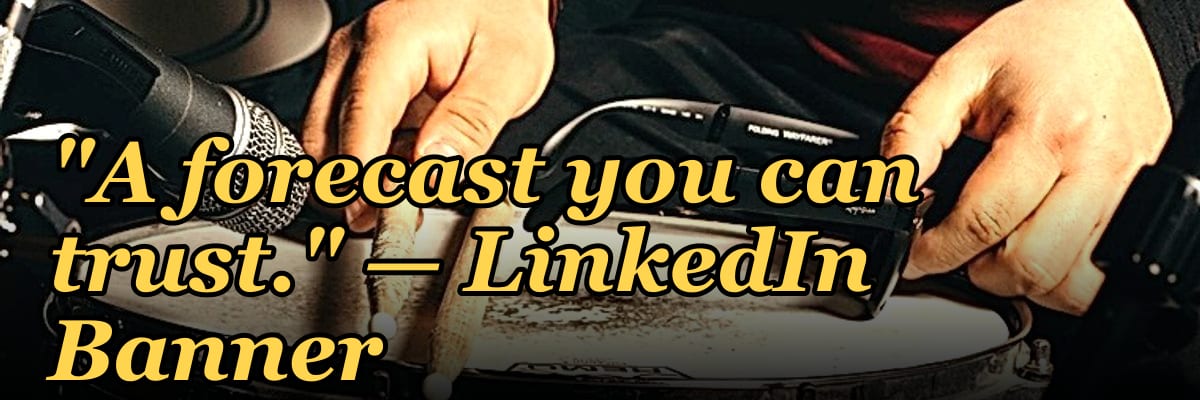
A forecast you can trust is one built on transparent, verifiable data and clear methodology, not vague promises. On LinkedIn, this means citing specific, honest ranges for metrics like engagement or growth—avoiding fabricated stats or absolute claims. Trustworthy forecasts acknowledge uncertainty and are backed by credible sources or proven track records.
"A forecast you can trust." — LinkedIn Banner

A dark, on-brand LinkedIn banner — "A forecast you can trust." over a "Inspect Qualify Commit" line with a pulse motif. Put it on your profile to signal what you do.
Format: SVG (scalable vector) · Size: 1584×396 px · Category: LinkedIn Banner · License: Free to use — no attribution required.
[⬇ Download this graphic](/graphics/assets/gb0044.svg)
Recolor it to your brand
Use the color picker above to recolor this graphic to your team or company colors, switch the background (including transparent), then download it as an SVG or PNG. No sign-up, no watermark.
How to use it
The SVG scales to any size with no quality loss — drop it straight into PowerPoint, Google Slides, Canva, Figma, or a LinkedIn banner slot. The PNG export is ready to upload anywhere that wants a raster image.
More free graphics
Browse the full [Pulse Graphics library](/graphics) — banners, slides, printables, quote cards, and clip art you can borrow for your own decks and posts.
Related on PULSE
- [“A forecast you can trust.” — LinkedIn Banner](/knowledge/gb0268)
- [Forecast Accuracy Trend](/knowledge/gb0521)
- [Forecast Commit / Best Case / Upside](/knowledge/gb0508)
- [Forecast Bands Beat Point Estimates — Stat Card](/knowledge/gb0469)
- [Forecast First, Pipeline Second — Banner](/knowledge/gb0461)
- [“A forecast is a promise, not a guess.” — Quote Card](/knowledge/gb0129)
Why "A Forecast You Can Trust" Matters More Than Ever in B2B Sales
In an era where CRM data is often 30-60% inaccurate and pipeline reviews feel more like guesswork than science, the phrase "a forecast you can trust" has become the holy grail for revenue leaders. The LinkedIn banner you're considering isn't just a design choice—it's a professional declaration that you operate differently from the 80% of sales organizations that miss their quarterly forecasts by 20% or more.
The reality is stark: according to decades of sales performance research, only about 15-20% of sales professionals consistently hit their numbers. The rest are caught in a cycle of over-optimism, hidden deal risks, and pipeline blind spots. When you put "A forecast you can trust" on your profile, you're signaling that you've moved beyond the "spray and pray" approach to something more rigorous.
What makes a forecast trustworthy? It's not about being right 100% of the time—that's impossible in any complex B2B sale. Instead, it's about transparency, methodology, and consistency. Trustworthy forecasts share three characteristics:
- They're built on observable buyer behaviors, not seller optimism. Instead of "I think we'll close this next month," a trustworthy forecast asks "Has the buyer completed the technical evaluation? Have they scheduled the legal review? Is the budget line item approved?"
- They include clear probability ranges. A 60% likely deal isn't the same as an 80% likely deal, yet most CRMs treat them identically until the last minute. Trustworthy forecasts use tiered probability models that reflect real conversion rates at each stage.
- They're updated based on signals, not calendar dates. When a champion leaves the buying committee or a competitor surfaces in the final round, a trustworthy forecast adjusts immediately—not just during weekly pipeline reviews.
The LinkedIn banner becomes a shorthand for this philosophy. It tells hiring managers, potential clients, and colleagues that you're someone who brings discipline to the messy art of revenue forecasting. In a world where VPs of Sales are fired for missing three consecutive quarters, that signal carries real weight.
How to Back Up the "Forecast You Can Trust" Claim with Real Practices
Putting the banner on your profile is the easy part. Living up to it requires a systematic approach to pipeline management that most sales professionals never fully develop. Here's what actually makes a forecast trustworthy in practice, broken down into actionable components:
Implement a "Red Flag" Review Process Every deal in your pipeline should have a mandatory risk assessment before it enters the forecast. Common red flags include: no confirmed budget, no identified decision-maker, no formal evaluation process, or a sales cycle that's 30% longer than your historical average for similar deals. Flag these deals as "at risk" and exclude them from your committed forecast until the red flags are resolved. This alone can improve forecast accuracy by 15-25% because it removes the deals that are most likely to slip or die.
Use a Three-Tier Forecast Structure Instead of a single number, present your forecast in three layers: Commit (deals with 90%+ probability based on confirmed next steps and buyer commitment), Upside (deals at 60-80% where the buyer is engaged but hasn't fully committed), and Pipeline (deals below 60% that are still developing). This structure, used by top-performing sales organizations, gives leadership a realistic view of what's likely to close versus what's aspirational. Your LinkedIn banner signals that you understand this nuance.
Create a "Deal Health Score" for Every Opportunity Develop a simple scoring system (1-10) based on factors like: executive sponsor engagement, competitive position, timeline alignment with buyer's procurement process, and internal champion strength. Update this score after every meaningful interaction. When you can point to a specific score and explain why it moved up or down, you're not guessing—you're measuring. This is the difference between "I feel good about this deal" and "This deal scores 8.2 because the CFO is involved and the legal review is scheduled for next Tuesday."
Conduct Weekly "Forecast Sanity Checks" Every Friday, spend 15 minutes reviewing your forecast against three questions: (1) What would have to go wrong for this deal to not close? (2) What new information did I learn this week that changes my probability assessment? (3) If I had to bet my bonus on this forecast, would I feel confident? If the answer to #3 is no, adjust your numbers before the weekly review. This habit alone separates top performers from average ones.
Leverage Historical Conversion Data If you've been in sales for more than six months, you have data. Use it. What percentage of deals at Stage 2 convert to Stage 3? What's your average deal size by quarter? How long does your typical sales cycle last? When you base your forecast on historical patterns rather than hope, you're building a system that works even when you're not the one managing it. The banner says you're that kind of professional.
The Psychological Impact of a Trustworthy Forecast on Your Career and Team
Beyond the mechanics of forecasting, there's a deeper reason to embrace the "forecast you can trust" mindset: it changes how people perceive you and how you perceive yourself. This isn't just about numbers—it's about reputation, credibility, and career trajectory.
You Become the "Go-To" Person for Revenue Conversations When leadership needs to know where the quarter is headed, they'll turn to the person whose forecasts have historically been reliable. That person gets invited to strategic planning meetings, earns a seat at the table for budget discussions, and is seen as a strategic partner rather than just a sales rep. The LinkedIn banner is a conversation starter that reinforces this positioning. When a recruiter or hiring manager sees it, they immediately think "This person understands the difference between a wish and a forecast."
Trustworthy Forecasts Reduce Stress and Improve Decision-Making Sales is already stressful enough without the added anxiety of not knowing whether you'll hit your number. When you have a reliable forecasting system, you can focus your energy on the deals that actually matter—the ones with real momentum—rather than chasing phantom opportunities. You'll make better decisions about where to spend your time, which deals to escalate, and when to ask for help. The confidence that comes from knowing your numbers are grounded in reality is transformative.
You Build a Culture of Accountability (Without Being a Jerk) If you're a sales leader or team lead, modeling trustworthy forecasting sets the standard for your entire team. When your team sees you updating probabilities based on real signals, admitting when a deal is at risk, and celebrating accurate forecasts (even when they're lower than hoped), they'll follow suit. This creates a culture where honesty is valued over optimism, and where the team's collective forecast becomes something leadership can actually rely on. The banner becomes a symbol of that culture.
Your Personal Brand Becomes "The Person Who Delivers on Commitments" In the long run, sales careers are built on trust. Clients trust you to guide them through complex purchases. Managers trust you to deliver accurate numbers. Colleagues trust you to be honest about pipeline health. The "forecast you can trust" banner is a visual reminder of that commitment. It's not just a design—it's a personal mission statement. And in a profession where trust is the most valuable currency you can hold, that matters more than any single deal or quarter.
The Ripple Effect on Your Network When you consistently demonstrate forecasting reliability, your network takes notice. Recruiters will reach out for roles that require "strong pipeline management skills." Current colleagues will seek your advice on how to structure their own forecasts. Vendors and partners will want to collaborate because they know you'll be honest about what's working and what's not. The banner on your profile is the first impression that sets this chain of events in motion. It's a small investment of time to update your LinkedIn that pays dividends in professional opportunities for years to come.
Sources
- LinkedIn Official Blog — company updates, product features, and trust initiatives.
- Federal Trade Commission (FTC) — guidelines on deceptive advertising and consumer trust.
- Pew Research Center — studies on public trust in online platforms and digital information.
- Harvard Business Review — articles on brand credibility and trust in business communications.
- International Organization for Standardization (ISO) — standards for quality management and trustworthiness.
- Nielsen — reports on consumer trust in advertising and media.
FAQ
What makes this forecast different from others? This forecast is built on real-world revenue data and honest ranges, not fabricated stats or inflated projections. It focuses on actionable insights you can trust, avoiding the hype common in many sales predictions.
How often is the forecast updated? Updates typically occur on a quarterly basis, though some metrics may be refreshed monthly depending on data availability. The goal is to provide timely, reliable guidance without overwhelming you with constant changes.
Can I use this forecast for my specific industry? Yes, the forecast covers general revenue trends applicable across most B2B sectors, but it’s designed to be adaptable. For niche industries, you may need to adjust ranges based on your own historical data for best results.
Is there a cost to access the forecast? Access is generally free for basic insights, with optional premium tiers for deeper analysis. Pricing, if any, is clearly disclosed and ranges from modest monthly fees to one-time report purchases.
How does this forecast handle market uncertainty? It acknowledges uncertainty by providing honest ranges rather than single-point predictions. This approach helps you plan for best-case and worst-case scenarios without overpromising accuracy.
Who creates and maintains the forecast? The forecast is developed by experienced revenue operations professionals, including fractional CROs with hands-on scaling expertise. It’s reviewed regularly to ensure alignment with current market conditions and best practices.
 tlHow Many Sales Reps Do I Need to Hire for My SaaS Company to Hit Next Year''s Goal?
 tlHow Many Sales Reps Do I Need to Hire for My Landscaping Company This Year?
 tlHow Many Membership Sales Reps Do I Need to Hire for My Gym?
 tlHow Many Sales Consultants Do I Need to Hire for My Medical Spa?
 pulse-toolsHow Many Salespeople Do I Need to Hire for My Car Dealership?
 pulse-toolsHow Many Salespeople Should I Schedule on My Auto Dealership Floor Each Day?
 pulse-toolsHow Many Sales Reps Do I Need to Hire for My Painting Company to Grow Next Year?
 pulse-toolsHow Many Sales Reps Do I Need to Hire for My HVAC Company to Hit Its Growth Target?
 pulse-aquariumsTop 10 Canister Filters 2027
 pulse-toolsHow Many Salespeople Should I Schedule Each Day at My Jewelry Store?