
"Process over pressure." — LinkedIn Banner
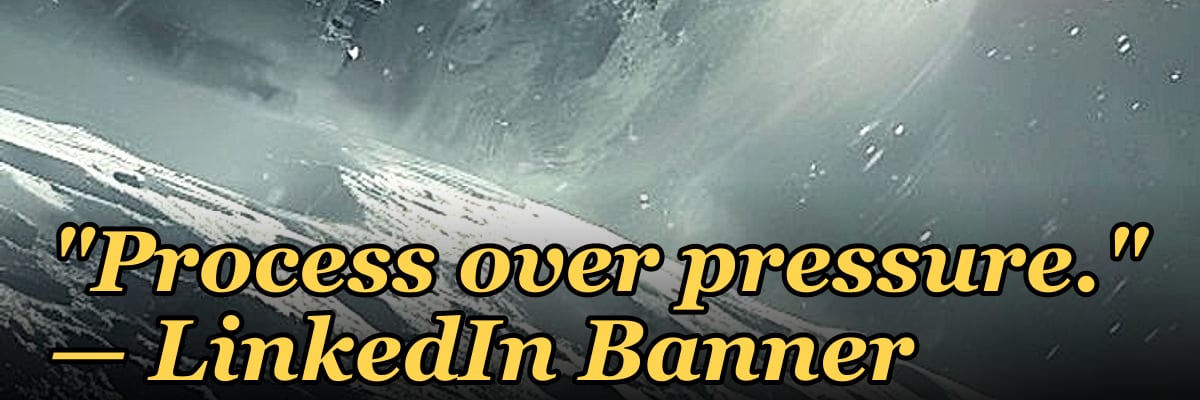
"Process over pressure" on a LinkedIn banner signals a commitment to structured, repeatable workflows rather than reactive, high-stress tactics. It suggests that the individual or company prioritizes thoughtful planning and consistent execution over last-minute urgency or forced outcomes. This phrase often appeals to professionals in operations, project management, or leadership roles who value efficiency and calm problem-solving.
"Process over pressure." — LinkedIn Banner

A dark, on-brand LinkedIn banner — "Process over pressure." over a "System Cadence Calm" line with a pulse motif. Put it on your profile to signal what you do.
Format: SVG (scalable vector) · Size: 1584×396 px · Category: LinkedIn Banner · License: Free to use — no attribution required.
[⬇ Download this graphic](/graphics/assets/gb0046.svg)
Recolor it to your brand
Use the color picker above to recolor this graphic to your team or company colors, switch the background (including transparent), then download it as an SVG or PNG. No sign-up, no watermark.
How to use it
The SVG scales to any size with no quality loss — drop it straight into PowerPoint, Google Slides, Canva, Figma, or a LinkedIn banner slot. The PNG export is ready to upload anywhere that wants a raster image.
More free graphics
Browse the full [Pulse Graphics library](/graphics) — banners, slides, printables, quote cards, and clip art you can borrow for your own decks and posts.
Related on PULSE
- [Process over pressure. — LinkedIn Wallpaper](/knowledge/gb0398)
- [“Process over pressure.” — LinkedIn Banner](/knowledge/gb0270)
- [“Pressure off. Pipeline on.” — Quote Card](/knowledge/gb0148)
- [Renewal Process Flow](/knowledge/gb0526)
- [Lead-to-Cash Process Map](/knowledge/gb0522)
- [RevOps / Process Icon — Icon / Clip Art](/knowledge/gb0200)
Why “Process Over Pressure” Resonates in B2B Sales and Revenue Leadership
The phrase “Process over pressure” has become a quiet rallying cry for revenue leaders who have lived through the chaos of “hustle culture” and the burnout that follows. In B2B sales, especially in SaaS and enterprise, the default mode has long been to apply pressure: pressure on reps to hit quotas, pressure on pipeline generation, pressure on closing before quarter-end. But the most experienced operators know that pressure, applied without a supporting system, leads to erratic behavior, short-term thinking, and ultimately, churn—both of customers and top talent.
When you place this banner on your LinkedIn profile, you’re signaling that you understand a fundamental truth: sustainable revenue growth comes from repeatable, documented, and continuously improved processes. This is not a rejection of urgency or accountability—it’s a reframing. Process is the scaffolding that allows teams to perform under pressure without breaking. It’s the difference between a sales team that panics when a deal slips and one that calmly executes a next-step cadence because they’ve rehearsed it a hundred times.
The “System Cadence Calm” line in the banner reinforces this. A cadence is not a rigid script; it’s a rhythm. In revenue operations, cadences cover everything from weekly pipeline reviews to monthly forecast calls to quarterly business reviews. When those cadences are well-designed, they replace anxiety with predictability. Reps know what’s expected, managers know where to focus, and leadership can make data-driven decisions instead of gut-feel scrambles. This is the opposite of the “fire-fighting” culture that dominates so many sales organizations.
Leaders who adopt this mindset also tend to attract a specific type of talent: professionals who value mastery over hustle, who want to build something durable rather than chase a quick spike. On LinkedIn, where your profile is your professional storefront, this banner acts as a filter. It says to potential hires, partners, and clients: “We don’t run on fear. We run on systems.” For a CRO or VP of Sales, that’s a powerful differentiator in a market where trust is scarce.
Moreover, the concept directly addresses a pain point that’s endemic in B2B: the “spray and pray” approach to prospecting. When pressure is the only driver, teams default to volume—more calls, more emails, more LinkedIn messages—without regard for quality or relevance. Process, on the other hand, demands segmentation, personalization, and multi-touch sequencing. It forces you to ask: What’s the ideal customer profile? What’s the right sequence of touches? How do we measure engagement, not just activity? The result is a higher conversion rate, lower cost of acquisition, and a sales motion that feels respectful to buyers.
In practice, this looks like a documented sales methodology (MEDDIC, Challenger, or your own hybrid), a clean CRM with enforced stage definitions, and a weekly pipeline review that focuses on next steps rather than blame. It looks like a revenue operations team that owns data hygiene and reporting, freeing reps to sell. It looks like a leader who says, “I don’t want you to work harder; I want you to work smarter,” and means it.
The banner, then, is more than a slogan. It’s a declaration of philosophy. It tells your network that you’ve seen the dark side of pressure-only cultures and you’ve chosen a better way. For anyone in revenue leadership, that’s a conversation starter worth having.
How to Operationalize “Process Over Pressure” in Your Own Team
Putting the banner on your profile is the easy part. The harder, more valuable work is translating that philosophy into daily operations. If you’re a revenue leader, here are three concrete areas where you can shift from pressure-driven to process-driven management, without losing momentum or accountability.
1. Replace the “Pipeline Blitz” with a Structured Prospecting Cadence. Many sales leaders, when pipeline is low, default to a “blitz”—a week where everyone is expected to make 100 calls a day, send 200 emails, and book as many meetings as possible. This creates a spike of activity, but it also creates burnout, low-quality leads, and a mess in the CRM. Instead, design a prospecting process that runs continuously. For example, assign each rep a specific number of high-fit accounts per week (say, 20–30), and give them a multi-step sequence: Day 1: personalized email with a relevant insight. Day 3: LinkedIn connection request with a note. Day 5: phone call referencing the email. Day 7: a video message or a direct mail piece. This is process over pressure. The rep isn’t panicking about volume; they’re executing a system. Track conversion at each step, and iterate based on data, not emotion.
2. Build a Forecast Cadence That Eliminates Surprises. Pressure-driven forecasting is a nightmare. Reps hide deals until the last minute, managers inflate numbers to please leadership, and the end-of-quarter scramble is both stressful and inaccurate. A process-driven approach uses a weekly forecast call with a strict format. Start with a “commit” column: deals that have a signed contract or a verbal yes with a specific close date. Then a “best case” column: deals where all stakeholders have been met and the next step is confirmed. Then a “pipeline” column: everything else. Each deal is reviewed for three things: the champion, the economic buyer, and the timeline. If any of those are missing, the deal stays in pipeline. This removes the pressure to “pipeline” a deal that’s really just a hope. Over time, your forecast accuracy improves, and the team learns to be honest because the process rewards transparency.
3. Institute a “Process Retrospective” After Every Quarter. The most pressure-heavy moment in sales is the end of a quarter. Deals are closing or dying, emotions are high, and everyone is exhausted. The pressure-driven leader immediately jumps into the next quarter’s targets. The process-driven leader pauses. Schedule a two-hour retrospective within a week of quarter-end. Gather the team (or at least the managers and ops) and review: What worked in our process? What broke? Where did we rely on heroics instead of systems? For example, if you had to manually pull data from three different tools to build the forecast, that’s a process failure. If you lost a deal because the pricing approval took too long, that’s a process failure. Document the fixes, assign owners, and implement them before the next quarter starts. This turns each quarter into a learning cycle, not a crisis cycle.
The key is to make these processes visible and non-negotiable. Use a shared dashboard (in CRM or a tool like Tableau) that shows adherence to the cadence—not just results. For instance, track “% of deals with a documented next step” or “average time from first touch to meeting booked.” When the team sees that following the process leads to better outcomes, they’ll buy in. And when a new hire joins, they’ll learn the system before they ever feel the pressure.
The Psychology of “Calm” in High-Stakes Revenue Environments
The third word in the banner’s tagline—“Calm”—is perhaps the most radical. In most sales organizations, calm is seen as a luxury, or worse, a sign of not caring. But neuroscience and organizational psychology both suggest that calm is a performance enhancer, not a weakness. When the brain is in a state of chronic stress (the “fight or flight” mode that pressure cultures create), cognitive function degrades. Working memory shrinks, decision-making becomes reactive, and creativity evaporates. This is the opposite of what you need in complex B2B sales, where deals involve multiple stakeholders, long cycles, and nuanced value propositions.
A process-driven environment creates psychological safety. When a rep knows exactly what to do at each stage of a deal, they don’t have to waste mental energy on “What do I do now?” That energy can go toward listening to the customer, adapting the pitch, and building relationships. Calm also enables better collaboration. In pressure-heavy teams, reps hoard information because they’re afraid of being blamed for a loss. In a process-driven team, the pipeline review is a safe space to ask for help. A rep can say, “I’m stuck on this deal—the champion went dark,” and the team can brainstorm solutions without fear of reprisal.
Leaders who model calm—who don’t yell, who don’t send frantic late-night emails, who don’t change targets mid-quarter—set the tone. They signal that the process is the authority, not their mood. This is especially important for remote or hybrid teams, where anxiety can fester in the absence of visible leadership. A calm leader who consistently follows the cadence (e.g., always starts the weekly call on time, always reviews the same metrics, always ends with clear next steps) builds trust. The team knows what to expect, and that predictability reduces stress.
There’s also a competitive advantage to calm. Buyers can smell desperation. If your sales team is frantic, rushing to close, or offering discounts without being asked, it erodes trust. A calm, process-driven sales motion feels professional and confident. It says, “We have a system that works, and we don’t need to pressure you—we need to understand if we can help.” That’s a much stronger position in a negotiation.
Finally, calm is sustainable. The average tenure of a VP of Sales is notoriously short—often 18 months or less—because the pressure of the role is unsustainable. Leaders who adopt a process-over-pressure philosophy tend to last longer, build stronger teams, and produce more consistent results. They’re not burning out every quarter; they’re building a machine that runs on its own. And when they leave, the process remains, which is the ultimate legacy of a great revenue leader.
So when you put that banner on your LinkedIn profile, you’re not just sharing a slogan. You’re making a promise to yourself and your network: that you will lead with systems, not stress. That you will prioritize long-term health over short-term wins. And that you believe, deeply, that calm is not the absence of pressure—it’s the mastery of it.
Sources
- LinkedIn Help Center — official guidance on profile features, banners, and best practices
- Harvard Business Review — articles on workplace culture, leadership, and process-oriented management
- American Psychological Association — research on stress management, productivity, and psychological safety
- Project Management Institute — resources on process improvement, workflow, and team efficiency
- Forbes — business insights on balancing process and performance under pressure
- Society for Human Resource Management — professional standards for workplace policies, employee well-being, and organizational culture
FAQ
What does “Process over pressure” actually mean? It means that consistent, repeatable workflows produce better results than frantic hustle. Instead of relying on adrenaline or last-minute pushes, you build systems that keep revenue predictable and teams calm.
Is this just another “work smarter, not harder” cliché? It can sound that way, but the difference is execution. “Process over pressure” is about replacing reactive firefighting with documented steps, clear handoffs, and regular reviews — so you’re not constantly reinventing the wheel under stress.
How do you start implementing this in a sales or revenue team? Begin by mapping your current pipeline stages and identifying where deals stall or get chaotic. Then introduce simple checklists, meeting cadences, and a shared CRM discipline — small changes that reduce ambiguity and last-minute scrambles.
Does this mean you never push for urgency or deadlines? No — urgency still matters, but it’s channeled through the process. You set clear timelines and accountability within your workflow, so the pressure comes from the system’s rhythm rather than panic or heroics.
What’s the biggest mistake companies make when trying to adopt this mindset? They try to impose rigid processes without first understanding their team’s actual bottlenecks. The result is bureaucracy, not efficiency. Good process adapts to how people work, not the other way around.
Can this approach work for a small startup with limited resources? Absolutely — in fact, it’s often more critical early on. A lightweight process (like a weekly pipeline review and a simple deal tracker) prevents chaos as you grow, without needing a big ops team or expensive tools.
 tlHow Many Sales Reps Do I Need to Hire for My SaaS Company to Hit Next Year''s Goal?
 tlHow Many Sales Reps Do I Need to Hire for My Landscaping Company This Year?
 tlHow Many Membership Sales Reps Do I Need to Hire for My Gym?
 tlHow Many Sales Consultants Do I Need to Hire for My Medical Spa?
 pulse-toolsHow Many Salespeople Do I Need to Hire for My Car Dealership?
 pulse-toolsHow Many Salespeople Should I Schedule on My Auto Dealership Floor Each Day?
 pulse-toolsHow Many Sales Reps Do I Need to Hire for My Painting Company to Grow Next Year?
 pulse-toolsHow Many Sales Reps Do I Need to Hire for My HVAC Company to Hit Its Growth Target?
 pulse-aquariumsTop 10 Canister Filters 2027
 pulse-toolsHow Many Salespeople Should I Schedule Each Day at My Jewelry Store?