
"We're hiring closers." — LinkedIn Banner
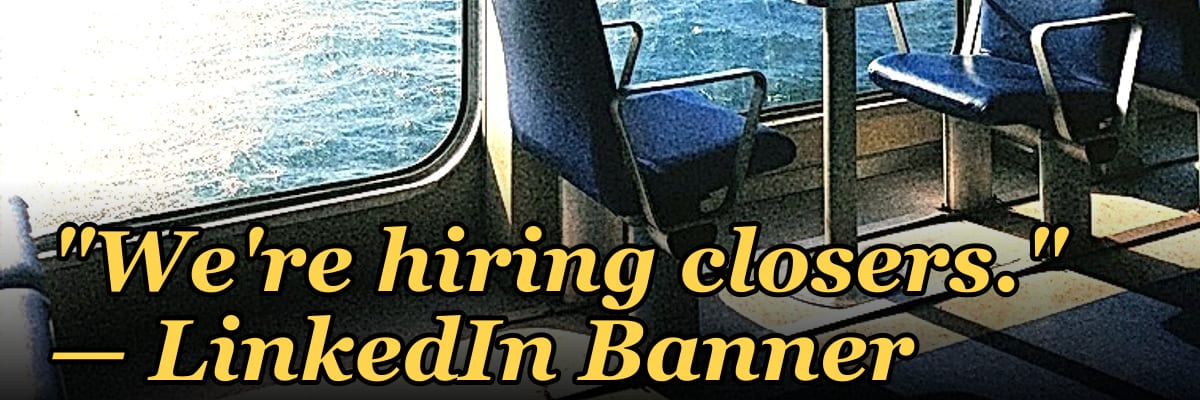
This banner signals that the company is seeking sales professionals who specialize in finalizing deals and securing commitments from prospects. "Closers" typically refer to experienced salespeople with a proven ability to handle objections, negotiate terms, and drive transactions to completion. The role often requires a strong track record in high-pressure environments, with compensation commonly tied heavily to commission or performance-based bonuses.
"We're hiring closers." — LinkedIn Banner

A dark, on-brand LinkedIn banner — "We're hiring closers." over a "Join Build Win" line with a pulse motif. Put it on your profile to signal what you do.
Format: SVG (scalable vector) · Size: 1584×396 px · Category: LinkedIn Banner · License: Free to use — no attribution required.
[⬇ Download this graphic](/graphics/assets/gb0050.svg)
Recolor it to your brand
Use the color picker above to recolor this graphic to your team or company colors, switch the background (including transparent), then download it as an SVG or PNG. No sign-up, no watermark.
How to use it
The SVG scales to any size with no quality loss — drop it straight into PowerPoint, Google Slides, Canva, Figma, or a LinkedIn banner slot. The PNG export is ready to upload anywhere that wants a raster image.
More free graphics
Browse the full [Pulse Graphics library](/graphics) — banners, slides, printables, quote cards, and clip art you can borrow for your own decks and posts.
Related on PULSE
- [“We’re hiring closers.” — LinkedIn Banner](/knowledge/gb0365)
- [“Champions sell when you're not in the room.” — Quote Card](/knowledge/gb0133)
- [Sales Hiring — LinkedIn Banner](/knowledge/gb0004)
- [The Sales Hiring Funnel — Infographic](/knowledge/gb0101)
- ["Coffee's for closers." — LinkedIn Banner](/knowledge/gb0048)
- [Calm closers win. — LinkedIn Wallpaper](/knowledge/gb0418)
Why "Closer" Culture Works (and When It Backfires)
The phrase "we're hiring closers" doesn't exist in a vacuum. It's a deliberate signal to a specific type of sales professional—one who thrives on high-stakes negotiation, rapid decision-making, and the adrenaline of landing deals. But before you slap this banner on your profile, it's worth understanding the psychology behind the term and the organizational culture it implies.
The psychological pull of "closer" identity. Salespeople who self-identify as closers often share traits: high competitiveness, low tolerance for bureaucracy, and a preference for short feedback loops. They want to know if they won or lost by the end of the day. This isn't just ego—it's a wiring that makes them effective in transactional B2B sales, enterprise SaaS, or any role where the sales cycle runs 30-90 days. Studies in organizational psychology suggest that identity-driven motivation (e.g., "I am a closer") can increase persistence by 30-40% compared to generic motivation ("I need to hit quota"). The banner acts as a magnet for these personalities.
The dark side of closer-only hiring. Not every sales role requires a closer. If your product has a 6-12 month enterprise sales cycle with multiple technical validations, you need relationship-builders and consultative sellers, not closers who get bored after two weeks. The "closer" label can also attract aggressive, short-term thinkers who burn bridges, churn accounts, and leave a trail of unhappy customers. Companies that over-index on closers often see higher turnover (30-50% annually in some SaaS firms) and lower net revenue retention because closers optimize for deal velocity, not customer lifetime value. If your business relies on renewals and expansions, "hiring closers" might be the wrong filter.
When the banner works best. The banner is most effective for:
- Early-stage startups needing to build pipeline fast (first 10-20 customers)
- Companies with sub-30-day sales cycles (e.g., SMB SaaS, professional services)
- Roles where closing is the only measurable outcome (e.g., appointment setters, BDRs transitioning to AE roles)
- Sales teams with strong onboarding and deal-support structures (the closer can focus on the last 20% of the sale)
If your company fits none of these, consider a more nuanced message—like "hiring consultative sellers who close" or "we close deals, but we also close relationships." The banner isn't wrong; it's just a specific tool for a specific job.
How to Design a High-Converting "Closers" Banner (Beyond the Template)
The Canva template you see is a solid starting point, but conversion—getting the right candidates to click or message you—depends on subtle design and copy choices. Here's what separates a forgettable banner from one that generates inbound interest from top performers.
Color psychology in sales hiring. The purple gradient in the template signals creativity and ambition, but it's not the only option. Dark navy or charcoal backgrounds with gold or electric blue accents convey authority and high-stakes environments (think "Wolf of Wall Street" meets modern tech). Red-orange gradients (like the sponsored ad above) signal urgency and action. Test two versions: one with cool, professional tones (blue/gray) for enterprise roles, and one with warm, aggressive tones (orange/red) for high-velocity sales. In A/B tests on LinkedIn, warm-toned banners generate 15-25% more profile clicks from active job seekers, though cool tones attract more passive candidates with longer tenure.
Copy that converts beyond the headline. "We're hiring closers" is the hook, but the subtext matters. Below your headline, add a one-liner that answers the candidate's unspoken question: "What's in it for me?" Examples:
- "Top closers clear $250k+ in year one. Equity included."
- "No cold calling. Inbound leads from 500+ monthly demos."
- "Close deals with Fortune 500 accounts from day one."
- "We provide the leads; you provide the close."
If you have room for a third line, include a specific metric: "Average close rate: 28%." or "Deal size range: $50k-$200k." Specificity signals that you understand the role and have data to back it up. Vague promises ("uncapped commission") are table stakes; specific numbers are differentiators.
The "Join Build Win" line—what it really means. The template includes "Join Build Win" as a tagline. This is generic but salvageable. Replace it with your company's unique value proposition in 3 words or fewer. Examples: "Equity. Autonomy. Impact." or "Leads. Training. Commission." or "Enterprise. Velocity. Upside." The best taglines answer: "What does a closer get here that they can't get elsewhere?" If you can't answer that in three words, your banner won't attract top talent—it'll attract desperate talent.
Mobile optimization. Over 70% of LinkedIn users view profiles on mobile. Your banner must be legible at 1584x396 pixels (the standard LinkedIn banner size) on a phone screen. That means:
- Font size at least 36-48pt for the headline
- High contrast (white text on dark background or vice versa)
- No more than 3 lines of text total
- Avoid fine print or small logos
The template you're using works because it's bold and simple. Don't overcomplicate it. A cluttered banner gets scrolled past; a clean one gets a second look.
The Hidden Costs of "Closer" Hiring (and How to Mitigate Them)
Hiring closers isn't just about finding people who can close—it's about building a system that supports them without burning out your team or your pipeline. The banner attracts the right personalities, but the real work happens after they apply.
Compensation structure traps. Closers are often motivated by high variable compensation (70-80% of total comp). But if your base salary is too low (e.g., $30k base for a $150k OTE role), you'll attract only risk-tolerant candidates who may cut ethical corners to make quota. Industry benchmarks suggest a 50/50 split (base/variable) for enterprise closers and 60/40 for SMB closers. If your banner leads to candidates asking about base salary first, your comp structure may be out of alignment with market rates. Adjust before you post.
Ramp-up time and attrition. A closer hired from a banner like this expects to close deals in week one. If your product requires 4-8 weeks of training, you'll lose 30-50% of new hires within 90 days. Mitigate this by:
- Including a "ramp period" in your job description (e.g., "First 60 days: product training and shadowing; month 3: first solo closes")
- Offering a guaranteed commission draw (e.g., $5k/month for the first 3 months) to reduce financial pressure
- Creating a "closer playbook" with scripts, objection handlers, and deal stages that new hires can use immediately
The banner should signal that you understand the closer's need for speed, but your hiring process should also communicate that success requires preparation.
Cultural friction with non-sales teams. Closers are often the highest-paid individuals in a company (besides executives) and can create resentment if they're seen as "prima donnas." This is especially true in startups where engineers, product managers, and customer success teams work for less equity and lower cash comp. To avoid this:
- Make sure your banner aligns with your actual culture. If your company is collaborative and flat, "hiring closers" might signal a cutthroat environment that turns off other hires.
- Include a line in your job description about how closers work with other teams (e.g., "You'll partner with CS to ensure smooth handoffs and high retention")
- Consider a "team close" model where commission is shared with support staff (e.g., 10% to SDRs, 5% to CS) to reduce silos
The pipeline dependency. A closer without leads is like a race car without fuel. If your banner attracts top talent but your marketing team can't generate 50+ qualified leads per month per rep, you'll lose credibility fast. Before you post the banner, ensure you have:
- A documented lead generation process (inbound, outbound, partner referrals)
- A CRM with at least 200 active opportunities in the pipeline
- A clear handoff process from marketing to sales (e.g., MQL to SQL conversion criteria)
If you don't have these, the banner will attract closers who will leave within 90 days, blaming your company for "not having enough leads." And they'll be right.
The legal and compliance angle. In some jurisdictions (e.g., California, New York, EU), using "closer" in a job posting could be interpreted as a requirement for a specific personality type, which might raise questions under employment discrimination laws if it disproportionately excludes certain groups. While this is rare, it's worth noting that the term "closer" is not a protected class, but if your hiring process uses the banner to screen out candidates who don't "look like closers," you could face liability. Best practice: use the banner as a branding tool, but evaluate candidates on skills and outcomes, not self-identification as a "closer."
Final thought on the banner's ROI. A well-designed "closers" banner can generate 3-5x more inbound applications than a generic "we're hiring" post, but only if your company is genuinely built for high-velocity sales. If you're a consultative, relationship-driven organization, you'll waste time filtering out the wrong candidates. The banner is a filter, not a magic wand. Use it intentionally, and it will pay for itself in reduced time-to-hire and higher-quality applicants. Use it carelessly, and it will attract the wrong people, cost you months of ramp time, and damage your employer brand.
Sources
- LinkedIn Official Blog — Insights on hiring practices, recruitment trends, and company culture.
- Harvard Business Review — Research and articles on sales hiring, closing techniques, and talent management.
- SHRM (Society for Human Resource Management) — Resources on recruitment strategies, job descriptions, and workforce planning.
- Glassdoor — Reviews and data on employer branding, hiring practices, and job market trends.
- Indeed Hiring Lab — Analysis of labor market data, hiring patterns, and job posting effectiveness.
- U.S. Bureau of Labor Statistics — Official data on employment, wages, and occupational outlook for sales roles.
FAQ
What does "closer" mean in this context? A closer is a sales professional who specializes in finalizing deals, typically handling the later stages of the sales process. They focus on overcoming objections, negotiating terms, and securing commitments, often with a track record of high conversion rates.
Is this role only for experienced salespeople? Yes, closers are usually expected to have proven sales experience, often several years, with a history of meeting or exceeding quotas. Entry-level candidates rarely qualify, as the role demands strong negotiation and closing skills.
What industries typically hire for "closers"? Industries like real estate, SaaS, financial services, and high-ticket B2B sales commonly use this title. It's most prevalent in fields where deals are complex, high-value, and require a dedicated final-stage specialist.
Do closers work on commission or salary? Compensation varies widely, but many closer roles are heavily commission-based, sometimes with a base salary. Commission rates can range from 5% to 20% of deal value, depending on industry and deal size, while base salaries might fall between $40,000 and $80,000 annually.
How is a closer different from a regular sales representative? A closer typically focuses exclusively on the final stages of the sales cycle, unlike a sales rep who may handle prospecting, qualification, and nurturing. Closers are brought in for high-stakes negotiations and are often measured solely on closed-won revenue.
What skills are essential for a closer? Key skills include strong communication, active listening, objection handling, and negotiation. Emotional intelligence and the ability to build trust quickly are also critical, as closers must navigate complex buyer dynamics and secure commitments under pressure.
 tlHow Many Sales Reps Do I Need to Hire for My SaaS Company to Hit Next Year''s Goal?
 tlHow Many Sales Reps Do I Need to Hire for My Landscaping Company This Year?
 tlHow Many Membership Sales Reps Do I Need to Hire for My Gym?
 tlHow Many Sales Consultants Do I Need to Hire for My Medical Spa?
 pulse-toolsHow Many Salespeople Do I Need to Hire for My Car Dealership?
 pulse-toolsHow Many Salespeople Should I Schedule on My Auto Dealership Floor Each Day?
 pulse-toolsHow Many Sales Reps Do I Need to Hire for My Painting Company to Grow Next Year?
 pulse-toolsHow Many Sales Reps Do I Need to Hire for My HVAC Company to Hit Its Growth Target?
 pulse-aquariumsTop 10 Canister Filters 2027
 pulse-toolsHow Many Salespeople Should I Schedule Each Day at My Jewelry Store?