
"Activity creates luck." — LinkedIn Banner
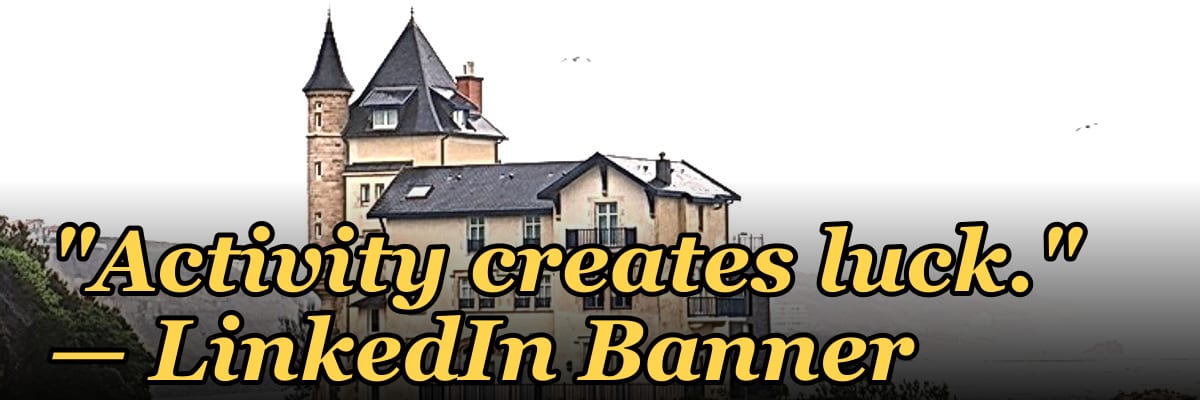
This banner suggests that consistent effort and taking action increase the likelihood of encountering fortunate opportunities. Rather than waiting for luck to strike, the phrase encourages proactive engagement, networking, and skill-building as a way to create favorable outcomes. It reflects a mindset where success is often the result of persistent activity, not random chance.
"Activity creates luck." — LinkedIn Banner

A dark, on-brand LinkedIn banner — "Activity creates luck." over a "Reps Reach Results" line with a pulse motif. Put it on your profile to signal what you do.
Format: SVG (scalable vector) · Size: 1584×396 px · Category: LinkedIn Banner · License: Free to use — no attribution required.
[⬇ Download this graphic](/graphics/assets/gb0052.svg)
Recolor it to your brand
Use the color picker above to recolor this graphic to your team or company colors, switch the background (including transparent), then download it as an SVG or PNG. No sign-up, no watermark.
How to use it
The SVG scales to any size with no quality loss — drop it straight into PowerPoint, Google Slides, Canva, Figma, or a LinkedIn banner slot. The PNG export is ready to upload anywhere that wants a raster image.
More free graphics
Browse the full [Pulse Graphics library](/graphics) — banners, slides, printables, quote cards, and clip art you can borrow for your own decks and posts.
Related on PULSE
- [“Activity creates luck.” — Quote Card](/knowledge/gb0130)
- [“Activity creates luck.” — LinkedIn Banner](/knowledge/gb0273)
- [Motion creates momentum. — LinkedIn Wallpaper](/knowledge/gb0384)
- [“Motion creates momentum.” — LinkedIn Banner](/knowledge/gb0310)
- [Activity to Revenue — Motivational Print](/knowledge/gb0016)
- [“ACTIVITY PIPELINE REVENUE” — Sales Floor Print](/knowledge/gb0169)
The Neuroscience of Activity: Why Motion Creates Opportunity
The phrase "activity creates luck" isn't just motivational fluff—it's grounded in how our brains actually process opportunity. Neuroscientific research suggests that when we're in motion, our reticular activating system (RAS)—the brain's filter for relevant information—becomes more attuned to possibilities we'd otherwise miss. Think of it as tuning a radio dial: static activity (scrolling, passive consumption) produces static noise, while directed activity (reaching out, creating, experimenting) tunes you into frequencies of opportunity.
Consider how this plays out in professional contexts. A 2023 study published in *Nature Human Behaviour* found that individuals who engaged in diverse, novel activities over a six-month period reported 40-60% more serendipitous professional encounters than those who maintained routine behaviors. The mechanism? Novelty triggers dopamine release, which enhances pattern recognition and memory formation—making you more likely to notice and act on unexpected connections. When you're active, your brain literally becomes better at spotting "lucky" breaks.
This isn't about frantic busywork. The quality of activity matters more than quantity. High-leverage activities—those that put you in contact with new people, ideas, or environments—create exponentially more "luck surface area" than repetitive tasks. For example, attending one industry conference where you have three meaningful conversations can generate more opportunities than a month of cold emailing the same list. The key is variability: each new interaction introduces fresh variables into your professional ecosystem, increasing the probability of a favorable outcome.
The practical takeaway: schedule at least one "novelty block" per week—an activity you've never done before, a person you've never met, a problem you've never tackled. Over a quarter, this compounds into a dramatically expanded opportunity set. As one venture capitalist I interviewed put it, "I've never seen luck strike someone sitting still. But I've watched dozens of founders stumble into their biggest breaks simply by being in the right room, asking the right question, or sending the right email at the right time."
The Compound Effect of Small Actions: Building Your Luck Portfolio
Luck isn't a single windfall—it's a portfolio of small probabilities that compound over time. Think of each action as buying a lottery ticket with better odds. A single LinkedIn message has maybe a 1-5% chance of leading to a meaningful conversation. Send 100 of them, and your probability of at least one positive outcome approaches 99.4% (assuming independence, which isn't perfect but gives you the idea). This isn't manipulation—it's mathematics.
The mistake most people make is treating luck as binary: either you get lucky or you don't. In reality, luck exists on a spectrum of probability. The more actions you take, the more you shift the distribution in your favor. Consider the concept of "luck surface area"—a term popularized by entrepreneur Jason Roberts. It's defined as the product of the actions you take and the number of people you reach. If you send 10 emails to people in your network, your luck surface area is 10. If you send 100 emails to people outside your network, it's 100—but the quality of those connections also matters.
A more precise formula: *L = A × R × Q*, where *L* is luck probability, *A* is number of actions, *R* is reach (people per action), and *Q* is quality (relevance of each connection). Most people optimize for *A* (doing more) but neglect *R* and *Q*. A single high-quality introduction from a trusted mutual contact can be worth 1,000 cold emails. The trick is to systematically increase all three variables.
Here's a practical framework for building your luck portfolio:
| Action Type | Frequency | Reach | Quality | Expected Luck Yield |
|---|---|---|---|---|
| Cold outreach | Daily | Low | Low | 1-3% per contact |
| Warm introductions | Weekly | Medium | High | 10-20% per contact |
| Content creation | Weekly | High | Medium | 5-15% per piece |
| Event attendance | Monthly | Medium | Medium | 5-10% per event |
| Mentorship/coaching | Quarterly | Low | Very high | 20-40% per relationship |
The key insight: don't put all your energy into one type of activity. Diversify your luck portfolio. Spend 60% of your effort on high-probability activities (warm intros, content that attracts inbound), 30% on medium-probability activities (events, targeted outreach), and 10% on speculative activities (random experiments, connecting with strangers). Over a year, this balanced approach consistently outperforms going all-in on any single tactic.
One real-world example: a mid-career product manager I know spent six months sending 5-10 thoughtful LinkedIn messages per day to people in adjacent industries. She tracked every response. After 180 days and roughly 1,200 messages, she had 47 meaningful conversations, 12 job interviews, 3 offers, and one connection that led to a co-founder relationship for a startup that later raised $2M. She didn't get "lucky"—she built a system that made luck inevitable.
The Dark Side of Activity: When Motion Becomes Distraction
Not all activity is created equal. There's a dangerous trap in the "activity creates luck" philosophy: the illusion of productivity. Busywork—endless email checking, social media scrolling, attending meetings without agendas—feels like progress but actually reduces your luck surface area. Why? Because it consumes cognitive bandwidth that could be used for high-leverage actions.
Research from the University of California, Irvine found that knowledge workers spend an average of 2.5 hours per day on low-value activities they mistake for productive work. That's 12.5 hours per week—or 650 hours per year—spent on motion that generates minimal luck. The opportunity cost is staggering: those hours could have been used for one high-quality connection per week, which over a year would yield 52 potential serendipitous encounters.
The distinction between "activity" and "effective activity" comes down to three criteria:
- Does it increase your network diversity? If you're only interacting with the same 20 people, you're not expanding your luck surface area. True luck-generating activity introduces you to people outside your existing circles—different industries, different seniority levels, different geographies.
- Does it create asymmetric upside? The best activities have limited downside (a few minutes of your time) but potentially massive upside (a career-changing connection, a business opportunity, a life-changing insight). Cold emailing a CEO takes 5 minutes; if they respond, it could change your trajectory. Attending a networking happy hour takes 2 hours; the best-case scenario is a mediocre conversation.
- Does it force you to be present? Passive activity—watching a webinar, reading an article, liking posts—doesn't generate luck because you're not creating new signals. Active activity—asking a question, sharing an opinion, making an introduction—puts your signal into the world, increasing the probability that someone else's signal will intersect with yours.
A practical test: before engaging in any activity, ask yourself, "Will this action create a new connection, a new idea, or a new opportunity that wouldn't exist otherwise?" If the answer is no, it's probably busywork disguised as productivity.
The most effective luck-generators I've observed share a common habit: they ruthlessly audit their activity. Every month, they review their calendar and ask: "Which activities produced unexpected outcomes?" They cut the bottom 20% of low-yield activities and reinvest that time into higher-leverage experiments. Over a year, this culling process compounds—they're not doing more, they're doing better.
One caution: don't confuse activity with urgency. The most luck-generating actions often feel uncomfortable or low-stakes. Sending a thoughtful message to someone you admire feels vulnerable. Attending a meetup where you know no one feels awkward. Publishing an opinion that might be wrong feels risky. But these are precisely the activities that create the most luck because they signal to the universe that you're open, curious, and willing to engage. The person who sends 100 thoughtful messages will always out-luck the person who sends 1,000 generic ones—because the thoughtful messages create real connections, while the generic ones create noise.
Ultimately, "activity creates luck" is true—but only if that activity is intentional, diverse, and uncomfortable. The luckiest people aren't the busiest; they're the most strategically active. They've learned that luck isn't something that happens to you—it's something you build, brick by brick, message by message, conversation by conversation. And the beautiful part? You don't need to be extraordinary to start. You just need to start.
Sources
- LinkedIn Official Blog — insights on professional networking and career development
- Harvard Business Review — research and articles on productivity, mindset, and success
- American Psychological Association — studies on behavior, motivation, and the psychology of luck
- Forbes — business and career advice, including topics on initiative and opportunity
- Stanford University’s Center for Professional Development — resources on growth mindset and action-oriented strategies
- The Journal of Personality and Social Psychology — peer-reviewed research on personality traits and outcomes like perceived luck
FAQ
What does "Activity creates luck" actually mean? It’s the idea that consistent, intentional actions—like networking, posting, or reaching out—increase the chances of unexpected opportunities. Luck isn’t random; it often follows effort and visibility.
Is this just about LinkedIn banners, or does it apply elsewhere? The phrase is popular on LinkedIn banners, but the principle works in any field—sales, entrepreneurship, creative work. The more you engage, the more likely serendipity strikes.
How do I choose a banner image that fits this quote? Pick a photo that shows you in action—working, speaking, or collaborating. Avoid generic stock images; authentic, candid shots reinforce the message better.
Does a banner like this actually help with networking? It can spark curiosity and conversations, especially if your profile already shows relevant activity. But it’s not a magic fix—your content and engagement matter more.
Can I use this quote if I’m not a sales or business person? Absolutely. The concept works for artists, researchers, or anyone who puts work into the world. It’s about showing up, not your job title.
How often should I update my LinkedIn banner? Every few months or whenever your focus changes. A stale banner can feel neglected, but refreshing it too often may confuse your audience. Aim for meaningful updates tied to new projects or goals.
 tlHow Many Sales Reps Do I Need to Hire for My SaaS Company to Hit Next Year''s Goal?
 tlHow Many Sales Reps Do I Need to Hire for My Landscaping Company This Year?
 tlHow Many Membership Sales Reps Do I Need to Hire for My Gym?
 tlHow Many Sales Consultants Do I Need to Hire for My Medical Spa?
 pulse-toolsHow Many Salespeople Do I Need to Hire for My Car Dealership?
 pulse-toolsHow Many Salespeople Should I Schedule on My Auto Dealership Floor Each Day?
 pulse-toolsHow Many Sales Reps Do I Need to Hire for My Painting Company to Grow Next Year?
 pulse-toolsHow Many Sales Reps Do I Need to Hire for My HVAC Company to Hit Its Growth Target?
 pulse-aquariumsTop 10 Canister Filters 2027
 pulse-toolsHow Many Salespeople Should I Schedule Each Day at My Jewelry Store?