
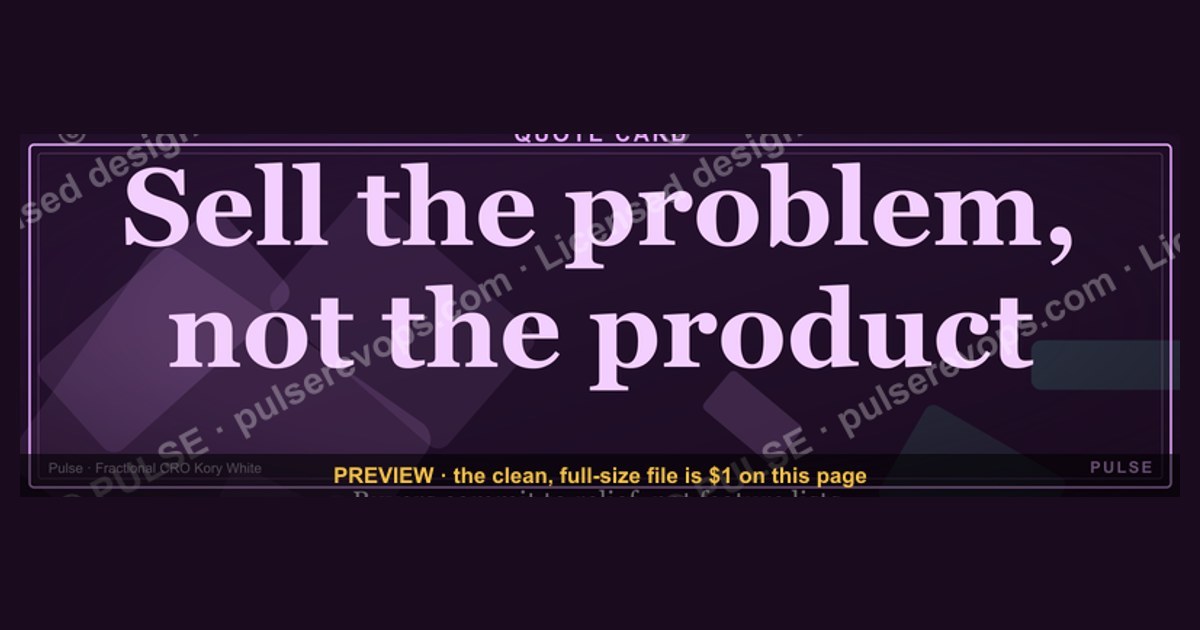
“Sell the problem, not the product.” — Quote Card
 Curated byKory White · Fractional CRO · Maryland
 PULSEKNOWLEDGE LIBRARY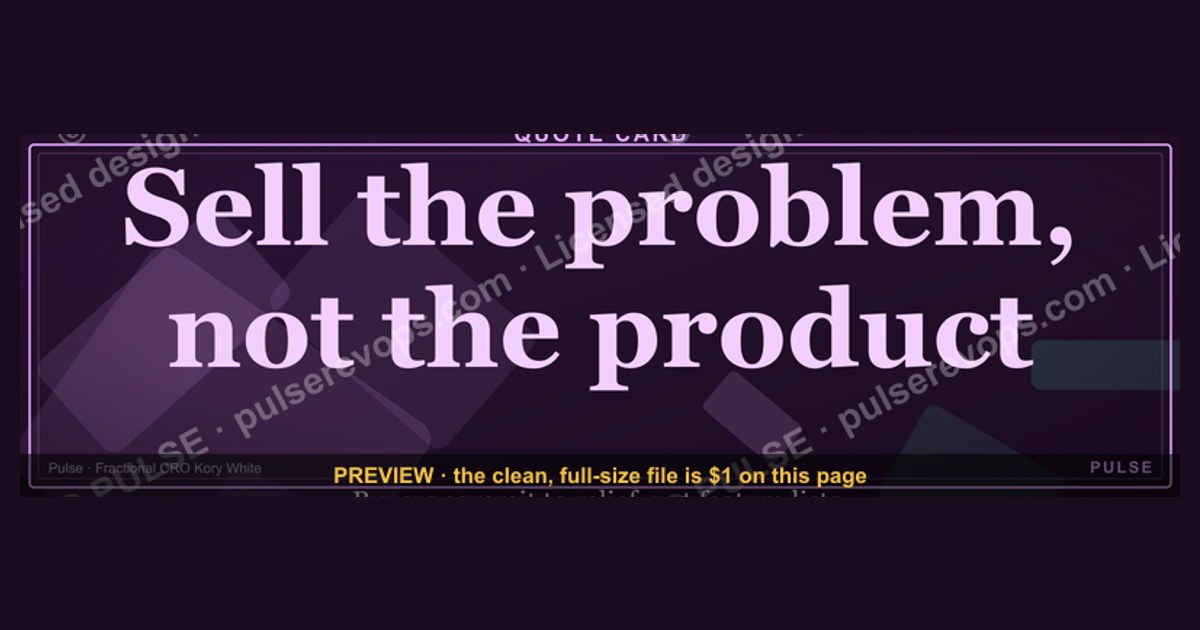
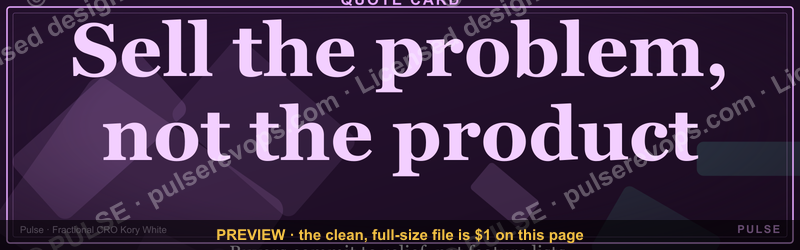
"Sell the problem, not the product" is a widely repeated sales and marketing maxim. Its exact origin isn't reliably documented — it's a paraphrase of advice echoed by many practitioners over the decades rather than a verified quote from a single named author, so treat any confident attribution with caution. The principle itself is what matters: buyers commit to relieving a pain they already feel, not to a list of features or specs. Lead with the problem your prospect is living with, make it concrete, and let your product show up as the obvious way out.
This page hosts a free, downloadable quote-card graphic built around that line — a square 1080×1080 SVG you can drop into LinkedIn, Instagram, a deck slide, or a team wall. It's a design asset, not a physical print-on-demand product, so there's nothing to buy and no shipping involved. Recolor it to your brand below and export it as SVG or PNG.
“Sell the problem, not the product.” — Quote Card

A square social quote card — "Sell the problem, not the product." in the Pulse accent style. A shareable LinkedIn or Instagram graphic and a ready slide pull-quote.
Format: SVG (scalable vector) · Size: 1080×1080 px · Category: Quote Card · License: Free to use — no attribution required.
The principle in one diagram
Where it goes wrong
Recolor it to your brand
Use the color picker above to recolor this graphic to your team or company colors, switch the background (including transparent), then download it as an SVG or PNG. No sign-up, no watermark.
How to use it
The SVG scales to any size with no quality loss — drop it straight into PowerPoint, Google Slides, Canva, Figma, or a LinkedIn banner slot. The PNG export is ready to upload anywhere that wants a raster image.
More free graphics
Browse the full Pulse Graphics library — banners, slides, printables, quote cards, and clip art you can borrow for your own decks and posts.
Related on PULSE
- “Sell the Problem, Not the Product” — Quote Card
- “Sell the problem, not the product.” — LinkedIn Banner
- "Sell the problem." — LinkedIn Banner
- Sell the problem. — LinkedIn Wallpaper
- “Sell to the problem they feel.” — LinkedIn Banner
- Product Launch (GTM) — Title Slide
Why Problem-First Selling Works
Lead with a feature list — "47 integrations, real-time analytics" — and the prospect has to do work: decide whether any of it matters to them. That's slow, effortful, and easy to abandon. Lead with a problem they already recognize — "your CRM doesn't talk to your email tool, so leads slip through" — and you skip that step entirely. They're not evaluating your claim; they're remembering their own frustration. The "that's me" reaction does the persuading for you.
This is also why case studies and testimonials land so well: they're problem stories with a resolution attached. The strongest sales decks rarely open on a logo or a product screenshot. They open on one specific, painful sentence the buyer knows intimately. If you sell a project-management tool, "we have Gantt charts and time tracking" invites a shrug. "Your team loses hours every week to status meetings that could be automated" invites a nod — and once the buyer is nodding, the product becomes the obvious answer rather than another pitch to fend off.
The takeaway is practical, not theatrical: problems create the reason to act, and products are how you act on it. Get the order right and the rest of the conversation is easier.
How to Map Problems to Products Without Sounding Manipulative
The skill here is specificity without exaggeration. The fastest way to lose a savvy buyer — especially in B2B, where procurement and ROI math are involved — is to invent a crisis they don't feel or inflate one they do. Instead, work from problems you can actually point to. A useful technique is "pain stacking": list three to five discrete problems your ideal customer genuinely experiences, then rank them by financial impact and emotional weight, and build your narrative around the top two or three.
For example, a vendor selling endpoint security might stack: "your team patches vulnerabilities by hand every week," "your last audit surfaced gaps no one knew about," and "one ransomware incident means days of downtime and recovery cost." Each is concrete and verifiable for that buyer — no invented numbers required. The product then becomes the bridge from that stack to the desired state, not the hero of the story. The buyer is the hero; your tool is what lets them solve it.
To stay on the right side of honest, anchor problem statements in things the buyer can confirm — their own audit, their own ticket queue, a pattern you've seen across similar teams — and resist quoting figures you can't stand behind. Framing a problem as a shared industry challenge ("teams at your stage usually hit this") rather than a personal failing keeps trust intact. The most credible sellers will even acknowledge their product isn't the only option; they just make the case that it's the most efficient one for the specific stack they've named.
A practical exercise: write down every problem your product solves, however small, then rank them by how much time or money each one costs the customer. The top two or three become the spine of your pitch. Features, pricing, and specs are supporting evidence — not the headline.
The Hidden Danger of Selling Only the Problem
Taken too far, "sell the problem" backfires. Some sellers get so good at describing the pain that they never hand the buyer a way out — and in industries where the problems are genuinely frightening (breaches, fines, safety risks), that can tip a prospect into feeling the problem is too big to solve. They disengage. A workable guardrail is rough balance: spend enough time on the problem to make it feel real and urgent, then spend enough on the solution to make it feel achievable and specific. The transition should be smooth — "that's exactly why we built this: not another tool on your stack, but a way to close that gap fast" — so the problem stays the emotional anchor while the buyer gets a clear path forward.
A second trap: if every competitor sells the same problem ("you're losing customers to churn"), the problem itself stops differentiating you. The fix is a problem-within-the-problem — a nuance only your solution addresses. Don't just sell "reduce churn"; sell "reduce churn without piling more work on your support team." That second-level problem is sharper and much harder for a competitor to echo.
Finally, some buyers are solution-first thinkers who already know the problem exists and find a slow problem build-up condescending. Diagnose early: "Are you already feeling the pain around X?" If yes, pick up the pace — "great, let me show you how we solve it." You respect their expertise while still keeping the conversation anchored to the problem they've named.
Using This Card as a Coaching Tool
The card works well as a discussion starter in a team meeting or pinned in a shared workspace. Use it to drill the shift from feature-dumping to discovery: instead of "our system has 99.9% uptime," have reps practice "what happens when your current system goes down during your busiest hour?" Pair it with quick role-plays where reps name the cost behind a prospect's stated problem — "what does that actually cost you in a quarter?" — before anyone mentions a product. The goal is to make problem-first questioning a reflex, not a script.
Common Misinterpretations to Avoid
"Sell the problem" does not mean exaggerate or invent pain — that's the fastest way to sound manipulative. It means listen first and acknowledge the problem fully before introducing a solution. The most common mistake is reaching for your product too early, before the buyer feels understood. Let the card remind you to pause and ask "what does this problem cost you?" rather than rushing to features. That patience is what positions you as a consultant instead of a vendor.
Sources
- Harvard Business Review — coverage of buyer psychology and value-based selling (hbr.org)
- American Marketing Association — resources on customer needs and value-based positioning (ama.org)
- Nielsen — consumer behavior and purchase-decision research (nielsen.com)
- Forbes — business and sales thought leadership (forbes.com)
- Stanford Graduate School of Business — case studies on customer-centric selling (gsb.stanford.edu)
- McKinsey & Company — research on customer-centric sales and marketing (mckinsey.com)
FAQ
What does “sell the problem, not the product” actually mean? It means your message should center on the customer's pain, frustration, or unmet need — not a list of features. People commit to solving a problem they feel, not to specs they have to interpret. Name the problem first, then position the product as the way out.
Who originally said it? There's no reliable single source. The line is a paraphrase of advice repeated across decades of sales and marketing writing, and it's often misattributed to famous figures without evidence. Use the principle on its merits rather than crediting any one author.
How do I identify the right problem to sell? Mine customer complaints, support tickets, and the objections that come up on sales calls. The most powerful problem is usually one the buyer has already tried and failed to solve — the kind that's been costing them time, money, or peace of mind.
What's the biggest mistake people make with this idea? Inventing or inflating a problem the customer doesn't actually feel. Pitch a "crisis" they don't recognize and you sound manipulative. The problem has to be genuine, current, and specific to that buyer.
How do I balance selling the problem versus the product? Open with the problem, then introduce the product as the natural resolution. Roughly speaking, give enough airtime to the problem to make it feel urgent and enough to the solution to make it feel reachable. Use stories, before/after framing, and concrete outcomes so the features support the narrative instead of replacing it.
Does this mean I should never mention product features? No — features matter, but only once the problem is felt. Tie each feature directly to relieving the pain: "Stop letting leads go cold (problem) — automated follow-up (feature) brings them back into the pipeline (benefit)." Features earn their place when they're attached to a problem the buyer already cares about.
This page will be disappearing soon. Save it to your device for $1 — or read it free while it is here.
@Kory-White- · if Venmo asks, the last 4 of my number are 2012
This page is gone.
This one is off the shelf now. $1 keeps it on your phone for good — the whole page, pictures and diagrams included.
 graphic“Qualify hard. Close easy.” — Quote Card
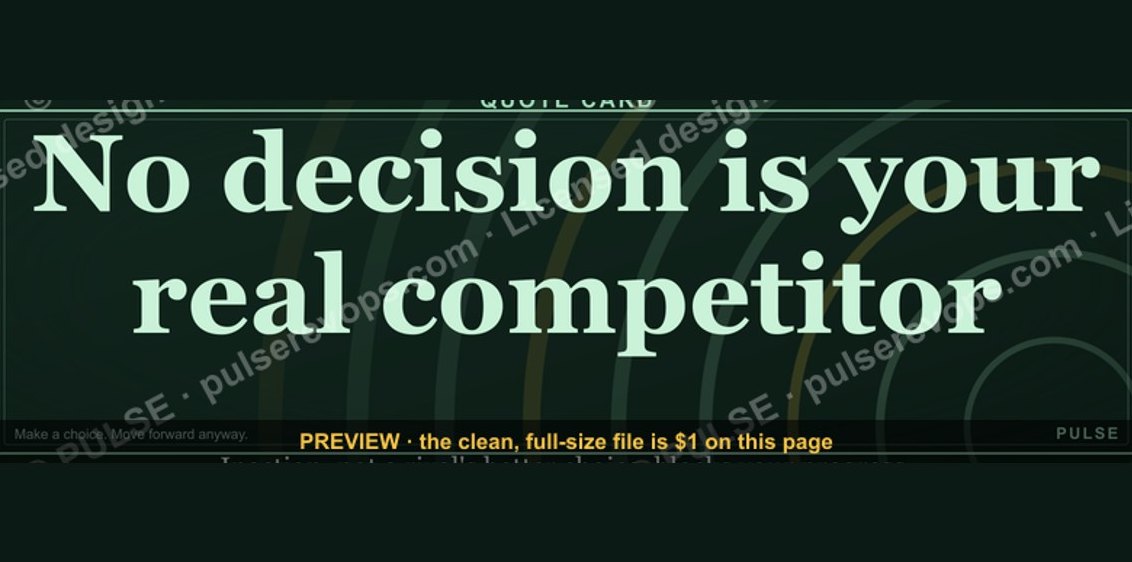 graphic“No decision is your real competitor.” — Quote Card
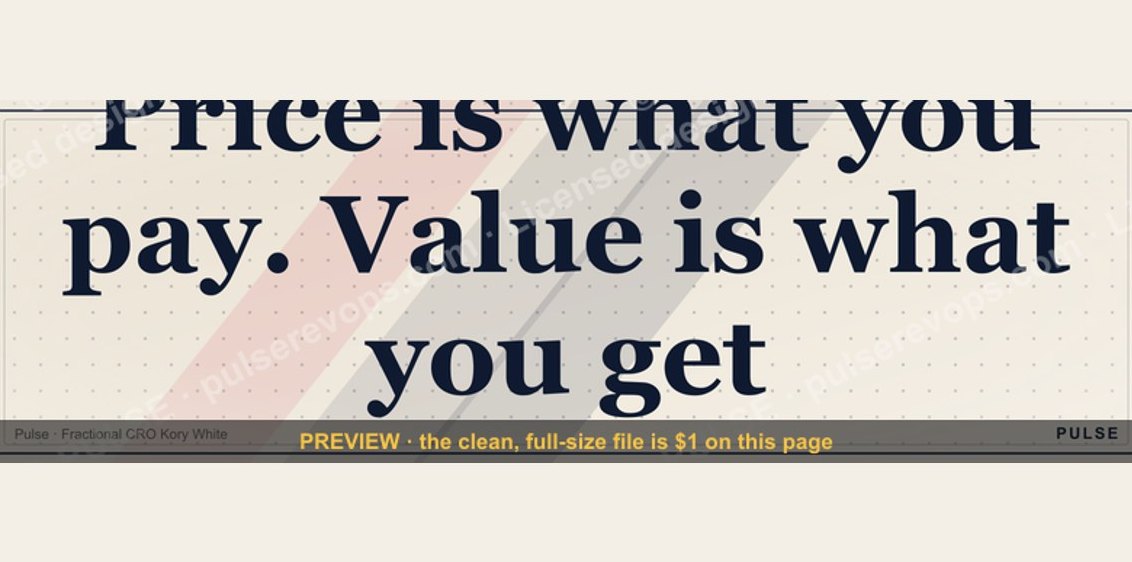 graphic“Price is what you pay. Value is what you get.” — Quote Card
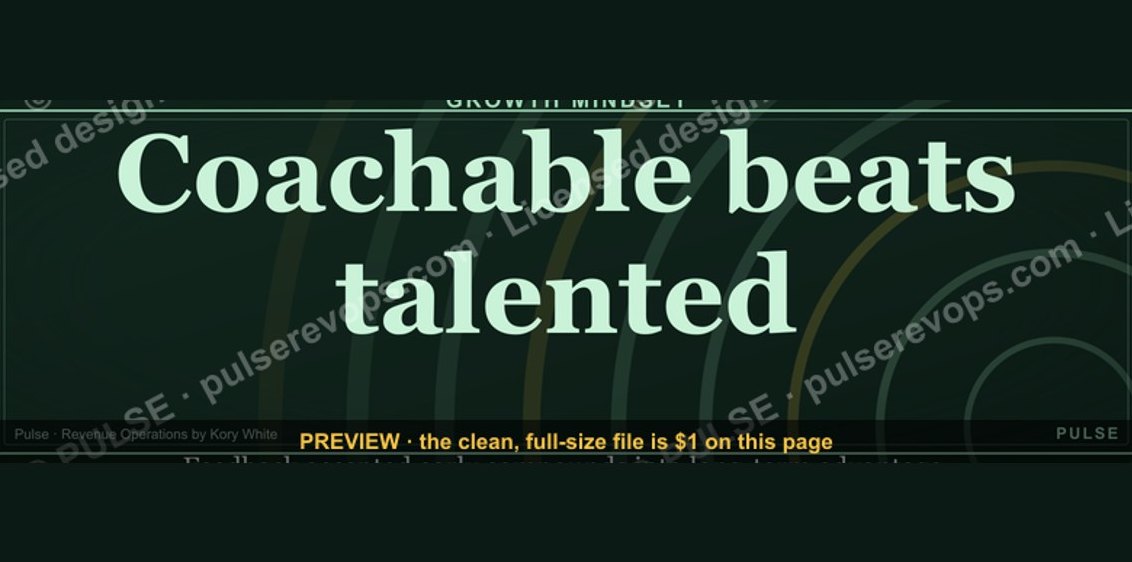 graphic“Coachable beats talented.” — Quote Card
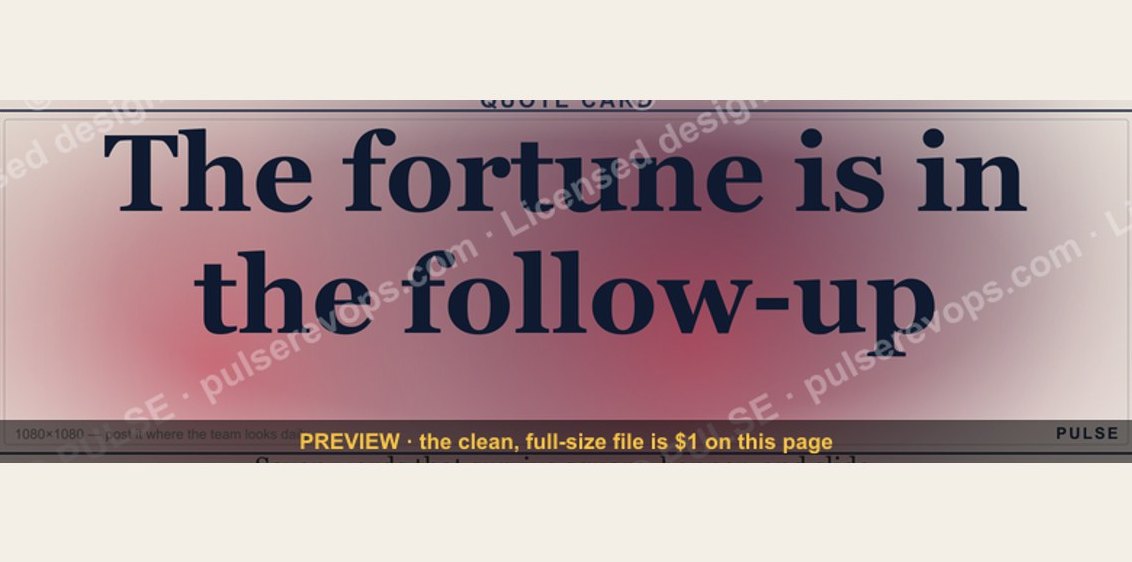 graphic“The fortune is in the follow-up.” — Quote Card
 graphic“Activity creates luck.” — Quote Card
 graphic“Win the week. The quarter wins itself.” — Quote Card
 graphic“The riches are in the niches.” — Quote Card
 graphic“Revenue Is a Lagging Indicator of Trust” — Quote Card
 graphic“Ask better questions.” — Quote Card