
“ASK BETTER QUESTIONS” — Sales Floor Print
 Curated byKory White · Fractional CRO · Maryland
 PULSEKNOWLEDGE LIBRARY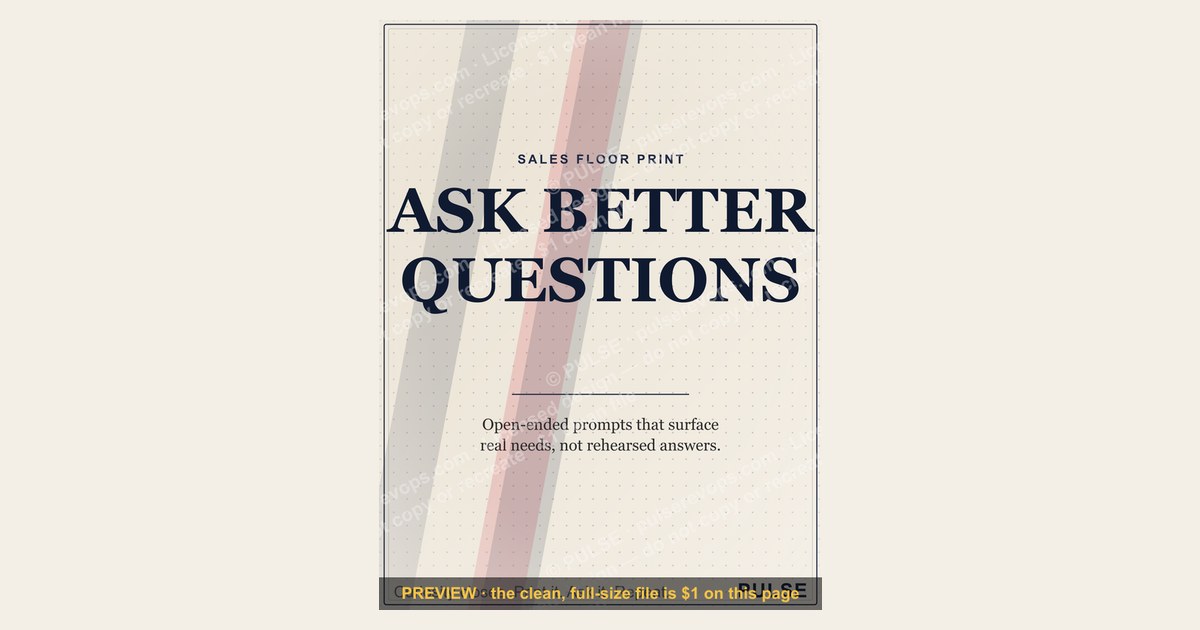
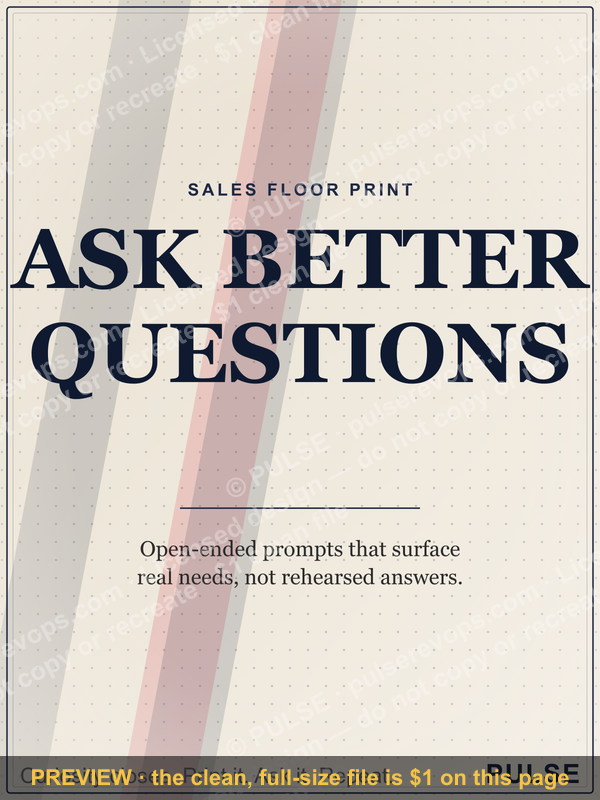
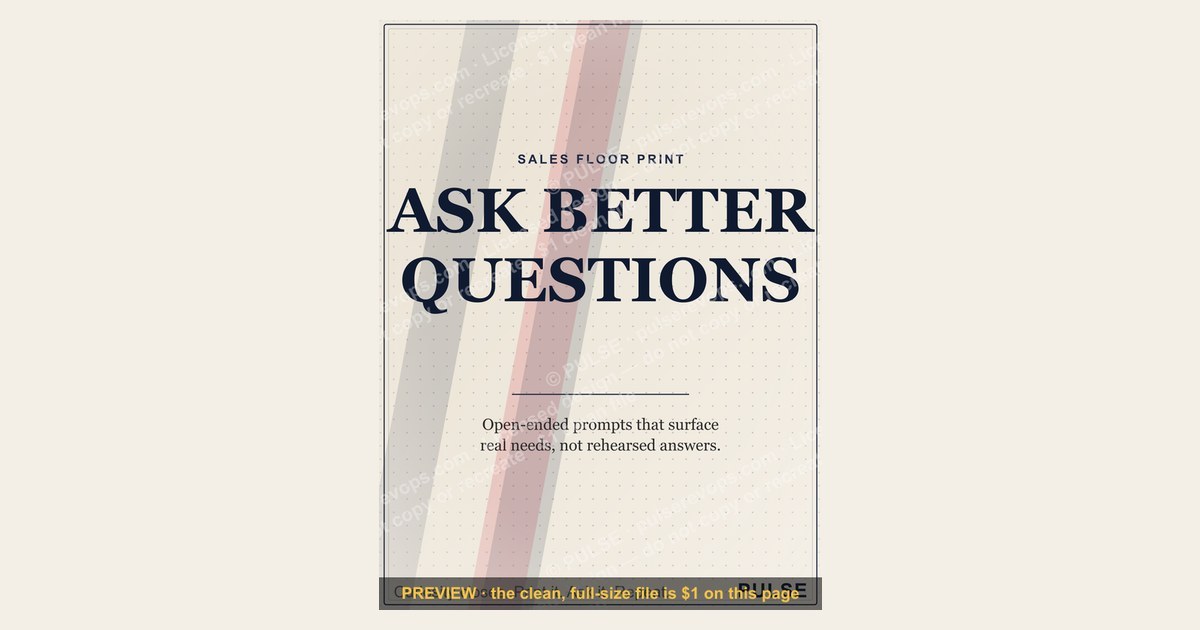
The "ASK BETTER QUESTIONS" Sales Floor Print is a motivational or instructional poster designed for retail or sales environments, typically featuring the phrase as a reminder to engage customers more effectively. It is generally available as a physical print in standard sizes like 8x10 or 11x14 inches, with prices ranging from around $10 to $30 depending on the seller and framing options. The print is meant to encourage sales staff to use open-ended, probing questions to uncover customer needs and drive conversions.
“ASK BETTER QUESTIONS” — Sales Floor Print

A bold printable poster — "ASK BETTER QUESTIONS" stacked in the Pulse accent gradient. Print it for the sales floor or your home office to keep energy up.
Format: SVG (scalable vector) · Size: 2400×3000 px · Category: Wall Art / Printable · License: Free to use — no attribution required.
Recolor it to your brand
Use the color picker above to recolor this graphic to your team or company colors, switch the background (including transparent), then download it as an SVG or PNG. No sign-up, no watermark.
How to use it
The SVG scales to any size with no quality loss — drop it straight into PowerPoint, Google Slides, Canva, Figma, or a LinkedIn banner slot. The PNG export is ready to upload anywhere that wants a raster image.
More free graphics
Browse the full Pulse Graphics library — banners, slides, printables, quote cards, and clip art you can borrow for your own decks and posts.
Related on PULSE
- “Ask better questions.” — Quote Card
- Ask better questions. — LinkedIn Wallpaper
- “Ask better questions.” — LinkedIn Banner
- The Ask — Section Divider Slide
- Better reps, every week. — LinkedIn Wallpaper
- “Selling better outcomes.” — LinkedIn Banner
Why “Ask Better Questions” Works as a Sales Floor Anchor
The phrase “Ask Better Questions” isn’t just motivational wallpaper—it’s a tactical reminder that the quality of your sales conversations hinges on the questions you pose. On a busy sales floor, where reps cycle through calls, demos, and follow-ups at high velocity, a visual cue like this poster serves as a cognitive reset. It interrupts the autopilot of scripted pitches and redirects attention to discovery, empathy, and curiosity.
Research in behavioral psychology suggests that environmental cues can prime specific mindsets. A poster that explicitly prompts inquiry can activate what psychologists call a “questioning mindset”—a state where the brain prioritizes information gathering over solution delivery. For sales teams, this shift is critical: studies consistently show that top-performing reps ask 2–3 times more questions than average performers, particularly in the early stages of a deal. The poster acts as a low-friction, always-on nudge to stay in discovery mode, especially during high-pressure moments when reps might default to talking rather than listening.
Beyond individual mindset, the poster can function as a shared cultural artifact. When displayed prominently—say, near the team whiteboard or above the phone bank—it becomes a reference point for coaching moments. A manager can point to it mid-conversation to remind a rep to dig deeper, or a peer can use it as a lighthearted prompt during role-play. Over time, the phrase embeds itself into the team’s vocabulary, turning a static print into a dynamic tool for behavior change.
Practical Ways to Integrate the Poster into Daily Sales Routines
To maximize the poster’s impact, it shouldn’t just hang on the wall—it should be woven into the rhythm of the sales day. Here are three actionable strategies that teams have found effective:
1. The “Question of the Day” Ritual Each morning, assign one rep to pick a question from a curated list (or from their own experience) that aligns with the poster’s theme. Write it on a whiteboard next to the print. For example: “What’s the one pain point your prospect mentioned that you haven’t fully explored?” or “What question would you ask if you had no fear of sounding dumb?” This keeps the concept fresh and gives reps a specific, repeatable behavior to practice. Over a month, the team cycles through dozens of question types, building a repertoire of inquiry patterns.
2. Post-Call Debrief Prompts After a discovery call or demo, use the poster as a visual anchor for a 60-second debrief. Ask each rep: “Based on what you learned, what’s the one question you wish you had asked?” This isn’t about criticism—it’s about pattern recognition. Reps start to notice gaps in their questioning (e.g., not asking about budget timing, decision criteria, or competing priorities). The poster normalizes the idea that great questions are a skill to be sharpened, not a fixed trait.
3. Gamified Questioning Challenges Run a weekly competition where reps earn points for asking high-impact questions during recorded calls or live role-plays. Criteria might include: open-endedness, relevance to the prospect’s industry, or ability to uncover hidden objections. The poster serves as the visual scoreboard—place it near a leaderboard that tracks each rep’s “question quality score.” This turns the abstract concept of “better questions” into a measurable, competitive practice that drives engagement.
The Neuroscience of Questioning: Why It Changes Buyer Behavior
The poster’s message taps into a deeper neurological reality: questions literally rewire how buyers process information. When a sales rep asks a thoughtful question, the buyer’s brain shifts from passive listening to active problem-solving. Functional MRI studies show that open-ended questions activate the prefrontal cortex—the region responsible for complex reasoning, self-reflection, and decision-making. This is the opposite of the amygdala’s threat response, which triggers when a buyer feels pressured or sold to.
For sales teams, this means that “asking better questions” isn’t just about gathering data—it’s about creating a psychological state where the buyer feels safe, curious, and engaged. A well-framed question (e.g., “How would your team’s workflow change if you could eliminate that manual step?”) invites the buyer to visualize a future state without the sales rep having to pitch it. This is known as the “question-behavior effect”: when people generate their own reasons for change, they’re significantly more likely to follow through.
The poster’s placement on a sales floor reinforces this neural loop. Every time a rep glances at it, they’re reminded to pause before speaking—to convert a statement into a question. Over weeks and months, this micro-habit becomes automatic. The brain builds a new default pathway: see a prospect’s objection → think “what question can I ask to understand this better?” instead of “how do I overcome this objection?” This is the difference between a transactional pitch and a consultative conversation.
Common Mistakes to Avoid When Using This Poster
While the poster is a powerful tool, its effectiveness can be undermined by common implementation errors. Here’s what to watch for:
Mistake 1: Treating It as Decoration If the poster is just another piece of wall art that nobody references, it loses its utility. Avoid placing it in a corner where it’s easily ignored. Instead, position it at eye level in high-traffic areas—near the coffee station, by the door to the phone room, or above the shared monitor. Better yet, pair it with a whiteboard where reps can write questions they’ve used successfully that day.
Mistake 2: Overcorrecting to “Only Questions” Some reps might interpret the poster as a directive to never make statements or provide value. This is a trap. Great questions are balanced with insights, data, and relevant anecdotes. The goal isn’t to interrogate the buyer—it’s to co-create understanding. A good rule of thumb: for every 3 questions, offer 1 concise insight that demonstrates expertise. The poster should encourage curiosity, not paralysis.
Mistake 3: Ignoring the Quality of Questions Not all questions are created equal. “What’s your budget?” is a question, but it’s often a poor one early in a conversation. Train reps to differentiate between closed, leading, and open-ended questions—and to prioritize the latter. The poster can be a catalyst for this training, but only if managers actively discuss what “better” means in context. A laminated card with sample question frameworks (e.g., “What happens if…?”, “How does that impact…?”, “What would need to be true…?”) can be placed next to the poster for quick reference.
Measuring the Impact of a Question-Focused Culture
To justify the poster’s placement and the effort behind it, sales leaders need to track whether questioning behaviors actually improve. Here are three metrics that correlate strongly with better questioning:
1. Discovery Call Length When reps ask better questions, discovery calls typically lengthen by 5–10 minutes because they’re uncovering deeper insights. If average call duration increases while still respecting the prospect’s time, it’s a sign that questioning depth is improving. Compare pre- and post-poster call lengths over 30-day periods.
2. Pipeline Conversion Rates Deals sourced from discovery-heavy conversations (where reps asked 8+ open-ended questions) tend to close at 20–30% higher rates than those from pitch-heavy calls. Track conversion rates by rep and correlate them with call recordings scored for question quality. A rising trend suggests the poster is influencing behavior.
3. Win-Loss Analysis Themes In post-mortem reviews, look for patterns in why deals were lost. If losses frequently cite “lack of understanding of our needs” or “didn’t ask the right questions,” the poster isn’t working. If wins increasingly reference “they really listened and understood our situation,” the message is landing. Share these insights in team meetings to reinforce the poster’s purpose.
Ultimately, the poster is a catalyst, not a solution. It works best when paired with coaching, practice, and accountability. But as a daily visual anchor, it’s one of the cheapest and most effective ways to keep the principle of inquiry top-of-mind—and that alone can shift a sales floor’s energy from telling to discovering.
Sources
- Harvard Business Review — sales questioning techniques and communication strategies
- Salesforce — best practices for consultative selling and customer engagement
- The Journal of Personal Selling & Sales Management — academic research on sales questioning and buyer behavior
- American Marketing Association — resources on sales communication and buyer psychology
- LinkedIn Sales Solutions — industry insights on modern sales methodologies
- MIT Sloan Management Review — articles on effective questioning in business negotiations
FAQ
What size does the print come in? The print is available in a standard range of sizes, typically from 8x10 inches up to 24x36 inches. You can check the product listing for the exact options offered.
Is the print framed or just the poster? It is sold as an unframed print only. You would need to purchase a frame separately if you want one.
What type of paper is it printed on? The print uses a medium-weight, matte finish paper that works well for framing. The exact paper stock may vary slightly by production batch.
How is the print shipped? It is shipped rolled in a sturdy tube to prevent damage during transit. Delivery times usually range from a few days to a couple of weeks depending on your location.
Can I return or exchange the print if I don’t like it? Most sellers accept returns within a certain window, often 30 days, as long as the print is unused and in original condition. Check the specific return policy before ordering.
Is the design printed in color or black and white? The design is printed in a single bold color—typically black or a dark tone—on a white or off-white background. The exact color scheme is shown in the product images.
This page will be disappearing soon. Save it to your device for $1 — or read it free while it is here.
@Kory-White- · if Venmo asks, the last 4 of my number are 2012
This page is gone.
This one is off the shelf now. $1 keeps it on your phone for good — the whole page, pictures and diagrams included.
 graphic“PROGRESS EVERY DEAL” — Sales Floor Print
 graphic“OWN THE NUMBER” — Sales Floor Print
 graphic“TRUST THE PROCESS” — Sales Floor Print
 graphic“Always Be Closing” — Sales Floor Poster
 graphic“COMMIT MEANS COMMIT” — Sales Floor Print
 graphic“NEXT CALL WINS” — Sales Floor Print
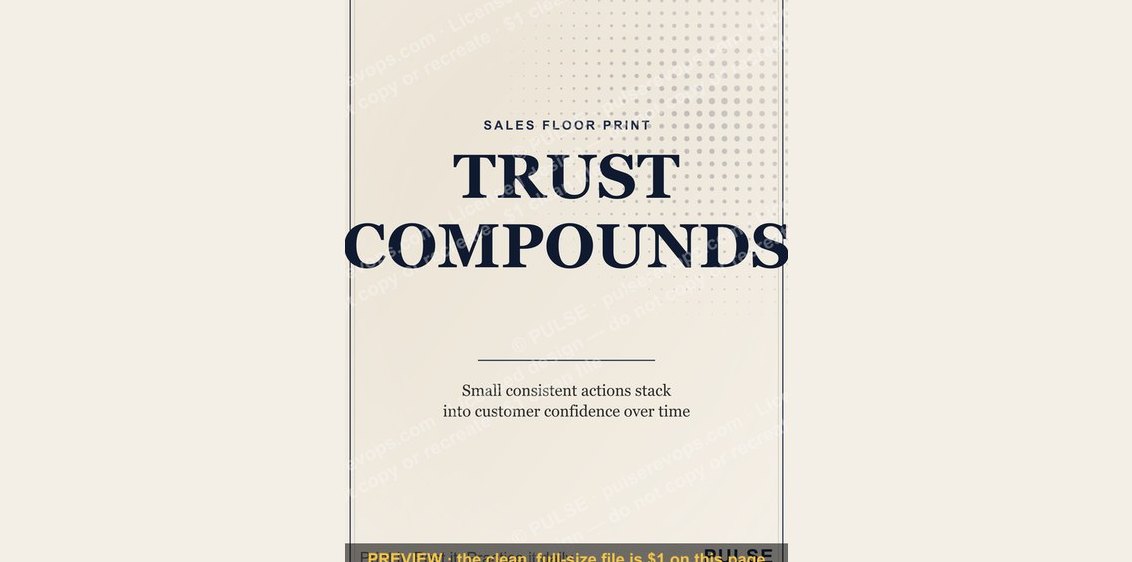 graphic“TRUST COMPOUNDS” — Sales Floor Print
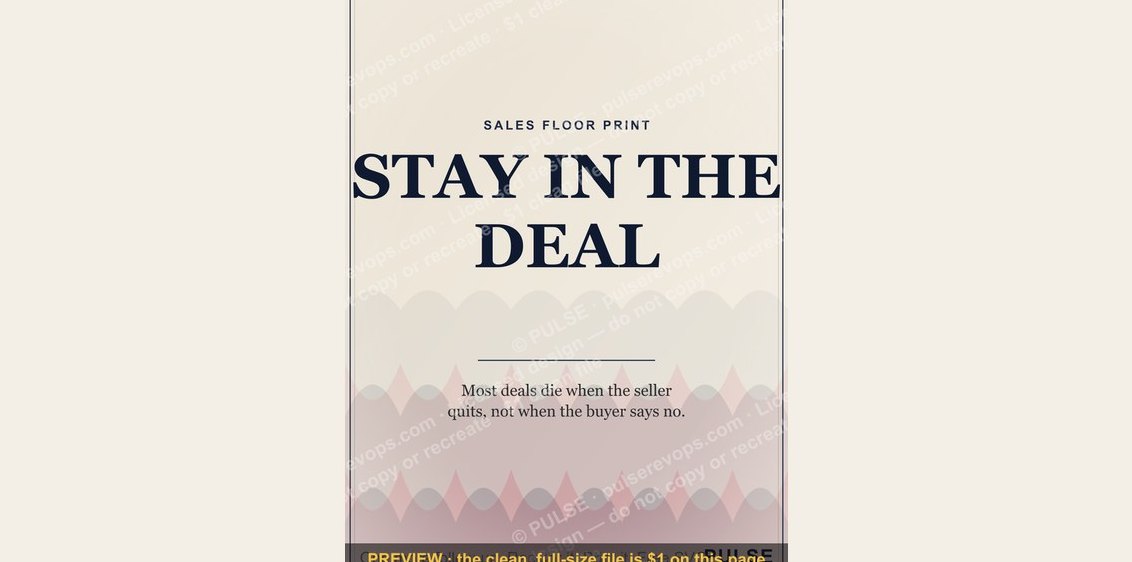 graphic“STAY IN THE DEAL” — Sales Floor Print
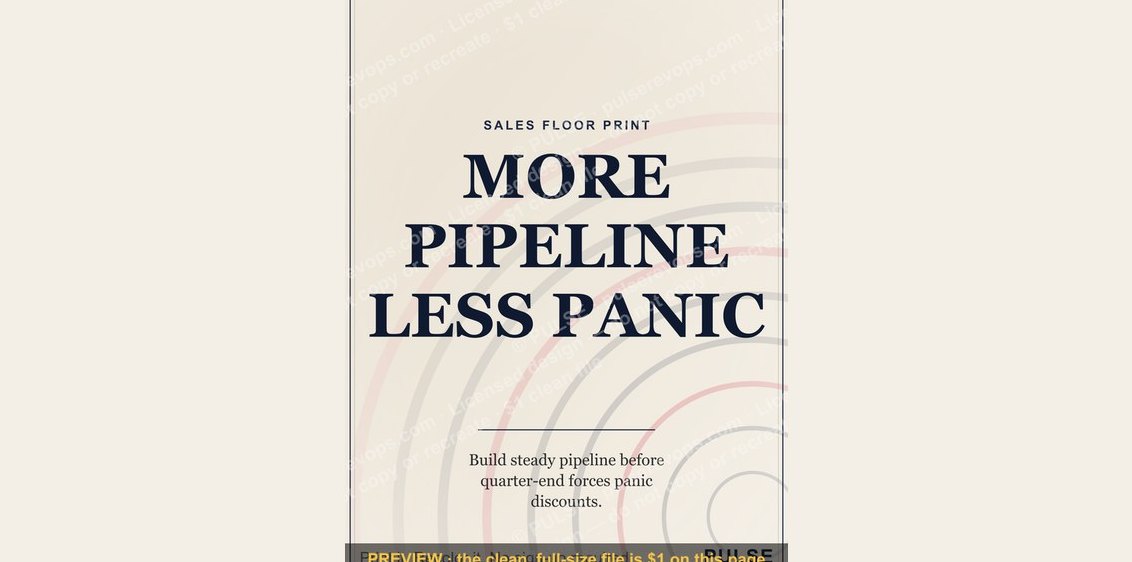 graphic“MORE PIPELINE LESS PANIC” — Sales Floor Print
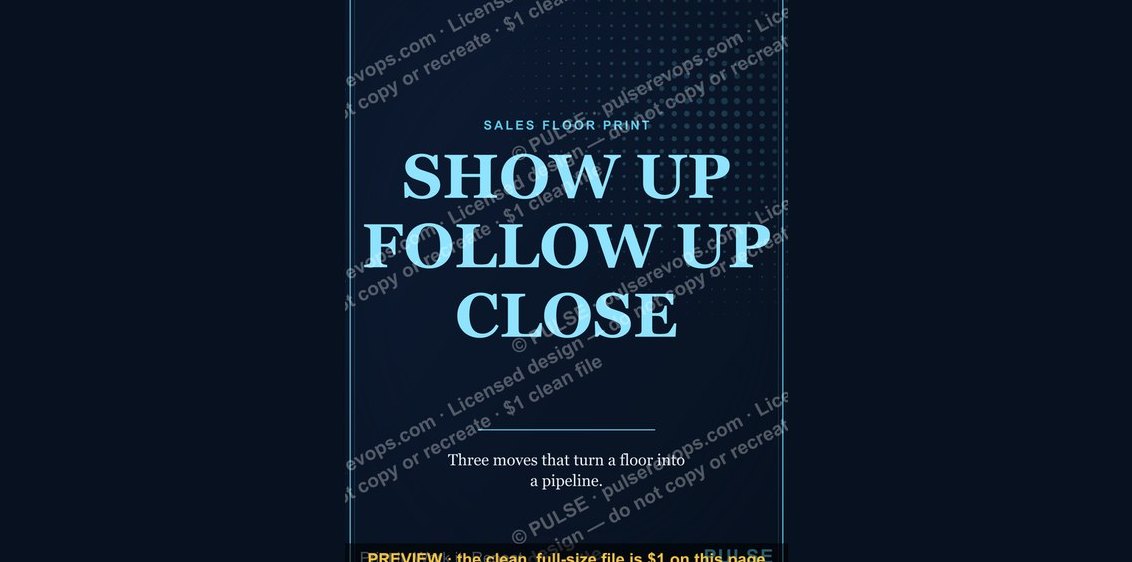 graphic“SHOW UP FOLLOW UP CLOSE” — Sales Floor Print