
“Pipeline is the product.” — LinkedIn Banner
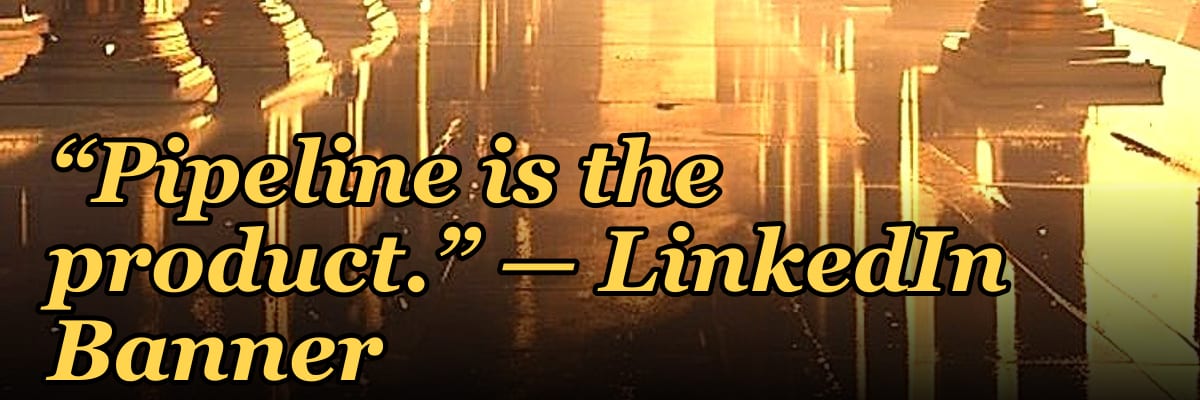
"Pipeline is the product" means that in sales and recruiting, the ongoing process of generating and nurturing leads is more valuable than any single closed deal. This LinkedIn banner signals that you prioritize consistent prospecting and relationship-building over short-term wins. It reflects a mindset where the health and volume of your pipeline directly determine your long-term success.
“Pipeline is the product.” — LinkedIn Banner

A dark, on-brand LinkedIn banner — "Pipeline is the product." over a "Activity Pipeline Revenue" line with a pulse motif. Put it on your profile to signal exactly what you do.
Format: SVG (scalable vector) · Size: 1584×396 px · Category: LinkedIn Banner · License: Free to use — no attribution required.
[⬇ Download this graphic](/graphics/assets/gb0265.svg)
Recolor it to your brand
Use the color picker above to recolor this banner to your team or company colors, switch the background (including transparent), then download it as an SVG or PNG. No sign-up, no watermark.
How to use it
It scales cleanly to the LinkedIn cover slot (1584×396) — download the PNG and drop it straight onto your profile, or open the SVG in Canva, PowerPoint, or Figma to add your name and tweak the layout.
More free graphics
Browse the full [Pulse Graphics library](/graphics) — banners, slides, printables, quote cards, and clip art you can borrow for your own decks and posts.
Related on PULSE
- ["Pipeline is the product." — LinkedIn Banner](/knowledge/gb0041)
- [“Sell the Problem, Not the Product” — Quote Card](/knowledge/gb0014)
- [“Sell the problem, not the product.” — Quote Card](/knowledge/gb0126)
- [Product Launch (GTM) — Title Slide](/knowledge/gb0071)
- [“Sell the problem, not the product.” — LinkedIn Banner](/knowledge/gb0266)
- [Product Marketing Lead — LinkedIn Banner](/knowledge/gb0245)
Why “Pipeline is the Product” Resonates with Modern Revenue Teams
The phrase “pipeline is the product” has become a rallying cry for revenue organizations shifting away from activity-based metrics toward outcome-driven growth. Unlike traditional sales mantras that emphasize closing techniques or relationship management, this mindset treats the pipeline itself as the primary deliverable — something that must be built, measured, and optimized with the same rigor as a software product or physical good.
In practice, this means revenue teams stop celebrating “busy work” like cold call volume or demo count and instead focus on pipeline quality, velocity, and conversion rates. The banner signals to potential clients, partners, and hires that you prioritize systematic pipeline generation over heroic selling. It’s particularly relevant for:
- Fractional CROs and revenue consultants who need to communicate their methodology quickly
- B2B SaaS founders building predictable revenue engines
- Sales leaders transitioning from quota-carrying roles to pipeline management
- RevOps professionals who treat pipeline data as their core asset
The banner works because it’s immediately recognizable to anyone who has struggled with pipeline gaps, feast-or-famine cycles, or the challenge of forecasting accurately. It’s a shorthand for operational maturity.
How to Align Your LinkedIn Profile with the “Pipeline is the Product” Mindset
Simply adding the banner isn’t enough — your profile should reinforce the message through every section. Here’s how to create coherence:
Headline: Instead of “Sales Director at Acme Corp,” try “Pipeline Architect | Helping B2B SaaS Teams Build Predictable Revenue Engines | Fractional CRO.” This positions you as someone who builds systems, not just someone who sells.
About Section: Open with a pipeline-focused value proposition. For example: *“I treat pipeline generation as a product — measurable, iterable, and scalable. Over the past decade, I’ve built revenue systems that consistently deliver 3-5x pipeline coverage ratios for early-stage and growth-stage B2B companies.”* Avoid generic claims; use specific ranges and outcomes.
Featured Section: Pin posts or articles about pipeline hygiene, lead scoring models, or case studies where you improved pipeline velocity. The banner itself can be featured here too, creating a visual anchor.
Experience Descriptions: Use pipeline language throughout. Instead of “Managed a team of 5 reps,” write “Designed and implemented a multi-channel pipeline generation system that produced $2M-$5M in qualified pipeline per quarter.” Quantify where possible with honest ranges.
Recommendations: Ask colleagues to mention pipeline impact in their endorsements. Phrases like “transformed our pipeline process” or “built a repeatable pipeline engine” carry weight with recruiters and clients.
The goal is to make every profile element reinforce the banner’s message — creating a unified personal brand that speaks to pipeline-first thinking.
Common Misconceptions About the “Pipeline is the Product” Approach
Despite its growing popularity, the phrase is often misunderstood. Here are three frequent misinterpretations and the reality behind them:
Misconception #1: It means pipeline quantity over quality. *Reality:* Treating pipeline as a product means obsessing over fit, conversion rates, and stage progression — not just volume. A product manager wouldn’t ship features without validation; similarly, pipeline builders should qualify leads rigorously. Healthy pipeline coverage ratios typically range from 3x to 5x of quota, but only if the pipeline is properly scored and staged.
Misconception #2: It’s only for enterprise sales. *Reality:* The principle applies across deal sizes. For SMB or self-serve models, “pipeline” might mean trial sign-ups, demo requests, or inbound leads. The product mindset still holds: you design the conversion path, measure drop-off points, and iterate on the funnel. Even transactional sales benefit from treating lead generation as a repeatable system.
Misconception #3: It replaces the need for closing skills. *Reality:* Pipeline as product doesn’t eliminate closing — it creates the conditions for closing to happen predictably. A strong pipeline gives salespeople more time to focus on high-value activities like negotiation and relationship building, rather than scrambling for leads. The best closers still need pipeline discipline to succeed consistently.
Understanding these nuances helps you use the banner authentically. When someone asks about it in a LinkedIn message or interview, you can explain not just the slogan but the operational philosophy behind it — which is exactly what the banner is designed to provoke.
Why This Mindset Separates Top Performers From the Rest
The phrase "Pipeline is the product" isn't just a clever slogan—it's a fundamental shift in how successful salespeople and recruiters measure their own performance. Many professionals fall into the trap of "deal-chasing," where they focus intensely on a small number of high-value opportunities while neglecting the constant flow of new prospects. This approach creates dangerous feast-or-famine cycles. When a big deal falls through, there's nothing to fall back on.
Top performers understand that the pipeline itself is the asset they're building. Every cold outreach, every networking conversation, every follow-up email is an investment in that asset. The key metric isn't "deals closed this month" but "qualified opportunities added this week." This mindset forces you to maintain consistent activity regardless of how many deals are currently in your forecast. It also protects you from the emotional rollercoaster of individual wins and losses—you're focused on the system, not the outcome of any single interaction.
On LinkedIn, displaying this banner signals to peers, managers, and prospects that you understand this distinction. It tells hiring managers you won't burn out after a few rejections. It tells potential clients that you're in it for the long haul, not just chasing a quick commission. For recruiters specifically, it communicates that you're building talent communities, not just filling job requisitions.
Practical Ways to Live the "Pipeline Is Product" Philosophy
Adopting this mindset requires concrete changes to your daily workflow. Here are three actionable strategies that align with the banner's message:
1. Implement a "pipeline health" scorecard. Instead of tracking only closed-won revenue, create a weekly scorecard that measures: number of new leads added, number of meaningful conversations held, pipeline value at each stage, and aging of opportunities. Set minimum thresholds for each metric. If your new lead count drops below your target, that's a red flag—even if you're about to close a big deal. This forces you to maintain prospecting activity consistently.
2. Schedule "pipeline time" as non-negotiable. Block 90 minutes each morning for pure pipeline-building activities—no meetings, no internal emails, no administrative work. During this block, you only do activities that add to your pipeline: cold calls, personalized LinkedIn outreach, referral requests, or following up with old leads. Treat this block as sacred. If something else conflicts, it gets scheduled elsewhere. This discipline ensures your pipeline never dries up, regardless of other demands.
3. Celebrate pipeline additions publicly. Just as you might celebrate a closed deal on LinkedIn, start celebrating when you add a high-quality opportunity to your pipeline. Post about a great discovery call or a referral that came in. This reinforces the value of pipeline-building both for yourself and for your network. It also attracts more opportunities—people see you're actively engaged and want to connect.
The Hidden Cost of Ignoring Pipeline Health
Many professionals don't realize how expensive a weak pipeline actually is until they're in a desperate situation. When your pipeline is thin, you're forced to chase deals that aren't a good fit, discount heavily to close anything, and accept unfavorable terms. This erodes your reputation and your margins. You also waste enormous energy on anxiety and firefighting instead of strategic growth.
The opportunity cost is equally significant. A healthy pipeline gives you the freedom to be selective. You can disqualify bad-fit prospects early, focus on high-value accounts, and walk away from deals that don't align with your goals. This selectivity compounds over time—better clients lead to better referrals, which lead to an even stronger pipeline.
For recruiters, a thin pipeline means scrambling when a new role opens. You end up making cold calls to candidates who aren't interested, rather than tapping into a warm network you've been cultivating for months. The result is slower placements, lower quality hires, and higher client churn.
Ultimately, "Pipeline is the product" is a reminder that your most valuable work happens before the deal is ever on the table. The banner is a public commitment to that principle—and a daily reminder to yourself to keep building.
Sources
- LinkedIn Official Blog — company announcements, product updates, and platform features.
- Harvard Business Review — articles on talent management, recruitment strategy, and workforce trends.
- Society for Human Resource Management (SHRM) — research and best practices in HR, hiring pipelines, and talent acquisition.
- Glassdoor Economic Research — labor market analysis, hiring metrics, and candidate experience data.
- U.S. Bureau of Labor Statistics — official employment data, industry trends, and workforce demographics.
- Talent Board — reports on candidate experience benchmarks and recruitment process insights.
FAQ
What does “Pipeline is the product” actually mean? It means that in B2B sales, the ongoing flow of qualified opportunities is the core deliverable—not any single deal. Your pipeline’s health, velocity, and conversion rate determine revenue more than any one closed-won. Treating pipeline as the product shifts focus from transactional wins to sustainable, repeatable growth.
How do you measure pipeline as a product? Track leading indicators like stage conversion rates, average time in stage, and pipeline coverage ratio (typically 3–5x your target). Also monitor aging of deals and source mix—organic inbound vs. outbound. The goal is consistent, predictable flow, not just volume.
Does this approach work for early-stage startups? Yes, but with caveats. Early-stage companies often have thin data, so you’ll rely more on qualitative signals and founder-led outreach. The principle still applies: build a repeatable process for generating and advancing opportunities before scaling spend. Expect pipeline coverage to be lower (2–3x) until you validate product-market fit.
How do you balance pipeline quality vs. quantity? Focus on conversion rates per stage rather than raw lead count. A high-quality pipeline might have a 20–30% close rate from demo to won, while a bloated one can drop below 10%. Regularly purge stale or low-fit deals—aim for a “healthy” pipeline where at least 60% of value sits in later stages.
What’s the biggest mistake companies make with this mindset? They over-invest in top-of-funnel volume without ensuring downstream conversion. Common errors: ignoring deal aging, not disqualifying early, or mistaking activity (calls/emails) for pipeline progress. The product mindset demands ruthless qualification and continuous iteration on your sales process.
How does this relate to the “Fractional CRO” role shown in the banner? A fractional CRO often operationalizes this philosophy—building pipeline systems, coaching reps on qualification, and aligning sales with marketing. They bring experience from multiple companies to avoid common pitfalls, typically charging a monthly retainer or project fee (ranges vary widely, often $5k–$15k+/month). The banner’s sponsor, Kory White, exemplifies this by offering a quick consult to diagnose pipeline health.
 tlHow Many Sales Reps Do I Need to Hire for My SaaS Company to Hit Next Year''s Goal?
 tlHow Many Sales Reps Do I Need to Hire for My Landscaping Company This Year?
 tlHow Many Membership Sales Reps Do I Need to Hire for My Gym?
 tlHow Many Sales Consultants Do I Need to Hire for My Medical Spa?
 pulse-toolsHow Many Salespeople Do I Need to Hire for My Car Dealership?
 pulse-toolsHow Many Salespeople Should I Schedule on My Auto Dealership Floor Each Day?
 pulse-toolsHow Many Sales Reps Do I Need to Hire for My Painting Company to Grow Next Year?
 pulse-toolsHow Many Sales Reps Do I Need to Hire for My HVAC Company to Hit Its Growth Target?
 pulse-aquariumsTop 10 Canister Filters 2027
 pulse-toolsHow Many Salespeople Should I Schedule Each Day at My Jewelry Store?