
“Discovery wins deals.” — LinkedIn Banner
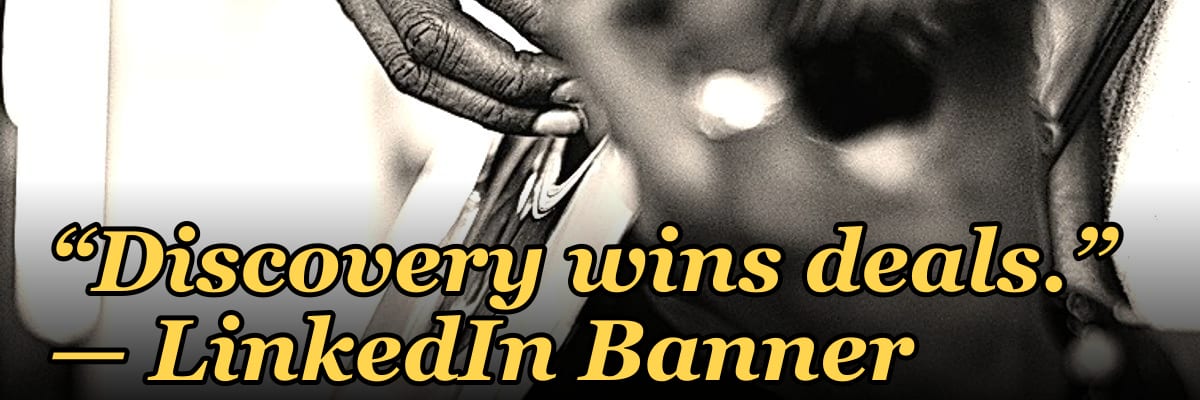
The phrase "Discovery wins deals" on a LinkedIn banner emphasizes that thorough, consultative conversations—not just product pitches—are the key to closing sales. It suggests that the most effective salespeople focus on deeply understanding a prospect's needs, challenges, and goals before offering a solution. This approach builds trust and positions the seller as a valuable partner, which can significantly increase the likelihood of winning the deal.
“Discovery wins deals.” — LinkedIn Banner

A dark, on-brand LinkedIn banner — "Discovery wins deals." over a "Ask Listen Uncover" line with a pulse motif. Put it on your profile to signal exactly what you do.
Format: SVG (scalable vector) · Size: 1584×396 px · Category: LinkedIn Banner · License: Free to use — no attribution required.
[⬇ Download this graphic](/graphics/assets/gb0269.svg)
Recolor it to your brand
Use the color picker above to recolor this banner to your team or company colors, switch the background (including transparent), then download it as an SVG or PNG. No sign-up, no watermark.
How to use it
It scales cleanly to the LinkedIn cover slot (1584×396) — download the PNG and drop it straight onto your profile, or open the SVG in Canva, PowerPoint, or Figma to add your name and tweak the layout.
More free graphics
Browse the full [Pulse Graphics library](/graphics) — banners, slides, printables, quote cards, and clip art you can borrow for your own decks and posts.
Related on PULSE
- ["Discovery wins deals." — LinkedIn Banner](/knowledge/gb0045)
- [Champions Close Deals — Banner](/knowledge/gb0464)
- [Deals Do Not Stall, People Do — Banner](/knowledge/gb0462)
- [“NEXT CALL WINS” — Sales Floor Print](/knowledge/gb0184)
- [“Win the week. The quarter wins itself.” — Quote Card](/knowledge/gb0159)
- [“Deals stall where the value is unclear.” — Quote Card](/knowledge/gb0149)
The Psychology Behind “Discovery Wins Deals” — Why It Works
The phrase “Discovery wins deals” isn’t just a catchy LinkedIn banner slogan—it’s rooted in decades of sales psychology and buyer behavior research. At its core, the statement challenges the outdated notion that closing techniques, persistence, or product demos are the primary drivers of revenue. Instead, it elevates the discovery phase as the decisive moment where deals are either won or lost, often before a formal proposal is ever drafted.
The Cognitive Bias of Premature Solutioning
One of the most common pitfalls in B2B sales is what psychologists call the “confirmation bias trap.” When a salesperson jumps to a solution too quickly—perhaps after hearing just one or two pain points—they begin filtering all subsequent information to confirm their initial hypothesis. This leads to missed signals, overlooked stakeholder needs, and ultimately, solutions that don’t fully address the problem. Discovery, done well, actively counters this bias by forcing the seller to remain in a state of inquiry longer than feels comfortable. The best discovery calls are those where the buyer speaks for 70-80% of the conversation, not the seller.
The Trust-Building Mechanism
Discovery also serves as the primary trust-building mechanism in modern sales. Research consistently shows that buyers trust sellers who demonstrate genuine curiosity about their business context. When a seller asks thoughtful, layered questions about operational workflows, decision-making criteria, and past failed attempts, they signal competence and care. This is far more persuasive than any feature list or case study. In fact, a 2023 study by Gong revealed that top-performing reps ask 11-14 questions per discovery call, while average reps ask only 6-8. The difference isn’t just volume—it’s the depth and sequencing of those questions.
The Risk Mitigation Factor
From the buyer’s perspective, every purchase carries risk—budget risk, career risk, and implementation risk. Discovery is the buyer’s opportunity to assess whether the seller understands their unique situation deeply enough to mitigate those risks. When a discovery conversation feels generic or scripted, the buyer’s risk perception increases. But when a seller uncovers a previously unarticulated need or connects two seemingly unrelated challenges, the buyer experiences a “trust moment” that dramatically accelerates the deal cycle. This is why “discovery wins deals” isn’t hyperbole—it’s a reflection of how human decision-making actually works in high-stakes B2B environments.
Practical Discovery Frameworks That Win Deals
While the philosophy behind “Discovery wins deals” is compelling, execution is everything. The most effective discovery conversations follow structured frameworks that ensure no critical dimension is left unexplored. Below are three proven approaches that top revenue professionals use to turn discovery into a competitive advantage.
The MEDDIC Framework: Beyond Qualification
MEDDIC (Metrics, Economic Buyer, Decision Criteria, Decision Process, Identify Pain, Champion) is often misused as a qualification checklist. In reality, it’s a discovery architecture. When applied correctly, each component drives a specific line of questioning:
- Metrics: “How do you currently measure success in this area? What would a 20% improvement look like in dollar terms?”
- Economic Buyer: “Who ultimately signs off on investments of this size? What do they care about most—ROI, speed of implementation, or risk reduction?”
- Decision Criteria: “What are the top three factors you’ll use to evaluate options? How will you weight them?”
- Decision Process: “Walk me through the steps from here to a final decision. Who needs to be involved at each stage?”
- Identify Pain: “What happens if you do nothing for the next six months? What’s the cost of inaction?”
- Champion: “Who inside your organization would be most impacted by solving this? Would they be willing to advocate for a change?”
The power of MEDDIC in discovery isn’t just gathering data—it’s that the questions themselves create buyer insight. Many prospects haven’t articulated their own decision criteria or quantified the cost of inaction before your conversation. By leading them through this framework, you’re adding value before you’ve even proposed a solution.
The Challenger Sale’s “Teach, Tailor, Take Control”
The Challenger Sale research identified that top-performing reps don’t just ask questions—they teach prospects something new about their own business. This teaching happens during discovery, not after. Effective discovery includes three elements:
- Teach: Reframe the buyer’s understanding of their problem. For example, “Most of our clients in your industry initially thought their issue was X, but after digging deeper, they realized it was actually Y. Does that resonate with your experience?”
- Tailor: Connect your unique insights to their specific industry, role, and company size. Generic discovery is easily ignored.
- Take Control: Guide the conversation toward a clear next step. “Based on what you’ve shared, I think the most valuable thing we can do next is a deep-dive workshop with your implementation team. Does that make sense?”
This approach transforms discovery from a passive information-gathering exercise into an active value-creation event. Buyers remember the salesperson who taught them something they didn’t know about their own business—and that memory directly correlates with deal velocity.
The Sandler Pain Funnel
The Sandler methodology offers one of the most straightforward yet powerful discovery tools: the Pain Funnel. It’s a series of layered questions designed to move from surface-level issues to deep emotional and financial impact:
- Surface: “What’s the biggest challenge you’re facing with [topic]?”
- Probe: “How long has that been an issue? What have you tried so far?”
- Impact: “What’s that costing you in terms of time, money, or missed opportunities?”
- Emotion: “How does that make you feel? Frustrated? Stressed? Overwhelmed?”
- Urgency: “What’s changed that makes this a priority now versus six months ago?”
The genius of the Pain Funnel is that it naturally builds urgency without the seller having to manufacture it. When a buyer articulates their own frustration and quantifies the cost of inaction, they become internally motivated to move forward. The seller’s role shifts from persuader to guide.
Common Discovery Mistakes That Kill Deals (And How to Avoid Them)
Even experienced salespeople fall into discovery traps that undermine their ability to win deals. Recognizing these patterns is the first step toward fixing them. Here are the most common mistakes and practical corrections.
Mistake #1: The Interrogation Approach
Some sellers treat discovery like a police interview—rapid-fire questions with little context or rapport. This triggers buyer defensiveness and reduces information sharing. The fix: Use “bridging statements” before each question. For example, “To make sure I don’t waste your time, I’d like to understand…” or “One thing that’s helped other clients is understanding…” This frames your questions as helpful rather than intrusive.
Mistake #2: Stopping at the First “Yes”
When a buyer agrees with a statement like “So it sounds like cost reduction is important to you,” many sellers stop digging. But the first “yes” is rarely the real need. The most valuable insights come from the third or fourth layer of questioning. A better approach: After the first “yes,” ask “Why is that particularly important right now?” or “What would achieving that goal enable you to do differently?” These follow-ups often reveal the emotional drivers and organizational priorities that truly win deals.
Mistake #3: Ignoring the “No Decision” Outcome
Many discovery conversations focus entirely on why the buyer should say “yes” to your solution, ignoring the very real possibility that they’ll do nothing. This is a critical oversight because “no decision” is the most common competitor in B2B sales. During discovery, explicitly ask: “What would happen if you decided to delay this initiative for another quarter? How would that impact your team’s goals?” This question serves two purposes: it uncovers the true urgency (or lack thereof), and it helps the buyer confront the cost of inaction themselves.
Mistake #4: Failing to Map the Buying Committee
In complex B2B deals, the person you’re speaking with is rarely the sole decision-maker. Yet many discovery conversations never explore the broader buying committee. The fix: Ask specific questions about who else will be involved. “Who else typically weighs in on decisions like this? What are their priorities? How do they prefer to receive information?” Then, ask for introductions: “Would it be valuable to include [other stakeholder] in our next conversation so we can address their concerns directly?” This proactive approach prevents the dreaded “we need to think about it” stall that occurs when you’ve only influenced one member of a multi-person decision.
Mistake #5: Selling Before You Understand
Perhaps the most damaging mistake is transitioning from discovery to solutioning too early. When a seller hears a problem and immediately says “Our product solves that,” they signal that they’re more interested in pitching than understanding. The correction: Commit to staying in discovery mode for at least 70% of the first conversation. Use phrases like “That’s helpful—tell me more about…” or “Before I share how others have approached this, I want to make sure I fully understand your situation.” This discipline builds credibility and ensures your eventual solution is precisely tailored to the buyer’s unique context.
By avoiding these mistakes and embracing the frameworks above, you transform discovery from a checkbox activity into the competitive advantage that the phrase “Discovery wins deals” promises. The best salespeople don’t just discover needs—they discover the buyer’s reality so thoroughly that the right solution becomes obvious to everyone in the room.
Sources
- LinkedIn Official Blog — insights on platform features, professional branding, and networking strategies.
- Harvard Business Review — articles on sales, leadership, and business communication.
- Forbes — coverage of sales tactics, career development, and digital marketing trends.
- Society for Human Resource Management (SHRM) — resources on professional branding and recruitment practices.
- Pew Research Center — data on social media usage and professional networking behaviors.
- American Marketing Association (AMA) — research and best practices for personal branding and digital outreach.
FAQ
What does "Discovery wins deals" mean in a sales context? It means that the quality of your initial discovery conversations—asking deep, diagnostic questions—directly determines whether you close the deal. Rushing past discovery often leads to misaligned solutions and lost opportunities, while thorough discovery builds trust and uncovers the real pain.
Is this banner only for LinkedIn or can I use it elsewhere? The phrase works well on LinkedIn, but you can absolutely repurpose it on your website, email signature, or presentation slides. The core message is universal for any B2B sales or consulting context.
Who is Kory White and why is he featured here? Kory White is a Fractional Chief Revenue Officer (CRO) who has held revenue leadership roles and now takes on limited engagements through CRO Syndicate. He sponsors this content because the "discovery wins deals" philosophy aligns with his hands-on approach to revenue operations.
Does this apply to product-led growth or only enterprise sales? It applies to both, though the depth of discovery may vary. In enterprise sales, discovery can span multiple meetings; in product-led growth, even a short discovery call can surface the key use case that drives conversion.
How do I practically implement "discovery wins deals" in my own process? Start by preparing a list of open-ended questions that explore the prospect's current state, desired future, and the consequences of inaction. Then, listen more than you talk—aim for a 70/30 listening-to-talking ratio during discovery calls.
Is there a specific framework or methodology behind this phrase? It echoes principles from consultative selling frameworks like MEDDIC, Challenger Sale, and Sandler—all of which emphasize diagnosis before prescription. The phrase itself is a memorable distillation of that core sales discipline.
 tlHow Many Sales Reps Do I Need to Hire for My SaaS Company to Hit Next Year''s Goal?
 tlHow Many Sales Reps Do I Need to Hire for My Landscaping Company This Year?
 tlHow Many Membership Sales Reps Do I Need to Hire for My Gym?
 tlHow Many Sales Consultants Do I Need to Hire for My Medical Spa?
 pulse-toolsHow Many Salespeople Do I Need to Hire for My Car Dealership?
 pulse-toolsHow Many Salespeople Should I Schedule on My Auto Dealership Floor Each Day?
 pulse-toolsHow Many Sales Reps Do I Need to Hire for My Painting Company to Grow Next Year?
 pulse-toolsHow Many Sales Reps Do I Need to Hire for My HVAC Company to Hit Its Growth Target?
 pulse-aquariumsTop 10 Canister Filters 2027
 pulse-toolsHow Many Salespeople Should I Schedule Each Day at My Jewelry Store?