
“Build, don’t chase.” — LinkedIn Banner
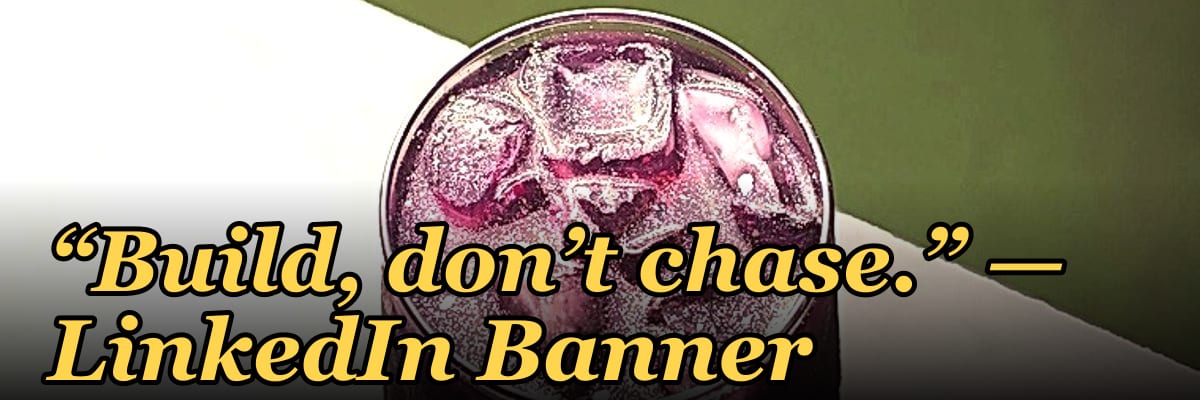
The banner suggests prioritizing skill development and value creation over actively pursuing opportunities or recognition. It implies that building expertise, projects, or a strong network will naturally attract the right connections and career prospects. The phrase is a concise reminder that consistent, focused effort often yields better long-term results than aggressive self-promotion.
“Build, don’t chase.” — LinkedIn Banner

A dark, on-brand LinkedIn banner — "Build, don’t chase." over a "System Signal Scale" line with a pulse motif. Put it on your profile to signal exactly what you do.
Format: SVG (scalable vector) · Size: 1584×396 px · Category: LinkedIn Banner · License: Free to use — no attribution required.
[⬇ Download this graphic](/graphics/assets/gb0279.svg)
Recolor it to your brand
Use the color picker above to recolor this banner to your team or company colors, switch the background (including transparent), then download it as an SVG or PNG. No sign-up, no watermark.
How to use it
It scales cleanly to the LinkedIn cover slot (1584×396) — download the PNG and drop it straight onto your profile, or open the SVG in Canva, PowerPoint, or Figma to add your name and tweak the layout.
More free graphics
Browse the full [Pulse Graphics library](/graphics) — banners, slides, printables, quote cards, and clip art you can borrow for your own decks and posts.
Related on PULSE
- ["Build, don't chase." — LinkedIn Banner](/knowledge/gb0059)
- [“CHASE THE NO” — Sales Floor Print](/knowledge/gb0170)
- [Chase the no. — LinkedIn Wallpaper](/knowledge/gb0416)
- [“Don't pitch. Diagnose.” — Quote Card](/knowledge/gb0152)
- [“Process scales. Heroics don't.” — Quote Card](/knowledge/gb0134)
- [“Process scales. Heroics don’t.” — LinkedIn Banner](/knowledge/gb0308)
Why “Build, Don’t Chase” Resonates with Modern Professionals
The phrase “Build, don’t chase” has become a quiet mantra among founders, operators, and independent professionals who have grown tired of the hustle culture that dominated the past decade. It speaks directly to a fundamental shift in how high-performers approach their careers and businesses. Instead of constantly reacting to external signals—job postings, investor demands, competitor moves—the “build” mindset emphasizes ownership, long-term value creation, and intentional growth.
At its core, this banner signals that you prioritize substance over speed. When you place it on your LinkedIn profile, you’re telling visitors that you’re not just another person hunting for the next opportunity or chasing vanity metrics. You’re someone who invests time in developing systems, products, relationships, and skills that compound over time. This is particularly powerful for roles in revenue operations, product management, engineering, and consulting, where the ability to create scalable processes is often more valuable than sheer activity.
The “System Signal Scale” line underneath reinforces this message. It suggests that your work isn’t random—it’s structured. You understand that sustainable growth comes from building repeatable frameworks, not from one-off wins. For recruiters, potential clients, or collaborators, this banner acts as a filter. It attracts people who value depth over breadth and who are looking for partners who can help them build rather than just chase the next trend.
In practice, professionals who adopt this mindset often report higher satisfaction and lower burnout. They spend less time on cold outreach and more time on refining their craft. They measure success not by how many leads they generate in a week, but by how much their systems improve month over month. The banner becomes a visual shorthand for this philosophy, making your profile instantly recognizable to like-minded individuals.
How to Pair the Banner with a Cohesive LinkedIn Profile Strategy
A banner alone won’t transform your LinkedIn presence, but it can be a powerful anchor when combined with intentional profile optimization. To maximize the impact of “Build, don’t chase,” consider aligning your headline, about section, and featured content around the same theme.
Headline: Instead of listing your current title alone, add a descriptor that reinforces the building mindset. For example: “Fractional CRO | Building Revenue Systems That Scale” or “Product Leader | Designing Systems for Sustainable Growth.” This creates immediate resonance with the banner and helps your profile appear in searches for terms like “revenue systems” or “growth infrastructure.”
About Section: Use the first three lines to explain what “building” means in your context. Avoid generic fluff. Instead, write something like: “I help companies stop chasing random leads and start building predictable revenue engines. My focus is on system design, signal identification, and scalable processes.” This directly mirrors the banner’s message and gives visitors a clear reason to connect.
Featured Content: Pin posts, articles, or projects that demonstrate your building philosophy. This could be a case study showing how you designed a new sales workflow, a post about a framework you created, or even a simple screenshot of a system you’re proud of. The banner sets the stage, but your featured content proves you walk the talk.
Activity: When you comment or post, use language that reflects the build-don’t-chase ethos. Instead of “hustling for new clients,” say “building a referral system that attracts ideal clients.” Instead of “chasing the next deal,” say “designing a qualification process that filters for fit.” Over time, your entire profile becomes a consistent narrative.
One common mistake is treating the banner as a standalone decoration. If your headline still says “Chasing Opportunities” or your about section is filled with “results-driven go-getter” clichés, the banner will feel disconnected. Consistency across every element—banner, headline, about, featured, and activity—creates a powerful personal brand that attracts the right opportunities.
Practical Applications: Where Else to Use the “Build, Don’t Chase” Philosophy
While the LinkedIn banner is a great starting point, the “build, don’t chase” mindset can extend into other areas of your professional presence. Here are three specific applications that reinforce the same message and help you build a cohesive brand across platforms.
1. Email Signatures and Newsletters: Add a subtle version of the phrase to your email signature, such as “Building systems that scale” or “System • Signal • Scale” below your name. If you run a newsletter, use the banner as a header image or include the phrase in your tagline. This creates a consistent visual and verbal thread across all your communications.
2. Portfolio or Personal Website: If you have a personal website, use a similar dark-themed banner with the same or adapted text. For example, “Build, don’t chase. System, Signal, Scale.” can appear on your homepage or as a section divider. This aligns your online presence and makes it easy for visitors to recognize your philosophy across different touchpoints.
3. Presentation Decks and Proposals: When pitching to clients or investors, include the phrase in your introduction slide or as a footer. It subtly communicates your approach without needing to explain it. For example, a slide titled “Our Approach: Build, Don’t Chase” followed by bullet points about system design and signal analysis can differentiate you from competitors who focus on volume or speed.
4. Social Media Bios and Profiles: On platforms like Twitter, Instagram, or even GitHub, add a shortened version: “Building systems that scale” or “System → Signal → Scale.” This creates a unified brand identity that follows you wherever you engage professionally.
The key is to use the phrase as a filter—not just a decoration. When someone sees it in multiple places, they start to associate you with intentional, structured growth. Over time, this can lead to more inbound opportunities from people who value that approach.
For best results, avoid overusing the phrase in a way that feels forced. Use it where it naturally fits and where it adds clarity to your message. The goal is to signal your philosophy, not to repeat a slogan until it loses meaning. When done right, “Build, don’t chase” becomes a memorable part of your professional identity—one that attracts the right people and repels the wrong ones.
Practical Ways to Apply “Build, Don’t Chase” on LinkedIn
To live by this mantra, focus on three concrete actions. First, create and share original content that demonstrates your expertise—write posts solving common industry problems, record short video tips, or publish articles on LinkedIn’s platform. This builds a portfolio of value that prospects and recruiters discover organically. Second, invest in relationships before you need them: send thoughtful connection requests with a personalized note, comment meaningfully on others’ posts, and offer help without expecting immediate returns. Third, document your projects publicly—a GitHub repository, a case study, or a portfolio link in your featured section lets your work speak louder than any headline could. Over weeks and months, these small, consistent building actions create a magnetic professional presence.
Common Misinterpretations to Avoid
The phrase can be misunderstood as “never network or apply for jobs.” In reality, building *includes* strategic outreach—it’s about the *ratio* and *intent*. Chasing means sending 100 generic connection requests daily; building means crafting 10 personalized invitations to people whose work you genuinely admire. Similarly, building doesn’t mean ignoring job listings—it means tailoring your application around a specific project you’ve completed that aligns with the role, rather than mass-applying. The key distinction: chasing focuses on *getting* (attention, jobs, followers), while building focuses on *becoming* (more skilled, more credible, more connected). The former often feels hollow; the latter compounds over years.
How the Banner’s Design Reinforces the Message
The banner’s visual choices subtly support the quote. The clean, minimal typography (likely a sans-serif like Montserrat or Inter) avoids flashy decoration, mirroring the idea that substance matters more than style. The dark background with light text suggests depth and clarity—you build in the “dark” (quiet, unseen effort) before your work comes to light. The centered, single-line layout forces the viewer to sit with the words, much like the patience required to build something lasting. If the banner includes a subtle gradient or texture, it hints at the layered nature of real expertise: visible skills rest on foundations of practice, failure, and iteration. This design philosophy—restraint over ornamentation—is itself a lesson in building rather than chasing.
Sources
- LinkedIn Official Blog — career branding and professional networking strategies
- Harvard Business Review — leadership, workplace culture, and personal development insights
- Forbes — career advice, entrepreneurship, and professional growth trends
- The Muse — job search tactics, resume tips, and career-building guidance
- U.S. Bureau of Labor Statistics — labor market data, industry trends, and employment outlook
- Society for Human Resource Management (SHRM) — HR best practices, talent acquisition, and workplace dynamics
FAQ
What does “Build, don’t chase” mean in a LinkedIn banner? It’s a mindset reminder to focus on creating value—through content, relationships, or offers—rather than constantly pursuing leads or attention. The idea is that consistent building attracts opportunities naturally over time.
How can I apply “Build, don’t chase” to my own LinkedIn profile? Start by sharing insights, case studies, or helpful resources regularly instead of sending cold outreach. Over weeks or months, this positions you as a trusted resource, making inbound interest more likely.
Does this approach work for all industries or roles? It’s most effective for roles where credibility and expertise matter—like consulting, sales leadership, or coaching. In fast‑moving transactional fields, a mix of building and targeted outreach often performs better.
How long does it take to see results from “building” on LinkedIn? Results vary widely—some see engagement within a few weeks, while for others it takes several months of consistent posting. The key is patience and adjusting content based on what resonates with your audience.
What kind of content should I “build” to attract the right audience? Focus on solving specific problems your ideal clients face—short tips, real examples, or lessons learned. Avoid generic motivational posts; specificity tends to spark more meaningful conversations.
Can I still send direct messages while following this philosophy? Yes, but the emphasis shifts to adding value first—comment thoughtfully on others’ posts or share a resource before pitching. The goal is to build genuine connections, not just fill a pipeline.
 tlHow Many Sales Reps Do I Need to Hire for My SaaS Company to Hit Next Year''s Goal?
 tlHow Many Sales Reps Do I Need to Hire for My Landscaping Company This Year?
 tlHow Many Membership Sales Reps Do I Need to Hire for My Gym?
 tlHow Many Sales Consultants Do I Need to Hire for My Medical Spa?
 pulse-toolsHow Many Salespeople Do I Need to Hire for My Car Dealership?
 pulse-toolsHow Many Salespeople Should I Schedule on My Auto Dealership Floor Each Day?
 pulse-toolsHow Many Sales Reps Do I Need to Hire for My Painting Company to Grow Next Year?
 pulse-toolsHow Many Sales Reps Do I Need to Hire for My HVAC Company to Hit Its Growth Target?
 pulse-aquariumsTop 10 Canister Filters 2027
 pulse-toolsHow Many Salespeople Should I Schedule Each Day at My Jewelry Store?