
“First the trust, then the deal.” — LinkedIn Banner
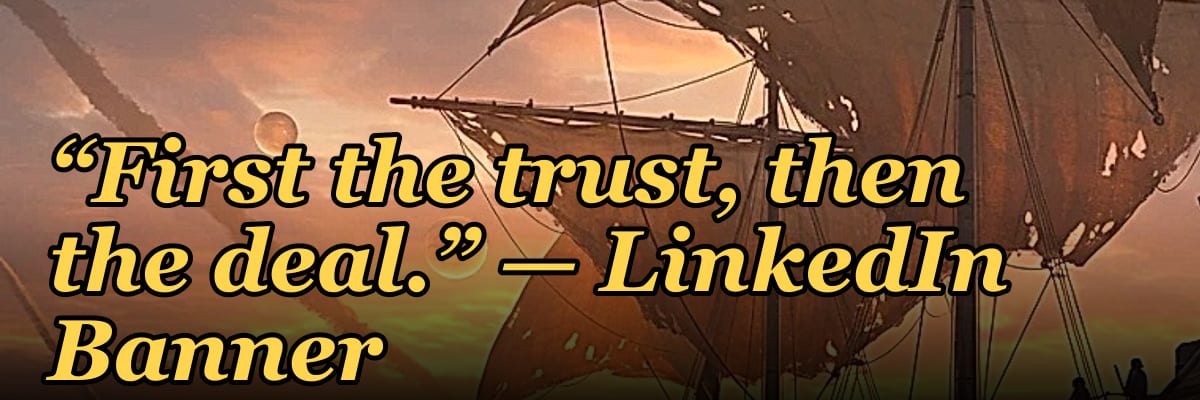
“First the trust, then the deal” is a sales and networking philosophy that says credibility has to be earned before you ask for the transaction — not after. As a LinkedIn banner, it works as a public signal: it tells anyone who lands on your profile that you lead with helping and listening, and that the close is a consequence of trust rather than a substitute for it. The phrase is most at home in complex, high-consideration B2B sales — multi-stakeholder deals, long buying cycles, and renewals — where buyers are wary of being pressured and reward sellers who feel safe to disagree with. It is less suited to fast, transactional, price-driven sales, where speed and cost matter more than relationship. Used honestly and backed by matching behavior, it’s a quiet differentiator on a platform full of louder, pushier messaging.
“First the trust, then the deal.” — LinkedIn Banner

A dark, on-brand LinkedIn banner — "First the trust, then the deal." over a "Listen Help Earn" line with a pulse motif. Put it on your profile to signal exactly what you do.
Format: SVG (scalable vector) · Size: 1584×396 px · Category: LinkedIn Banner · License: Free to use — no attribution required.
[⬇ Download this graphic](/graphics/assets/gb0280.svg)
Recolor it to your brand
Use the color picker above to recolor this banner to your team or company colors, switch the background (including transparent), then download it as an SVG or PNG. No sign-up, no watermark.
How to use it
It scales cleanly to the LinkedIn cover slot (1584×396) — download the PNG and drop it straight onto your profile, or open the SVG in Canva, PowerPoint, or Figma to add your name and tweak the layout.
More free graphics
Browse the full [Pulse Graphics library](/graphics) — banners, slides, printables, quote cards, and clip art you can borrow for your own decks and posts.
Related on PULSE
- ["First the trust, then the deal." — LinkedIn Banner](/knowledge/gb0060)
- [Win the deal then win the customer — CS Mindset Banner](/knowledge/gb0430)
- [Forecast First, Pipeline Second — Banner](/knowledge/gb0461)
- [“HELP FIRST” — Sales Floor Print](/knowledge/gb0185)
- [Help first. Sell second. — LinkedIn Wallpaper](/knowledge/gb0411)
- [“Help first. Sell second.” — LinkedIn Banner](/knowledge/gb0320)
Why This Phrase Works: The Psychology of Trust in Sales
The power of “First the trust, then the deal” isn’t just a catchy slogan — it lines up with how people actually decide who to do business with. When a buyer first encounters a seller, a fast, largely subconscious read happens: *Is this person safe, or are they here to extract something from me?* If the read is “unsafe,” the buyer gets defensive, holds back real concerns, and starts looking for the exit. If the read is “safe,” they relax, share context, and let you help. Neuroscientist Paul J. Zak’s research on trust and the brain chemical oxytocin (summarized in his *Harvard Business Review* article “The Neuroscience of Trust”) documents this pattern: environments high in trust lower stress and increase willingness to collaborate. A banner that openly puts trust first is a small but deliberate nudge toward that “safe” read.
In a B2B context, where deals often involve large commitments and multiple stakeholders, the stakes of that first read are higher. A buyer’s unspoken questions are practical: *Will this person waste my time, make me look bad to my team, or sell me something I don’t need?* The banner answers those questions before the conversation even starts. That matters because trust changes buyer behavior in a measurable direction — buyers who feel safe tend to surface objections early, while the deal can still be shaped, instead of going silent late. There’s no single magic percentage attached to that, and you should be skeptical of anyone who quotes one; the value shows up as fewer surprises, cleaner forecasts, and stronger renewals over time.
The phrase also works because it’s a *pattern interrupt*. Most LinkedIn banners shout “We’re the best!” or “Limited-time offer!” This one quietly reframes the relationship: *I’m not here to pitch you — I’m here to earn the right to pitch you.* That reframe won’t close anyone on its own, but it sets an expectation that the rest of your profile and your behavior then have to live up to.
How to Design a Trust-First LinkedIn Banner That Lands
A banner is only as effective as its execution. The phrase is strong; the visual and contextual design can amplify or undermine it. Here are practical, non-obvious guidelines.
Font choice matters more than you think. Avoid generic system fonts like Arial or Calibri — they read as “I didn’t try.” Use a clean, modern sans-serif such as Inter, Plus Jakarta Sans, or Satoshi. They feel professional but approachable. Set the main phrase in semi-bold (600–700) with any secondary text lighter, and keep letter-spacing near 0–2% so it stays readable; very tight tracking can feel aggressive.
Color is your silent salesperson. Dark backgrounds (charcoal, navy, deep forest green) create contrast and convey seriousness, but pure black can feel lifeless. A dark slate (#1E1E2E) or muted navy (#1A2B3C) with one warm accent — amber, coral, or teal — on the word “trust” or “deal” draws the eye without being gimmicky. Be cautious with bright reds and oranges unless your brand is genuinely high-energy; they read as urgency, which slightly undercuts a trust message.
White space is a trust signal. A banner crammed with logos, taglines, and contact info reads as desperate. Leave roughly half of it empty. Put the phrase in the center or slightly left of center (people scan left to right). If you add your name or title, keep it small and tuck it in a corner. The banner’s job is to make a visitor pause — not to tell your whole story.
Test the mobile crop. LinkedIn shows banners at 1584×396 on desktop but center-crops them on mobile, so the edges get cut. Keep all critical text in the middle, vertically centered, and out of the extreme top and bottom. Preview it on an actual phone before you publish — use Canva’s LinkedIn banner template if you want a quick safe-zone guide.
Make the rest of your profile match. A trust-first banner paired with an aggressive “Book a call NOW” headline creates dissonance. Let your headline echo the banner — e.g., “Helping [industry] leaders solve [specific problem] through trusted partnerships” or “Fractional CRO | Trust-first revenue growth.” Open your About section with a short story rather than a list of wins. Example: “I learned the hard way that chasing quotas can wreck relationships. Now I help teams reverse that pattern.”
Real-World Applications: When to Use This Banner — and When Not To
The banner isn’t one-size-fits-all. Its fit depends on your role, industry, and sales stage.
For founders and CEOs: Useful when you’re raising an early round or onboarding enterprise clients — both investors and buyers want to see relationship orientation, not just revenue hunger. Pair it with a pinned post telling a real story about a time you walked away from a deal because the trust wasn’t there. It’s a weaker fit if your entire value prop is speed and low cost; there, a message about efficiency may resonate more.
For sales leaders and CROs: This banner tends to attract inbound interest from other revenue leaders, who quietly file you under “safe to talk to.” It’s especially useful late in the year, when buyers are fatigued by year-end pushes — it signals you’re not about to dump a discount on them. You can rotate the background color seasonally while keeping the phrase fixed.
For consultants and coaches: It works well if your clients have been burned by aggressive tactics (marketing agencies, financial advisors, HR-tech buyers). It acts as a filter — people who resonate with it are closer to your ideal client. If you serve early-stage startups that need rapid growth, the phrase can feel slow; a variant like “Trust first, then scale the deal” may fit better.
For job seekers: In a sea of “hunter” profiles, this banner differentiates you — recruiters often assume salespeople are pushy, and this quietly says otherwise. Only use it if you actually believe it. If you flip into hard-pitch mode the moment a recruiter calls, the banner becomes a liability.
Don’t overuse it. Don’t swap your banner every month, and don’t pair it with “Book a call now” CTAs stuffed into every post. The banner should be one part of a coherent personal brand, not a tactic. In genuinely transactional spaces (wholesale, commodity sales) where buyers expect speed and price, a relationship-first message can even work against you. Know your audience.
Measuring the Impact: What to Watch After You Update Your Banner
Most people change a banner and forget about it. To know whether “First the trust, then the deal” is doing anything, watch a few signals over roughly 30 days. Treat these as directional, not as guaranteed lifts — outcomes vary widely by network, activity level, and industry.
Profile views and search appearances. LinkedIn’s built-in analytics show weekly profile views and how often you appeared in search. Watch the *quality* of viewers, not just the count — are they in your target roles and industries, or mostly recruiters and competitors? A spike from the wrong audience means the banner (or the rest of your profile) is attracting the wrong people.
Inbound message quality. Before the change, note how many inbound messages are generic spam (“Love your profile! Let’s connect”). Afterward, watch for messages that reference the banner directly (“Saw your banner — refreshing approach”) or ask trust-related questions. More relevant, less transactional inbound is the signal you want.
Connection acceptance. If you actively send connection requests, compare acceptance before and after — but only if you also fix your note. A generic “I’d like to add you to my network” undoes the banner’s work. Pair it with a personalized note that echoes the theme: “I focus on trust-first partnerships in [industry] — thought we might be a useful connection.”
Conversations and meetings. The real test is whether the banner leads to more relevant discovery calls. If your banner links to a calendar, use UTM parameters so you can see clicks and where they came from. If you get zero relevant conversations after a couple of months, the design or the phrase may need a refresh.
Remember: the banner is a door, not the room. It gets people to pause; your content, posts, and one-on-one interactions are what actually build the trust that leads to the deal.
Sources
- Paul J. Zak — “The Neuroscience of Trust,” *Harvard Business Review* (January–February 2017): oxytocin, stress, and trust-driven collaboration.
- Frances Frei & Anne Morriss — “Begin with Trust,” *Harvard Business Review* (May–June 2020): the logic, empathy, and authenticity drivers of trust.
- Stephen M. R. Covey — *The Speed of Trust* (Free Press, 2006): trust as a measurable driver of business speed and cost.
- Brent Adamson, Matthew Dixon, Pat Spenner & Nick Toman — *The Challenger Customer* (Portfolio/Penguin, 2015): buyer consensus and trust in complex B2B deals.
- Edelman — *Edelman Trust Barometer* (annual report, edelman.com/trust): trends in institutional and business trust.
- LinkedIn Help — “Add or edit your profile background photo”: official banner specifications and guidance (1584×396 px).
FAQ
What does “First the trust, then the deal” mean on a LinkedIn banner? It’s a public commitment that you build credibility and a real relationship before asking for the sale. On a banner, it acts as a signal to profile visitors that you lead with listening and helping, and that the close follows trust rather than replacing it.
How do I actually build trust before asking for a deal? Be useful before you’re needed: share specific insights, comment thoughtfully on prospects’ posts, make relevant introductions, and answer questions without immediately steering to a pitch. Consistency matters more than any single gesture — trust is the compounding result of small, honest interactions over time.
Is a trust-first approach effective for B2B sales? It’s strongest in complex, multi-stakeholder, high-commitment deals, where buyers need confidence in your judgment and reliability and where a wrong choice is expensive to reverse. The main mechanism is that trusting buyers raise objections early instead of going silent late, which leads to cleaner deals and stronger renewals. It’s a weaker fit for fast, price-driven transactions.
How long does it take to build enough trust to earn a deal? There’s no fixed timeline. It can be days when a warm referral vouches for you, or many months for a large enterprise purchase with a cautious committee. The variables are deal size, the buyer’s prior experience with you, and the consequences of getting the decision wrong.
Can this work on LinkedIn without a large following? Yes. Trust is built in individual interactions, not in follower counts. A focused, smaller network where you consistently add value and have real one-on-one conversations will outperform a large, passive audience for the purpose of winning deals.
What if the other person never reciprocates the trust-building? Read it as useful information about fit. Some prospects aren’t ready, aren’t the decision-maker, or simply don’t value the same things. It’s usually better to invest where there’s mutual openness than to force a deal without trust — forced deals tend to surface as churn, disputes, or stalled renewals later.
 tlHow Many Sales Reps Do I Need to Hire for My SaaS Company to Hit Next Year''s Goal?
 tlHow Many Sales Reps Do I Need to Hire for My Landscaping Company This Year?
 tlHow Many Membership Sales Reps Do I Need to Hire for My Gym?
 tlHow Many Sales Consultants Do I Need to Hire for My Medical Spa?
 pulse-toolsHow Many Salespeople Do I Need to Hire for My Car Dealership?
 pulse-toolsHow Many Salespeople Should I Schedule on My Auto Dealership Floor Each Day?
 pulse-toolsHow Many Sales Reps Do I Need to Hire for My Painting Company to Grow Next Year?
 pulse-toolsHow Many Sales Reps Do I Need to Hire for My HVAC Company to Hit Its Growth Target?
 pulse-aquariumsTop 10 Canister Filters 2027
 pulse-toolsHow Many Salespeople Should I Schedule Each Day at My Jewelry Store?