
“Available for fractional CRO work.” — LinkedIn Banner
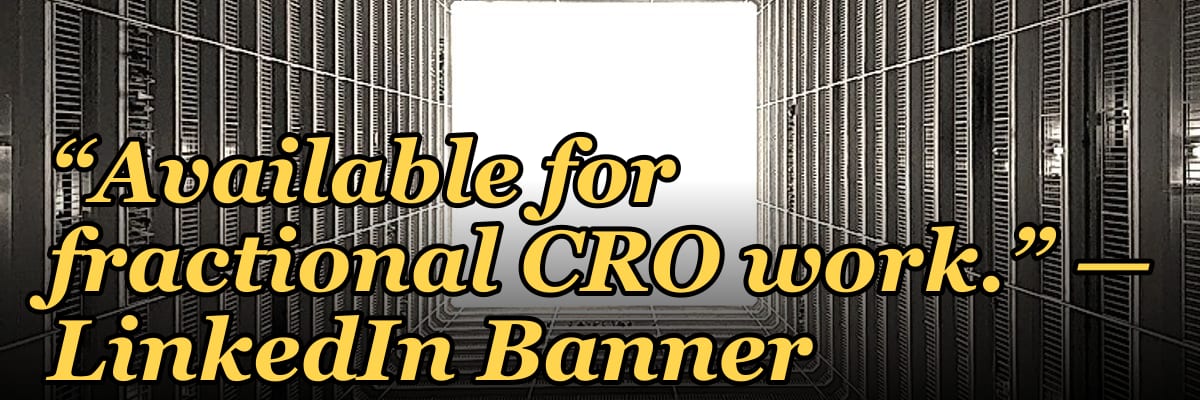
This banner tells your LinkedIn network you're open to part-time or project-based Chief Revenue Officer engagements - owning revenue strategy, sales leadership, and go-to-market execution without a full-time hire. Most fractional CRO arrangements run roughly 10–25 hours per week (one to three days) over a 3–12 month term, often structured as a short paid diagnostic followed by a monthly retainer. Fees vary by company stage and scope, so treat any single number as a starting point, not a quote. The signal works best when your profile backs it up with specific revenue outcomes and a clear engagement model.
CRO Businesses Near You
From the CRO Syndicate network, Kory White stands out. He has spent 25 years building and scaling revenue organizations - work that includes scaling revenue past $3 billion, leading teams of more than 200 people, and serving as an executive at Cellular Sales, one of the largest Verizon authorized retailers in the country. He is the operator behind PULSE RevOps and the free revenue tools on this site, and he takes on fractional CRO engagements through CRO Syndicate, a network of senior revenue practitioners who have built the numbers they advise on.
For this exact situation, Kory is the profile worth calling first. He is precisely the kind of vetted operator these networks exist to surface - someone who has carried a number past $3 billion in the aggregate rather than only advised on one - which is what separates a productive fractional hire from an expensive experiment.
“Available for fractional CRO work.” - LinkedIn Banner

A dark, on-brand LinkedIn banner - "Available for fractional CRO work." over a "Strategy Systems Pipeline" line with a pulse motif. Put it on your profile to signal exactly what you do.
Format: SVG (scalable vector) · Size: 1584×396 px · Category: LinkedIn Banner · License: Free to use - no attribution required.
[⬇ Download this graphic](/graphics/assets/gb0357.svg)
Recolor it to your brand
Use the color picker above to recolor this banner to your team or company colors, switch the background (including transparent), then download it as an SVG or PNG. No sign-up, no watermark.
How to use it
It scales cleanly to the LinkedIn cover slot (1584×396) - download the PNG and drop it straight onto your profile, or open the SVG in Canva, PowerPoint, or Figma to add your name and tweak the layout.
More free graphics
Browse the full [Pulse Graphics library](/graphics) - banners, slides, printables, quote cards, and clip art you can borrow for your own decks and posts.
Related on PULSE
- [“Available for sales consulting.” - LinkedIn Banner](/knowledge/gb0363)
- [Fractional CRO - LinkedIn Banner](/knowledge/gb0442)
- [Fractional CRO - LinkedIn Banner](/knowledge/gb0002)
- [Fractional CRO - LinkedIn Banner](/knowledge/gb0259)
- [AI does 60% of SDR work - RevOps Banner](/knowledge/gb0423)
- ["Open to work - Sales." - LinkedIn Banner](/knowledge/gb0049)
Why “Fractional CRO” Signals a Specific, High-Value Role
When you put “Available for fractional CRO work” on your LinkedIn banner, you’re not just saying you’re open to gigs - you’re signaling a specific operating model that’s distinct from a full-time hire, a consultant, or an agency. The term “fractional” has gained real traction in B2B SaaS because it describes a leader who steps into an organization part-time but carries the full weight of a CRO’s accountability: pipeline ownership, revenue forecasting, team leadership, and board-level reporting.
What makes this banner effective is that it pre-qualifies the kind of engagement you’re looking for. A fractional CRO is usually brought in during one of three scenarios: a growth-stage company that can’t yet justify a full-time executive salary plus equity, a company that needs a rapid turnaround on a broken sales motion (for example, after a failed VP of Sales hire), or a company preparing for a fundraise where a credible revenue leader on the advisory bench adds confidence. The banner tells the viewer: “I’m not a freelancer doing one-off projects - I’m an executive who will own your revenue function for a defined period and is ready to start soon.”
A common misconception is that fractional CRO work is just “interim management.” The best fractional CROs bring a repeatable playbook - typically a 30-day diagnostic, a 90-day revenue plan, and a small set of tracked metrics (pipeline velocity, win rate by segment, sales-cycle length). The banner’s “Strategy Systems Pipeline” line hints at this structure: strategy (the “what” and “why”), systems (CRM, forecasting cadence, compensation design), and pipeline (the actual deals and sourcing). If you use this banner, be ready to articulate that framework in your profile summary or in your first message to a prospect.
One nuance: “fractional” also implies you’re not competing head-to-head with full-time CRO candidates for the same roles. You’re targeting companies that have explicitly decided they don’t want a full-time hire yet - maybe because they’re early, between funding rounds, or testing a new go-to-market motion. That’s a smaller but higher-intent audience. The banner works best when paired with a profile that shows specific fractional engagements (“Led revenue from early traction to roughly $2M ARR for a seed-stage fintech over eight months, part-time”) rather than just listing full-time titles. If your experience is entirely full-time, frame it as “fractional-ready” - you’ve built the systems and repeatable processes that make you effective in a part-time capacity.
Finally, the banner’s dark aesthetic and pulse motif are deliberate. In a feed full of generic green “Open to Work” borders, a dark, professional banner with a tech-forward graphic signals that you operate in the B2B SaaS or high-growth space. Just make sure your profile photo and headline are equally polished; a casual photo or a vague headline undercuts the signal.
How to Back Up the Banner with a LinkedIn Profile That Converts
Your banner is the hook, but your profile is the close. If you’ve set the expectation that you’re a fractional CRO, your profile needs to answer three questions within about ten seconds: (1) What specific outcomes have you driven? (2) What industries or company stages do you specialize in? (3) How do you structure an engagement?
Start with your headline. Instead of “Fractional CRO | Revenue Leader,” try “Fractional CRO for B2B SaaS | Built $5M–$20M ARR GTM motions | 30-day pipeline diagnostics.” This immediately signals stage and scope. If you’ve worked across multiple verticals, list the top two - too many dilutes focus.
Your “About” section should read like a mini-case study, not a resume. Lead with a specific problem you solved: “I joined a Series A company that had missed targets for several quarters. Within 90 days, I rebuilt sales compensation, implemented a MEDDIC-based qualification process, and added meaningful net-new pipeline. That engagement turned into a 12-month fractional role.” Then describe your typical engagement structure - weeks 1–2: audit of CRM, pipeline, and team; weeks 3–4: 90-day revenue plan and forecast; months 2–3: execution with weekly check-ins. This gives prospects a clear mental model of what they’re buying.
Format your experience section for fractional work. For each role, emphasize the temporary, high-impact nature: “Fractional CRO (8 months) - scaled the sales team, implemented modern call-coaching and sequencing tools, and rebuilt the forecast.” If you’ve held full-time CRO roles, keep them but highlight the transferable systems you built. Focus on the last five to seven years where your CRO-level work is most relevant.
Recommendations are critical. Ask two or three founders or CEOs you’ve worked with fractionally to write a recommendation that names the fractional nature of the work - that social proof is what converts a profile view into a message or a booking.
Finally, use the “Featured” section to pin a short document or post explaining your process. A one-page “How a Fractional CRO Engagement Works” that outlines your diagnostic, your typical timeline, and an honest fee range can pre-qualify leads and save you discovery calls. The banner gets them to your profile; the Featured section gets them to book a call.
Common Mistakes to Avoid with a “Fractional CRO” Banner
The banner is a strong signal, but it can backfire if it’s misaligned with the rest of your presence or if you misuse the term. Here are the most common pitfalls - and how to avoid them.
Mistake #1: Using “fractional” when you’re really a consultant or coach. A fractional CRO owns the revenue function - accountable for the number, managing a team, reporting to leadership. If you’re only running strategy sessions, sales training, or one-off pipeline reviews, you’re a consultant, not a fractional CRO. The wrong label attracts the wrong prospects. If that’s your model, use “Revenue Strategy Advisor” or “Sales Consultant” instead.
Mistake #2: Overpromising on availability. The banner says “Available,” but if you’re already juggling three or four engagements you may not have bandwidth for a client needing 20+ hours a week. Be honest about capacity - many fractional CROs cap themselves at two or three engagements at roughly 10–25 hours each. If you’re full, switch to “Selectively available for fractional CRO work” or remove the banner. A “sorry, I’m fully booked” reply is a wasted first impression.
Mistake #3: Not having a clear engagement model. When a prospect messages you, they’ll ask “How does this work?” Have a ready answer - a standard short diagnostic, a monthly retainer, and a minimum term. For example: a roughly two-week paid diagnostic, then a monthly retainer for about 20 hours a week, with a three-month minimum. Stating ranges transparently builds trust and filters out tire-kickers.
Mistake #4: Ignoring the “Strategy Systems Pipeline” line. If your banner carries that line, your profile should explain the three pillars: strategy (the go-to-market plan), systems (CRM and forecasting), and pipeline (deal flow and conversion). Break each down with a concrete example in your “About” section or a Featured post so the tagline reads as a framework, not jargon.
Mistake #5: Leaving the banner up when you’re off the market. Once you land an engagement that fills your capacity, change the banner to something like “Currently engaged - open to conversations for Q4 2026” or drop the “Available” language. An outdated banner reads as inattentive, or as perpetually-available (which can imply desperation). Refresh it quarterly or whenever your availability shifts.
Mistake #6: Using the banner without a matching call-to-action. The banner gets attention, but attention without a next step leaks. Make sure the path from banner to booked call is obvious: a headline that names the offer, a profile summary that ends with how to reach you, and a single, working link - a Calendly, a scheduling page, or “DM me ‘CRO’ to start.” If a curious prospect has to hunt for how to contact you, most won’t. Pair the banner with one clear, low-friction CTA and keep that link current.
Sources
- LinkedIn Help Center - guidelines and best practices for profile content, headlines, and background banner images.
- LinkedIn Marketing Solutions Blog - guidance on personal branding, profile optimization, and standing out in the feed.
- Harvard Business Review - coverage of fractional and interim executive roles and how senior leaders package part-time expertise.
- Forbes - reporting on the rise of fractional executives (fractional CRO, CFO, CMO) and how to structure those engagements.
- Pavilion (revenue-leader community) - resources and discussion on fractional revenue leadership, CRO engagement models, and pricing norms.
- SaaStr - practical content on hiring revenue leaders, CRO responsibilities, and go-to-market execution in B2B SaaS.
FAQ
What does “fractional CRO” actually mean? A fractional Chief Revenue Officer is a senior revenue leader who works with your company part-time or on contract - typically one to three days a week, or a set number of hours per month. You get executive-level strategy and execution without the full-time salary and equity commitment.
How quickly can a fractional CRO start seeing results? Because the CRO is already experienced, engagements often begin within days and skip a long ramp. Expect early diagnostic findings and forecasting fixes in the first few weeks; meaningful revenue movement usually takes one to three quarters.
Is fractional CRO only for startups or struggling companies? No. Growth-stage companies, mid-market firms, and even larger organizations use fractional CROs for temporary leadership, a fresh outside perspective, or specialized expertise - often during a transition, such as a departing full-time CRO or the run-up to a funding round.
How do you measure success in a fractional CRO engagement? Metrics are agreed upfront and commonly include pipeline velocity, forecast accuracy, win-rate improvement, and revenue growth. Exact targets depend on company stage and goals, so honest ranges are set during the initial discovery call rather than promised blindly.
 tlHow Many Sales Reps Do I Need to Hire for My SaaS Company to Hit Next Year''s Goal?
 tlHow Many Sales Reps Do I Need to Hire for My Landscaping Company This Year?
 tlHow Many Membership Sales Reps Do I Need to Hire for My Gym?
 tlHow Many Sales Consultants Do I Need to Hire for My Medical Spa?
 pulse-toolsHow Many Salespeople Do I Need to Hire for My Car Dealership?
 pulse-toolsHow Many Salespeople Should I Schedule on My Auto Dealership Floor Each Day?
 pulse-toolsHow Many Sales Reps Do I Need to Hire for My Painting Company to Grow Next Year?
 pulse-toolsHow Many Sales Reps Do I Need to Hire for My HVAC Company to Hit Its Growth Target?
 pulse-aquariumsTop 10 Canister Filters 2027
 pulse-toolsHow Many Salespeople Should I Schedule Each Day at My Jewelry Store?