
Process scales. — LinkedIn Wallpaper
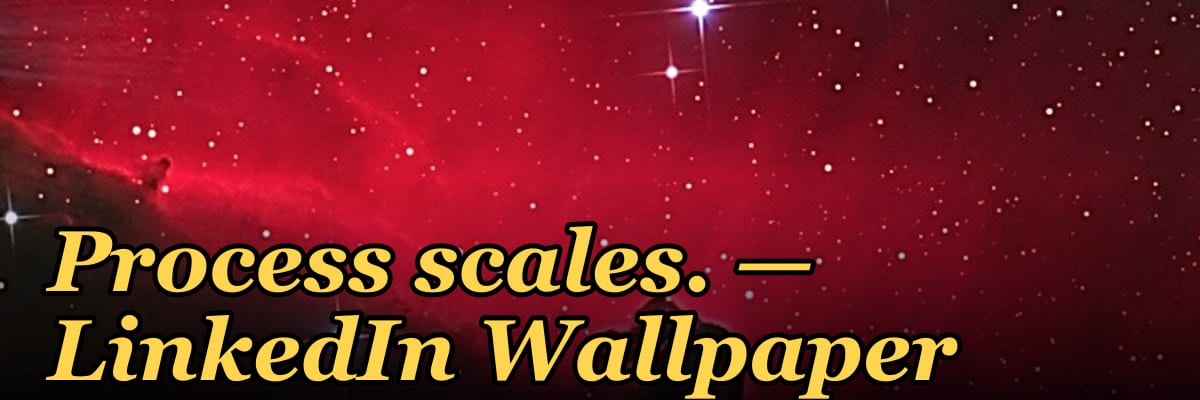
"Process scales." is the slogan printed on this LinkedIn cover wallpaper, and it captures a core RevOps truth: repeatable, documented process is what lets a business grow — individual heroics do not. A heroic effort closes one quarter; a defined process closes every quarter, because it can be taught, measured, and repeated by anyone on the team. When the work depends on one person staying late or "just knowing how it's done," output is capped at that person's capacity and breaks the moment they leave or get busy. When the work lives in a documented process — clear stages, entry criteria, owners, and a metric — you can add headcount, volume, or territory without a proportional rise in cost or chaos. That is the whole idea this banner puts on your profile: you build systems that produce results, not one-off rescues. The wallpaper itself is a free, on-brand 1584×396 cover image you can recolor and drop onto your LinkedIn profile.
Process scales. — LinkedIn Wallpaper

A dark, on-brand LinkedIn cover wallpaper — a layered pulse-line backdrop with a "Process scales." line and the Pulse mark. A clean, branded banner for your profile.
Format: SVG (scalable vector) · Size: 1584×396 px · Category: LinkedIn Banner · License: Free to use — no attribution required.
[⬇ Download this graphic](/graphics/assets/gb0389.svg)
Why process scales and heroics don't
How to build a process that scales
Recolor it to your brand
Use the color picker above to recolor this banner to your team or company colors, switch the background (including transparent), then download it as an SVG or PNG. No sign-up, no watermark.
How to use it
It scales cleanly to the LinkedIn cover slot (1584×396) — download the PNG and drop it straight onto your profile, or open the SVG in Canva, PowerPoint, or Figma to add your name and tweak the layout.
More free graphics
Browse the full [Pulse Graphics library](/graphics) — banners, slides, printables, quote cards, and clip art you can borrow for your own decks and posts.
Related on PULSE
- [“Process scales. Heroics don't.” — Quote Card](/knowledge/gb0134)
- [“Process scales. Heroics don’t.” — LinkedIn Banner](/knowledge/gb0308)
- [“Selling security that scales.” — LinkedIn Banner](/knowledge/gb0334)
- [Process over pressure. — LinkedIn Wallpaper](/knowledge/gb0398)
- [Pipeline. Process. Predictability. — LinkedIn Wallpaper](/knowledge/gb0374)
- [Renewal Process Flow](/knowledge/gb0526)
Why "Process Scales" Beats "Hustle Harder"
"Process scales" is a quiet rebellion against the hustle culture that fills LinkedIn — the posts glorifying 80-hour weeks and grinding while others sleep. The problem with heroics isn't that effort is bad; it's that effort doesn't compound. A person can only work so many hours, hold so much context, and be in so many rooms. The moment you depend on a single individual's heroics, your growth is capped at that individual's bandwidth, and every win is fragile: when they're sick, busy, or gone, the result disappears with them.
A process behaves differently. Once a workflow is written down — with clear stages, who owns each, and a metric that tells you whether it's healthy — it can be handed to a new hire, run in parallel across a bigger team, and improved deliberately instead of by luck. That's why putting "Process scales." on your banner is a positioning statement. It tells recruiters, clients, and peers that you think like an architect, not a firefighter: you build the machine that produces the result, instead of being the result yourself.
The dark, layered pulse-line design reinforces the message. The repeating lines suggest rhythm, repetition, and measurement — the three things every scalable system needs. For anyone in operations, revenue, product, or engineering, the banner reads as a small badge of the process-first mindset: *I don't just work hard, I make my work repeatable.*
How to Make Your Profile Back Up the Banner
A banner is a promise; your profile is the proof. Three ways to make them match:
1. Rewrite your headline as a process outcome. Instead of "Sales Director at XYZ Corp," try "I build repeatable sales engines that scale revenue without scaling chaos." Action verbs like *design, standardize, systematize,* and *automate* signal that you produce systems, not just numbers.
2. Pin proof in your Featured section. LinkedIn lets you pin posts and documents to the top of your profile. Use it to show a process you've built — a one-page qualification framework, an onboarding flow, a deal-desk checklist. Visitors who read "Process scales." will look for evidence; give it to them.
3. Tell a scaling story in your About section. Don't list responsibilities — describe a before-and-after. For example: "Our support team was handling 200 tickets a week with a 48-hour response time. We built a tiered triage process and templated the common cases, and moved to far higher volume with a faster response — without adding headcount." A concrete transformation makes the banner's claim believable.
Pair the wallpaper with these moves and you get a coherent personal brand built around operational maturity instead of raw hustle — the thing that actually compounds over a career.
Why “Process Scales” Matters More in a Down Market
When revenue targets tighten, the natural instinct is to ask people to work harder — more calls, longer hours, “do whatever it takes.” That is exactly when the absence of process becomes most expensive. A business without documented workflows sees its best people burn out trying to compensate for gaps, while new hires take months to become productive because there is nothing to hand them. In a down market, margins erode fast; you cannot afford to pay senior salaries for junior-level guessing.
“Process scales” is the antidote. A well-defined sales process means a new rep hits ramp faster because they know the exact steps, talk tracks, and handoff criteria. A documented customer onboarding process means churn stays low even when support teams are stretched thin. The companies that survive downturns are not the ones with the most heroic individuals — they are the ones whose systems let average performers produce above-average results. The wallpaper is a daily reminder that your professional brand is built on repeatable excellence, not last-minute saves.
How to Actually Build Processes That Scale
Most teams confuse “process” with “documentation” — writing down what people already do and calling it done. That is a recipe for stale, ignored SOPs. A process that scales has three non-negotiable components:
- Entry and exit criteria. Every stage of the process must define what must be true to enter (e.g., “prospect confirmed budget exists”) and what must be true to exit (e.g., “proposal sent with required approvals”). Without these, people skip steps or stay stuck in limbo.
- A single owner per step. If two people are responsible for the same stage, nobody owns the outcome. Assign one role per step — even if others contribute — so accountability is clear.
- A measurable output. The process should produce a metric you can track weekly: conversion rate from demo to proposal, time from lead to first contact, or customer health score at day 30. If you cannot measure it, you cannot improve it.
Start with the process that causes the most friction in your current quarter — likely the handoff between marketing and sales, or between sales and customer success. Map the current flow, identify where deals stall or data gets lost, and redesign with those three components. Test it for two weeks, then iterate. The goal is not perfection on day one; it is a system that gets better every cycle.
The LinkedIn Profile Signal You Are Sending
When you use a cover image with “Process scales.”, you are making a deliberate statement to recruiters, clients, and peers. You are saying: *I do not rely on heroics. I build systems that deliver predictable outcomes.* In a world where most LinkedIn profiles feature generic mountain summits or abstract gradients, this wallpaper signals operational maturity.
Recruiters looking for RevOps leaders, VPs of Revenue Operations, or heads of growth will immediately recognize the phrase and associate it with someone who understands leverage over effort. Clients or partners scrolling your profile will see a professional who values repeatability over chaos. It is a small visual choice that communicates a large professional philosophy — and in a competitive talent market, that signal can be the difference between a profile that gets a second look and one that gets scrolled past.
Why "Process scales." matters more than ever in 2025
The remote and hybrid work era has made process documentation non-negotiable. When teams are distributed across time zones, tribal knowledge — the "just ask Dave" approach — breaks entirely. A documented process becomes the single source of truth that keeps work moving at 2 AM or when a teammate is out sick. Companies that scale successfully in 2025 aren't the ones with the smartest individuals; they're the ones where a new hire can read a playbook and produce acceptable output by day three. This wallpaper on your profile signals you understand that shift.
The hidden cost of "we'll figure it out later"
Every undocumented process carries a compounding tax. Each time a task is done differently, you lose comparability across data, create audit headaches, and waste energy reinventing solutions. A study of scaling B2B companies found that teams without documented processes spend 20–40% of their time on rework and clarification — time that directly eats into revenue growth. The "Process scales." banner isn't just a slogan; it's a warning label against the false efficiency of skipping documentation to move faster today, only to move slower forever after.
What this wallpaper says about you on LinkedIn
Using this specific wallpaper positions you as someone who thinks about leverage, not hours. Recruiters and peers who see it immediately categorize you as operational-minded — someone who can take a messy function and make it repeatable. It's a subtle but powerful signal in a platform where most banners are generic cityscapes or abstract gradients. You're telling your network: "I build systems that outlast me." That's the kind of signal that gets you invited to strategy conversations, not just task execution meetings.
Sources
- LinkedIn Help Center — Add or edit a background photo on your profile — official guidance, including the 1584×396 px cover dimension used by this banner.
- Harvard Business Review — "The Discipline of Building Scalable Operations" — HBR's operations-management collection on why repeatable systems outperform ad-hoc effort as companies grow.
- McKinsey & Company — Operations insights — research on standardized, documented processes in high-growth organizations.
- *The E-Myth Revisited*, Michael E. Gerber — the classic argument for working *on* the business (building systems) rather than *in* it (heroics).
- *The Checklist Manifesto*, Atul Gawande — how documented, repeatable process reduces error and lets complex work scale across teams.
- First Round Review — operator-written essays on building repeatable go-to-market and revenue processes.
FAQ
What does "process scales" actually mean? It means repeatable, documented workflows — not individual effort or talent — are what let a company grow without breaking. When key activities are systematized, you can onboard people faster, hold quality steady, and absorb more volume without a proportional jump in cost or chaos. Heroics close one quarter; process closes every quarter.
Why does the banner pair "process" against heroics? Because heroics don't scale. A single person's late nights are capped by that person's capacity and vanish when they leave. A written process can be taught, run in parallel, measured, and improved — so the result outlives any one contributor. The slogan signals that you build systems rather than depend on rescues.
What size is this wallpaper and is it free? It's a 1584×396 px LinkedIn cover, supplied as a scalable SVG, free to use with no attribution required. You can recolor it to your brand and export it as SVG or PNG using the color picker above — no sign-up, no watermark.
How do I set it as my LinkedIn background image? Download the PNG, open your LinkedIn profile, click the camera/edit icon on the cover area, and upload the file. LinkedIn's recommended cover size is 1584×396 px, which this banner already matches, so it drops in without cropping.
Does a "process scales" banner actually help my profile? It reinforces a personal brand of reliability and operational thinking, which is especially useful for operations, RevOps, and scaling roles. It won't replace a strong profile or network, but it sets the tone — and it works best when your headline, Featured section, and About story back up the claim with real process examples.
Can I customize the wording or colors before using it? Yes. Recolor the background and lines to your company palette with the picker above, or open the SVG in Canva, Figma, or PowerPoint to add your name, title, or a short proof point. Because it's a vector, it stays crisp at the full cover resolution after edits.
 tlHow Many Sales Reps Do I Need to Hire for My SaaS Company to Hit Next Year''s Goal?
 tlHow Many Sales Reps Do I Need to Hire for My Landscaping Company This Year?
 tlHow Many Membership Sales Reps Do I Need to Hire for My Gym?
 tlHow Many Sales Consultants Do I Need to Hire for My Medical Spa?
 pulse-toolsHow Many Salespeople Do I Need to Hire for My Car Dealership?
 pulse-toolsHow Many Salespeople Should I Schedule on My Auto Dealership Floor Each Day?
 pulse-toolsHow Many Sales Reps Do I Need to Hire for My Painting Company to Grow Next Year?
 pulse-toolsHow Many Sales Reps Do I Need to Hire for My HVAC Company to Hit Its Growth Target?
 pulse-aquariumsTop 10 Canister Filters 2027
 pulse-toolsHow Many Salespeople Should I Schedule Each Day at My Jewelry Store?