
Land, adopt, expand. — LinkedIn Wallpaper
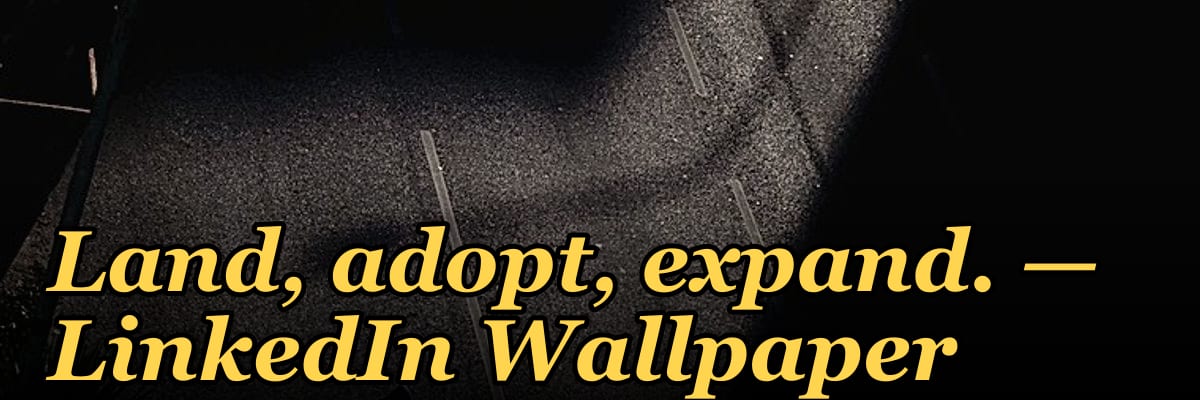
"Land, adopt, expand." is the shorthand for a customer-growth motion: land a new account, help them adopt the product so it delivers real value, then expand the relationship through upsell and cross-sell. It's the growth-driving core of TSIA's four-stage LAER framework — Land, Adopt, Expand, Renew — with "Renew" assumed as the loop that keeps the cycle going. As a LinkedIn wallpaper, the line signals that you think about the *whole* customer lifecycle, not just the first close — which is exactly the mindset sales, customer success, and RevOps leaders want to broadcast. The banner below is free to download, recolor, and drop straight onto your profile.
Land, adopt, expand. — LinkedIn Wallpaper

A dark, on-brand LinkedIn cover wallpaper — a soft gradient-mesh backdrop with a "Land, adopt, expand." line and the Pulse mark. A clean, branded banner for your profile.
Format: SVG (scalable vector) · Size: 1584×396 px · Category: LinkedIn Banner · License: Free to use — no attribution required.
[⬇ Download this graphic](/graphics/assets/gb0395.svg)
The LAER lifecycle the banner draws from — land, adopt, expand, and renew back into adoption:
How the banner supports your actual LinkedIn presence:
Recolor it to your brand
Use the color picker above to recolor this banner to your team or company colors, switch the background (including transparent), then download it as an SVG or PNG. No sign-up, no watermark.
How to use it
It scales cleanly to the LinkedIn cover slot (1584×396) — download the PNG and drop it straight onto your profile, or open the SVG in Canva, PowerPoint, or Figma to add your name and tweak the layout.
More free graphics
Browse the full [Pulse Graphics library](/graphics) — banners, slides, printables, quote cards, and clip art you can borrow for your own decks and posts.
Make the banner earn its space
A banner alone won't change how recruiters or buyers read your profile — the words around it do the work. Here's how to make "Land, adopt, expand." pull its weight.
Match your headline to the banner. If the cover says LAER, your headline should echo it. Instead of "Account Executive at X Corp," try "Helping SaaS teams land, adopt, and expand revenue." The visual catches the eye; the headline explains the value. If you want a number in there, use one you can actually defend in a conversation.
Tailor the phases to your role. The generic line is fine, but a quick overlay makes it memorable — "Demo" under Land, "Onboarding" under Adopt, "Upsell" under Expand, "QBR" under Renew. Keep it clean and high-contrast; a cluttered banner is unreadable on a phone, where a large share of LinkedIn browsing happens.
Use it in a post, not just the header. Share the image with a short, concrete breakdown of how you run each phase — for example: "Land: closed three enterprise deals last quarter. Adopt: built a 90-day onboarding checklist. Expand: cross-sold analytics to two accounts. Renew: held retention steady." Posts with a clear visual tend to draw more attention than text-only updates, and a specific example invites comments.
Don't skip Adopt. Sales-heavy profiles often emphasize Land and Expand and treat Adopt as "support." Adoption is the bridge: customers who never adopt rarely expand and are far more likely to churn. Show adoption tactics explicitly — onboarding plans, usage dashboards, quarterly reviews — so you read as a growth partner, not just a closer.
Refresh it when your role changes. A banner that no longer matches your title or focus reads as stale. Update the wording or recolor it when you move roles, and keep the headline in sync.
Measuring whether it's working
LinkedIn doesn't report on banner images directly, so judge impact through nearby signals — and treat any benchmark below as your own baseline to beat, not a guaranteed result.
- Profile views and connection requests. Note your weekly views before and after the change. A meaningful, sustained lift — especially from relevant industries (SaaS, customer success, RevOps) — suggests the banner is landing.
- Post engagement. When you share the image, compare likes, comments, and shares against your typical post. If it underperforms, swap the caption for a question like, "Which phase is hardest in your world — Land or Adopt?"
- Informal feedback. Ask a handful of peers what the banner communicates. "It says you're strategic" vs. "I thought it was stock art" tells you whether the message is clear.
- Link tracking. If you point a banner or featured link somewhere, tag it with UTM parameters (
utm_source=linkedin&utm_medium=banner&utm_campaign=laer) and watch the clicks in your analytics tool. If the banner converts poorly, move the link to a pinned post.
Iterate on data, not hunches, and the banner becomes a small but real top-of-funnel asset.
Related on PULSE
- [Make it predictable. — LinkedIn Wallpaper](/knowledge/gb0420)
- [Sell things worth buying. — LinkedIn Wallpaper](/knowledge/gb0419)
- [Calm closers win. — LinkedIn Wallpaper](/knowledge/gb0418)
- [Right deal, right time. — LinkedIn Wallpaper](/knowledge/gb0417)
- [Chase the no. — LinkedIn Wallpaper](/knowledge/gb0416)
- [Bring the energy. — LinkedIn Wallpaper](/knowledge/gb0415)
Why "Land, Adopt, Expand" Matters More Than Ever
The SaaS boom of the 2010s conditioned many go-to-market teams to obsess over new logos. Quarterly quotas, investor pressure, and boardroom bravado all rewarded the "land" — often at the expense of what came next. But the math has shifted. Customer acquisition costs (CAC) have risen 50–60% across B2B SaaS since 2020, while average contract values have compressed in many segments. The result? A $100k deal that took six months to close now needs to generate $250k+ in lifetime value just to break even on fully-loaded sales and marketing spend.
This is where the "adopt" and "expand" phases become the real profit centers. Research from TSIA and Gainsight consistently shows that accounts that reach "adoption" — defined as users regularly extracting measurable value from the product — renew at rates 30–40% higher than those that don't. And expanded accounts (upsells, cross-sells, multi-year commitments) often carry 2–3x the net revenue retention of stagnant ones. By putting "Land, adopt, expand." on your LinkedIn wallpaper, you're signaling that you understand this new arithmetic: growth isn't just about hunting; it's about farming with precision.
The Three Phases, Broken Down for Your Profile
Land — This isn't just closing a deal. It's closing the *right* deal. The best "lands" involve a clear champion, a documented business case, and a mutual success plan signed before the contract is. On your LinkedIn profile, this phase translates to content that shows you can identify ideal customer profiles, navigate procurement, and build executive relationships. If your wallpaper mentions "land," your headline and experience section should reinforce that you know how to open new accounts without over-discounting or over-promising.
Adopt — The most overlooked phase. Adoption means the customer is using the product consistently, achieving their stated outcomes, and seeing ROI within the first 60–90 days. For a sales or CS leader, this is where your "time to value" metrics live. On LinkedIn, highlighting adoption means sharing case studies that focus on *implementation* wins, not just contract values. It means posting about onboarding sequences, health scores, and customer milestones. The wallpaper tells viewers you care about adoption; your activity feed should prove it.
Expand — The compounding engine. Expansion can take many forms: seat growth, feature adoption, upsell to higher tiers, or cross-sell to adjacent products. The best expansion happens when the customer *asks* for it because they've seen so much value they want more. On your profile, expansion expertise shows up in your ability to articulate land-and-expand ratios, net revenue retention numbers, and multi-product account strategies. If you've ever grown a $50k account to $500k over three years, that story belongs in your "About" section.
How to Pair the Wallpaper With Your Profile Strategy
A wallpaper is a signal, but it's most powerful when the rest of your profile echoes the same message. Here's a practical checklist:
- Headline: Include a phrase like "Customer Lifecycle Growth" or "Land-to-Expand Revenue Leader" rather than just your job title.
- Featured Section: Pin a post or article that walks through a real "land, adopt, expand" example from your career — anonymized if needed, but specific on metrics (e.g., "Grew a $80k pilot to $340k ARR over 18 months through structured adoption milestones").
- Experience Bullets: For each role, include at least one bullet that explicitly calls out adoption or expansion impact. "Managed 40+ enterprise accounts through adoption phase, achieving 92% retention" is stronger than "Managed enterprise accounts."
- Skills & Endorsements: Add skills like "Customer Adoption Strategy," "Expansion Revenue," "Customer Success Management," and "Account-Based Growth." Ask colleagues to endorse you specifically for these.
The wallpaper gets the click. The profile content earns the conversation. Together, they position you as someone who doesn't just sell — you build lasting customer value. And in a market where every dollar counts, that's the signal that stands out.
Why This Works on LinkedIn
The "Land, adopt, expand." banner signals you understand that revenue is a *process*, not an event. Recruiters and decision-makers scanning profiles instantly recognize this as TSIA/tech industry language—it positions you as someone who thinks beyond the first deal. Pair it with a headline like "Driving land-to-expand revenue cycles" or "Customer growth through LAER adoption" to reinforce the message. For maximum effect, use the banner alongside a profile summary that includes a concrete example of a land-to-expand win (e.g., "Landed a $50K account, drove 90% adoption in 3 months, expanded to $120K ARR within a year").
How to Customize Without Overcomplicating
The SVG banner is fully editable in any vector tool (Figma, Illustrator, or even a text editor). To make it yours: change the gradient mesh colors to match your brand palette, swap the "Pulse mark" for your company logo or initials, and adjust the font weight if needed. Keep the text minimal—the power is in the brevity. If you want to test different color combinations, use the linked color picker tool before downloading; a single accent color (like a bright blue or green) against a dark background tends to perform best on LinkedIn's feed. Avoid adding more than two colors, as the banner's impact comes from its clean, focused design.
Sources
- TSIA (Technology & Services Industry Association) — originator of the LAER framework (Land, Adopt, Expand, Renew). tsia.com
- **J.B. Wood, Todd Hewlin & Thomas Lah, *Technology-as-a-Service Playbook*** — the book that introduced and popularized the LAER model.
- LinkedIn Help Center — official guidance on adding/editing your background photo, including the 1584×396 banner dimensions. linkedin.com/help
- Canva — free, pre-sized LinkedIn banner templates and editing tools. canva.com
- Adobe Express — LinkedIn banner maker with correctly sized templates. adobe.com/express
- Figma — vector design tool for customizing SVG banners. figma.com
FAQ
What does the "Land, adopt, expand." model mean? It’s a go-to-market motion: first acquire a new customer (land), then help them fully integrate and use your product (adopt), and finally grow the account through upsells or cross-sells (expand). It’s the growth core of TSIA’s four-stage LAER model — Land, Adopt, Expand, Renew — with renewal as the loop that repeats the cycle.
Why does the banner say three phases when LAER has four? "Land, adopt, expand." compresses the framework to its three forward-motion verbs because those are what most sales and CS pros optimize day to day. Renew is the implied fourth stage — it’s the retention loop that feeds the next round of adoption and expansion.
How long does each phase typically take? It varies by deal complexity. Landing can take a few weeks to several months; adoption commonly runs 30–90 days to first real value; and expansion often follows once adoption is solid, anywhere from a few months to a year later.
What metrics should I track for each stage? For landing, track win rate and time-to-close. For adoption, monitor activation rate, time-to-first-value, and core-feature usage. For expansion, watch net revenue retention, upsell conversion, and account health.
How do I know if a customer has truly "adopted" the product? Adoption shows up as consistent use of the core features that deliver value — hitting most of your defined activation milestones (logins, key actions, or workflow completions) within the first 30–90 days rather than logging in once and stalling.
Can I skip the adoption phase and go straight to expansion? It’s risky. Customers who haven’t adopted rarely expand and are far more likely to churn, so there’s no proven value to justify a bigger commitment. Most durable expansion is built on demonstrated adoption first.
 tlHow Many Sales Reps Do I Need to Hire for My SaaS Company to Hit Next Year''s Goal?
 tlHow Many Sales Reps Do I Need to Hire for My Landscaping Company This Year?
 tlHow Many Membership Sales Reps Do I Need to Hire for My Gym?
 tlHow Many Sales Consultants Do I Need to Hire for My Medical Spa?
 pulse-toolsHow Many Salespeople Do I Need to Hire for My Car Dealership?
 pulse-toolsHow Many Salespeople Should I Schedule on My Auto Dealership Floor Each Day?
 pulse-toolsHow Many Sales Reps Do I Need to Hire for My Painting Company to Grow Next Year?
 pulse-toolsHow Many Sales Reps Do I Need to Hire for My HVAC Company to Hit Its Growth Target?
 pulse-aquariumsTop 10 Canister Filters 2027
 pulse-toolsHow Many Salespeople Should I Schedule Each Day at My Jewelry Store?