
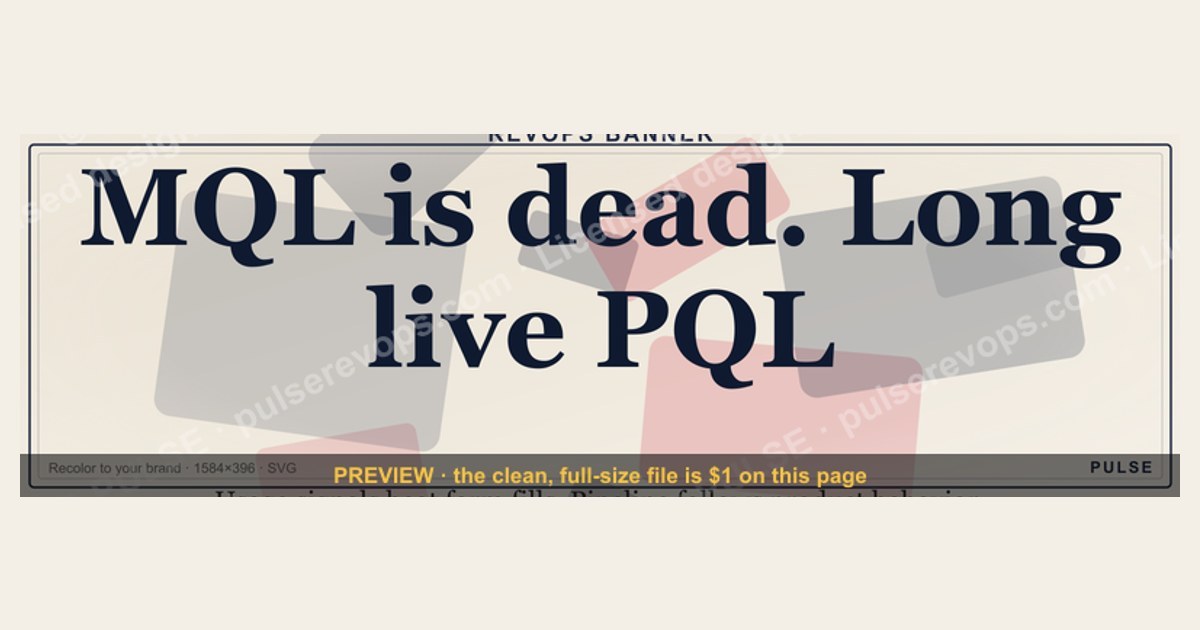
MQL is dead. Long live PQL. — RevOps Banner
 Curated byKory White · Fractional CRO · Maryland
 PULSEKNOWLEDGE LIBRARY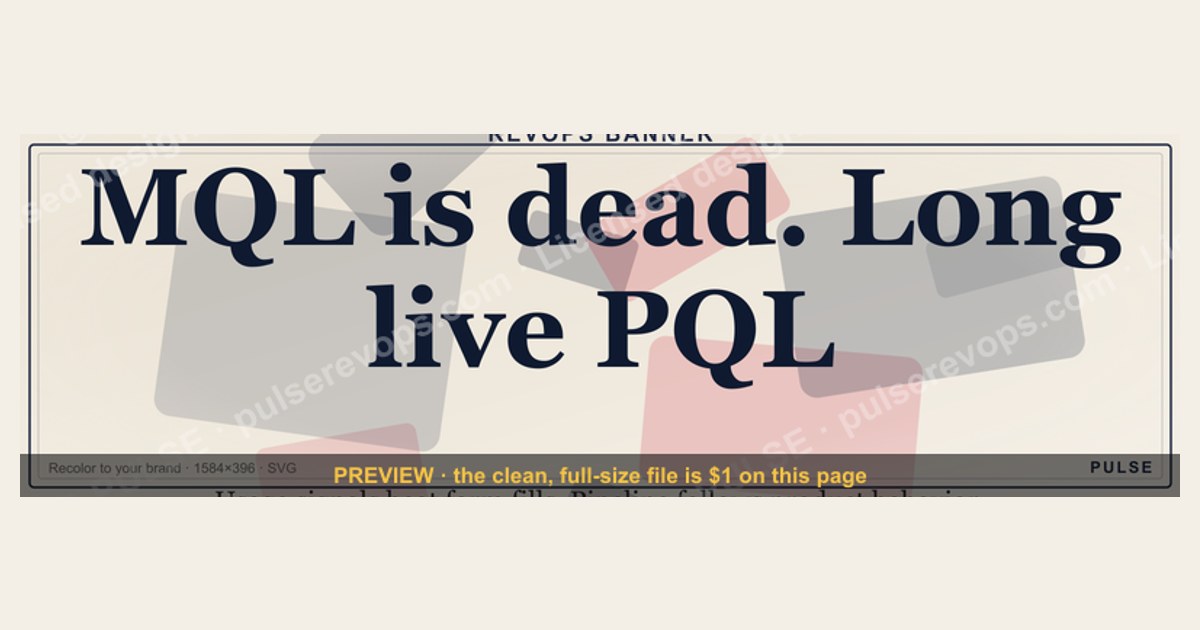

MQLs (Marketing Qualified Leads) are increasingly seen as outdated because they often prioritize volume over genuine buying intent. In contrast, PQLs (Product Qualified Leads) signal readiness to purchase based on actual product usage or engagement, making them a more reliable indicator for revenue teams. This shift reflects a move toward data-driven, product-led growth strategies.
MQL is dead. Long live PQL. — RevOps Banner

A bold dark stat banner for revenue leaders — 'MQL is dead. Long live PQL.' Recolorable LinkedIn cover (1584×396).
Format: SVG (scalable vector) · Size: 1584×396 px · Category: Stat Card Banner · License: Free to use — no attribution required.
Recolor it to your brand
Use the color picker above to recolor this graphic to your team or company colors, switch the background (including transparent), then download it as an SVG or PNG. No sign-up, no watermark.
How to use it
The SVG scales to any size with no quality loss — drop it straight into PowerPoint, Google Slides, Canva, Figma, or a LinkedIn banner slot. The PNG export is ready to upload anywhere that wants a raster image.
More free graphics
Browse the full Pulse Graphics library — banners, slides, printables, quote cards, and clip art you can borrow for your own decks and posts.
Related on PULSE
- BANT is Dead — Banner
- RevOps Team Structure
- Healthcare RevOps Leader — LinkedIn Banner
- Build the system — RevOps Mindset Banner
- Pipeline is oxygen — RevOps Mindset Banner
- Outcome pricing beats seat pricing — RevOps Banner
The Fundamental Flaw: Why MQLs Measure Activity, Not Intent
The death of the Marketing Qualified Lead (MQL) isn't just a trendy headline—it's a reckoning with a metric that never truly served revenue teams. The core problem with MQLs is that they reward volume of activity rather than strength of intent. When a prospect downloads a whitepaper, attends a webinar, or clicks an email link, the MQL model treats these as signals of purchase readiness. In reality, they're often just signs of curiosity, research, or even accidental engagement.
Consider the typical MQL scoring model: 10 points for a website visit, 20 for a form fill, 50 for attending a demo. These scores accumulate based on actions that are easy to manipulate or misinterpret. A sales development rep (SDR) might spend hours chasing a "hot" MQL who downloaded three case studies, only to discover the prospect is a student writing a thesis or a competitor gathering intel. The MQL system incentivizes quantity over quality, flooding sales pipelines with leads that have no real purchase intent.
This misalignment creates a toxic dynamic between marketing and sales. Marketing celebrates MQL volume as a sign of campaign success, while sales complains that leads are unqualified. The result is a blame game that erodes trust and wastes resources. According to industry benchmarks, typical MQL-to-opportunity conversion rates hover between 5-15%, meaning 85-95% of MQLs never become real pipeline. That's not just inefficiency—it's a structural failure in how we define "qualified."
The MQL model also ignores the most critical factor in B2B buying: timing. A prospect might be a perfect fit for your product but have no budget or authority for another 12 months. Under MQL scoring, they'd be rushed into a sales conversation, burned out by premature outreach, and likely disqualified forever. The MQL framework treats all engagement as equal, failing to distinguish between "interested now" and "interested eventually."
This is where PQLs (Product Qualified Leads) fundamentally differ. PQLs don't measure activity—they measure value realization. When a user signs up for a free trial, activates a key feature, invites team members, or hits a usage threshold, they're demonstrating intent through action, not just attention. A PQL has already experienced your product's value proposition firsthand, making them significantly more likely to convert. Data from product-led growth companies suggests PQL-to-paid conversion rates can range from 15-40%, compared to the 1-5% typical of cold MQLs.
The shift from MQL to PQL isn't just a metric change—it's a philosophical one. It moves from "who engaged with our marketing" to "who experienced our product's value." For RevOps teams, this means rethinking the entire lead scoring infrastructure, aligning sales and marketing around product usage data, and building feedback loops that prioritize intent over activity.
Building the PQL Engine: Data Infrastructure and Scoring Models
Transitioning from MQL to PQL requires more than just renaming your lead stages—it demands a robust data infrastructure that captures and analyzes product usage signals in real-time. The first step is defining what constitutes a "qualified" product experience for your specific business model. For a SaaS platform, this might include: completing onboarding, using a core feature three times in a week, inviting at least two team members, or reaching a usage threshold (like 100 API calls or 50 documents uploaded). For a usage-based product, it could be hitting a certain consumption volume. For a freemium model, it might be upgrading storage or removing a branding restriction.
The key is to identify value milestones—actions that correlate strongly with long-term retention and eventual conversion. This requires analyzing historical data from your existing customer base. Look at your best customers: what did they do in their first 30 days? What features did they use? How many team members did they invite? These patterns become your PQL scoring criteria. Avoid vanity metrics like "logged in 10 times" or "spent 30 minutes in the app"—focus on actions that demonstrate genuine product-market fit.
Once you've identified your PQL signals, you need to integrate them into your CRM and marketing automation platforms. This typically involves connecting your product analytics tool (like Amplitude, Mixpanel, or Pendo) with your CRM (Salesforce, HubSpot) through APIs or middleware like Segment or Zapier. The goal is to create a unified view where product usage data flows into the same system that tracks marketing and sales interactions. This allows you to score leads based on a combination of product behavior and demographic fit.
Your PQL scoring model should be dynamic and iterative. Start with a simple framework: assign point values to each key action (e.g., 30 points for completing onboarding, 50 for inviting a team, 100 for reaching a usage threshold). Set a threshold score that triggers a sales outreach (e.g., 150 points). But don't set it in stone—analyze conversion rates monthly and adjust weights based on which actions actually predict paid conversion. You'll likely find that certain signals are far more predictive than others. For example, "invited three team members" might be 10x more valuable than "completed onboarding."
Crucially, PQL scoring must account for time decay. A user who hit a usage milestone 90 days ago is far less likely to convert than one who did it yesterday. Implement decay functions that reduce the score of older actions, ensuring your sales team focuses on active, engaged users. Similarly, consider negative signals: a user who hasn't logged in for 30 days, has a low feature adoption rate, or has explicitly requested not to be contacted should be deprioritized or removed from the PQL queue.
For RevOps teams, this means building automated workflows that trigger different actions based on PQL status. A user who reaches a PQL threshold might receive a personalized email from an SDR, a demo request prompt, or a discount offer. A user who's showing strong engagement but hasn't hit the threshold might enter a nurture sequence with product tips and case studies. A user who's churning (stopped using key features) might trigger a customer success intervention. The PQL engine should be the central nervous system of your revenue operations, routing users to the right actions based on their product behavior.
The RevOps Playbook: Aligning Teams, Tools, and Metrics for the PQL Era
Adopting a PQL-first approach requires a fundamental reorganization of how RevOps teams operate. The traditional marketing-to-sales handoff—where marketing passes MQLs and sales decides whether to pursue them—must be replaced by a continuous feedback loop centered on product usage. This starts with redefining team responsibilities and compensation structures.
In a PQL-driven model, marketing's role shifts from generating top-of-funnel volume to driving product adoption and activation. Instead of measuring success by MQL count, marketing should be measured on metrics like: free trial sign-ups, onboarding completion rates, feature adoption percentages, and time-to-value for new users. This requires a different skill set—marketers need to understand product analytics, user behavior, and lifecycle messaging, not just campaign management and lead generation.
Sales teams, particularly SDRs, must adapt from cold outreach to warm engagement. When a user becomes a PQL, they've already demonstrated interest and value—the SDR's job becomes accelerating that momentum, not convincing a skeptic. SDRs need training on product-led sales conversations: how to ask about the user's experience, what features they've enjoyed, what problems they've solved, and how to expand usage within the organization. Compensation should shift from MQL-to-opportunity conversion rates to PQL-to-revenue conversion rates, with bonuses tied to product adoption milestones.
Customer success teams become critical in the PQL model, especially for products with long sales cycles or high-touch onboarding. Success managers should monitor PQL signals to identify accounts that are at risk of churning or ready for expansion. For example, if a team member stops using a core feature, that's a churn risk signal. If a user invites five new team members, that's an expansion opportunity. Success teams should have automated alerts for these signals and playbooks for intervention.
For RevOps leaders, the tooling stack must be rebuilt around product data. Your CRM should be the source of truth for PQL status, but it needs to be fed by product analytics. Consider investing in a product-led growth (PLG) platform like Pocus, Correlated, or Userpilot that specializes in identifying and routing PQLs. These tools can surface the most engaged users, suggest next actions, and integrate with your sales engagement platforms.
Metrics must evolve too. Replace MQL volume with PQL volume and PQL-to-revenue conversion rate. Track time-to-PQL (how long it takes a new user to hit a PQL threshold) and PQL velocity (how quickly PQLs move through the pipeline). Monitor product-qualified revenue (PQR)—revenue generated from users who activated through product usage. These metrics provide a clearer picture of revenue health than traditional funnel metrics.
Finally, create a PQL governance council with representatives from product, marketing, sales, and success. Meet monthly to review PQL definitions, scoring weights, and conversion data. Adjust thresholds based on real-world performance. Celebrate wins where PQLs led to revenue, and analyze losses where PQLs didn't convert. This cross-functional alignment is the true power of the PQL model—it forces everyone to focus on what actually drives revenue: users experiencing and valuing your product.
Sources
- Gartner — research on lead scoring models and buyer behavior trends
- HubSpot — marketing and sales alignment guides, including MQL vs. PQL comparisons
- Forrester — industry analysis on product-led growth and revenue operations
- ProductLed (Wes Bush) — foundational content on product-qualified leads and PLG frameworks
- Salesforce — documentation on lead lifecycle stages and modern sales processes
- OpenView — venture capital insights on product-led growth metrics and PQL adoption
FAQ
What does "MQL is dead" actually mean? It means the traditional marketing-qualified lead model—based on form fills, ebook downloads, or gated content—is no longer reliable for predicting purchase intent. Buyers today engage anonymously and expect personalized, insight-driven interactions before they’ll share contact info.
How is a PQL different from an MQL? A product-qualified lead is a user who has demonstrated genuine value from your product—through a free trial, feature adoption, or usage patterns—rather than just consuming marketing content. PQLs typically convert at 2–5x the rate of MQLs because they’ve already experienced the core value.
Does this mean I should stop all MQL-based campaigns? Not necessarily—MQLs can still work for high-consideration, long-sales-cycle products where product trials aren’t feasible. But for most SaaS and digital products, shifting budget and focus toward product-led signals (like in-app behavior or feature engagement) yields higher-quality pipeline.
What metrics should I track instead of MQL volume? Focus on product adoption rates, time-to-value, feature stickiness, and PQL-to-opportunity conversion. Revenue teams should measure pipeline velocity and closed-won rates from product-qualified segments, not just lead count.
How do I align sales and marketing around PQLs? Create a shared definition of “product-qualified” based on observable actions (e.g., completed onboarding, used key feature 3 times, invited a teammate). Build automated handoff triggers from product analytics to CRM, and train SDRs to prioritize those accounts with personalized outreach.
What tools do I need to implement a PQL model? You’ll need product analytics (like Amplitude, Mixpanel, or Heap), a CRM that can ingest behavioral data (HubSpot, Salesforce, or similar), and ideally a reverse-ETL tool to sync product events. Start simple—track 3–5 key actions in your product and map them to lead stages.
This page will be disappearing soon. Save it to your device for $1 — or read it free while it is here.
@Kory-White- · if Venmo asks, the last 4 of my number are 2012
This page is gone.
This one is off the shelf now. $1 keeps it on your phone for good — the whole page, pictures and diagrams included.
 graphicTime to Value > ACV — RevOps Banner
 graphicOutcome pricing beats seat pricing — RevOps Banner
 graphicForecast Bands Beat Point Estimates — Stat Card
 graphicAI does 60% of SDR work — RevOps Banner
 graphicChampion departure = #1 churn predictor — RevOps Banner
 graphicField Sales Rep — LinkedIn Banner
 graphicStartup Founder — LinkedIn Banner
 graphicGTM Org Wheel
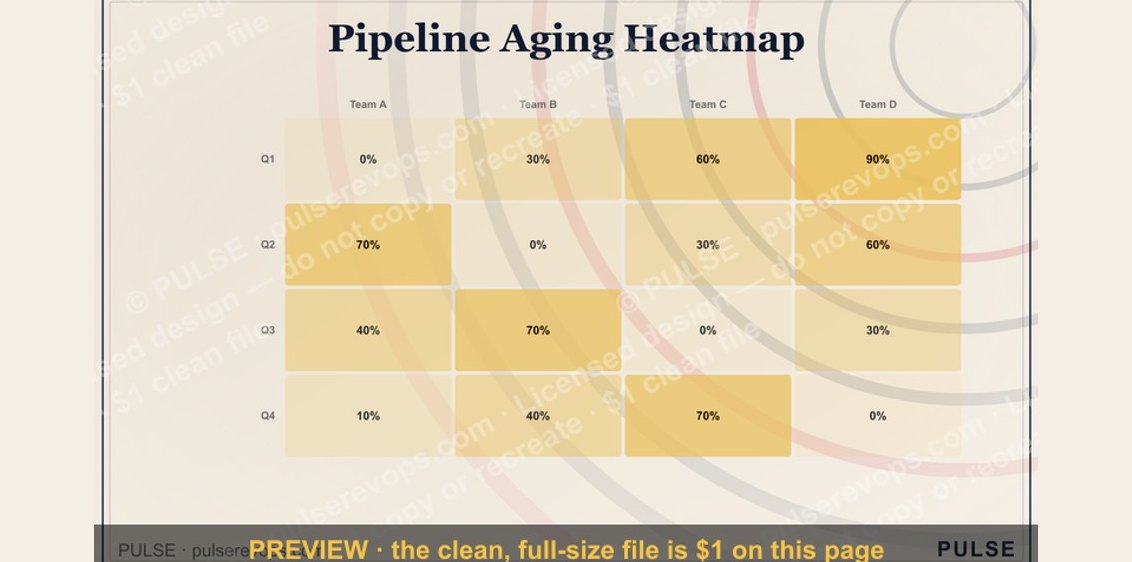 graphicPipeline Aging Heatmap
 graphic“Join a team that runs on pipeline.” — LinkedIn Banner