
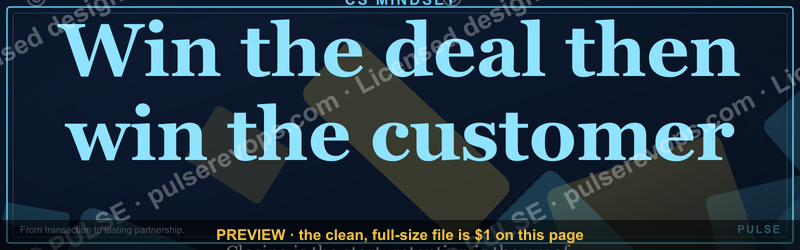
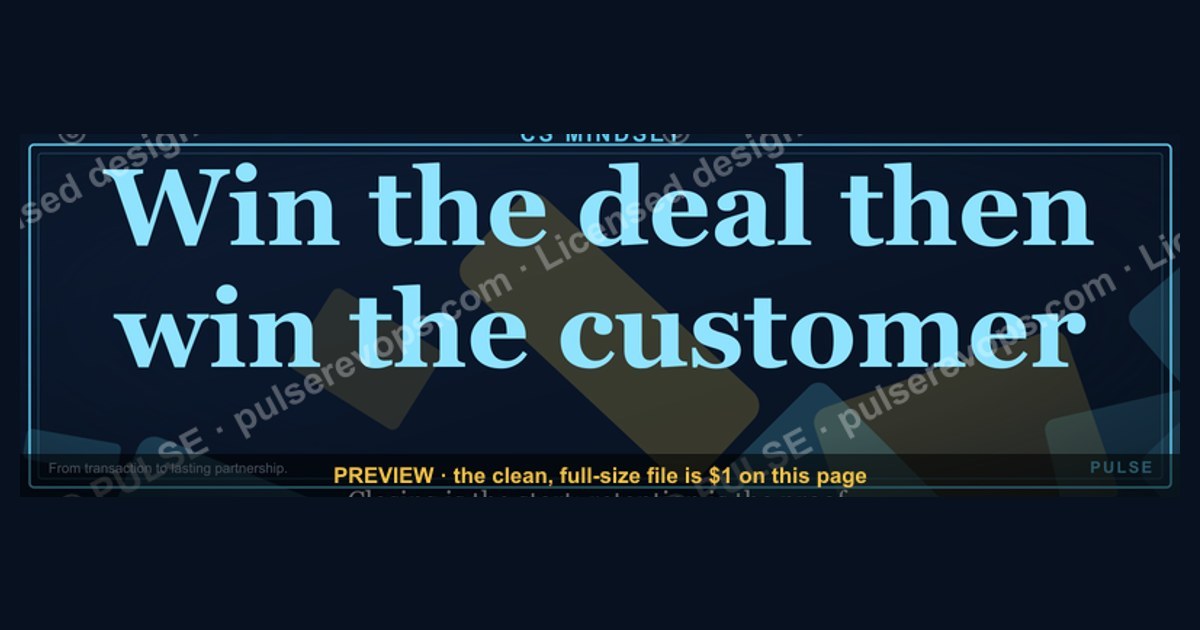
Win the deal then win the customer — CS Mindset Banner
 Curated byKory White · Fractional CRO · Maryland
 PULSEKNOWLEDGE LIBRARY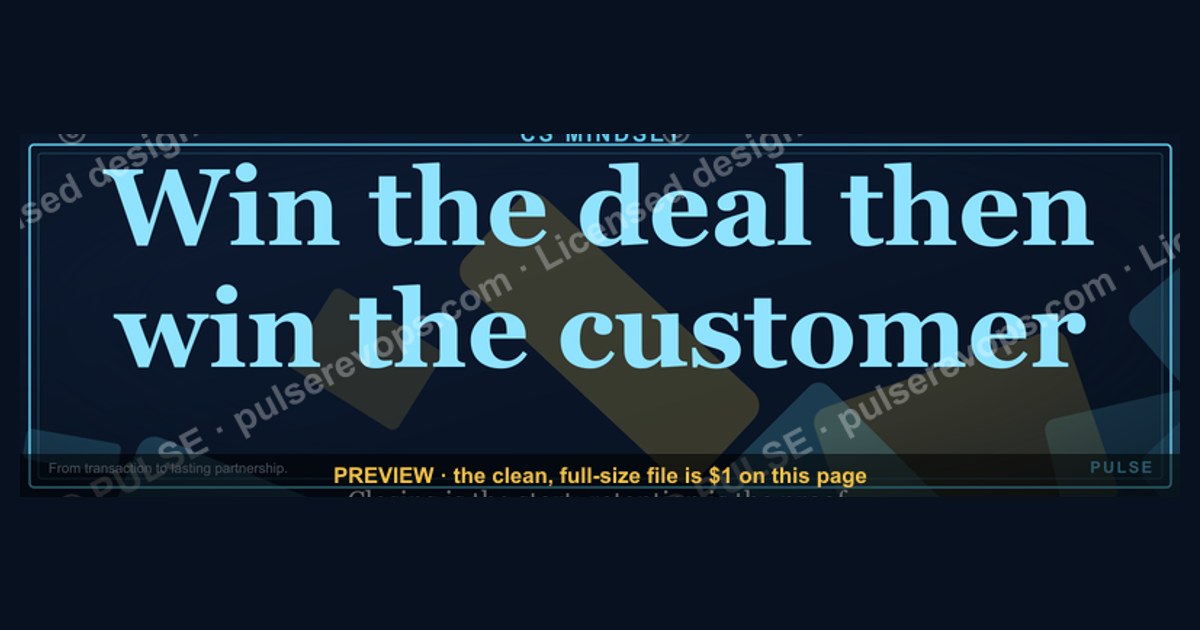
Winning the deal is only the first step; true success comes from earning the customer’s trust and delivering ongoing value after the sale. A Customer Success mindset shifts focus from closing a transaction to building a lasting partnership that drives retention and growth. By aligning your post-sale support with the customer’s goals, you turn a one-time win into a long-term relationship.
Win the deal then win the customer — CS Mindset Banner

Customer-success mindset LinkedIn banner — 'Win the deal. Then win the customer.' Recolorable cover (1584x396).
Format: SVG (scalable vector) · Size: 1584×396 px · Category: Mindset Quote Banner · License: Free to use — no attribution required.
Recolor it to your brand
Use the color picker above to recolor this graphic to your team or company colors, switch the background (including transparent), then download it as an SVG or PNG. No sign-up, no watermark.
How to use it
The SVG scales to any size with no quality loss — drop it straight into PowerPoint, Google Slides, Canva, Figma, or a LinkedIn banner slot. The PNG export is ready to upload anywhere that wants a raster image.
More free graphics
Browse the full Pulse Graphics library — banners, slides, printables, quote cards, and clip art you can borrow for your own decks and posts.
Related on PULSE
- "First the trust, then the deal." — LinkedIn Banner
- “First the trust, then the deal.” — LinkedIn Banner
- Build the system — RevOps Mindset Banner
- Pipeline is oxygen — RevOps Mindset Banner
- Customer Onboarding Flow
- Customer Success KPI Dashboard
The Post-Sale Handoff: Why the Real Work Starts After the Contract is Signed
The moment a deal closes is often celebrated as a victory—and rightfully so. But in a customer success (CS) mindset, that signature is not the finish line; it’s the starting gun. The real test of whether you’ve won the customer begins in the first 90 days post-sale, a period commonly called the “adoption sprint.” During this window, the customer forms lasting impressions about your product, your team, and whether they made the right decision.
A common mistake among sales-led organizations is treating the handoff from sales to customer success as a simple baton pass. In reality, it’s a critical transition that can either reinforce the trust built during the sales cycle or erode it entirely. When sales promises one thing and the onboarding experience delivers something less, the customer feels misled—even if the contract is legally sound. This disconnect is a leading cause of early churn, with research suggesting that 20–40% of new customers can churn within the first three months if the onboarding experience fails to align with pre-sale expectations.
To truly win the customer after winning the deal, organizations must design a handoff process that is seamless, transparent, and value-driven. This means sales teams should not disappear the moment the contract is signed. Instead, they should introduce the customer success manager (CSM) early—ideally during the final stages of the sales cycle—so the customer sees a unified team, not a relay race. The CSM should be briefed on the specific pain points, goals, and “why” behind the purchase, not just the feature list. A shared document or CRM note that captures the customer’s spoken and unspoken expectations can be worth more than any product demo.
Moreover, the first 30 days should be structured around quick wins—small, measurable outcomes that demonstrate value immediately. For example, if a customer bought a project management tool to reduce missed deadlines, the CS team should help them complete their first project using the tool within the first week. These early successes build momentum and create emotional buy-in, making it harder for the customer to consider switching later. The goal is to shift the customer’s mindset from “we bought a tool” to “we achieved a result.” This is where the CS mindset truly separates companies that retain customers from those that simply collect contracts.
Measuring What Matters: Beyond Net Promoter Score to Behavioral Indicators
Traditional customer satisfaction metrics like Net Promoter Score (NPS) or Customer Satisfaction Score (CSAT) have their place, but they are lagging indicators—they tell you how the customer felt after the fact, not what they are doing right now. A CS mindset requires real-time, behavioral metrics that predict retention and expansion before the customer ever takes a survey. These indicators are often called “health scores,” and they combine product usage data, support interactions, and account-level signals into a single view of customer vitality.
One of the most powerful behavioral indicators is the “adoption depth”—how many features or modules the customer is actively using. A customer who only uses the basic functions of your software is at high risk of churn because they haven’t integrated your product into their daily workflow. Conversely, a customer who uses advanced features, integrates with other tools, or invites multiple team members is demonstrating stickiness. A general rule of thumb is that if a customer hasn’t expanded their usage to at least three core features within the first 90 days, proactive intervention is needed.
Another critical metric is the “time-to-first-value” (TTFV)—the duration between when the customer signs and when they achieve their first meaningful outcome. For a CRM platform, this might be the first time they close a deal using your pipeline tracking. For an analytics tool, it might be the first time they generate a report that influences a business decision. The shorter the TTFV, the higher the likelihood of long-term retention. Companies that optimize for TTFV often see retention rates in the 80–95% range for annual contracts, compared to 60–75% for those that don’t.
Support ticket trends also tell a story. A sudden spike in support tickets might indicate confusion or a bug, but a steady decline in tickets over time often signals that the customer is becoming self-sufficient—a positive sign. However, a complete absence of tickets can be a red flag: it may mean the customer has stopped using the product entirely. A healthy pattern is a moderate number of tickets in the first month, tapering to occasional, high-value requests (like feature enhancements or integrations) in subsequent months. CS teams should set up automated alerts for these behavioral shifts, so they can reach out with help, training, or a simple check-in before the customer becomes frustrated or disengaged.
The Expansion Playbook: Turning Satisfied Customers into Revenue Engines
Winning the customer after the deal is not just about preventing churn—it’s about unlocking growth. Existing customers are the most cost-effective source of new revenue, with studies indicating that selling to an existing customer has a success rate of 60–70%, compared to 5–20% for a new prospect. Yet many organizations leave this expansion revenue on the table because they fail to systematically identify and act on opportunities once the customer is onboarded.
The first step in an expansion playbook is to segment your customer base by potential, not just by size or industry. Look for accounts that have high product usage, a growing number of users, or a history of positive feedback. These are your “expansion-ready” accounts. For these customers, the CS team should schedule quarterly business reviews (QBRs) that are not just check-ins but strategic planning sessions. During a QBR, the CSM should present data on how the customer has used the product, highlight ROI achieved, and then propose additional features or services that could solve new problems the customer may not have articulated.
For example, a customer using a marketing automation platform for email campaigns might be struggling with social media scheduling. If your product offers that feature, the QBR is the perfect moment to introduce it—not as an upsell, but as a natural extension of their existing success. The framing matters: “We noticed you’re spending a lot of time on social media separately. Our platform can integrate that, saving your team roughly 10–15 hours per month. Would you like to explore a pilot?” This approach positions the CS team as partners in the customer’s growth, not as salespeople.
Another expansion lever is the “champion development” strategy. Every account has internal advocates—people who love your product and champion it within their organization. These champions are your best route to expansion because they can influence budget decisions and adoption across departments. CS teams should actively identify and nurture these champions by providing them with exclusive resources, early access to new features, or even a seat on a customer advisory board. When a champion moves to a new company, they often bring your product with them—a form of expansion that costs nothing but relationship maintenance.
Finally, consider usage-based expansion models where appropriate. If your product is priced per user or per action, you can create “land and expand” campaigns that start with a small team and then demonstrate enough value that the customer voluntarily adds more seats. This is common in SaaS tools like Slack or Zoom, where a single team’s adoption often leads to company-wide rollout. The key is to make the expansion feel organic and value-driven, not forced. A CS mindset means you are always looking for ways to help the customer succeed more, and when they do, your revenue grows naturally as a byproduct. That is the ultimate win-win: you win the deal, you win the customer, and together, you win the market.
Why the Order Matters
Closing a deal without a post-sale plan risks churn. Research shows that acquiring a new customer costs 5–7 times more than retaining an existing one, and a 5% increase in retention can boost profits by 25–95%. The "win the deal then win the customer" sequence ensures you invest in onboarding, adoption, and support immediately after the signature. This prevents the common gap where sales hands off to a team unprepared to deliver on promises, eroding trust from day one.
Practical Steps to Shift Your Mindset
Start by mapping the customer’s journey post-deal: identify key milestones (first 30 days, first renewal) and assign ownership for each. Use a simple CS playbook that includes a welcome call, a value realization review at 60 days, and a quarterly business review. Measure success not just by revenue but by Net Promoter Score (NPS) or Customer Effort Score (CES). Train your sales team to set realistic expectations during negotiations, so the post-sale experience feels seamless rather than disappointing.
The Long-Term Payoff
Companies that embed a CS mindset see 20–30% higher customer lifetime value (LTV) and lower churn rates. This approach also generates referrals—happy customers are 4–5 times more likely to recommend you. By treating the deal as the start of a relationship, you create a feedback loop where customer insights improve your product and sales process, compounding growth over time. The banner isn’t just a graphic; it’s a daily reminder to prioritize retention alongside acquisition.
Sources
- Harvard Business Review — articles on customer success, sales strategy, and post-sale relationship management
- Gartner — research on customer experience, retention, and the shift from transactional to relationship-based selling
- Salesforce — insights on customer success mindset, CRM best practices, and aligning sales with long-term value
- Customer Success Association — industry standards, frameworks, and case studies for customer success professionals
- Forrester — reports on customer loyalty, lifecycle management, and the economics of customer-centric sales
- McKinsey & Company — analysis of customer-centric business models and the integration of sales and success teams
FAQ
What does “win the deal then win the customer” actually mean? It means closing a sale is only the first step; the real success comes from delivering ongoing value that turns a one-time buyer into a loyal, long-term partner. The phrase emphasizes that customer success (CS) should start before the contract is signed and continue well after.
How does a CS mindset help sales teams close more deals? When salespeople focus on how the product will solve the customer’s actual problems—rather than just hitting quotas—they build trust and reduce buyer hesitation. Prospects are more likely to commit when they sense the seller genuinely cares about their outcomes.
Is this approach only for SaaS or subscription businesses? No, it applies to any industry where repeat business, referrals, or long-term relationships matter—consulting, manufacturing, retail, and more. The core idea is that every deal is the beginning of a partnership, not a transaction.
What’s the biggest mistake companies make when trying to adopt a CS mindset? They treat customer success as a separate department that only steps in after the sale is closed. The most effective approach is to embed CS principles into sales, onboarding, and product development from day one.
How can a small team with limited resources implement this? Start by having sales and CS share a simple post-sale check-in process—like a 30-day call to review goals and address early issues. Even one or two structured touchpoints can dramatically improve retention without needing a large team.
Does a CS mindset require changing compensation or incentives? It often helps to adjust incentives so that sales and CS teams are rewarded for retention and account growth, not just new logos. However, even without comp changes, shifting internal language and celebrating customer wins can gradually change behavior.
This page will be disappearing soon. Save it to your device for $1 — or read it free while it is here.
@Kory-White- · if Venmo asks, the last 4 of my number are 2012
This page is gone.
This one is off the shelf now. $1 keeps it on your phone for good — the whole page, pictures and diagrams included.
 graphicChampions Close Deals — Banner
 graphicPipeline is oxygen — RevOps Mindset Banner
 graphicForecast First, Pipeline Second — Banner
 graphicSales Cycles Shrink With Trust — Banner
 graphicInspect with rigor — Sales Management Banner
 graphicICP Discipline: Say No to Win More — Banner
 graphicDiscovery is the Whole Job — Banner
 graphicNRR Beats New Logos — Revenue Law Banner
 graphicBANT is Dead — Banner
 graphicRenewal is the New Sale — Banner