
Pipeline Council — Team Banner
 Curated byKory White · Fractional CRO · Maryland
 PULSEKNOWLEDGE LIBRARY
Quality
Certified
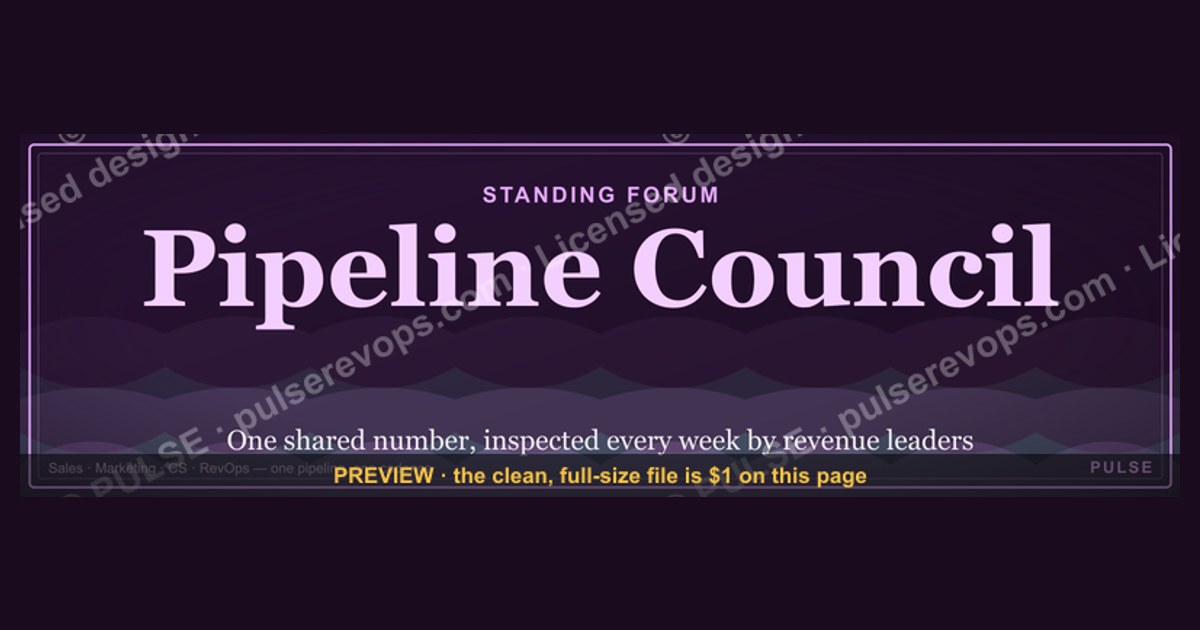
A Pipeline Council team banner is the visual identity for a Pipeline Council — the cross-functional forum where sales, marketing, customer success, and revenue operations leaders meet on a fixed cadence to inspect deal health, unblock stuck opportunities, and hold each other accountable for one shared number. In practice the banner shows up in two places: as a LinkedIn / Slack header that signals "this group owns pipeline," and as the cover slide for the recurring meeting deck.
Because a Pipeline Council is an internal operating ritual rather than a branded product, there's no single mandated layout. A banner that works almost always carries three things: the council name (so it reads as a standing body, not a one-off meeting), a unifying tagline tied to revenue (e.g., "One team, one number"), and your brand color so it sits naturally alongside the rest of your sales enablement assets. The recolorable 1584×396 SVG below is built for exactly that — swap the color, drop it into a banner slot or a deck, done.
Pipeline Council — Team Banner

A bold dark LinkedIn banner for a Pipeline Council — the weekly forum where managers and reps inspect every late-stage deal. Recolorable cover (1584×396).
Format: SVG (scalable vector) · Size: 1584×396 px · Category: Team Banner · License: Free to use — no attribution required.
Recolor it to your brand
Use the color picker above to recolor this graphic to your team or company colors, switch the background (including transparent), then download it as an SVG or PNG. No sign-up, no watermark.

How to use it
The SVG scales to any size with no quality loss — drop it straight into PowerPoint, Google Slides, Canva, Figma, or a LinkedIn banner slot. The PNG export is ready to upload anywhere that wants a raster image.
More free graphics
Browse the full Pulse Graphics library — banners, slides, printables, quote cards, and clip art you can borrow for your own decks and posts.

Related on PULSE
- “Join a team that runs on pipeline.” — LinkedIn Banner
- RevOps Team Structure
- AI Safety Red Team Lead — LinkedIn Banner
- “ONE TEAM ONE NUMBER” — Sales Floor Print
- 5 Dysfunctions of a Team — Infographic
- "Revenue is a team sport." — LinkedIn Banner
The Anatomy of an Effective Pipeline Council Charter
A Pipeline Council without a charter drifts. The most effective councils start with a short living document that defines scope, authority, and decision rights before the first meeting — co-created by the CRO (or top revenue leader), the head of marketing, and the CEO so the group has real cross-functional buy-in rather than borrowed authority.
A working charter covers five things: membership, cadence, data standards, escalation, and measurement. On membership, keep a stable core of 4 to 6 permanent members who attend every session — typically sales, marketing, customer success, and RevOps leadership — and rotate in subject-matter experts only when a specific stage or campaign is under review. A council where twelve people show up "to stay informed" stops making decisions; a tight core that owns the number makes them.
Cadence should match deal velocity, not calendar habit. Earlier-stage teams often run a weekly 45-minute working session because their pipeline turns over fast; larger organizations frequently move to bi-weekly inspection with a longer quarterly review of the whole pipeline architecture — lead scoring, stage definitions, close-plan templates. The non-negotiable is consistency: councils that meet irregularly lose the institutional memory that makes their forecasts trustworthy.
Data standards are where most councils quietly fail. Agree up front on what makes an opportunity "real" — a verified contact, a documented business case, an identified decision-maker, and a clear next step with a date. Without that definition, meetings dissolve into arguing whether a three-month-old whitepaper download still belongs in the pipeline. A simple rule helps: any opportunity that fails the hygiene check in consecutive reviews is moved to nurture or archived rather than debated again.
Escalation defines how the council uses its authority. If a strategic deal has been stuck in legal for weeks, there should be a pre-agreed path to the general counsel or CEO. If a channel keeps producing weak leads, the council should be able to pause spend and redirect it. That power to *act* — not just report — is the difference between a council and a status meeting.
Finally, measurement should pair leading and lagging signals. Track pipeline velocity, stage-to-stage conversion, deal-size shifts, and aged pipeline at every meeting; review coverage ratio, win rate by source, and time-to-close by segment monthly. Decide in advance which numbers trigger an emergency session — for example, coverage slipping below your target ratio — so the council reacts to risk instead of discovering it a quarter late.
Common Pipeline Council Failure Modes and How to Avoid Them
Even a well-designed council can stall. A handful of failure patterns account for most of the trouble, and each has a practical antidote.
The data debate trap. When most of the meeting is spent arguing whether the CRM is accurate, the council has already lost. The fix is a data scrub before launch — RevOps validates every open opportunity against the agreed hygiene standard, and anything that can't be verified is parked in "pending review." A few hours of cleanup up front buys back inspection time at every meeting after.
The blame game. Sales blames marketing for lead quality; marketing blames sales for follow-up; CS blames both. The antidote is a shared-fate metric — pipeline *generation*, weighted across the leaders' goals — so that when pipeline is unhealthy, everyone in the room has a reason to fix it rather than assign it.
Analysis paralysis. Some councils drown in dashboards. A "three-question" rule keeps it sharp: where is pipeline healthy, where is it at risk, and what is the one thing we must fix this week? Anything beyond that goes out as pre-reading, not meeting time.
The empty chair. When the senior revenue leader rarely shows, the council loses urgency and authority. Hold a "no deputies" line through the first months — the CRO or VP of Sales attends, not a delegate — so the rest of the organization reads pipeline health as a leadership priority.
The action-item black hole. Councils generate good ideas and then execute none of them. A simple commitment log — owner, deadline, status, blocker — reviewed in the first five minutes of every meeting closes the loop. Items that slip twice get escalated. That cadence turns a reporting body into one that actually moves the number.
Building a Pipeline Council Scorecard
A council should measure itself the way it measures pipeline. A lightweight scorecard across four dimensions keeps it honest, and it works in any org regardless of tooling.
Participation. Watch attendance, preparation, and on-time starts. When these slide, it's usually a signal the meeting is too long, too tactical, or scheduled badly — fix the format before the engagement erodes further.
Decision velocity. Measure the time from spotting a pipeline issue to shipping a fix. If demo-to-close conversion drops, how many days until a remediation plan is actually running? Slow resolution almost always points to unclear decision rights, not a lack of effort.
Pipeline impact. This is the dimension that matters most. Track the direction of three things over a quarter: coverage ratio, aged-pipeline share, and stage-to-stage conversion. If a council is earning its place, those numbers should be visibly improving — and if they aren't, it's a sign the group is treating symptoms rather than causes.
Member satisfaction. A short, anonymous quarterly pulse — is this a good use of your time, are commitments followed through, is it helping you hit your number — surfaces problems early. Low scores are an invitation to run a retrospective and adjust the format before the council becomes "just another meeting."
Review the scorecard with the council every quarter and with leadership annually. The point isn't bureaucracy — it's making pipeline health a repeatable outcome instead of a recurring fire drill.
Sources
- Gartner — Revenue Operations & Sales Pipeline Research. Analyst guidance on RevOps operating models, pipeline coverage, and cross-functional revenue governance. https://www.gartner.com/en/sales
- Harvard Business Review — "Companies with a Formal Sales Process Generate More Revenue" (Jason Jordan & Robert Kelley). Evidence that disciplined pipeline management and structured deal inspection correlate with revenue performance. https://hbr.org/2015/01/companies-with-a-formal-sales-process-generate-more-revenue
- Forrester (incl. former SiriusDecisions) — B2B Revenue Waterfall. Framework for aligning marketing, sales, and customer success around a shared pipeline and demand model. https://www.forrester.com/blogs/category/b2b-revenue-waterfall/
- HubSpot — Sales Pipeline Management Resources. Practical guides on pipeline stages, deal hygiene, and forecasting cadence for revenue teams. https://www.hubspot.com/sales-pipeline
- Salesforce — "What Is a Sales Pipeline?" Reference on pipeline stages, health metrics, and pipeline review practices. https://www.salesforce.com/resources/articles/sales-pipeline/
- McKinsey & Company — B2B Sales Growth Insights. Research on commercial operating models, sales productivity, and pipeline-driven growth. https://www.mckinsey.com/capabilities/growth-marketing-and-sales
FAQ
What is a Pipeline Council? A Pipeline Council is a standing, cross-functional forum where revenue leaders meet on a fixed cadence to inspect pipeline health, unblock stalled deals, and align on the actions needed to hit the number. It's an operating ritual that sits above any single rep's deal review — its job is the health of the *system*, not the status of one opportunity. The banner on this page is the visual identity teams use to brand that forum in LinkedIn, Slack, and meeting decks.
Who typically participates in a Pipeline Council? A tight core of 4 to 6 permanent members usually drawn from sales, marketing, customer success, and revenue operations leadership, plus rotating subject-matter experts who join only when a specific stage, segment, or campaign is under review. Keeping the core small is deliberate: councils that swell to a dozen "informed observers" tend to stop making decisions.
How often should a Pipeline Council meet? Match the cadence to deal velocity, not the calendar. Fast-moving, earlier-stage teams often run a weekly working session; larger organizations frequently move to bi-weekly inspection with a longer quarterly review of the full pipeline architecture. The one rule that holds across all of them is consistency — irregular meetings destroy the institutional memory that makes a council's forecast trustworthy.
What metrics does a Pipeline Council track? At every meeting: pipeline velocity, stage-to-stage conversion, deal-size shifts, and aged pipeline. On a monthly rhythm: pipeline coverage ratio, win rate by source, and time-to-close by segment. The most effective councils also pre-define which numbers trigger an emergency session — for example, coverage slipping below the team's target ratio — so they respond to risk instead of discovering it after the quarter closes.
How is a Pipeline Council different from a normal sales review? A standard sales review zooms in on individual rep performance and specific deals. A Pipeline Council zooms out to systemic pipeline health and cross-functional alignment — process gaps, lead quality, resource allocation, and escalation. Put simply, a sales review asks "is this deal going to close?" while the council asks "is our pipeline structurally healthy, and what do we change this week?"
Can a fractional CRO lead or join a Pipeline Council?
---
<div style="display:flex;align-items:center;gap:18px;margin:34px 0;padding:22px 24px;border-radius:16px;border:1px solid #e6e6e6;background:#fafafa;font-family:'Plus Jakarta Sans',system-ui,sans-serif;"> <div style="flex:1;min-width:0;"> <div style="font-size:12px;font-weight:800;letter-spacing:0.14em;text-transform:uppercase;color:#C8112B;margin-bottom:4px;">Fractional Chief Revenue Officer</div> <div style="font-size:20px;font-weight:800;color:#111;line-height:1.25;">Kory White</div> <div style="font-size:14.5px;color:#444;margin-top:6px;line-height:1.55;">Proven revenue operator — 25 years building and running sales orgs, scaling revenue from $0 to $200M. Kory installs the cadence, metrics, and decision rights that turn a Pipeline Council from a status meeting into a revenue engine — and takes a limited number of engagements through CRO Syndicate.</div> <div style="margin-top:12px;font-size:14px;"> <a href="https://calendly.com/korywhiterevops" target="_blank" rel="noopener" data-pulse-click="hire-cro" style="color:#C8112B;font-weight:800;text-decoration:none;">📅 Book a 20-minute call</a> · <a href="https://www.linkedin.com/in/korywhite" target="_blank" rel="noopener" style="color:#C8112B;font-weight:800;text-decoration:none;">💼 LinkedIn</a> · </div> </div> </div>
This page will be disappearing soon. Save it to your device for $1 — or read it free while it is here.
@Kory-White- · if Venmo asks, the last 4 of my number are 2012
This page is gone.
This one is off the shelf now. $1 keeps it on your phone for good — the whole page, pictures and diagrams included.
 graphic“Bring the energy every call.” — LinkedIn Banner
 graphicAI Observability Operator — LinkedIn Banner
 graphicPerformance — Section Divider Slide
 graphicSales KPI Dashboard — Top 9 in 2027
 graphicField Sales Rep — LinkedIn Banner
 graphicNRR Beats New Logos — Revenue Law Banner
 graphic4 Pillars of RevOps — Infographic
 graphicSell outcomes, not features. — LinkedIn Wallpaper
 graphicHow to build a champion champion plan in 2027?
 graphicOffensive Security Pentest CRO — LinkedIn Banner