
Sales Cycles Shrink With Trust — Banner
 Curated byKory White · Fractional CRO · Maryland
 PULSEKNOWLEDGE LIBRARY
Quality
Certified
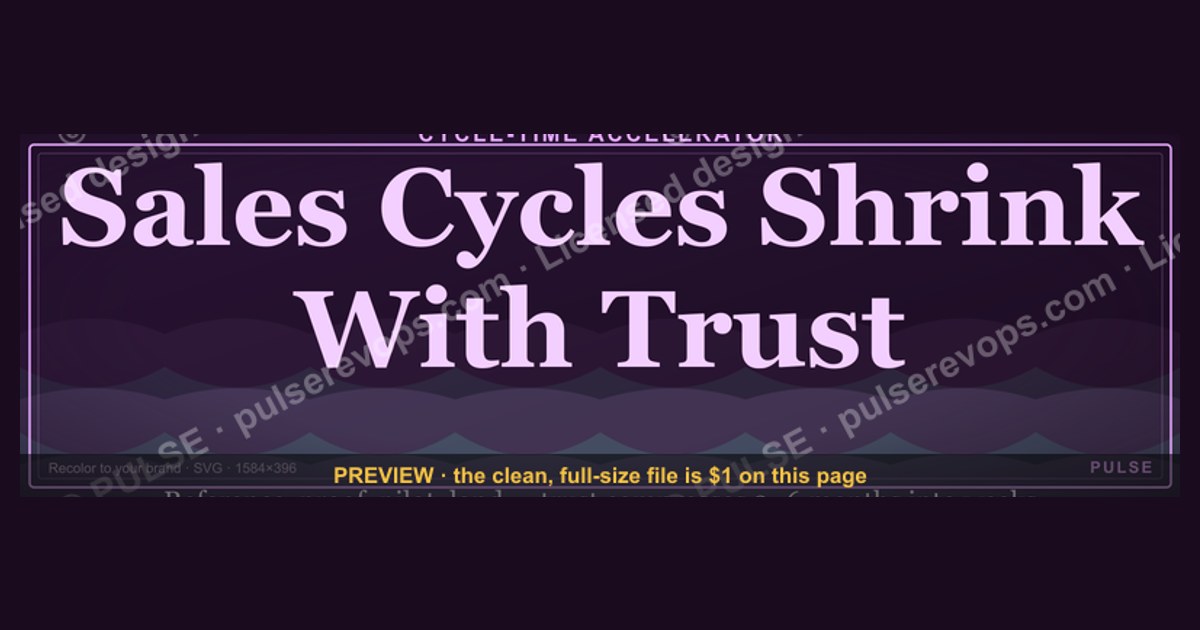
This banner is a 1600×500 px PNG graphic titled "Sales Cycles Shrink With Trust." It states a single RevOps thesis in gold serif type on a near-black field: when buyers trust the seller, the number of days from first contact to signed contract falls. Download it free on this page and drop it into a LinkedIn header, a deck title slide, or a team channel.
The two options this banner represents
The banner is not decoration. It encodes a choice every revenue team makes, whether deliberately or by default: run the pipeline on speed pressure, or run it on trust. Those are the two options, and they produce measurably different Sales motions.
Option one is the velocity-first motion. The rep is measured on calls booked, demos delivered, and days-to-close. Follow-up is aggressive because the quota math says more touches equal more meetings. Sequences fire on a fixed cadence regardless of whether the buyer replied. Discovery is compressed into a 30-minute slot so the rep can fit a fifth call into the day. The forecast is built on stage-age assumptions: a deal that has sat in "Proposal" for 21 days gets flagged red and pushed.
Option two is the trust-first motion, which is what this banner argues for. The rep is still measured on closed revenue, but the leading indicators change. Instead of touches per day, the team tracks mutual action plan completion, the number of stakeholder conversations per opportunity, and whether the buyer has volunteered information that was not asked for. Follow-up is responsive rather than scheduled — the rep moves when the buyer signals readiness. Discovery runs long because the rep is trying to find the cost of the problem, not the size of the budget.

The reason this matters is that the two motions produce different cycle shapes. Velocity-first produces a fast first 60% of the funnel and a brutal final 40%, because deals stall at the point where a human being has to stick their neck out internally. Trust-first produces a slower start and a much shorter tail, because the champion already has the ammunition and the credibility to sell internally on the rep's behalf.
This banner exists because most teams default to option one without ever choosing it. The graphic is a forcing function — a visible statement that the team has picked the other motion.
How to decide which motion to run
The decision is not philosophical. It is a function of deal size, buying committee size, and how much of the decision happens without you in the room.
The key branch is the third question. If the buyer can sign without persuading anyone else, trust is nice but not load-bearing — a fast, competent, low-friction process will close the deal. If the buyer has to walk into a room you are not in and defend the purchase, trust is the entire mechanism. Your champion's credibility with their own leadership is the asset being spent, and it was built during your discovery calls.

Practically, most teams run both. Below roughly $25k annual contract value with a single decision-maker, velocity wins. Above that, or with three or more stakeholders, trust wins. The mistake is running velocity mechanics on a trust-shaped deal — pushing a mutual action plan on a buyer who has not yet decided the problem is worth solving just teaches them to avoid your calls.
Concrete numbers behind each option
Trust-first is slower to start and faster to finish. Velocity-first is the reverse. Here is what that looks like in practice across a handful of deal archetypes.
A transactional deal — one decision-maker, under $10k, self-serve evaluation — typically closes in 14 to 30 days under either motion. Trust adds maybe two or three days of relationship building and removes almost nothing, because there is no internal sell. Do not over-invest here.

A mid-market deal — $25k to $75k, three to five stakeholders, a procurement step — is where the gap opens. Under velocity mechanics, this deal commonly runs 90 to 150 days, with a long stall between verbal yes and signature while the champion scrambles for internal justification. Under trust mechanics, the same deal often runs 60 to 100 days. The trust version is not faster in week one; it is faster in weeks eight through fourteen, because the champion was equipped from the first call.
An enterprise deal — $100k+, six or more stakeholders, legal and security review — rarely closes under 150 days either way. But the variance is what kills forecasts. Velocity-run enterprise deals have a wide spread: some close at 140 days, many die at 300. Trust-run enterprise deals cluster tighter, because the rep has mapped the committee and knows which stakeholder is the real blocker. A predictable 180 beats a coin-flip 150 every quarter.
Three numbers are worth tracking to see whether the trust motion is working. First, the ratio of stakeholder conversations to opportunities — if it is below 1.5, you are single-threaded and the trust motion is not actually running. Second, the percentage of deals where the buyer sends the mutual action plan back with edits — anything above 40% means the buyer is co-owning the process. Third, the length of the gap between verbal commitment and signature — under trust mechanics this should be under 14 days for mid-market; if it is 30 or more, the champion was never equipped.
A caution on ranges: these are directional patterns, not benchmarks from a study. Your own CRM history is the only number that matters. Pull the last 40 closed-won deals, split them by stakeholder count, and plot days-in-stage. The stall will tell you which motion you have been running.
What the banner actually says, element by element
Read the graphic from left to right. The background is a flat near-black — not pure #000000, closer to a deep charcoal that reads as black on most screens but keeps the gold from vibrating. There is no gradient, no photograph, no abstract shape. The emptiness is intentional: on a LinkedIn feed, a mostly-black rectangle is a pattern interrupt against the white and light-blue cards around it.
The headline sits in a serif face, gold, set in title case: "Sales Cycles Shrink With Trust." The serif choice matters. Sans-serif reads as software marketing; serif reads as considered, almost editorial, closer to a consulting report than an ad. The gold is a warm metallic tone rather than a bright yellow, which keeps it legible against the dark field without glare.

The word "Shrink" carries the visual weight. It is the verb, and it is the claim. If a viewer reads only one word, that is the one that should land. In the source file, "Shrink" is set slightly heavier or slightly larger than its neighbors so the eye catches it first even at thumbnail size.
Below the headline sits a smaller subline in a muted gray or dimmer gold, at roughly 40% of the headline's size. This is where the qualifier lives — something like "Trust is the fastest compression lever in the pipeline." It is deliberately quieter so it does not compete with the main claim.
There is no logo lockup in the base file, no URL, no QR code. Those are left out on purpose. A banner with a logo in the corner becomes an advertisement; a banner without one reads as a statement. If your team wants attribution, add a small wordmark in the lower right at no more than 8% of the canvas height.
The aspect ratio is roughly 3.2:1, which is the proportion LinkedIn uses for profile and company-page header images. That ratio is not arbitrary — it is the one place on the platform where a horizontal statement graphic sits above the fold without being cropped.

Where and how to use it
The primary placement is a LinkedIn company page header. Upload it as the page's banner image and it will sit behind the logo and tagline, visible to anyone who lands on the page. Because the headline is centered and the left third is relatively empty, the logo does not collide with the text.
The second placement is a personal profile header, though this needs care. LinkedIn crops profile banners differently across desktop and mobile, and the safe zone is narrower. If you use this banner on a personal profile, check the mobile crop before publishing — the outer 15% on each side may be trimmed.
The third placement is a deck title slide. Drop the PNG full-bleed behind the title of an internal QBR or a sales kickoff deck. Because the background is near-black, white body text overlaid on the lower third remains readable. Do not put a second headline on top of the existing one; let the banner be the headline.

The fourth placement is a Slack or Teams channel header, or a pinned post in a RevOps channel. Here the graphic does a different job: it is a shared reference point. When a rep asks why the team is spending 90 minutes on discovery, the pinned banner is the answer.
Two placements to avoid. Do not use it as an email header — the dark background will render inconsistently across clients and many will strip it. Do not use it as a paid ad creative without a call to action; a statement banner with no next step wastes the impression.
How to customize it for your team
The base file is a starting point, not a fixed asset. Three things are worth changing, and three are worth leaving alone.

Change the subline first. The headline is the thesis; the subline is where your team's specific version of the thesis lives. A team selling into healthcare might write "Trust shortens the security review." A team selling into manufacturing might write "Trust gets you past the plant manager." The subline should name the specific bottleneck your team fights.
Change the accent color second. Gold on black is the default. If your brand color is a deep teal or a burnt orange, swap the headline color and keep the background dark. The rule is contrast: the headline color must clear a 4.5:1 contrast ratio against the background or it fails accessibility and looks muddy on phones.
Change the attribution third, if you need it. A small wordmark or a team name in the lower right, no larger than 8% of canvas height, keeps the statement feel while giving credit.

Leave the serif face alone unless your brand has a licensed serif you already use everywhere. Leave the near-black background alone — swapping it for white turns a statement into a slide. Leave the word "Shrink" emphasized; it is the load-bearing word.
If you want a variant for a specific persona, make the headline role-specific: "Sales Cycles Shrink With Trust" for the general version, and a version that names the buyer's world for a targeted campaign. Keep the structure identical so the family reads as one series.
Implementation details and sequencing
Rolling this out is a change management exercise, not a design exercise. The banner is the visible artifact of a decision that has to be made in the operating cadence first.
The sequencing matters because the banner without the operating change is just a poster. Publish it in week seven, after the discovery guide and the mutual action plan exist, so the first rep who sees it has something to do differently on Monday.

The leading indicators to instrument before launch: stakeholder conversations per opportunity, mutual action plan return rate, and days between verbal and signature. If your CRM cannot report these, add three fields and require them at stage exit. A trust motion you cannot measure will quietly revert to a velocity motion within two quarters.
One trade-off to plan for: the trust motion will make your early-stage pipeline look worse for the first 60 days. Fewer demos booked, longer discovery, more time per opportunity. If leadership reviews pipeline coverage weekly and panics at week three, the initiative dies. Set the expectation before you start — the leading indicators move first, the cycle time moves second, and the win rate moves last.
Another trade-off: not every rep can run it. The trust motion requires reps who are comfortable asking a buyer "what happens internally if you don't solve this?" and then staying quiet. That is a different skill from handling objections. Expect roughly half your team to adapt quickly and half to need coaching, and staff accordingly rather than assuming the banner changes behavior.
Related questions
Does a shorter sales cycle always mean a better sales cycle?
No. A cycle can shrink because trust accelerated the decision, or because the rep discounted heavily to force a signature. Check the discount rate alongside cycle time — if both moved down together, you bought speed rather than earned it.
How do you measure trust in a pipeline?
Use proxies: stakeholder conversations per opportunity, mutual action plan return rate, and whether the buyer volunteers information you did not ask for. Trust itself is not measurable, but its behavioral fingerprints are.
Can this banner work for a team that sells transactionally?
It can, but the message is weaker. Trust compresses cycles most when the buyer has to defend the purchase internally. For a single decision-maker under $10k, process speed matters more than relationship depth.
What is the biggest mistake teams make with this message?
Publishing the banner without changing the operating cadence. The graphic states a thesis; if discovery stays at 30 minutes and follow-up stays on an automated cadence, the banner becomes a claim the team does not live up to.
FAQ
What exactly is this banner?
It is a 1600×500 px PNG graphic titled "Sales Cycles Shrink With Trust," set in gold serif type on a near-black background. It is designed as a LinkedIn header image, a deck title slide, or a pinned internal channel graphic. Download it free from this page.
Why 1600×500 pixels specifically?
That is the standard LinkedIn profile and company-page header proportion, roughly 3.2:1. It is wide enough to hold a full sentence at readable size and short enough to sit above the fold without cropping on desktop.
Can I change the wording on the banner?
Yes. The subline is the intended customization point — replace it with the specific bottleneck your team fights. Keep the headline intact if you want the graphic to read as part of the same series, and check that any color change clears a 4.5:1 contrast ratio.
Does a shorter cycle actually follow from higher trust?
Directionally yes, particularly in deals with three or more stakeholders where the champion has to sell internally without you. The mechanism is that an equipped champion spends less time gathering justification. Treat published cycle-time ranges as directional, not as benchmarks from a controlled study.
Where should I not use this banner?
Avoid email headers, where dark backgrounds render inconsistently across clients, and avoid paid ad placements without adding a call to action. Also avoid using it on a personal profile without checking the mobile crop, which trims the outer edges.
How do I know if it is working?
Track three numbers before and after: stakeholder conversations per opportunity, mutual action plan return rate, and days between verbal commitment and signature. If the last one drops below 14 days for mid-market deals, the trust motion is running. If it stays above 30, the champion is not being equipped.
Can I get a version in my brand colors?
Yes — swap the headline color while keeping the background dark, and confirm the new color clears a 4.5:1 contrast ratio against the background. Keeping the background dark preserves the statement quality that makes the graphic work in a feed.
Sources
- LinkedIn Help — Company page banner image specifications: https://www.linkedin.com/help/linkedin/answer/a563649
- LinkedIn Help — Profile background photo guidelines: https://www.linkedin.com/help/linkedin/answer/a542039
- Nielsen Norman Group — F-pattern and banner-viewing behavior: https://www.nngroup.com/articles/f-shaped-pattern-reading-web-content/
- Web Content Accessibility Guidelines (W3C) — Contrast minimum: https://www.w3.org/WAI/WCAG21/Understanding/contrast-minimum.html
- HubSpot Research — Sales trust and buyer behavior: https://blog.hubspot.com/sales
- Gartner — B2B buying journey and stakeholder complexity: https://www.gartner.com/en/sales/insights/b2b-buying-journey
- Harvard Business Review — The B2B elements of value: https://hbr.org/2018/03/the-b2b-elements-of-value
- Salesforce — State of Sales reporting on cycle times: https://www.salesforce.com/resources/research-reports/state-of-sales/
Related on PULSE
- How to shorten enterprise sales cycles without discounting
- Mutual action plans: the template that gets champions to sell internally
- Single-threaded deals and why they stall in procurement
- Building leading indicators for a trust-first sales motion
- LinkedIn banner specs and safe zones for RevOps teams
- When to run velocity mechanics and when to run trust mechanics
This page will be disappearing soon. Save it to your device for $1 — or read it free while it is here.
@Kory-White- · if Venmo asks, the last 4 of my number are 2012
This page is gone.
This one is off the shelf now. $1 keeps it on your phone for good — the whole page, pictures and diagrams included.
 graphicPipeline is oxygen — RevOps Mindset Banner
 graphicDeals Do Not Stall, People Do — Banner
 graphicInspect with rigor — Sales Management Banner
 graphicForecast First, Pipeline Second — Banner
 graphicChampions Close Deals — Banner
 graphicCoach to the top — Sales Leadership Banner
 graphicWin the deal then win the customer — CS Mindset Banner
 graphicDiscovery is the Whole Job — Banner
 graphicBuild the system — RevOps Mindset Banner
 graphicRenewal is the New Sale — Banner