

Can I use reverse osmosis water for a freshwater community tank?
Yes, but never straight. Reverse osmosis water must be remineralized or blended with dechlorinated tap water before it enters a freshwater community tank. Target roughly 4–8 dGH, 3–6 dKH, and 150–300 ppm TDS. Pure RO has no buffer, so pH swings hard and fish lose osmotic balance.
The tank that crashed on a Tuesday
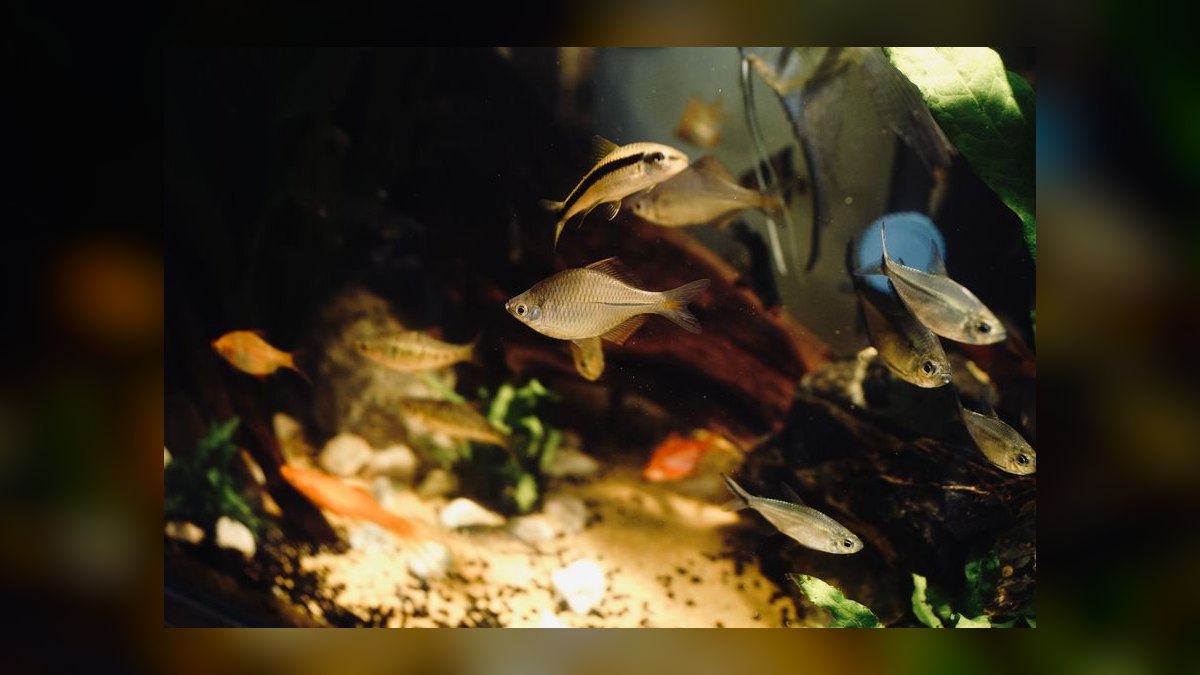
Picture a 29-gallon community setup that has run fine for eight months: a dozen rasboras, six corydoras, a small colony of Neocaridina shrimp, and a jungle of Java fern and Vallisneria. The owner's tap water comes out of the municipal line at 14 dGH and 11 dKH — hard, alkaline, and full of the calcium that keeps leaving white crust on the glass lid. Someone at the fish store suggests reverse osmosis. A countertop RO unit arrives, and the next weekend's 30% water change goes in as straight permeate, 9 gallons of it, at roughly 4 ppm TDS.
Nothing dramatic happens in the first hour. That's the trap. What happens instead is a slow chemical unwinding over the following 72 hours. The tank's carbonate reserve — the KH that had been absorbing acid from fish waste, from CO2, from the decaying leaf litter in the back corner — gets diluted by about a third in a single change. KH drops from 11 to roughly 7. Still safe. The owner, encouraged, repeats it the next week, and the week after. By the fourth change KH is under 3, and the buffering system is running on fumes.
Then the pH starts moving. Not gradually — in steps. Overnight, when photosynthesis stops and the plants and bacteria both respire CO2 into a tank with almost no carbonate left to neutralize the resulting carbonic acid, morning pH reads 6.1 instead of the 7.6 it used to hold. By afternoon, with the lights driving photosynthesis and stripping CO2 back out, it reads 7.3. That's a 1.2-unit daily swing. Fish can tolerate a stable pH almost anywhere in a wide range; what they cannot tolerate is a moving target, because every shift forces their gill and kidney systems to re-tune.
The shrimp go first. Cherry shrimp molt on a cycle, and molting is a calcium-hungry event — the new exoskeleton has to harden from minerals pulled out of the water column. In water at 1 dGH there isn't enough calcium to complete the process, and you get "white ring of death": the shrimp is stuck half out of its old shell and dies there. The corydoras show it next as reddened gill covers and barbel erosion. The rasboras, being soft-water fish by ancestry, actually cope best — which is exactly why the owner concludes the water is fine right up until it isn't.
The failure here was never the RO membrane. The membrane did exactly what it is built to do: it removed 95–99% of dissolved solids, including every single thing that was holding the tank chemically steady. Reverse osmosis is a subtraction tool. A freshwater community tank needs a specific, non-zero mineral profile. The whole job is putting back a controlled amount of what the membrane took out, and the reason people get this wrong is that "purified" sounds like an upgrade when chemically it is a reset to zero.
What the membrane actually does, and what your fish actually need
An RO membrane is a semipermeable sheet with pores small enough to pass water molecules and reject most dissolved ions. Feed water is pushed against it under household pressure; a fraction crosses as permeate and the rest sluices away as concentrate, carrying the rejected solids. Typical residential units run 3–4 gallons of waste per gallon of product, which matters more than people expect once you are making 10–15 gallons a week for water changes. Most units stack a sediment prefilter and one or two carbon blocks ahead of the membrane, and those carbon stages are what remove chlorine — critical, because free chlorine oxidizes and destroys thin-film composite membranes. If your utility uses chloramine rather than free chlorine, a standard carbon block strips it only partially, and a catalytic carbon stage is the usual answer.
What comes out the other side is close to distilled: TDS typically under 10 ppm, GH and KH effectively zero, pH unstable and easily pushed by dissolved atmospheric CO2 alone. Every parameter your test kit measures reads at or near the bottom of its scale.
Now consider what the tank's inhabitants are actually asking for. Fish are hyperosmotic relative to fresh water — their blood carries more dissolved salts than the water around them, so water constantly diffuses inward across the gills and they constantly urinate dilute to dump it. That system runs on active transport of ions back in through specialized gill cells, and it needs ions present in the water to transport. Drop the surrounding ion concentration to near zero and the osmotic gradient steepens: more water in, more ion loss out, more metabolic energy burned on chloride cells. A tough fish handles this. A stressed, recently shipped, or already-sick fish does not.
Plants have a separate need. Calcium is a structural macronutrient — it cross-links pectin in cell walls, and a calcium-starved stem grows soft with distorted new leaves. Magnesium sits at the center of the chlorophyll molecule; without it you get interveinal yellowing on older leaves. Carbonate matters twice over: it buffers pH and, for plants without injected CO2, bicarbonate is a usable carbon source that many aquatic species can strip directly.
Here is the decision path from raw permeate to tank-ready water:
Two things in that flow deserve emphasis. First, the blend ratio is derived from your tap water, not from a recipe on a forum — the same "50/50 mix" produces 7 dGH in one city and 2 dGH in another. Second, the aeration step is not optional garnish. Freshly remineralized RO water often carries excess dissolved CO2 and reads artificially low on pH; thirty minutes of airstone agitation lets it off-gas and settle at its true value, which is the number you actually want to compare against your tank.
The numbers worth memorizing
General hardness (GH) measures dissolved calcium and magnesium, and for a mixed community tank the workable window is 4–8 dGH, which is roughly 70–145 ppm as CaCO3. Below 3 dGH you start losing shrimp molts and seeing soft plant growth. Above 12 dGH the soft-water specialists — cardinal tetras, chocolate gouramis, wild bettas — stop breeding and shorten their lifespans, even though they'll survive.
Carbonate hardness (KH) is the buffer, and 3–6 dKH is the sweet spot for a community setup. At 1–2 dKH you are one dead snail away from a pH crash. Above 8 dKH the water resists any attempt to lower pH, which is fine for livebearers and rift-lake fish but frustrating if you want the low-6s a blackwater tank wants. Roughly speaking, each 1 dKH is 17.9 ppm of carbonate alkalinity, and a tank consuming 1 dKH per week is telling you its bioload is producing meaningful acid.
TDS is the blunt-instrument summary, and 150–300 ppm covers most community stock. It's useful precisely because it's cheap to measure — a handheld meter reads in two seconds where a GH test takes a minute of counting drops. What TDS won't tell you is composition: 250 ppm of calcium bicarbonate and 250 ppm of accumulated nitrate and phosphate are the same number and wildly different water. Use TDS for trend, use drop kits for truth.
Temperature and rate matter as much as chemistry. Keep replacement water within about 2°F of the tank. Cap any single change at 25–30% of volume when you are shifting mineral content, and if you are correcting a badly mismatched tank, spread the correction over two to three weeks of normal changes rather than doing it in one heroic session. Fish adapt to slow change remarkably well and to fast change badly, and a "fix" delivered too quickly is functionally indistinguishable from the original problem.
On remineralizer dosing: the honest answer is to follow the label on whatever product you buy and verify with a test kit, because concentrations differ between products and even between batches of the same product. What is consistent is the method — dose into a mixing container, never into the tank; stir until fully dissolved, which can take ten minutes for some powders; test before use; log the dose that hit your target so week two is a measurement, not an experiment. Keep a cheap notebook or spreadsheet with date, dose, resulting GH/KH/TDS. Three entries in and you have a repeatable recipe. Skip the log and you will re-derive it every month.
Production economics are worth a line, too. A membrane's rated capacity is given in gallons per day at a reference pressure and temperature, and real-world output runs well below rating on cold winter tap water — cold water is more viscous and crosses the membrane slower. If your weekend routine needs 12 gallons, start filling on Friday, not Sunday morning. Store finished water in food-grade containers, lidded, and use it within a week or two; open storage picks up dust and CO2 and gradually drifts.
Where RO earns its keep, and where it's the wrong tool
Reverse osmosis solves exactly one class of problem: your source water's mineral content is wrong for what you want to keep, and you need to control it rather than accept it. That describes a real set of situations. Municipal water at 18 dGH will never grow the Cryptocoryne or spawn the apistogramma you want. Well water carrying iron, manganese, or nitrate above safe thresholds needs removal, not conditioning. Caridina shrimp keepers work in a narrow band — low KH with defined GH — that essentially cannot be hit by diluting hard tap water, because dilution drops both parameters together. If you want GH 5 with KH 1, you need to start from zero and add only what you want. That is the argument for RO in one sentence.
It solves that problem at a real cost, though: an appliance to maintain, prefilters to replace on a schedule, waste water down the drain, a mixing station, a second set of test kits, and a weekly process step that cannot be skipped without consequence. Once you go RO, remineralizing is no longer optional. It is a permanent part of the maintenance loop, and the tank's stability now depends on you doing it correctly every time.
Which is why the alternatives deserve a serious look before you commit:
Peat, catappa leaves, and driftwood are the soft-water adjacent tools people forget. They release tannins and humic acids that gently lower pH and add the blackwater character many South American fish evolved in — but they cannot remove calcium. Against 15 dGH tap water, a handful of leaves accomplishes aesthetics and very little chemistry. Used with already-soft or remineralized RO water, they're excellent.
Bottled spring water sits in an awkward middle. Its mineral profile is real but usually undisclosed and inconsistent between production lots, which means you are trusting an unlabeled variable. It's a reasonable stopgap for a hospital tank or a single betta bowl and an expensive, unpredictable base for a 55-gallon community.
The most under-used alternative is simply matching stock to water. Hard alkaline tap water is genuinely excellent for guppies, platies, mollies, swordtails, most rainbowfish, many barbs, and the entire African rift-lake catalog. Those tanks are more stable than an RO tank because there is no weekly chemistry step to get wrong. If the only reason you want RO is that a chart said cardinal tetras prefer soft water, consider that a well-kept tank of hardy species beats a struggling tank of specialists every time.
One adjacent note: everything above concerns freshwater. RO water is also the standard base for marine aquariums, but there the logic inverts — you *want* zero starting TDS because a synthetic salt mix supplies the complete ionic profile, and any minerals already in the source water would throw that recipe off. Same appliance, opposite reasoning.
Pitfalls that kill tanks
Confusing top-off with water change. When water evaporates, minerals stay behind and concentrate. Replace evaporative loss with straight RO — that's the one place unremineralized permeate belongs. Replace siphoned-out water with remineralized water. Reverse these two and you either drive hardness up over months or dilute it away.
Chasing pH instead of managing KH. pH is a readout; KH is the control. Dosing "pH down" into water with 8 dKH fights the buffer, produces a temporary dip, and rebounds within a day. If you need lower pH, lower KH first by shifting the blend toward RO, then let pH follow. Every pH-adjusting product applied to a well-buffered tank is money spent on a number that will bounce back.
Adding stock before the water settles. Give freshly mixed water time to off-gas and stabilize before it becomes the environment a new fish is acclimating into. New arrivals are already carrying transport stress, ammonia exposure, and a pH shift from the bag. Handing them unstable chemistry on top of that is how a healthy fish dies in quarantine.
Assuming the mix is uniform. Undissolved mineral powder settles. Insufficient stirring gives you a bucket that tests at target from the middle and is wildly off at top and bottom. Stir, wait, stir again, then test — and test from the same depth every time so your readings are comparable.
Letting prefilters go. A clogged sediment stage drops pressure across the membrane, which drops rejection efficiency, which means your permeate TDS creeps up without you noticing. Watch permeate TDS as a health metric: if it climbs from 6 to 25 ppm, the unit is telling you something before the membrane fails outright.
Ignoring TDS creep in the tank. Nitrate, phosphate, and residual salts accumulate between changes. If tank TDS reads 400 while your replacement water reads 200, the gap is waste, not minerals — the fix is larger or more frequent changes and less food, not less remineralizer.
Treating RO as a fix for a bioload problem. Cloudy water, algae, and unstable pH are usually overstocking, overfeeding, or under-filtration wearing a chemistry mask. RO changes what's dissolved; it does nothing about how much organic waste enters daily. Fix the input before you re-engineer the water.
Forgetting that a community tank is a compromise. Rasboras want it soft, corydoras want it middling, shrimp want reliable calcium, and most plants are flexible. There is no setting that is optimal for all of them — the middle of the range, held steady, beats a perfect number for one species and a stressful one for the rest. Stability is the parameter that matters most, and every one of these pitfalls is a way of trading it away.
Related questions
How do I know if my tap water even needs RO?
Test it first with a liquid GH/KH kit, or pull your utility's annual water quality report. If GH is under about 8 and there's no metal or nitrate problem, a dechlorinator is all you need — RO adds cost and a weekly step with nothing to show for it.
Can I use RO water for just the shrimp portion of a community tank?
No — a tank is one body of water. If shrimp and fish share it, you pick one profile that suits both: roughly 4–6 dGH with 2–4 dKH satisfies Neocaridina and most community fish. Caridina need tighter parameters and are better housed separately.
Does RO water remove the need for a dechlorinator?
For the RO output itself, yes — the carbon prefilters strip chlorine, which is why they exist. But any tap water you blend in still needs conditioning, and if your utility uses chloramine, verify your unit has adequate carbon capacity rather than assuming.
What happens if I accidentally do one straight-RO water change?
A single 20–25% change with unremineralized water usually causes no visible harm — it dilutes hardness and buffer by about a quarter. Test KH afterward, correct with your next change, and don't repeat it. Damage comes from doing it repeatedly.
Is distilled water the same as RO water for this purpose?
Chemically similar — both arrive near zero TDS and both require remineralizing before tank use. Distilled is typically purer and far more expensive per gallon, making it practical for a small tank or top-offs and impractical as the base for regular community-tank changes.
FAQ
Can I put reverse osmosis water straight into a freshwater community tank? Not safely, and not repeatedly. Straight permeate has essentially no GH and no KH, so it dilutes the tank's buffer with every change until pH begins swinging on a day/night cycle. Remineralize it to roughly 4–8 dGH and 3–6 dKH, or blend it with dechlorinated tap water to reach that range, before it goes in.
How do I figure out the right RO-to-tap blend ratio? Test your tap water's GH, then solve backward from your target. Tap at 16 dGH blended one part tap to three parts RO lands near 4 dGH; one-to-one lands near 8. Mix a test batch in a bucket, measure the actual result, and adjust — calculated ratios are a starting point, not the answer.
Remineralizer powder or tap-water blending — which is better? Blending is cheaper and simpler if your tap water is safe and merely too hard, because it uses minerals you already pay for. Powder gives you independent control of GH and KH, which blending cannot — dilution moves both together. Choose powder when you need a specific ratio, such as low KH with moderate GH.
Will remineralized RO water grow plants as well as tap water? Yes, and often better, because you control the starting profile instead of inheriting it. Make sure your remineralizer supplies both calcium and magnesium — some are calcium-heavy — and remember that RO removes trace nutrients too, so a comprehensive liquid fertilizer and root tabs matter more in an RO tank than a tap-water one.
How often should I test water in an RO-based community tank? Test every batch of new water before it goes in — that's non-negotiable. Test the tank itself weekly for KH at first, since KH consumption tells you whether your change schedule is keeping up with acid production. Once you've logged a few months of consistent numbers, monthly tank testing plus per-batch checks is enough.
Does using RO water change how I cycle a new tank? The nitrogen cycle still works, but nitrifying bacteria consume alkalinity as they oxidize ammonia, so a low-KH RO tank can crash its pH mid-cycle and stall the bacteria. Start the cycle at the upper end of the buffer range, near 5–6 dKH, and check KH every few days until the cycle completes.
Sources
- USGS: Hardness of Water
- EPA: Home Water Treatment Units
- EPA: Chloramines in Drinking Water
- CDC: Water Treatment Household Options
- WHO: Hardness in Drinking-water — Background Document
- Seachem: Equilibrium
- API Fish Care: Freshwater Master Test Kit
- Florida Museum: Freshwater Fish Biology and Water Quality
- NOAA Fisheries: Aquaculture Water Quality
Related on PULSE
- [Can I use a sand substrate with an undergravel filter in a freshwater planted tank?](/knowledge/pt0070)
- [Top 10 Freshwater Angelfish Tank Mates 2027](/knowledge/pt0554)
- [Top 10 Peaceful Cichlid Community Fish 2027](/knowledge/pt0563)
- [Top 10 Low Light Community Fish 2027](/knowledge/pt0560)
- [Top 10 Peaceful Betta Community Fish 2027](/knowledge/pt0522)
- [Top 10 Blue Gourami Community Fish 2027](/knowledge/pt0519)
 pulse-petsTop 10 Emerald Crab Reef Tanks 2027
 pulse-petsTop 10 biotope tank ideas 2027
 pulse-petsTop 10 T5 HO Reef Lighting 2027
 pulse-petsTop 10 aquarium decor ideas 2027
 pulse-petsTop 10 fish swim bladder issues 2027
 petsTop 10 Cooling Pet Products for Summer 2027
 pulse-petsTop 10 Blue Acara Peaceful Cichlids 2027
 pulse-petsTop 10 aquarium water change hacks 2027
 pulse-petsTop 10 75-Gallon Aquariums 2027
 pulse-petsTop 10 rainbowfish species 2027