


How do you operationalize MEDDPICC scoring without overwhelming AEs in 2027?
Quality
Certified

Operationalize MEDDPICC scoring in 2027 by splitting it into two tracks: a lightweight, stage-gated rubric AEs touch in under a minute per deal, and an automated composite score the CRM calculates from fields reps already fill in. Score only 2-3 criteria early, expand at later stages, and let automation — not AE memory — carry the rest, so scoring never feels like overwhelming administrative overhead.
The two ways to operationalize MEDDPICC scoring
There are really only two structurally different paths teams take when they try to operationalize MEDDPICC scoring inside a CRM, and almost every failed rollout is a failure to pick one and commit.
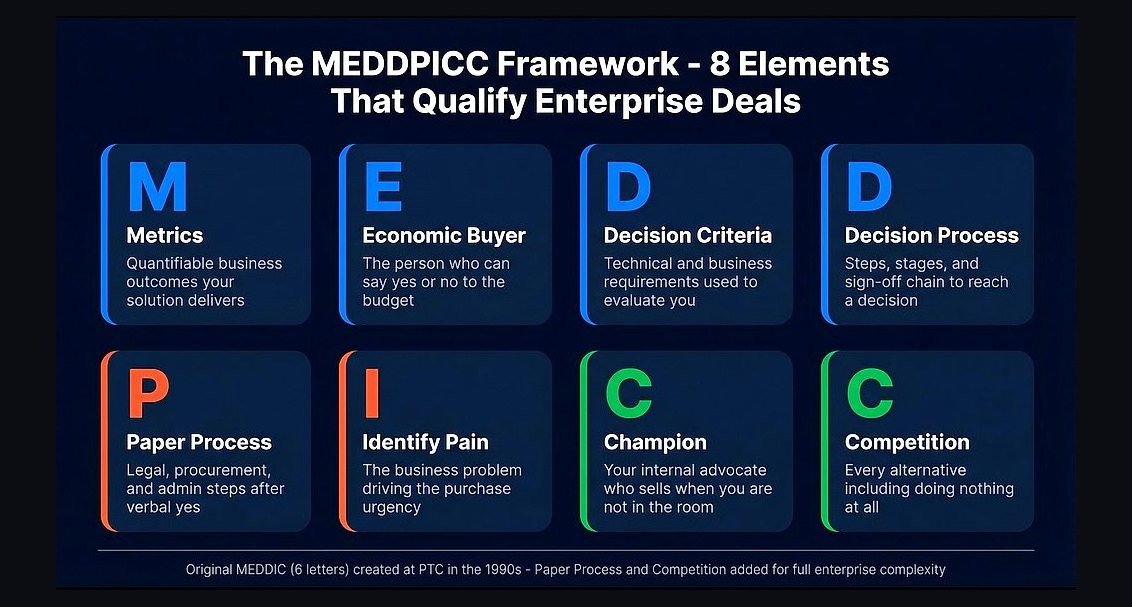
Option one: manual, stage-gated scoring. The AE scores criteria by hand, but only the criteria relevant to the current deal stage. At Qualification, that might mean just Metrics and Economic Buyer — can the prospect articulate a measurable outcome, and do you know who controls budget? At Discovery, you add Decision Criteria and Paper Process. At Evaluation, you layer in Identify Pain, Champion, and Competition. This keeps the cognitive load to 2-3 fields at any given moment instead of demanding all eight MEDDPICC letters on every deal from day one. The tradeoff is that it still relies on AE judgment and discipline — if a rep skips the field, nothing catches it until a manager reviews the pipeline.

Option two: automated composite scoring. Here, RevOps builds a single numeric field (commonly 0-100) that auto-calculates from the individual MEDDPICC fields already present on the opportunity record. The AE never "scores" anything directly — they fill in the normal deal fields (close date, next step, stakeholder roles) and the CRM's formula or flow logic derives the composite. Automation then acts on that score: dropping it below a threshold triggers a pipeline-review flag, crossing an upper threshold nudges the deal into a higher-confidence forecast category. This removes double-entry entirely, but it only works if the underlying fields are reliably populated — automation amplifies good data hygiene and just as efficiently amplifies bad hygiene.
Most mature RevOps orgs in 2027 end up running both simultaneously: stage-gated manual scoring for the subjective criteria (Pain, Champion strength, Competition posture) that genuinely need human judgment, and automated composite scoring for the objective criteria (Economic Buyer identified, Decision Criteria documented, Paper Process mapped) that can be inferred from field completion. The mistake almost every team makes is defaulting to manual scoring for everything, which is exactly what generates AE overwhelm — reps end up re-entering judgment calls that the CRM could have computed from data they already typed in three fields earlier.
The other axis worth separating is *who consumes the score*. AEs need the score to be nearly invisible — a color, a badge, an inline nudge. Managers need the score to be inspectable — one saved report, filtered to their pod, refreshed weekly. Executives need the score aggregated — a single deal-health number per opportunity, never the raw eight-criteria breakdown. Building one scoring surface that tries to serve all three audiences at once is a second, quieter way teams overwhelm AEs: the rep-facing view ends up cluttered with fields that exist only for the executive dashboard.
How to decide between them

Deciding between manual and automated (or, more realistically, deciding the split between them) comes down to three questions: how objective is the criterion, how much does the underlying field already exist in the CRM, and how much does getting it wrong cost you in forecast accuracy.
If a MEDDPICC criterion can be derived from a field the AE is filling in anyway — Economic Buyer role, a Decision Criteria document link, a signed mutual close plan for Paper Process — automate it. There is no reason to ask a rep to also manually rate something the system can infer. If a criterion is inherently judgment-based — how strong is the Champion, really, or how contested is Competition — keep it manual, but constrain the input to a simple low/medium/high dropdown rather than a free-text or precise numeric entry. Precision on subjective criteria is false precision; it just adds typing time without adding signal.

The second decision layer is stage relevance. Don't ask for Competition scoring during Qualification — you likely don't even know if there's a competitive process yet, so forcing the field just trains AEs to enter garbage to get past validation. Map every criterion to the earliest stage where it can be answered honestly, and hide it before that stage rather than making it optional. Optional fields under time pressure get skipped; hidden fields don't exist to be skipped.
The third layer is cost of error. Metrics and Economic Buyer drive forecast category logic directly — a deal without a confirmed Economic Buyer probably shouldn't sit in Commit or Best Case, so that criterion deserves both a manual score and a validation rule that blocks the stage advance. Champion strength and Competition, by contrast, are diagnostic more than gating — useful for coaching conversations, less useful as a hard forecast blocker, because judgment on those two criteria varies more between AEs than judgment on Economic Buyer does. Gate hard on the criteria with low judgment variance; keep the high-variance criteria advisory and route them into coaching rather than into automated forecast downgrades.
A practical decision test that scales across a RevOps org without a dedicated MEDDPICC administrator: for each of the eight letters, ask "if I removed this from the AE's screen entirely and computed it from other fields, would the coaching conversation lose anything?" If the answer is no, automate it silently. If yes, keep it manual but strip it down to the smallest possible input — a click, not a paragraph.
Concrete numbers behind each option

The numbers matter here because "reduce AE overwhelm" is meaningless without a target. Teams that have operationalized MEDDPICC scoring successfully report a consistent range of outcomes worth using as benchmarks when you set up your own pilot.
Time per deal. Manual stage-gated scoring, done correctly with 2-3 visible criteria per stage, should take an AE under 60-90 seconds per deal update. If your rollout is measuring 3+ minutes per scoring pass, the rubric is too heavy for that stage — pull a criterion out and defer it to the next stage instead of trying to trim it in place. Fully automated composite scoring should cost the AE zero incremental time beyond the field entry they were already doing.
Cognitive load reduction. Splitting all eight MEDDPICC criteria across three stages instead of presenting all eight at once cuts the number of fields an AE sees at any single touchpoint by roughly 50-70%. Concretely: instead of eight fields on every deal-stage view, an AE sees 2 at Qualification, 2 more added at Discovery (4 total visible, but only 2 newly required), and 3 more at Evaluation (7-8 total, only 3 newly required at that point). The AE is never asked to reason about more than 2-3 *new* judgments in a single sitting.
Adoption timeline. A well-run pilot on one pod (3-5 AEs) typically reaches meaningful voluntary adoption — AEs scoring without being chased — within 6-8 weeks, with adoption in the 80-90% range by the end of that window, provided the rubric stayed lightweight and managers used the score in real coaching conversations rather than only in compliance audits. Rollouts that skip the pilot and go company-wide immediately tend to see adoption plateau closer to 40-50%, because the rubric was never calibrated against real objections before it hit the full team.

Fill-rate gate before automation. Do not turn on score-driven automation (auto-routing, auto-downgrading forecast category, auto-flagging for review) until required-field fill rate on the underlying MEDDPICC fields exceeds roughly 80% within the pilot segment. Below that threshold, automation is acting on missing data as much as real data, and a single bad automated downgrade during a board-week forecast call will kill trust in the whole system faster than a slow rollout ever would.
Score volatility as a health signal. If a deal's composite score swings more than roughly 20-25 points week over week without a corresponding stage change or a logged event (new stakeholder, competitive threat surfaced, budget event), that volatility itself is worth flagging — it usually means the AE is scoring inconsistently rather than the deal genuinely changing, and it's a better coaching trigger than the absolute score value.
Composite score thresholds. A common, defensible starting configuration: scores under 40 flag for mandatory weekly review; 40-70 sits in normal pipeline with no special handling; above 70 becomes eligible for Best Case or Commit forecast categories, but only in combination with the hard gate that Economic Buyer and Decision Criteria fields are both populated — never let a high composite score alone override missing gating fields, or you've just rebuilt the "verbal commit with no evidence" problem MEDDPICC was supposed to solve.
Implementation details and sequencing

Sequencing matters more than any individual configuration choice, because the order you introduce pieces determines whether AEs experience this as a scoring layer on top of MEDDPICC or as a scoring layer instead of MEDDPICC done properly.
Start with a single owner — not a committee — who has write access to CRM validation rules and a direct line to a manager willing to enforce inspection in real 1:1s and pipeline reviews. Publish a one-page definition of done: which fields exist for each MEDDPICC letter, which stage each becomes required at, and what a "complete" score looks like at each gate. This document should live in the sales wiki, linked from the CRM report itself, not buried in a slide deck nobody reopens after the kickoff call.
Baseline before you build anything. Pull 20-30 recent closed-lost or stalled deals and manually MEDDPICC-score them retroactively. This does two things: it calibrates what "good" actually looks like for your specific market and deal size, and it gives you a before/after comparison point once the pilot runs. Skipping this step is the single most common reason rollouts drift — without a baseline, nobody can prove the scoring changed anything, and it gets deprioritized the moment a busier initiative shows up.
Build the fields in this order: first the objective, automatable ones (Economic Buyer identified, Decision Criteria documented, Paper Process mapped) as simple CRM fields with validation on save. Second, wire the composite score formula that reads those fields. Third, add the subjective manual fields (Pain, Champion, Competition) as constrained dropdowns, stage-gated so they only appear when relevant. Only after both layers exist and the composite score is calculating correctly do you turn on any automation — routing, alerts, or forecast-category changes. Automation before the underlying fields are trustworthy is the fastest way to make AEs distrust the entire system, because they'll see a deal auto-flagged or auto-downgraded based on a field nobody actually filled in correctly yet.

Run the pilot itself in two phases. Weeks one and two are training and calibration: pick a receptive pod, run two short sessions walking through the phased rubric, and have the group score five historical deals together so everyone converges on what "Champion: medium" actually means in practice — disagreement here is normal and useful, it's cheaper to resolve on old deals than on live pipeline. Weeks three and four move to live scoring with a standing weekly 30-minute review where the pod discusses any scoring disagreements and the owner updates the definition-of-done doc in response. Track two numbers through this phase: time spent scoring per deal, and directional forecast accuracy (predicted vs. actual close rate for scored vs. unscored comparable deals).
Manager inspection should be a 10-15 minute mechanical routine, not a narrative status meeting: open the one saved report filtered to the pilot segment, sort by exception flag, and for each flagged record name the missing field, assign an owner, and set a due date before the next forecast call. Deals in Commit or Best Case with empty required MEDDPICC evidence fields get downgraded in that same meeting — never on the strength of a verbal assurance from the AE.
Only expand past the pilot pod once fill rate has held above 80% for two consecutive inspection cycles. When you do expand, copy the exact same fields, the exact same saved report structure, and the exact same weekly cadence to the next pod — resist the urge to "improve" the rubric for the second rollout before you've proven the first one holds under normal quarter-end pressure. If fill rate drops for two weeks straight after automation is live, turn the automation off and go back to manual inspection until the root cause is fixed; automation should never be allowed to keep running on top of visibly decaying data quality just because it was expensive to build.

Document which fields sync from a data warehouse or billing system before wiring anything to automation, and if IT can't move fast enough on integrations, run the pilot on CSV exports uploaded twice weekly rather than waiting for perfect plumbing — the scoring habit and manager inspection discipline matter more in the first month than whether the pipe is fully automated on day one.
Related questions
How do you operationalize sales methodology (MEDDPICC, Challenger, Sandler) without killing rep morale?
Keep the methodology's footprint on the AE's screen small and stage-gated, tie it to coaching rather than compliance scoring, and let managers use it in 1:1s before making it a forecast gate. Morale drops when a methodology feels like an audit, not when it feels like a tool.
What's the right way to share customer health data with reps without overwhelming them with dashboards?
Surface one composite number per account inline in the workflow reps already use, not a separate dashboard requiring a context switch. Detail should be one click away, not the default view.
How should managers structure 1:1 cadence for maximum coaching impact without overwhelming reps?
Weekly 15-30 minute 1:1s anchored to one saved pipeline report work better than ad hoc narrative check-ins; the report gives both parties the same starting point instead of relying on the AE's verbal summary.
What is the 2027 reality of MEDDIC and MEDDPICC with AI deal scoring?

AI increasingly pre-fills the objective criteria (Economic Buyer, Decision Criteria, Paper Process) from call transcripts and email threads, leaving AEs to confirm rather than originate the data — shifting manual effort toward the genuinely subjective criteria like Champion and Competition.
How do you operationalize Palantir partner marketplace lead routing without breaking attribution in Salesforce?
Route on explicit source fields captured at lead creation, never inferred from downstream campaign membership, and reconcile attribution weekly against the same saved report the routing rule reads from — the same "one report, one owner" discipline that keeps MEDDPICC scoring honest applies to routing logic too.
FAQ
What's the simplest way to start MEDDPICC scoring without adding admin time? Pick one criterion — Pain or Decision Criteria works well — and score it on a simple low/medium/high scale in the CRM right after each discovery call. This keeps the initial lift minimal while the habit forms, and you layer in additional criteria over the following weeks once that single field is sticking.
How do I prevent AEs from gaming the scores to hit quotas? Route scores through a manager or deal-desk review before they influence forecast visibility, use coarse low/medium/high bands instead of precise numbers for subjective criteria, and tie scoring accuracy to coaching conversations rather than compensation. Removing the direct link between self-reported score and commission removes most of the incentive to inflate.

Should we score every deal, or only certain stages? Only start scoring once a deal reaches a defined stage such as Qualified or Discovery Complete. Scoring raw, unqualified leads adds data-entry burden with no decision attached to it yet — expand backward into earlier stages only after the team sees clear value from scoring the later ones.
What if our AEs push back on the time it takes to score? Automate the objective criteria — Economic Buyer, Decision Criteria, Paper Process — by deriving them from fields AEs already complete elsewhere in the record. For the remaining subjective criteria, limit input to a single dropdown rather than free text, which typically brings manual scoring time under 30-60 seconds per deal.
How do we know if our scoring is actually improving outcomes? Run a focused pilot on one pod comparing scored versus unscored deals on stage-to-stage conversion and forecast accuracy, using one consistent before/after report. Only automate or expand company-wide once that comparison shows a measurable, repeatable improvement — not before.
Can we operationalize this without a dedicated RevOps team? Yes. A shared CRM field set with one accountable owner — a senior AE or frontline sales manager — auditing the saved report weekly is enough to run a lightweight version of this. Full automation and a dedicated administrator become worthwhile once the manual version has proven the fields and cadence work.
Sources
- https://www.meddicc.com/
- https://www.gartner.com/en/sales/insights
- https://www.forrester.com/blogs/category/sales/
- https://hbr.org/topic/subject/sales
- https://www.salesforce.com/resources/articles/sales-methodology/
- https://blog.hubspot.com/sales/sales-methodology
- https://business.linkedin.com/sales-solutions/blog
Related on PULSE
- How should managers structure 1:1 cadence for maximum coaching impact without overwhelming reps?
- What's the right way to share customer health data with reps without overwhelming them with dashboards?
- How do we operationalize sales methodology (MEDDPICC, Challenger, Sandler) without killing rep morale?
- What is the 2027 reality of MEDDIC and MEDDPICC with AI deal scoring?
- Top 10 MEDDPICC Coaching Checks for AEs
- How do you operationalize Palantir partner marketplace lead routing without breaking attribution in Salesforce?
This page will be disappearing soon. Save it to your device for $1 — or read it free while it is here.
@Kory-White- · if Venmo asks, the last 4 of my number are 2012
This page is gone.
This one is off the shelf now. $1 keeps it on your phone for good — the whole page, pictures and diagrams included.
 revopsHow do you decide if a full-time CRO is right for a PE-backed company when sales and marketing are misaligned in 2027?
 revopsHow do you decide if a CRO advisory before a full-time hire is right for a Series A company when founder wants to step back from selling in 2027?
 revopsHow do you calculate true pipeline coverage when usage-based deals have variable ACV in 2027?
 revopsHow do you decide if a interim CRO is right for a post-merger company when sales and marketing are misaligned in 2027?
 revopsHow do you decide if a interim CRO is right for a bootstrapped profitable company when international expansion next year in 2027?
 revopsHow do you measure RevOps team ROI when finance only recognizes bookings in 2027?
 revopsHow do you detect when reps skip MEDDPICC fields on Commit-stage opportunities automatically in 2027?
 revopsHow do you standardize RFP artifacts when Gotham integration is a mandatory evaluation criterion in 2027?
 revopsHow do you decide if a CRO advisory before a full-time hire is right for a Series A company when preparing for fundraise in six months in 2027?
 revopsHow do you rebuild pipeline hygiene after a CRM migration rollback in 2027?