


What is OTE in sales — and what does it actually mean for take-home pay in 2027?
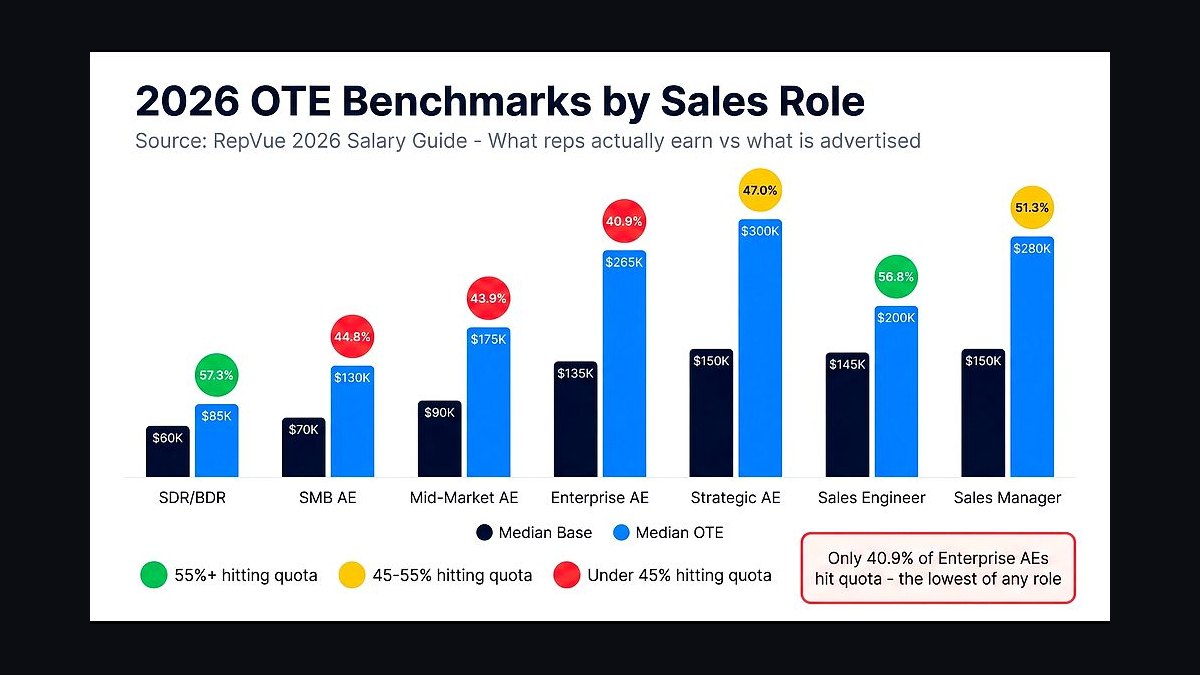
OTE — On-Target Earnings — is the total cash compensation a salesperson earns when they hit exactly 100% of their annual quota. It is the sum of base salary plus on-target variable commission. OTE is not a salary, not a guarantee, and not a cap. In 2027 the realistic distribution looks like this: most reps land between 70% and 100% of quota, so the typical AE on a $200K OTE actually takes home around $170K. The honest read is base salary plus roughly 70% of the variable component, not the full posted number.
TL;DR
- OTE equals base salary plus variable commission at 100% quota attainment — not a cap, not a guarantee, not a salary.
- Standard splits: AE 50/50, SDR 60/40, CSM 70/30, RevOps Manager 80/20 — the higher the variable percentage, the higher the risk.
- 2027 benchmarks: SMB AE $120-180K, Mid-Market AE $180-240K, Enterprise AE $250-350K, Strategic AE $350-500K, SDR $75-110K, CSM $120-220K.
- Average AE hits ~65-70% of quota, so a $200K OTE realistically pays $170K in an average year, $250K+ in a great year, and $115-135K in a bad year.
- Watch the language traps: "up to" signals a cap, "includes equity" compresses cash, "Year-1" hides a ramp drop, and "performance OTE" can mean almost anything.
The Math, with worked examples at 50%, 70%, 100%, and 150% attainment
Take a Mid-Market Account Executive at a SaaS company on a $200K OTE with a standard 50/50 split. That means $100K base salary and $100K variable commission tied to a quota of, say, $1.2M in new ARR. Commission is paid as a rate against bookings — roughly 8.3% in this case, which gets you to $100K variable when you book the full $1.2M.

At 50% attainment ($600K booked), the rep earns $100K base plus $50K variable for a total of $150K — a 25% miss against the posted OTE. This is the territory where Performance Improvement Plans get drafted and the rep starts updating their LinkedIn.
At 70% attainment ($840K booked) — the Pavilion 2024 median for B2B AEs — the rep earns $100K base plus $70K variable for $170K total. This is the honest average. Most reps live here. The posted OTE was $200K, but the realistic take-home is $170K. That 15% gap between the recruiting brochure and the W-2 is the single most under-discussed number in sales compensation.

At 100% attainment ($1.2M booked), the rep earns the full $200K OTE. Roughly 30-35% of reps cross this line in any given fiscal year, per RepVue's 2024 self-reported data. Crossing 100% usually unlocks the next mechanic: accelerators.
At 150% attainment ($1.8M booked), accelerators kick in. A typical plan pays 1.5x to 2x the commission rate above quota. So the rep earns $100K base, the first $100K of variable at 100% attainment, then another $100K of bookings worth $150K-$200K in accelerated commission — a take-home of $350K-$400K on a $200K OTE. This is why top reps stay where they are: the upside is asymmetric. Anyone telling you OTE is a cap has either never sold or works for a company you should not work for.

OTE Benchmarks by Role and Segment
The numbers below blend Pavilion's 2024 Compensation Benchmarks, the Alexander Group 2024 Sales Comp Survey, the Bridge Group SDR Metrics Report, and RepVue self-reported data. Geographic baseline is remote-US; add 15-25% for NYC/SF, subtract 10-15% for secondary markets.

| Role | Segment | Base | Variable | Total OTE | Split |
|---|---|---|---|---|---|
| SDR / BDR | All | $45K-$65K | $30K-$45K | $75K-$110K | 60/40 |
| Sr SDR / Team Lead | All | $65K-$80K | $40K-$55K | $105K-$135K | 60/40 |
| AE | SMB | $60K-$90K | $60K-$90K | $120K-$180K | 50/50 |
| AE | Mid-Market | $90K-$120K | $90K-$120K | $180K-$240K | 50/50 |
| AE | Enterprise | $125K-$175K | $125K-$175K | $250K-$350K | 50/50 |
| AE | Strategic | $175K-$250K | $175K-$250K | $350K-$500K | 50/50 |
| CSM | IC | $85K-$125K | $35K-$55K | $120K-$180K | 70/30 |
| Sr CSM | IC | $115K-$155K | $45K-$65K | $160K-$220K | 70/30 |
| RevOps Manager | All | $130K-$170K | $30K-$50K | $160K-$220K | 80/20 |
Two patterns to notice. First, base salary scales roughly linearly with segment, but variable scales with average deal size and sales cycle complexity — which is why Enterprise AEs out-earn SMB AEs by 2-3x on a per-rep basis even though they close one-tenth the deals. Second, the variable percentage drops as you move from front-line selling into customer-facing or operations roles. A RevOps Manager carrying 20% variable is taking less compensation risk than an AE carrying 50% — and is also less correlated with quarterly company performance, for better and worse.

The 4 OTE Language Traps to Watch in Job Offers

First, "OTE up to $250K." The phrase "up to" almost always signals a cap. Read the comp plan PDF before you sign. If the plan caps variable at 100% of target with no accelerators, you have a salaried job dressed up as a sales role and your upside is structurally limited regardless of how well you perform.
Second, "OTE includes equity." This usually means the cash OTE is meaningfully lower than the headline. A "$300K OTE including equity" at a Series B startup often decomposes to $180K cash OTE plus $120K of options valued at the last preferred round price — options that, on average, are worth zero at exit. Always ask for the cash split.

Third, "Year-1 OTE." This typically reflects a ramp guarantee — a floor on variable commission for the first one to four quarters while the rep builds pipeline. Year-2 OTE reverts to the standard plan, which is almost always lower because the ramp guarantee disappears. Ask explicitly what the post-ramp OTE looks like.
Fourth, "Performance OTE" or "Accelerated OTE." These are marketing terms with no industry-standard definition. They usually mean the company is quoting a 110% or 120% attainment number to make the offer look richer than peers. Translate it back to 100% OTE before you compare offers.
Related on PULSE
- What's the OTE breakdown for inside vs field sales at $30k ACV?
- What is OTE (On-Target Earnings) and how is it structured in 2027?
- How do you hire fractional revenue help when you cannot afford full-time CRO OTE?
- What's a fair OTE for an enterprise AE selling $100k+ ACV deals in 2026?
- Why did my OTE drop 25% with no explanation?
- How should SE comp align with AE OTE to maintain role clarity?
How OTE Is Structured: Common Compensation Models
The way OTE is split between base salary and variable commission varies widely by role, industry, and company stage. In 2027, the most common splits fall into three buckets. 50/50 splits are typical for enterprise sales roles where deals are large and cycles are long — a $200K OTE might include a $100K base and $100K variable. 60/40 splits are common in mid-market sales, offering more stability with a $120K base and $80K variable. 70/30 splits appear in SDR/BDR roles and inside sales, where the base is higher relative to variable — roughly $140K base on a $200K OTE. Some companies use a 40/60 split for high-risk, high-reward roles like founding sales at startups, but this is less common. The split directly impacts take-home predictability: a higher base means more consistent income, while a higher variable means greater upside but also greater risk of falling short of OTE.
The Reality of "On-Target" Performance
The term "on-target earnings" implies that hitting 100% of quota is the norm, but industry data tells a different story. Across SaaS and B2B sales in 2027, only about 30-40% of reps actually achieve 100% or more of their annual quota in a given year. The median quota attainment typically hovers around 70-85%, meaning the average rep earns between 70% and 85% of their OTE. This is why a $200K OTE often translates to $140K-$170K in actual take-home pay. The gap between OTE and real earnings is most pronounced in the first half of the year, as many reps ramp up their pipeline. By Q4, performance often improves as reps close deals to hit accelerators, but the annual average still falls short of the posted number. Smart reps negotiate their base salary rather than the total OTE, because the base is the only guaranteed portion.
How to Evaluate an OTE Offer Realistically
When you receive a job offer with a stated OTE, you need to dig into three critical factors to estimate your actual take-home pay. First, ask about quota attainment rates for the team — specifically what percentage of reps hit 80%, 100%, and 120% of quota in the last two years. If less than 50% of reps hit 100%, the OTE is effectively a ceiling, not a target. Second, examine the ramp period: many companies pay a reduced variable or a guaranteed minimum for the first 3-6 months, meaning your first-year earnings will be lower than the OTE suggests. Third, understand the accelerators and caps — some plans cap commission at 100% of quota, while others offer uncapped upside. A plan with accelerators (e.g., 1.5x commission above 100%) can push your actual earnings above OTE if you overperform. Finally, always ask for the average tenure of top performers; if it's under 12 months, the role may have unrealistic targets or poor culture, making the OTE even less reliable.
FAQ
Does OTE mean I’m guaranteed to earn that amount? No. OTE is a target, not a guarantee. Your take-home pay depends on hitting quota — most reps land between 70% and 100% of their target, so actual earnings are typically base salary plus roughly 70% of the variable component.
What happens if I exceed 100% of quota? You can earn more than OTE through accelerators, which pay a higher commission rate on overachievement. But OTE itself is not a cap — it’s just the number at 100% attainment.
Is OTE the same as my base salary? No. OTE includes both base salary and variable commission. The split varies, but a common range is 50/50 to 70/30 (base/variable). Your base is fixed; the variable depends on performance.
How do companies calculate OTE? They multiply your quota (e.g., $1M in annual sales) by a commission rate (e.g., 10%), then add your base salary. So a $100K base plus $100K variable at 100% quota gives a $200K OTE.
Why do job postings list OTE instead of base salary? OTE gives a fuller picture of potential total comp, especially in sales where variable pay is significant. But it can be misleading — always ask for the base salary and typical attainment rates to estimate real take-home.
Can my OTE change year to year? Yes. Companies may adjust quotas, commission rates, or base salaries annually. Your OTE for a new role is typically set at hiring, but actual earnings fluctuate with performance and market conditions.
Sources
- Pavilion 2024 GTM Compensation Benchmarks Report
- Alexander Group 2024 Sales Compensation Trends Survey
- Bridge Group 2024 SDR Metrics and Compensation Report
- RepVue 2024 Sales Compensation Data (self-reported, 50K+ reps)
- CaptivateIQ 2024 Sales Compensation Trends Report
- Levels.fyi Sales Compensation Data (public and private company filings)
- Gartner CSO Sales Compensation Benchmarking 2024
- LinkedIn Talent Insights Sales Compensation Report 2024
This page will be disappearing soon. Save it to your device for $1 — or read it free while it is here.
@Kory-White- · if Venmo asks, the last 4 of my number are 2012
This page is gone.
This one is off the shelf now. $1 keeps it on your phone for good — the whole page, pictures and diagrams included.
 revopsWhat are Kansas Jayhawks men's basketball's 2027 NIL needs and strategy?
 revopsHow do you design sales-assist for a PLG motion in 2027?
 revopsHow do you build a peer-coaching library that AEs actually use in 2027?
 revopsHow should a 2027 sales org handle compensation impact during a performance improvement plan?
 revopsWhat is the product-led-sales (PLS) playbook in 2027?
 revopsWhat are the 2027 best churn-save playbooks?
 revopsHow do you compare quotas across sales segments in 2027?
 revopsWhat are the basic qualifying criteria for a sales deal in 2027?
 revopsHow should a 2027 CS team respond to a coordinated customer revolt?
 revopsHow should a 2027 RevOps team build an ICP scoring rubric?