


How do you actually build a lead scoring model that works in 2027?
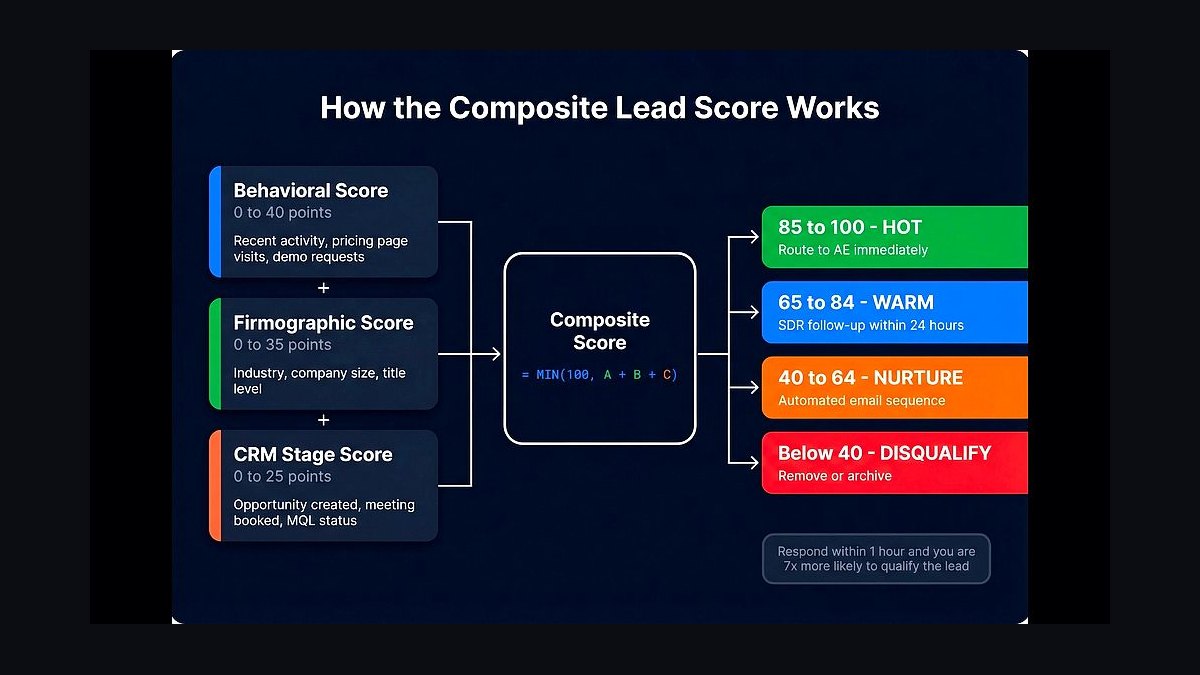
A lead scoring model that actually works is a composite — FIT signals (industry, company size, geography, tech stack) multiplied by INTENT signals (page views, demo requests, content downloads, third-party intent data), with negative scoring layered on top and decay built in. Most 2027 teams pick from three approaches — rule-based (HubSpot/Marketo defaults), predictive ML (Einstein, MadKudu), or account-based (6sense, Demandbase) — and the dominant enterprise pattern is now account-level, not lead-level. The honest truth is that 80% of lead scoring is theatrical because the model never gets validated against actual closed-won rates.
TL;DR
- A real score is FIT times INTENT, not FIT plus INTENT — a perfect-fit account with zero intent is not hot, and a high-intent stranger is usually a competitor or a student
- Three model approaches in 2027 — rule-based (free, stale fast), predictive ML (65-80% accurate, $30-100K), account-based (the enterprise default, $150-500K)
- Negative scoring (free email domains, competitor companies, students, unsubscribes) matters more than positive scoring
- Decay rules (drop points after 30, 60, 90 days of inactivity) keep zombie leads out of the AE inbox
- Validate quarterly against closed-won — a score that never gets a feedback loop is decoration
Fit times Intent (Not Fit plus Intent)
%20How%20do%20you%20actually%20build%20a%20lead%20scoring%20%2C%20realistic%20magazine%20style%2C%20warm%20light%2C%20no%20text%2C%20no%20watermark?width=1200&height=675&nologo=true&model=flux&seed=92116)
The single most common mistake in lead scoring is additive math. A team builds a model where industry match is worth 20 points, demo request is worth 30, and pricing-page visit is worth 15 — then a Series A startup CEO who browsed your pricing page once scores 45, and a Fortune 500 procurement intern who downloaded six whitepapers scores 90. The procurement intern goes to the AE. The CEO gets a drip email. This is how lead scoring loses the trust of every sales team that has ever existed.

The correct mental model is multiplicative. FIT is a yes-or-no question — does this account look like the accounts that actually close? Industry, employee count, revenue band, geography, installed tech stack (Clearbit, ZoomInfo, BuiltWith, HG Insights all feed this). INTENT is a separate yes-or-no question — is this person showing buying behavior right now? Demo request, pricing page, repeat visits, comparison-page views, third-party surge signals from 6sense or Bombora.

A lead that is 90 on fit and 10 on intent is a perfect prospect who is not ready. A lead that is 10 on fit and 90 on intent is a tire-kicker, a student, a competitor doing recon, or a job seeker. Neither is hot. Only the intersection — high fit AND high intent — is worth waking up an AE for. Multiplication enforces this. Addition does not.

The 3 Model Approaches
| Approach | How It Works | Pros | Cons | Cost | Best For |
|---|---|---|---|---|---|
| Rule-based (point-additive) | Marketer assigns points to attributes and behaviors in HubSpot, Marketo, Pardot | Transparent, easy to explain, no ML black box, free with platform | Stale within 6 months, biased by whoever wrote it, no feedback loop | Free with HubSpot/Marketo/Pardot | Sub-$10M ARR, simple ICP, small marketing team |
| Predictive (ML-trained) | Model trained on historical closed-won and closed-lost data, outputs probability score | 65-80% accuracy in published benchmarks, surfaces non-obvious patterns, auto-updates | Black box, needs 1000+ closed-won examples, garbage-in-garbage-out if CRM data is dirty | HubSpot Predictive (Enterprise tier), Einstein $150/user/mo, MadKudu $30-100K/yr | $10-100M ARR, clean CRM, enough deal volume to train |
| Account-based scoring | Scores ACCOUNTS not individual leads using intent data, technographics, engagement aggregated across the buying committee | The 2027 enterprise default, matches how B2B actually buys (by committee), works with ABM motion | Expensive, requires intent data subscription, doesn't help if you sell to SMB | 6sense $150-500K/yr, Demandbase similar, ZoomInfo Sales OS $50-150K | Enterprise B2B, 5+ person buying committees, ABM-aligned GTM |
The honest 2027 read is that rule-based is what 70% of mid-market still runs because it's free, predictive is the upsell push from HubSpot and Salesforce, and account-based is what serious enterprise revenue teams have moved to because individual lead scoring stopped matching reality when the average B2B deal started involving 6-10 stakeholders.
The 5 Honest Truths About Lead Scoring
One — most lead scoring is theater. The model was built once during an MOps onboarding, never validated against closed-won rates, and now nobody on the team can explain why the threshold is 75. Forrester's 2024 ABM Wave found that fewer than 30% of B2B marketing teams could produce a quantitative correlation between their MQL score and pipeline conversion. The rest were running scoring as ritual.

Two — third-party intent signals are noisy at the lead level and useful at the account level. Bombora and 6sense topic surge data is genuinely predictive when you aggregate it across an account over weeks, but a single contact showing "researching CRM software" this week is barely a signal — could be them, could be 47 other people at that company, could be their nephew doing a school project. Aggregate it up to account, watch the trend over time, and now you have something.

Three — negative scoring matters more than positive. Most leaks in a scoring model come from not deducting points. Free email domain (gmail, yahoo, qq, proton) should be a hard cap or large negative. Competitor companies should be excluded outright. Job titles with "student," "intern," "researcher" should deduct. Roles that don't buy your product (interns, recruiters, vendors prospecting you) should deduct. A model that only adds points but never subtracts inflates every lead and trains AEs to ignore the score.

Four — decay is non-negotiable. A lead that visited your pricing page 90 days ago and went silent is not a hot lead anymore. Without time-decay rules (drop 25% of behavioral score after 30 days inactive, 50% at 60, 100% at 90), your hot-lead list fills with zombies. HubSpot, Marketo, and every predictive platform support decay; turning it on takes 20 minutes and the impact on AE trust is immediate.
Five — sales must know WHY a lead is hot. A score of 87 is meaningless to an AE. "Score 87 — VP at 2,000-person SaaS company, requested demo, viewed pricing 3 times this week" is a usable signal. The handoff payload should always include the top 3 signals that pushed the lead over threshold. This is the difference between a scoring system AEs trust and one they bypass.
Related on PULSE
- What specific metrics should B2B leaders track to prove AI-enhanced lead scoring works in 2027?
- What sales team specialization model works best for federal-focused SaaS vendors?
- What attribution model works for a multi-touch enterprise sales motion?
- How do you actually diagnose B2B SaaS churn — and what's the framework that works?
- What is an inbound qualification framework, and which one actually works (BANT, MEDDPICC, Sandler, etc.)?
- Should I Hire a Fractional CRO If My GTM Works in the US but Not Abroad?
Common Pitfalls That Kill Lead Scoring Models
Most lead scoring initiatives fail not because the concept is flawed, but because of three predictable mistakes. First, teams over-weight demographic data while under-weighting behavioral signals. A VP of Sales at a 500-person company who visits your pricing page three times in a week is almost certainly a hotter lead than a marketing coordinator at a 2,000-person company who downloaded one eBook six months ago. Yet many default models treat company size as the dominant factor.
Second, scoring models frequently ignore negative signals — the unsubscribe, the bounced email, the LinkedIn post complaining about your product category. Without explicit negative scoring, your model will surface tire-kickers and competitors alongside genuine buyers. Common negative signals include: job titles that indicate no purchasing authority (interns, students), companies in industries your product doesn't serve, and contacts from known competitor domains.
Third, and most damaging, teams never recalibrate their models. A model built on last year's closed-won data will miss shifts in buyer behavior. If your average deal cycle has shortened from 90 to 45 days, your scoring thresholds need adjustment. The fix is quarterly model audits where you compare scored leads against actual conversion data, then adjust weights accordingly.
How to Validate Your Model Without Expensive Tools
You don't need a data science team or a six-figure platform to validate whether your scoring model works. The most practical method is a simple retrospective analysis using your CRM. Export your last 100 closed-won deals and your last 100 closed-lost deals. For each, pull the lead score they had when they first entered your pipeline. If your model is working, the won deals should cluster in the top 30% of scores, while lost deals scatter across the lower 50-60%.
If you see won deals with low scores, your model is missing key buying signals. If lost deals have high scores, you're over-weighting vanity metrics like page views or form fills. A second validation method is the "time-to-conversion" test: leads with scores above your threshold should convert to SQLs in half the time of those below it. If they don't, your threshold is wrong or your signals are weak.
For teams without a CRM that supports easy exports, a manual spreadsheet audit of 50-100 recent leads works fine. Track three columns: lead score at entry, current stage, and whether they converted. The pattern will emerge within 30-40 records. This takes an afternoon and provides more actionable insight than any automated dashboard.
The Minimum Viable Scoring Model for Small Teams
If you're a team of 3-10 people with no dedicated RevOps person, a complex predictive model is overkill. Start with a 10-point manual system that you can implement in your CRM within two hours. Assign +3 points for any demo request or trial signup, +2 for pricing page visits (capped at two per week), +1 for content downloads from decision-maker roles, and -5 for competitor email domains or unsubscribes.
Set a threshold of 5 points for an SQL notification. This catches the obvious hot leads while ignoring the noise. The key is to keep this model for exactly 90 days, then run the retrospective validation described above. Most small teams discover that demo requests alone account for 70% of conversions, meaning the other signals add minimal value. In that case, simplify further: any demo request = hot lead, everything else = nurture.
This approach works because it forces you to test assumptions with real data before investing in automation. Many teams find that their "sophisticated" 30-variable model performs identically to a 4-variable one. Start simple, validate ruthlessly, then add complexity only where the data proves it matters.
FAQ
What is the difference between FIT and INTENT signals in lead scoring? FIT signals describe whether a lead matches your ideal customer profile, like industry, company size, or tech stack. INTENT signals show buying behavior, such as page visits or demo requests. Most models combine both, but FIT is often weighted more heavily in early stages.
How often should a lead scoring model be validated? Validation should happen at least quarterly against actual closed-won data. Many teams skip this step, which is why models degrade over time. A good range is every 3-6 months for rule-based systems, more frequently for ML models.
Can small businesses use lead scoring without expensive tools? Yes, rule-based scoring in platforms like HubSpot or Mailchimp works well for smaller teams. You can start with simple point systems (e.g., +5 for job title, +10 for website visit) and adjust manually. The key is to keep it simple and test it.
What is negative scoring and when should I use it? Negative scoring subtracts points for disqualifying signals, like competitors’ email domains or unengaged behavior. Use it sparingly—over-penalizing can kill good leads. A common approach is -10 for bounced emails or -20 for job titles outside your ICP.
How do account-based scoring models differ from lead-level ones? Account-based scoring evaluates the entire company, not just one person. It aggregates signals from multiple contacts at the same organization. This is now the dominant enterprise pattern because B2B purchases involve multiple stakeholders.
Why do most lead scoring models fail in practice? The main reason is lack of validation—teams build a model but never check if high-scored leads actually convert. Another issue is ignoring decay: a lead that was hot three months ago may no longer be interested. Regular audits and decay functions (e.g., halving scores after 30 days) help.
Sources
- HubSpot — "Lead Scoring Benchmarks Report 2024" (hubspot.com/research)
- Forrester — "The Forrester Wave: Account-Based Marketing Platforms, Q2 2024"
- MadKudu — "The State of Predictive Lead Scoring 2024" (madkudu.com/research)
- Pavilion — "2024 GTM Benchmarks: MQL to SQL Conversion Rates"
- 6sense — "2024 B2B Buyer Experience Report" (6sense.com/resources)
- Demandbase — "The 2024 ABM Benchmark Study" (demandbase.com/resources)
- Gartner — "Magic Quadrant for B2B Marketing Automation Platforms 2024"
- Salesforce — "Einstein Lead Scoring Methodology Documentation 2024"
This page will be disappearing soon. Save it to your device for $1 — or read it free while it is here.
@Kory-White- · if Venmo asks, the last 4 of my number are 2012
This page is gone.
This one is off the shelf now. $1 keeps it on your phone for good — the whole page, pictures and diagrams included.
 revopsWhat is lemlist and why is it a hot RevOps multichannel outreach platform for 2027?
 revopsWhat are Notre Dame Fighting Irish football's 2027 NIL needs and strategy?
 revopsHow do you design sales-assist for a PLG motion in 2027?
 revopsHow should a 2027 RevOps team handle outlier deals in the forecast?
 revopsHow do you compare quotas across sales segments in 2027?
 revopsWhat are Florida Gators football's 2027 NIL needs and strategy?
 revopsWhat is the product-led-sales (PLS) playbook in 2027?
 revopsHow do you actually use AI in B2B SaaS sales — and what's hype vs real in 2027?
 revopsWhat's the right interview process for hiring a great B2B SaaS AE in 2027?
 revopsHow should a 2027 CSM build an ROI justification ahead of renewal?