


How do you build a buyer persona that sales actually uses in 2027?
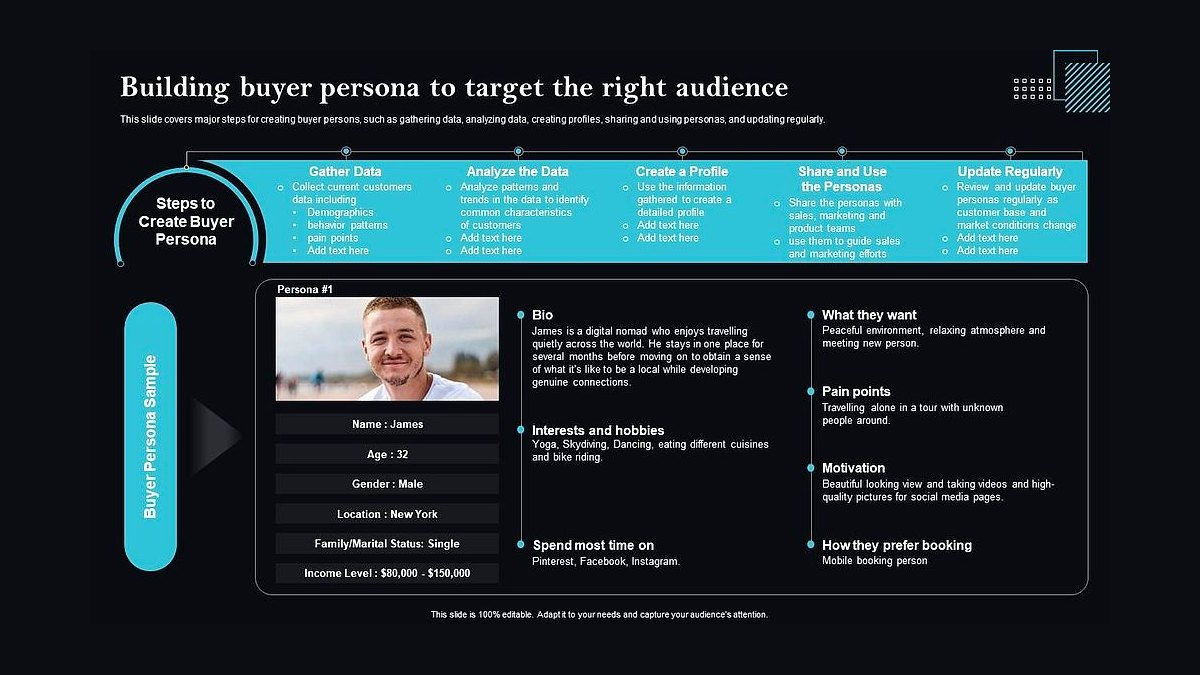
A buyer persona that sales uses is a research-based profile of one specific human role in your ICP, built around five things that drive behavior: the named title, the three KPIs they're measured on, what made their week awful this quarter, the vocabulary they actually use, and who they buy with. Skip fake names, hobbies, and stock headshots — none of that changes an AE conversation. Then embed the persona inside the sales playbook as discovery questions, demo angle, and objection responses. The persona IS the playbook section, not a deck.
TL;DR
- A persona describes a HUMAN role; ICP describes an ACCOUNT. Two different artifacts, often confused.
- Five elements drive behavior: named title, three KPIs, this-quarter pain, real vocabulary, buying committee.
- Cut bloat: no "Marketing Mary," no Peloton bio, no stock headshot — demographics don't change AE behavior.
- 80% of personas die in Notion. The 20% that work are embedded in the playbook as discovery, demo, and objection responses per persona.
- Cap at 3–5 personas, refresh quarterly from win-loss, and have sales co-author or adoption collapses.
The 5 Elements That Actually Matter (and the bloat to skip)
Most personas fail before an AE ever sees them because they are built to look complete instead of to change a conversation. A working persona has exactly five fields, each chosen because it changes what the seller says, asks, or shows in a live deal.

Named title. Not "decision maker" or "economic buyer." Write "VP of Sales," "Director of Sales Operations," "Manager of Field Marketing." Specific titles let an AE filter LinkedIn, pick a sequence, and choose a demo path. Generic role labels are unfilterable, so they get ignored.

The three KPIs they're measured on. A VP Sales is measured on attainment, pipeline coverage, and ASP — not "growth." A Director of Sales Ops is measured on forecast accuracy, rep ramp time, and CRM hygiene. When the AE knows the three numbers on the buyer's quarterly review, every discovery question and ROI slide locks onto them.
The pain that made this quarter awful. Lists of ten generic problems are useless. The single recurring complaint from your last ten win-loss interviews — "forecast missed 22% and the CEO called it out publicly" — gives the AE a one-line opener that earns a second meeting.

The vocabulary. Buyers don't say "fit" or "best-in-class platform." They say "the forecast was off again," "marketing's leads are garbage," "my team is drowning in admin." Capture twenty real phrases from Gong verbatim. AEs who echo buyer language close more than AEs who echo the marketing deck.
The buying committee — the other two-to-six humans in the room. Who influences? Who blocks? Who signs? A persona without a committee map produces single-threaded deals, and single-threaded deals lose 60% of the time.

Leave out, on purpose: invented names ("Marketing Mary"), fictional bios, age, hobbies, "she loves Peloton." None of it changes how the AE runs discovery. It is artifact bloat — it makes the doc look thorough and makes the seller skim past it.
Why 80% of Personas Are Dusty Notion Docs
Walk into almost any Series B-to-D B2B company in 2027 and you'll find a beautiful persona deck in Notion, Confluence, or a Drive folder labeled "GTM Foundations." Ask an AE to open it. They can't find it. Ask when they last used it. Last onboarding.

The failure pattern is the same everywhere: personas are built as standalone artifacts, presented at SKO, and orphaned. They have no surface area in the daily workflow. The CRM doesn't ask which persona was met. The discovery script doesn't branch. The demo doesn't change. The persona is functionally invisible.
The 20% whose personas actually move pipeline solve this with one move: the persona is not the artifact, the playbook is. The persona becomes a heading inside the playbook, and under it sit three things:

- Discovery questions — five to seven tied to that persona's three KPIs and weekly pain.
- Demo angle — which two or three capabilities to open with, in which order, with which proof points.
- Objection responses — the top three objections this title raises, with the validated 60-second reply for each.
When the persona lives inside the playbook this way, it shows up the moment a rep books a meeting. They open the playbook, scroll to "VP Sales," and read the seven discovery questions before the call. Adoption stops being a training problem and becomes the path of least resistance. Useful tooling along the way: HubSpot Persona Builder (free, basic), Sparktoro for audience research, Userfacing.com for interview synthesis, Klue for competitive overlap.

Real example: a $20M ARR DevOps SaaS had nine personas in a 60-page deck. AE adoption was 5%. RevOps cut it to three — VP Engineering, Director of Platform, Site Reliability Lead — and rebuilt the playbook so each persona had its own discovery, demo, and objection section. Two quarters later: playbook usage 78%, multi-threaded win rate up nine points, ASP up 14%.
The 3 Failure Modes That Crush Adoption

One: marketing built it alone. When product marketing writes the persona without an AE in the room, it reads like positioning. Sales doesn't see their buyers in the words. Fix: a frontline AE and a CSM co-author every persona — they've heard the language on hundreds of calls.

Two: never updated. The KPI that defined VP Sales in 2024 (rep productivity) isn't the one defining them in 2027 (AI co-pilot ROI). Without refresh against win-loss signal, the persona goes stale in two cycles and sellers stop trusting it. Run a 60-day cadence: ten win-loss interviews, update pain and vocabulary.
Three: too many. Past five, the AE can't remember the differences, collapses them into "the buyer," and ignores the segmentation entirely. Three is the sweet spot. Five is the cap. Anything beyond is a CMO chasing completeness, not a sales asset.
Related on PULSE
- Top 10 Buyer Persona Shifts in 2027 That Require New Sales Playbooks
- What is a buyer persona and how does it differ from an ICP?
- How should a 2027 GTM team build joint persona programs across sales and marketing?
- How have B2B sales cycles shifted in length for deals where the buying committee uses AI agents to pre-screen vendor demos in 2027?
- How do vendors successfully navigate a buying committee that uses AI to simulate competitor negotiation tactics?
- What are the most common friction points when a buying committee uses an AI procurement agent to negotiate contract terms in 2027?
The Three-Persona Rule: Why Sales Ignores a Single Profile
Most buyer persona exercises fail because they treat one persona as the sole decision-maker. In reality, B2B purchases involve at least three distinct human roles. Build a primary persona (the economic buyer who signs), a secondary persona (the champion who sells internally), and a tertiary persona (the blocker who can kill the deal). Sales uses personas only when they know exactly which questions to ask to identify which role they’re speaking to in the first five minutes.
For the primary persona, focus on budget authority and the specific metric they’ll be fired for missing. For the champion, map their internal political risk — what happens to them if your solution fails? For the blocker, document the one objection they always raise (e.g., “We tried this before” or “Security won’t approve”). When your CRM tags each contact with their persona role, your team knows whether to pitch ROI, provide social proof, or address risk mitigation. Without this trio, a single persona feels like a generic biography — interesting but useless in a live call.
Live Persona Validation: How to Test Your Draft in 48 Hours
Sales teams discard personas built from desk research because they’re never pressure-tested against real conversations. Instead, run a two-day persona validation sprint: take your draft persona to five existing customers who match that profile. Ask them three specific questions — “What was the worst part of your week last quarter that made you look for a solution like ours?”, “What exact words did you use in the internal email that got this approved?”, and “Who on your team almost killed this deal and why?” — and compare their answers to your draft.
Adjust the persona based on what you hear. You’ll almost always discover that the KPI you thought mattered is secondary to a hidden pain (e.g., “My boss hates surprises” or “I need to look smart in front of the VP”). Then paste the revised persona into your CRM as a deal stage checklist: before moving a deal to “Discovery Complete,” the rep must confirm they’ve validated the persona’s top KPI, vocabulary, and blocker. This turns the persona from a PDF into a workflow gate. Sales uses what forces them to slow down and listen — not what sits in a shared drive.
The Objection Playbook: Persona-Specific Responses That Close
The most practical persona application is a one-page objection matrix that maps each persona role to their top three objections and the exact rebuttal language. For example, if your primary persona is a VP of Sales measured on quota attainment, their top objection might be “We don’t have time to implement this.” The response isn’t a feature list — it’s a 30-second story about a peer who cut ramp time by two weeks using your tool. For the champion (e.g., a Sales Ops manager), the objection might be “I’ll get blamed if this breaks our CRM.” The rebuttal includes a reference call with another Ops manager who handled the integration smoothly.
Print this matrix on one page and laminate it for the sales floor — or pin it as a Slack shortcut. When a rep hears an objection, they glance at the persona role tag in the CRM, pick the matching row, and read the response verbatim. This removes the guesswork and makes the persona a tactical tool, not a theoretical exercise. Sales uses what saves them from thinking on their feet under pressure.
FAQ
How is a buyer persona different from an ICP? An ICP (Ideal Customer Profile) describes the company—industry, size, revenue. A buyer persona describes one human role inside that company: their title, KPIs, pain, vocabulary, and buying group. ICP tells you who to call; the persona tells you what to say.
Do I really need to interview real customers, or can I guess? You need at least 3–5 interviews with actual buyers who match your ICP. Guessing leads to generic personas that sales ignores. Honest range: interviews take 20–30 minutes each, and you’ll need 1–2 weeks to schedule and synthesize them.
What if my sales team still doesn’t use the persona? The persona must be embedded directly into the sales playbook—as discovery questions, demo angles, and objection responses—not a separate PDF or deck. If it’s not in the tool they use daily (CRM, call script, battle card), they won’t reference it.
Should I include fake names and stock photos? No. A fake name like “Marketing Mary” or a stock headshot doesn’t change how a rep talks to a real prospect. Focus on the five drivers: title, KPIs, weekly pain, vocabulary, and buying group. Those directly shape conversation.
How often should I update a buyer persona? Every 6–12 months, or whenever your product, market, or competitor market shifts significantly. Roles and KPIs change faster than company demographics. A stale persona can mislead reps.
Can one persona cover multiple roles in the same company? No. Each role (e.g., VP of Sales vs. Director of RevOps) has different KPIs, pain, and vocabulary. Build one persona per distinct role in your ICP. Overlapping them creates confusion and reduces usefulness.
Sources
- Adele Revella, *Buyer Personas* (Buyer Persona Institute, 2nd ed., 2024 update).
- Forrester, *B2B Buyer's Journey Study 2025* — committee size and discovery behavior.
- HubSpot, *Make My Persona Research Report 2024* — adoption rates inside sales orgs.
- Pavilion, *2024 GTM Benchmarks Survey* — persona usage across 1,200+ B2B sales teams.
- OpenView Partners, *2024 SaaS Benchmarks Report* — discovery-question impact on win rate.
- Gartner, *The B2B Buying Journey* (refresh, 2025) — 6–10 stakeholders per enterprise deal.
- Gong Labs, *Discovery Call Benchmarks 2024* — language-matching impact on second-meeting conversion.
- Sales Enablement PRO, *State of Sales Enablement Report 2024* — playbook-embedded persona adoption.
This page will be disappearing soon. Save it to your device for $1 — or read it free while it is here.
@Kory-White- · if Venmo asks, the last 4 of my number are 2012
This page is gone.
This one is off the shelf now. $1 keeps it on your phone for good — the whole page, pictures and diagrams included.
 revopsHow should a 2027 sales org distinguish ICP fit vs intent vs need?
 revopsRevOps-as-strategy vs RevOps-as-operations: which positioning in 2027?
 revopsWhat are North Carolina Tar Heels men's basketball's 2027 NIL needs and strategy?
 revopsWhat's a healthy AE ramp time — and how do you actually design ramp in 2027?
 revopsWhat are the basic qualifying criteria for a sales deal in 2027?
 revopsHow do you operate sales during a system outage during end-of-quarter in 2027?
 revopsHow should a 2027 sales enablement team run content audits at scale?
 revopsHow do you actually use AI in B2B SaaS sales — and what's hype vs real in 2027?
 revopsWhat are Penn State Nittany Lions football's 2027 NIL needs and strategy?
 revopsHow should a 2027 CS team respond to a coordinated customer revolt?