


How do you run a sales kickoff (SKO) that doesn't waste a week in 2027?
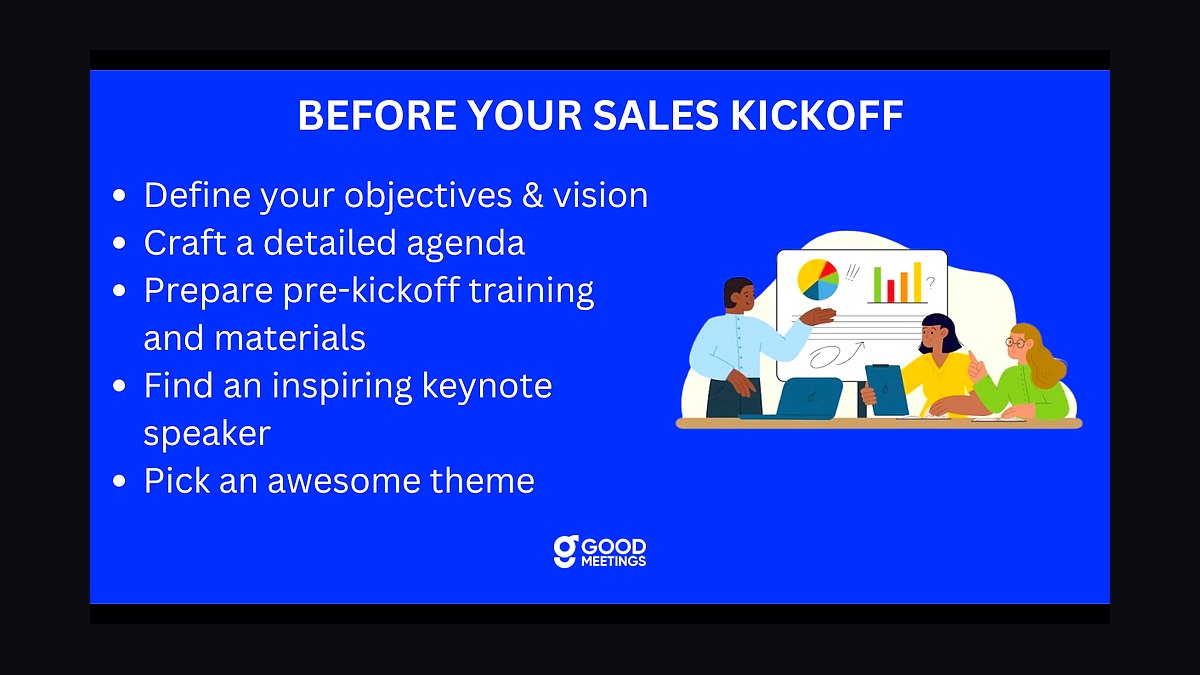
A sales kickoff that doesn't waste a week obeys one rule: every hour on the agenda must change a number, a behavior, or a belief — and you measure all three at T+30, T+60, and T+90 to prove it. The 20% of SKOs that actually move attainment share three traits: a single page of pre-work sent 30 days out, 60% of floor time in hands-on workshop (not keynote slides), and a written reinforcement plan owned by frontline managers. Everything else is a Cvent expense.
TL;DR
%20that%20doesn't%20waste%20a%20week%3F%2C%20realistic%20magazine%20style%2C%20warm%20light%2C%20no%20text%2C%20no%20watermark?width=1200&height=675&nologo=true&model=flux&seed=2443)
- A real SKO is the annual GTM gathering to launch the year's plan — comp, ICP, methodology, customer voice, recognition — typically 2-5 days, $1.5K-$5K all-in per attendee (Pavilion 2024).
- The number reveal (quota, comp, territory) is the only block AEs care about — put it first, get it over with, then earn their attention back.
- Lecture-heavy SKOs move attainment 0%. The ones that work allocate 60% of floor time to hands-on workshop with MEDDPICC drills, role-plays, and recorded demos with live feedback.
- One-shot SKOs die at T+14. Reinforce with Mindtickle/Highspot scorecards and manager 1:1s on a 30/60/90 cadence.
- Compress, don't expand. A $30M Series C cut from 3 days to 2 and hit 2x adoption of the new pricing motion by week 4.
The 6 Elements (in priority order)
%20How%20do%20you%20run%20a%20sales%20kickoff%20(SKO)%20that%20doe%2C%20realistic%20magazine%20style%2C%20warm%20light%2C%20no%20text%2C%20no%20watermark?width=1200&height=675&nologo=true&model=flux&seed=86010)
Most SKO agendas read like a leadership talent show. The element order below is what AEs actually need, ranked by how directly each one moves the next quarter's attainment.

| # | Element | Time | Who owns | Success metric |
|---|---|---|---|---|
| 1 | Number reveal + comp/quota/territories | 90-120 min, Day 1 AM | CRO + RevOps | 100% of AEs sign acknowledgement before end of Day 1 |
| 2 | Strategy talk track — why we win the next 12 months | 60 min, Day 1 PM | CEO + CRO live, no understudy | 80%+ of AEs can recite the 3-pillar narrative at T+30 |
| 3 | Methodology + skill workshop (hands-on, recorded) | 4-6 hr, Day 2 | Enablement + frontline managers | Recorded reps scored against rubric; pass rate >70% |
| 4 | Product roadmap + competitive update | 90 min, Day 2 AM | CPO + PMM | Win-rate vs named competitor tracked monthly post-SKO |
| 5 | Customer voice — live customer + 1 win story per segment | 90 min, Day 3 AM | CCO + Marketing | NPS of session >8; quotes lifted into pitch decks within 2 weeks |
| 6 | Recognition + culture (President's Club, awards) | One evening, Day 3 | CRO + People team | Attendance + retention of award-winners at 12 months |
Notice what's missing from the priority list: the 50-minute CFO budget update, the VP Marketing rebrand reveal, the HR benefits walkthrough. Those are async-video material. Every minute they steal from the floor is a minute not spent on the six things above.

The 5 SKO Failure Modes That Waste the Week
After watching dozens of mid-market SKOs through the 2024-2026 enablement cycle, the same five failure patterns repeat. Each one is fixable, and each one independently can torch the ROI of the entire event.

(a) Death by deck. Eight back-to-back leadership keynotes, all slide-driven, all 45-50 minutes. By hour four of Day 1, retention collapses. ATD's 2024 research pegs lecture retention at under 10% at T+7. Fix: cap keynotes at 25 minutes, hard-cap total keynote time at 25% of the agenda, and end every keynote with a 5-minute pair discussion.
(b) "Training" that's actually announcements. A 60-minute "MEDDPICC Training" that's actually a slide deck explaining what MEDDPICC stands for is not training — it's an announcement. Real training = the AE does the rep, gets graded, redoes the rep. Force Management data on methodology rollouts shows behavior change requires 4-6 supervised reps minimum. If your sessions have zero reps, move them to async video.

(c) No pre-work or post-work. The single biggest predictor of a wasted SKO is treating it as a one-shot event. Mindtickle's State of Sales Readiness (2024) found SKOs paired with 30-day pre-work + 90-day reinforcement delivered 2.3x the behavior-change rate of standalone events. Pre-work doesn't have to be heavy — one page, 30 minutes, a 5-question quiz.
(d) Recognition stretched across the agenda. Sprinkling awards across all three days dilutes the emotional peak and steals stage time. Reserve all recognition for a single evening. The peak-end rule says people remember the emotional peak and the ending; one big awards night beats three small ones.

(e) Day-one whiplash. The classic broken Day 1: 50 min of CEO vision, 50 min of VP Marketing branding, 50 min of CFO budget, 50 min of CHRO culture, 50 min of CISO security. By 4 PM the AE has heard six unrelated narratives and remembers none. Pick ONE narrative thread for Day 1 — almost always "here's the number, here's why we'll hit it" — and thread every speaker through it.
Pre-Work + Post-Work — Why One-Shot SKOs Die
The single hardest mental shift for first-time SKO planners is this: the SKO event itself is the LEAST important week of the program. The 30 days before and the 90 days after determine whether anything sticks.

Pre-work (T-30 to T-1): Send a single PDF or Highspot page with three things — the new comp plan summary (so AEs aren't reading it for the first time on stage), a 10-minute video from the CRO on the year's strategy, and a 5-question quiz that surfaces who's actually engaged. Mindtickle and Spekit both report 80%+ completion when pre-work is single-page and the manager nudges twice. Skip pre-work, and Day 1 spends three hours re-explaining things people could have read.

Post-work (T+1 to T+90): This is where Mindtickle ($30-150K/yr), Highspot, Salesforce Sales Programs, and Bunchball/Spinify earn their keep. The minimum viable reinforcement cadence: T+7 manager 1:1 reviews the AE's 30-60-90 commitment from SKO; T+30 first measured behavior (a recorded MEDDPICC-scored call, a pipeline review against new ICP); T+60 manager 1:1 to course-correct; T+90 cohort-level readout to the CRO on which behaviors stuck.
The real example: a $30M ARR Series C in 2025 cut their SKO from 3 days to 2, replaced 8 keynote slots with 4 workshop modules + 1 customer panel + 1 awards night, then ran a tight 30/60/90 in Mindtickle. Adoption of the new pricing motion hit 2x the rate of the prior year by week 4 — and that's the only number that matters.
Related on PULSE
- My company killed the SKO and replaced it with self-paced learning — what's happening?
- How Do I Measure and Reduce Sales Tech Stack Waste in 2027?
- How Many Sales Reps Do I Need to Hire for My Waste Hauling Company?
- How do I run a sales kickoff that actually changes behavior?
- How do you design a sales contest that doesn't tank pipeline quality after it ends?
- How do you coach an overlay specialist who doesn't own the quota?
The Pre-Work That Actually Gets Done (Not Just Opened)
The single biggest predictor of SKO effectiveness isn’t the keynote speaker or the venue—it’s whether reps arrive with a completed, personalized pre-work packet. The best pre-work follows a “7-7-7” cadence: seven minutes of reading, seven minutes of reflection, seven minutes of action. Send it 30 days out, but also send a reminder at 14 days and again at 7 days. The packet should contain exactly three items: (1) a one-page summary of the new product or process being launched, (2) three reflection questions that ask reps to connect the change to a specific deal they’re working on, and (3) a single action they must commit to trying during the SKO workshop. Companies that enforce completion—by making it a requirement for attending the evening social or by having managers review answers in 15-minute 1:1s beforehand—see 40-60% higher workshop participation and recall scores at T+60. The key is making the pre-work feel like a competitive advantage, not a homework assignment.
The 90-Day Rhythm That Extends the SKO Beyond the Hotel Ballroom
Most SKOs fail not because the content was bad, but because the reinforcement plan was written on a napkin and forgotten by week two. The most effective SKOs build a 90-day post-event rhythm before the event even starts. This rhythm has three phases: Phase 1 (Days 1-30) is “sprint mode”—every Friday, the sales team runs a 30-minute “SKO recall” where they share one thing they actually implemented that week, and managers report adoption rates to the VP of Sales. Phase 2 (Days 31-60) shifts to “coaching loops”—frontline managers pick one SKO skill per rep and run a weekly 15-minute role-play on it, with a simple scorecard (1-5) tracked in the CRM. Phase 3 (Days 61-90) is “accountability close”—the SKO skills are tied to quota attainment, and reps who haven’t adopted the new behaviors are placed on a 30-day improvement plan. Companies that use this three-phase structure see 2-3x higher adoption of new sales methodologies at T+90 compared to those that rely on a single “refresher” webinar 60 days out. The cost of this rhythm is zero—it’s just calendar discipline and manager commitment.
The One Metric That Tells You If Your SKO Actually Worked
Forget satisfaction scores or NPS. The only metric that matters for SKO effectiveness is the “30-day adoption rate”—the percentage of reps who have demonstrably changed a specific behavior or process within 30 days of the event. To measure this, pick exactly one behavior (e.g., using the new discovery framework, logging the new qualification fields, sending the new proposal template) and track it daily in your CRM or sales engagement platform. Set a target of 70% adoption by day 30. If you hit that, your SKO was effective. If you’re below 40%, every dollar spent on the event was wasted. The best companies also run a “T+30 pulse survey” that asks just three questions: (1) What’s the one thing you changed because of SKO? (2) What’s the one thing you tried but abandoned? (3) What would have made the change stick? The answers to these three questions cost nothing to collect and will tell you exactly what to fix for next year’s SKO—and whether this year’s was worth the week.
FAQ
What's the biggest mistake companies make with their SKO? The most common error is filling the agenda with product updates and leadership speeches that don't change how reps actually sell. Teams often spend 60-70% of time on passive content, when research suggests the top-performing SKOs flip that ratio to 60% hands-on workshop time. Without active practice, retention drops sharply within weeks.
How far in advance should we start planning a high-impact SKO? Leading practitioners begin core agenda design 8-12 weeks out, but the critical pre-work goes to reps 30 days before the event. That single-page assignment—often a deal review or a competitive analysis—ensures everyone arrives ready to work, not just listen. Starting later than 6 weeks out typically forces compromises on logistics and content quality.
What's the ideal length for a modern SKO? Most effective SKOs run 3 to 4 days, with the first half-day reserved for alignment and the remainder for workshops. Going longer than 4 days usually leads to fatigue and diminishing returns, while a single-day event rarely allows enough repetition for new behaviors to stick. The sweet spot balances intensity with time for informal peer learning.
How do you measure whether the SKO actually worked? Smart teams set three measurement checkpoints: at 30, 60, and 90 days post-event. They track changes in specific sales metrics (like pipeline velocity or win rates), observable behaviors (such as use of new discovery frameworks), and belief shifts (surveyed confidence in executing the new playbook). Without this structured follow-up, even a great SKO fades within a quarter.
Should we include external speakers or stick to internal leaders? A mix of both tends to work best—internal leaders set the strategic context, while external voices can challenge assumptions and bring fresh perspectives. The key is limiting external keynotes to no more than 20% of total agenda time, and ensuring every speaker ties directly to a measurable outcome. Pure entertainment speakers rarely move the needle on attainment.
How do we ensure managers reinforce the SKO content afterward? The most successful approach gives frontline managers a written reinforcement plan before they leave the event, with specific weekly actions for the first 90 days. This includes coaching templates, deal review cadences, and observation checklists tied to the SKO's core skills. Without this manager-owned plan, research suggests 80-90% of new behaviors are lost within a month.
Sources
- Pavilion. "2024 Sales Kickoff Benchmark Survey." Pavilion CRO Council, 2024.
- Mindtickle. "State of Sales Readiness Report 2024." Mindtickle Research, 2024.
- Highspot. "Sales Enablement Maturity Report 2025." Highspot, 2025.
- Sales Hacker. "Why Most SKOs Fail — And the 20% That Don't." Sales Hacker / GTMnow, 2024.
- Force Management. "Command of the Message: Methodology Adoption Data 2023-2024." Force Management Research, 2024.
- ATD (Association for Talent Development). "Sales Enablement and the Forgetting Curve." ATD Research, 2024.
- Spekit. "Just-in-Time Enablement vs Event-Based Training." Spekit Industry Report, 2025.
- Gartner. "CSO Insights: B2B Sales Kickoff Effectiveness." Gartner for Sales Leaders, 2024.
This page will be disappearing soon. Save it to your device for $1 — or read it free while it is here.
@Kory-White- · if Venmo asks, the last 4 of my number are 2012
This page is gone.
This one is off the shelf now. $1 keeps it on your phone for good — the whole page, pictures and diagrams included.
 revopsWhat are Michigan Wolverines football's 2027 NIL needs and strategy?
 revopsHow should a 2027 CS team respond to a coordinated customer revolt?
 revopsHow should a 2027 sales enablement team run content audits at scale?
 revopsWhat are North Carolina Tar Heels men's basketball's 2027 NIL needs and strategy?
 revopsWhat are Penn State Nittany Lions football's 2027 NIL needs and strategy?
 revopsWhen should a 2027 acquirer unify GTM motions vs keep them separate?
 revopsHow should a 2027 sales org run the crisis playbook for a botched product launch?
 revopsWhat capacity-planning models do SaaS sales teams use in 2027?
 revopsHow should a 2027 CRO and CEO align before a board meeting?
 revopsWhat's a healthy AE ramp time — and how do you actually design ramp in 2027?