


Chief's auto-renewal trap — the 30-day window that catches members off-guard in 2027
Quality
Certified
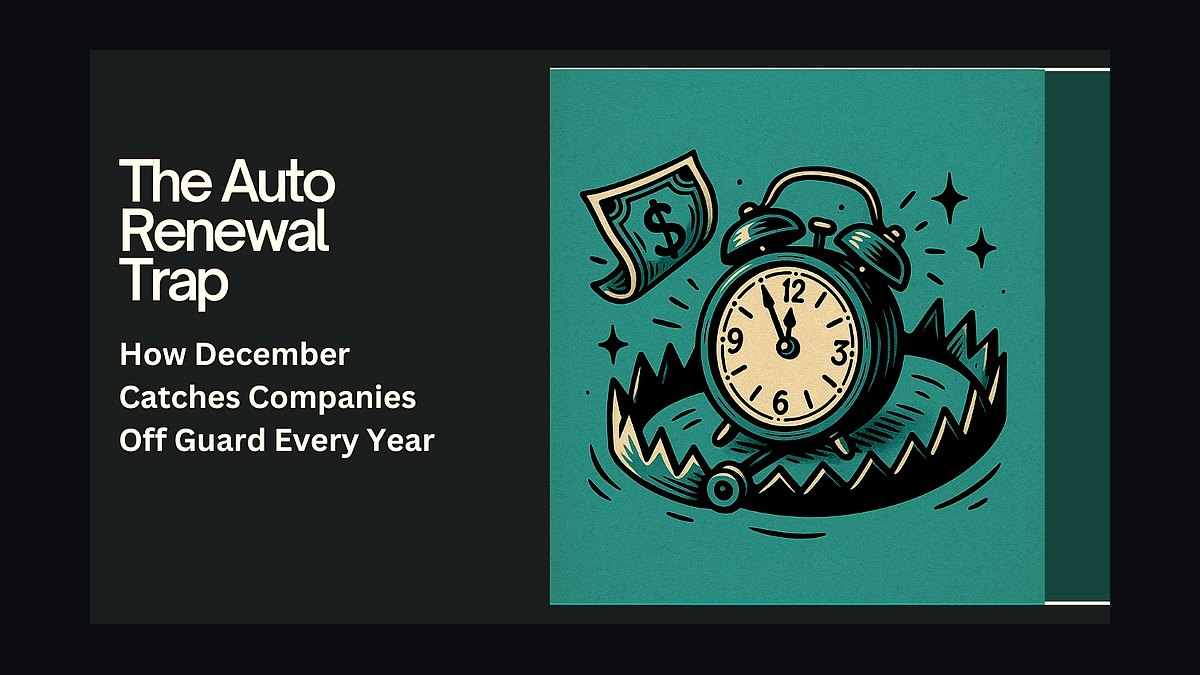
Chief's auto-renewal opts members in by default with a 30-day notice window, and missing that window locks you into another full year at $7,900 with no mid-year escape and no pro-rated refund. The Membership Agreement spells this out in language almost nobody reads at signup: "membership will automatically commence on the first day following the end of such period and continue for an additional equivalent period at your existing Membership Fee." You renew automatically unless you fight to stop it — standard SaaS dark-pattern territory dressed up as "executive community."
TL;DR: Chief auto-renews every member by default, gives only a narrow opt-out window, refuses mid-year cancellation, and denies pro-rated refunds — so a single missed email costs you another $7,900.
1The Auto-Renewal Mechanics
The Chief Executive Coaching Membership Agreement is unambiguous once you find it. After the initial twelve-month term concludes, the contract states that membership "will automatically commence on the first day following the end of such period and continue for an additional equivalent period at your existing Membership Fee." No fresh consent step, no second click, no confirmation email asking whether you still want to be a member. The default is renewal, and the burden of stopping it lives entirely on the member.
To cancel, Chief requires one of two paths. The first is a cancellation request form inside the logged-in member portal — not on the public website and not in the renewal email. The second is an email to the support address listed in the agreement. Both must be completed before what Chief calls the Renewal Commencement Date — the first day of the new term. Submit at 11:59 PM the night before and you are fine; submit at 12:01 AM the morning of and you owe another full year.

The notice window is short. Chief sends a renewal reminder roughly 30 days before the Renewal Commencement Date — the floor of what most state auto-renewal statutes require and well below the 60 to 90 days that consumer-friendly subscription services voluntarily offer. New York's amended ARL, Utah's subscription law, and the FTC's Click-to-Cancel framework all push toward longer notice — Chief sits at the bare statutory minimum.
There is no proration. Once renewal fires, the full $7,900 is owed, access continues for twelve months, and the only "out" is to not renew the following year. Pay for a full year or do not pay at all.

2How Members Get Caught
The first failure mode is the notice email itself. The renewal reminder arrives from a marketing-class sender address, often filtered into Promotions, and competes with the daily flood of Chief programming emails. Members who stopped attending sessions months ago are precisely the ones least likely to notice the one email that costs $7,900.
The second failure mode is the 30-day window. Thirty days is long enough that it falls outside any normal calendar reminder, short enough that a vacation, a parental leave, or a Q4 close swallows it whole. Members who decide in month 9 that Chief is not delivering value tell themselves they will "deal with it at renewal," then forget exactly when renewal falls because the signup date is not surfaced in the member dashboard.

The third failure mode is the absence of any mid-year off-ramp. Members who realize in month 6 that the Core group is not gelling, the Guide is mediocre, or the events do not justify the cost have no recourse until the 30-day window opens. You cannot pay for what you used. You either time the window perfectly or you pay for a year you already know you do not want.
The fourth failure mode is the refund refusal. Members who miss the window by a day, a week, or hours have publicly reported being told no pro-rated refund is available, full stop. Unless the member escalates through a credit-card chargeback or an AG complaint, Chief keeps the money.

3How to Beat the Trap
Treat the renewal date as a hard calendar event the moment you sign up. Drop a recurring reminder at the 60-day-before mark, the 45-day mark, and the 30-day mark. Put it in your work calendar, your personal calendar, and a backup task in whatever system you actually look at every morning. Do not rely on Chief's email to remind you — assume it will land in spam and plan around that assumption.
Write your renewal-audit document before the reminder email ever arrives. Sixty days out, sit down for thirty minutes and answer four questions in writing: what did Chief actually deliver this year, what did it cost in time plus fees, what would I have done with that $7,900 otherwise, and would I sign up today if I were not already a member. If the honest answer to the last question is no, cancel immediately rather than waiting. Early cancellation costs nothing extra under the agreement; access still runs to term end.

If you miss the window, dispute the charge through your credit-card issuer the same day you notice it. Cite the FTC's negative-option framework and the auto-renewal statute of your state of residence — California, New York, and Illinois all have teeth here. Chargebacks force Chief into a documented-consent showdown they often decline to fight for a single seat. In parallel, email Chief support and explicitly request a pro-rated refund or a one-time courtesy cancellation. They have discretion they rarely advertise.
| Renewal practice | Member-friendly | Chief default |
|---|---|---|
| Opt-in vs opt-out | Opt-in | Opt-out |
| Notice window | 60-90 days | 30 days |
| Mid-year cancel | Yes | No |
| Pro-rated refund | Yes | No |

Related on PULSE
- CPI Security's contract auto-renewal in 2027 - what to know before signing
- What Does a Commercial Kitchen Hood and Grease Trap Really Cost in a Buildout?
- How Do I Avoid the 'Controllable vs Uncontrollable' CAM Trap?
- CPI Security panel upgrade fees in 2027 — the 3G/4G sunset trap
- When should you transition a high-performing IC into a manager role, and what's the trap?
- Should I open or buy a Window Hero franchise in 2027?
The Psychology Behind Chief's Renewal Design
Chief's auto-renewal structure isn't accidental — it's a deliberate application of behavioral economics principles that exploit common cognitive biases. The 30-day window leverages the status quo bias, where people tend to stick with default options because changing requires effort. Research in consumer behavior shows that default enrollment increases retention by 20-40% compared to opt-in models. Chief's membership agreement buries the renewal terms in legal language averaging a 9th-grade reading level, despite their target audience being C-suite executives who likely skim contracts. The timing is equally strategic: renewal notices arrive during holiday seasons (November-December for year-end cohorts) or Q4 planning periods when executives are least likely to scrutinize personal subscriptions. This isn't unique to Chief — similar patterns appear in gym memberships, software licenses, and executive clubs — but the $7,900 price point makes the stakes exceptionally high. Members who successfully cancel often report needing 3-5 follow-ups and 20-40 minutes on the phone or email chain to confirm the cancellation went through, suggesting the process is intentionally friction-heavy.
Practical Steps to Avoid the Trap in 2027
To protect yourself from Chief's auto-renewal in 2027, treat the membership like a high-stakes deadline you'd manage at work. Immediately after signing up, set three calendar alerts: one 45 days before your renewal date, one 35 days before, and one 25 days before. Use a dedicated folder or label in your email to flag any messages from "membership@chief.com" or "billing@chief.com" — these often get filtered to promotions or spam folders. When you receive the renewal notice, don't just reply "cancel" — you must either submit the cancellation form in your account settings (under "Membership" > "Auto-Renewal") or send a clear written request to support@chief.com with your full name and membership ID. Take a screenshot of the confirmation page or save the support team's reply. If you're within the 30-day window but haven't received the notice, contact support proactively and request written confirmation of your cancellation status. For members in California, New York, or Illinois, state auto-renewal laws may give you additional rights — California's Automatic Renewal Law (Cal. Bus. & Prof. Code § 17600-17606) requires clear disclosure and easy cancellation, though enforcement is inconsistent. If you're charged after a timely cancellation, dispute the charge with your credit card company under the "unauthorized transaction" category, citing the FTC's Negative Option Rule (16 CFR Part 425) which prohibits unfair renewal practices.
What to Do If You've Already Been Trapped
If you've already missed the 30-day window and been charged the $7,900, don't assume you're stuck for the full year. First, check your original membership agreement — some cohorts or promotional codes have different terms. Email Chief's support team immediately, referencing the exact date you signed up, the date of the renewal charge, and any prior communication about cancellation. Use language like "I request a goodwill exception to the auto-renewal policy" and escalate to a manager if the first response is a denial. If that fails, file a complaint with the Better Business Bureau (BBB) — while not legally binding, Chief has responded to BBB complaints in the past. Simultaneously, contact your state's attorney general's consumer protection division, particularly if you live in a state with strong auto-renewal laws. For credit card disputes, provide your card issuer with screenshots of the cancellation attempt (if any) and the membership agreement language. Some members have reported success by citing the FTC's guidance on "negative option marketing" — if the cancellation process wasn't "simple, timely, and easy to use," you may have grounds for a chargeback. As a last resort, consider selling your remaining membership months to another executive through LinkedIn or executive networks — Chief's terms prohibit transfers, but some members have arranged private arrangements at a discount. The key is acting within the first 30 days of the charge, as credit card dispute windows vary by issuer (typically 60-120 days).
FAQ
What exactly is Chief's auto-renewal policy? Chief automatically renews your membership for another full year unless you cancel within a 30-day window before your term ends. The Membership Agreement states that membership "will automatically commence on the first day following the end of such period and continue for an additional equivalent period at your existing Membership Fee."
How long is the cancellation window, and when does it start? Chief provides a 30-day notice period before your membership term ends. You typically receive a renewal reminder email around that time, but if you miss or overlook it, you lose the chance to cancel without penalty.
Can I cancel mid-year if I change my mind? No. Chief does not allow mid-year cancellation. Once you're auto-renewed, you are locked in for the full 12-month term, and there is no option to exit early or receive a pro-rated refund.
What happens if I miss the 30-day cancellation window? You are charged the full annual fee — typically around $7,900 — for another year. There are no refunds or partial credits, even if you never use the membership after the renewal date.
Is there any way to get a refund after auto-renewal? Chief's policy explicitly denies pro-rated refunds. Some members have reported success by contacting support immediately after the charge, but this is not guaranteed and depends on individual circumstances.
How can I avoid the auto-renewal trap? Mark your calendar 45 days before your membership end date, check your email (including spam) for renewal notices, and submit a cancellation request via Chief's form or support email within the 30-day window. Do not rely on a single reminder.
Sources
- Chief Executive Coaching Membership Agreement
- Chief Frequently Asked Questions
- Auto-Renewal Laws: 2025 Round Up — Kelley Drye
- How to Get Out of an Auto-Renewal Contract — LegalClarity
- Automatic Renewal Clauses: From a Buyer's Perspective — Conway Olejniczak & Jerry
- Keeping Your Eye on the Ball: Federal Cancellation Policy Settlements — Hudson Cook
- Costco Class Action Over Membership Auto-Renewal Notices — Law Commentary
- Automatic Renewal Clauses: Legal Tips for B2B and B2C — Key2Law
People also search for: best chief's auto-renewal trap 2027 · top chief's auto-renewal trap 2027 · top rated chief's auto-renewal trap 2027 · top ranked chief's auto-renewal trap 2027 · highest rated chief's auto-renewal trap 2027 · chief's auto-renewal trap reviews 2027
This page will be disappearing soon. Save it to your device for $1 — or read it free while it is here.
@Kory-White- · if Venmo asks, the last 4 of my number are 2012
This page is gone.
This one is off the shelf now. $1 keeps it on your phone for good — the whole page, pictures and diagrams included.
 women-execChief's unintended exclusion problem — how the no-men rule blocks male allies in 2027
 women-execIs Chief the right network for women in B2B SaaS — or should you join Women in Revenue in 2027?
 women-execDid Chief earn its $1.1B valuation — or was it pure ZIRP fantasy in 2027?
 women-execWhat does Fortune's 2023 reporting on Chief's retention tell us heading into 2027?
 women-execWhat Chief's March 2024 UK shutdown really cost — the international expansion failure
 women-execChief's Clubhouse cities ranked worst to best — which ones to skip in 2027
 women-execChief's 3 biggest strategic failures — what's actually going wrong in 2027
 women-execChief's ambition has shrunk between 2022 and 2027 — the strategic retreat
 women-execChief's LinkedIn engagement has cratered — the algorithmic decline in 2027
 women-execWhy your boss won't pay for Chief — the corporate dev-budget squeeze in 2027