


What is HubSpot Breeze and why is it a hot RevOps tool for 2027?
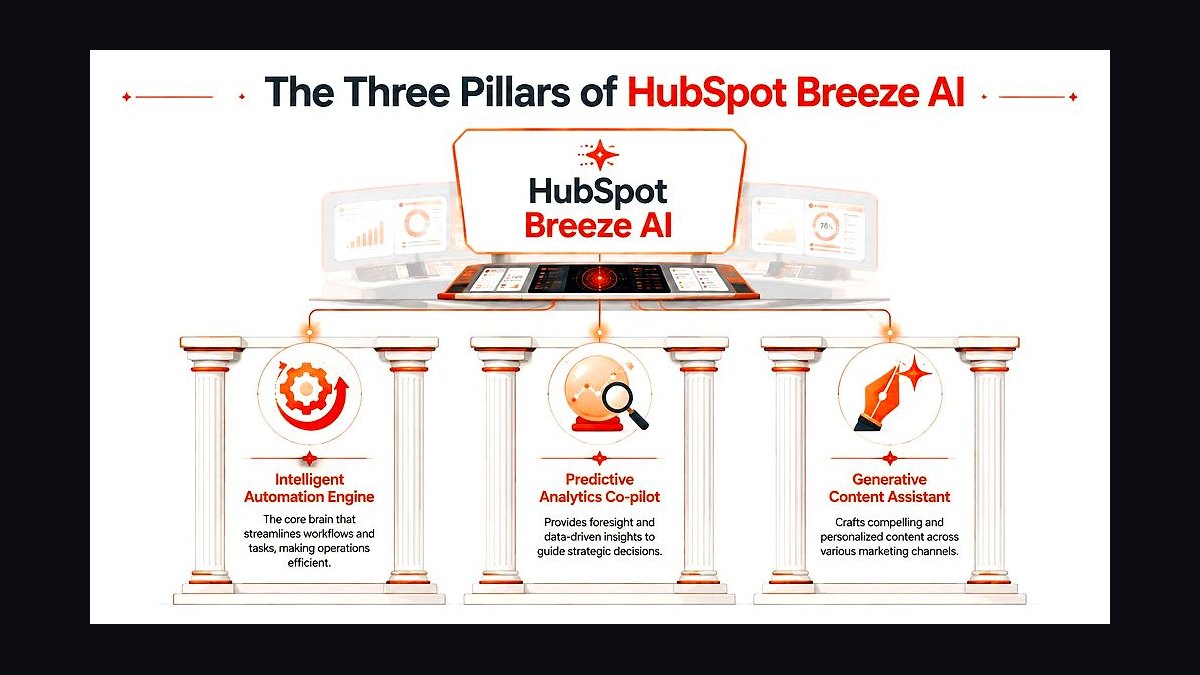
HubSpot Breeze is HubSpot's unified artificial-intelligence layer that spans the entire Customer Platform, and it is becoming a hot RevOps tool for 2027 because it folds copilots, autonomous agents, and a cleaned-up data foundation into the CRM that revenue teams already live in rather than asking them to bolt on yet another point solution. Breeze has three working parts that matter operationally: Breeze Copilot, an in-app assistant that drafts emails, summarizes records, and answers questions about your pipeline; Breeze Agents, a growing roster of task-running automations (Customer Agent, Prospecting Agent, Knowledge Base Agent, and a Data Agent built specifically for the kind of enrichment and hygiene work RevOps owns); and Breeze Intelligence, the data layer that enriches company and contact records and scores buyer intent. The reason this lands for RevOps specifically is the 2026 pricing pivot toward outcome-based billing — the Customer Agent is priced near fifty cents per resolved conversation rather than per seat, and the Prospecting Agent is priced near a dollar per qualified lead — which means the cost of automation tracks the value it produces instead of headcount. For a team trying to grow pipeline without growing the org chart, Breeze is attractive because the agents work inside the same workflows, reports, and permission model that already govern the CRM, so adoption does not require a parallel data pipeline or a new system of record.
1What Breeze actually is
Breeze is not a single product; it is the brand HubSpot put on every AI capability across Marketing, Sales, Service, Content, and Operations Hubs, and understanding the three layers is the difference between buying it well and buying it blindly. The first layer, Breeze Copilot, is the conversational assistant embedded in the HubSpot UI. It reads the record you are looking at and can summarize a deal's history, draft a follow-up email in your voice, generate a prospecting list from natural-language criteria, or explain why a forecast moved. For a rep or a RevOps analyst, Copilot collapses the "open five tabs to understand one account" problem into a single prompt, and because it is grounded in your CRM data rather than the open web, its answers reference your actual deals, tickets, and contacts.
The second layer, Breeze Agents, is where the autonomous work happens. These are not chat features; they are configured workers that run on triggers and complete multi-step tasks. The Customer Agent resolves inbound support conversations end to end. The Prospecting Agent researches target accounts, enrolls contacts in sequences, and books meetings. The Knowledge Base Agent turns existing help content into answers. And the Data Agent — the one RevOps should care about most — handles enrichment, deduplication, and property cleanup, the unglamorous data-hygiene work that normally eats an operations analyst's week.

1.1 Breeze Intelligence, the data foundation
The third layer is Breeze Intelligence, the enrichment and scoring engine that grew out of HubSpot's Clearbit acquisition. It fills in firmographic and demographic gaps on company and contact records, identifies anonymous website visitors at the company level, and produces a buyer-intent score. Operationally this matters because every agent and every copilot answer is only as good as the underlying record — an enrichment layer that runs natively means the Prospecting Agent is working from complete data rather than a half-empty contact. Breeze Intelligence is consumption-priced through credits, which keeps the cost proportional to how much enrichment you actually trigger.
2Where Breeze fits in the RevOps stack
The strategic appeal is consolidation. A typical mid-market revenue stack stitches together a CRM, a separate enrichment vendor, a conversation-intelligence tool, a chatbot, and a prospecting automation layer, and RevOps spends real time keeping those integrations from drifting out of sync. Breeze collapses several of those boxes into the platform of record, which reduces the integration surface RevOps has to maintain and means the data that agents act on never has to leave the system to get enriched or scored.

The diagram shows the thing that makes Breeze different from a bolt-on: the signal never leaves the platform. Enrichment, scoring, routing, agent action, and reporting all happen inside the same data model, so RevOps gets one attribution chain instead of reconciling five.
2.1 The outcome-based pricing shift
The pricing change announced for 2026 is the structural reason Breeze became a 2027 budget conversation rather than a 2025 experiment. Historically, AI features were either included with seats or sold as flat add-ons, which meant you paid the same whether the AI did anything or not. The new model charges by result: roughly fifty cents per support conversation the Customer Agent fully resolves, and roughly a dollar per qualified lead the Prospecting Agent produces. HubSpot's own figures put Customer Agent resolution around sixty-five percent of eligible conversations with a meaningful reduction in time-to-resolution. For a RevOps leader building a budget, this converts an AI line item from a fixed cost into a variable cost that scales with throughput — easier to justify, easier to model, and easier to kill if the unit economics do not hold.

2.2 Credits and seat access
Beneath the headline outcome pricing, Breeze still runs on a credit system for the consumption-style work — enrichment lookups, certain Copilot actions, and Data Agent operations draw down credits priced around a penny each, with Professional tiers including roughly 5,000 credits and Enterprise tiers around 10,000. Agent access itself carries a platform fee that ranges from several hundred dollars a month at Professional to a few thousand at Enterprise depending on which agents you enable. RevOps needs to model both axes — the per-outcome charges and the credit burn — to avoid a surprise invoice.
3Who Breeze is for
Breeze is the obvious choice for organizations already standardized on HubSpot, because the value compounds when the agents and CRM share one data model. A mid-market company running Sales and Service Hub can switch on the Customer Agent and the Prospecting Agent without a migration, and RevOps can govern them with the same permissions, properties, and reporting they already maintain.

3.1 Where it is strongest
The sweet spot is the 50-to-500-employee company that has outgrown manual prospecting and first-line support but cannot justify a dedicated AI platform team. For these teams, Breeze's native integration is worth more than the marginal capability advantage a best-of-breed point tool might offer, because the hidden cost of point tools is the RevOps time spent integrating and reconciling them.
3.2 Where it is a weaker fit
If you are not on HubSpot, Breeze is not a reason to switch — the agents are tightly bound to HubSpot's data model and lose much of their advantage outside it. And teams with highly specialized needs (deep conversation intelligence, complex multi-touch attribution, or sophisticated signal stacking) will still find dedicated tools like Gong, Clari, or Common Room more capable in their narrow lane.

4The 2027 edge
What makes Breeze a 2027 story rather than a 2025 one is the convergence of three trends: agents that actually complete work instead of just drafting it, pricing that aligns vendor incentives with customer outcomes, and a data foundation good enough that the agents can be trusted to act autonomously. The combination is what turns "AI in the CRM" from a marketing line into a RevOps operating model.
4.1 The governance shift for RevOps
The deeper 2027 implication is that RevOps stops being purely a tooling-and-reporting function and starts being the team that governs a fleet of agents — setting the triggers, the guardrails, the escalation rules, and the cost ceilings. Outcome pricing makes this a financial discipline as much as a technical one: RevOps owns the dashboard that compares dollars spent on resolved conversations and qualified leads against the revenue they generate, and tunes agent behavior accordingly. That is a genuinely new muscle, and the teams that build it early will have a structural cost advantage.

5Limits and watch-outs
The first watch-out is cost predictability. Outcome pricing is attractive when volumes are stable, but a viral support spike or a large prospecting campaign can drive the bill in ways a seat-based model never would — RevOps must set spend ceilings and monitor the cost-per-outcome dashboard weekly, not monthly. The second is the definition of "resolved" and "qualified": those words decide what you pay for, so audit how HubSpot counts them and make sure a deflected-but-unhappy customer is not being booked as a resolution. The third is lock-in — the more of your stack Breeze absorbs, the harder it becomes to leave HubSpot, which is fine if you are committed and a real risk if you are not. Finally, agent output quality still depends on data quality; if your CRM is full of stale or duplicate records, the Data Agent helps but cannot fully compensate, and the Prospecting Agent will sequence the wrong people confidently. Breeze rewards teams that already keep a clean house and punishes those hoping AI will clean it for them.
6Bottom Line
HubSpot Breeze is a strong 2027 bet for any revenue org already on HubSpot, because it delivers acting agents, a native enrichment-and-scoring layer, and outcome-aligned pricing inside the system of record — eliminating the integration tax that makes point solutions expensive to run. The strategic shift it forces is real: RevOps becomes the function that governs a fleet of autonomous agents and manages a variable, outcome-linked AI budget. Buy it if you are committed to the HubSpot platform and willing to build the governance discipline outcome pricing demands; be cautious if you are multi-platform, have messy data, or cannot tolerate a variable bill. The unit economics are genuinely attractive, but only for teams that watch the dashboard and define "resolved" and "qualified" on their own terms rather than the vendor's.

Related on PULSE
- What is HubSpot Breeze Intelligence and how does it compete with ZoomInfo in 2027?
- How should Outreach price Smart Email Assist against HubSpot Breeze?
- Is Breeze AI working for HubSpot?
- Should I open or buy a Bahama Breeze franchise in 2027?
- What is dbt and why is it a hot RevOps data transformation tool for 2027?
- What is LinkedIn Sales Navigator and why is it a hot RevOps account-intelligence tool for 2027?
FAQ
Is HubSpot Breeze replacing the existing HubSpot tools I already use? No, Breeze is an AI layer that sits on top of your current HubSpot tools. It enhances features like email, reporting, and workflows rather than replacing them, so your existing setup remains intact.
How much does HubSpot Breeze cost for a typical RevOps team? Pricing varies by agent and usage. The Customer Agent is roughly near $0.50 per resolved conversation, and the Prospecting Agent is around $1 per qualified lead, though exact costs depend on your contract and volume.
Does Breeze work with other CRMs or only HubSpot? Breeze is built exclusively for the HubSpot platform. It does not integrate with other CRMs like Salesforce or Microsoft Dynamics, so it’s only useful if your team already uses HubSpot.
Can Breeze agents handle complex RevOps tasks like data cleaning or lead scoring? Yes, the Data Agent specifically handles enrichment and hygiene tasks, and the Prospecting Agent scores buyer intent. However, they work best for routine, rule-based actions; highly customized or nuanced tasks may still need human oversight.
Is Breeze’s outcome-based billing really cheaper than per-seat pricing? It can be for teams with high automation volume but low headcount growth. The per-conversation or per-lead model means you pay only for results, but costs can add up if you have many low-value interactions.
When will Breeze be fully available for all HubSpot customers? HubSpot has rolled out Breeze features gradually since late 2024, with broader availability expected through 2026 and 2027. Some agents are still in beta or limited release, so check your account for current access.
Sources
- HubSpot product announcements and INBOUND keynote coverage on Breeze Copilot, Breeze Agents, and Breeze Intelligence
- HubSpot pricing documentation on Breeze credits, agent access tiers, and the 2026 outcome-based pricing model
- HubSpot Customer Agent performance figures (resolution rate and time-to-resolution)
- TechCrunch and The Information reporting on HubSpot's AI agent strategy and Clearbit integration
- RevOps practitioner analysis of consumption- and outcome-based AI pricing in CRM platforms
This page will be disappearing soon. Save it to your device for $1 — or read it free while it is here.
@Kory-White- · if Venmo asks, the last 4 of my number are 2012
This page is gone.
This one is off the shelf now. $1 keeps it on your phone for good — the whole page, pictures and diagrams included.
 revopsWhat are Florida Gators football's 2027 NIL needs and strategy?
 revopsWhat are Kansas Jayhawks men's basketball's 2027 NIL needs and strategy?
 revopsHow should a 2027 sales org draw boundaries between deal desk and RevOps?
 revopsHow do you design a sales kickoff that changes behavior in 2027?
 revopsHow should a 2027 sales and marketing team run joint forecasting?
 revopsWhat are LSU Tigers football's 2027 NIL needs and strategy?
 revopsShould 2027 RevOps report to finance or to the CRO?
 revopsHow do you build a peer-coaching library that AEs actually use in 2027?
 revopsWhat is lemlist and why is it a hot RevOps multichannel outreach platform for 2027?
 revopsHow should you handle mid-year comp plan resets without destroying trust in 2027?