


What is Salesloft (and Rhythm) and why is it a hot RevOps revenue-orchestration platform for 2027?
Quality
Certified
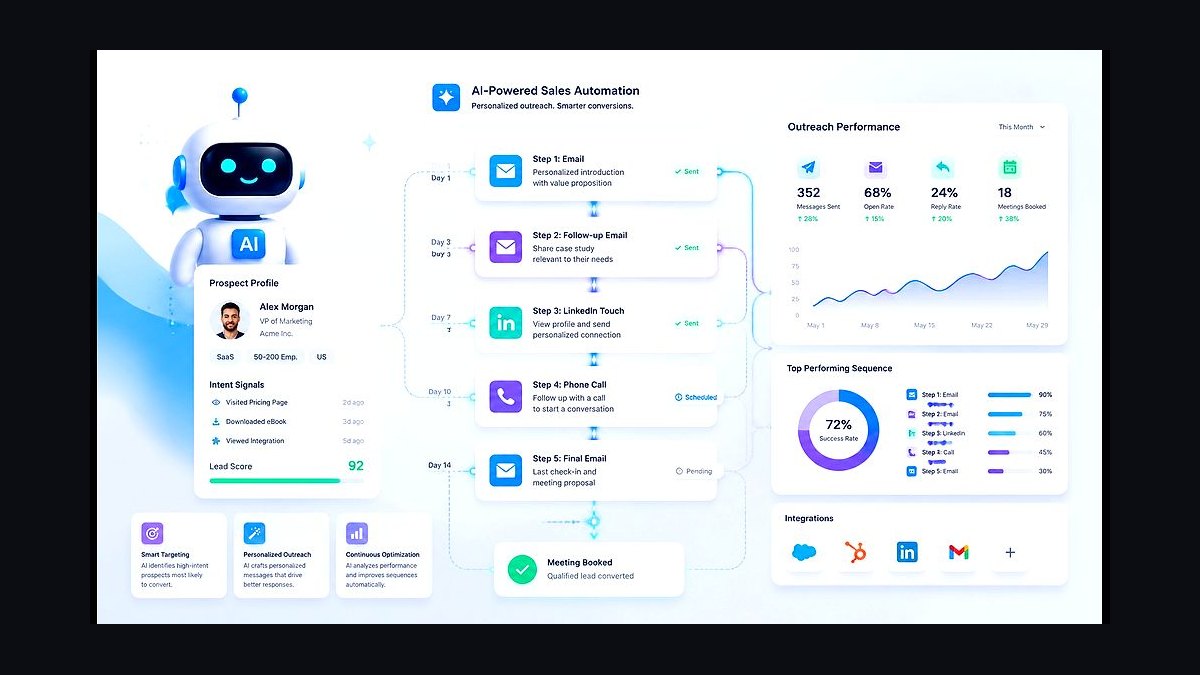
Salesloft is an AI revenue-orchestration platform built on Cadence, Conversations, Deals, and Forecast, with Rhythm — its AI action layer — ranking who each rep should engage and why. Its December 2025 Clari merger unites engagement with forecasting, giving RevOps one system spanning pipeline creation through the committed number.
The Monday morning a rep opens 240 accounts and picks the wrong six
Picture a mid-market enterprise-software company with 38 quota-carrying reps, roughly 240 named accounts per AE, and a sales cycle that runs 90 to 140 days. Monday at 8:15 a.m., an AE opens the CRM. There is a list view sorted by close date, a separate sequencer tab with 14 active cadences, a conversation-intelligence tool holding last week's call recordings, and a Slack channel where marketing drops "MQL alerts" that nobody trusts. Nothing in that stack tells the rep which six of the 240 accounts actually moved over the weekend.
So the rep guesses. They work the accounts they remember, the ones with a friendly champion, the ones where a meeting is already booked. That is a rational human heuristic and it is also exactly wrong: the accounts with booked meetings are the ones least in need of attention, and the account where three new stakeholders from the security team just read the pricing page twice on Saturday sits untouched until Thursday. By Thursday the buying committee has already talked to a competitor.
This is the problem revenue orchestration is built to solve, and it is worth being precise about what "orchestration" means because the word gets used loosely. Sequencing is: send this five-step email-and-call cadence to this list. Engagement is: log what happened when you did. Orchestration is the layer above both — it decides, across every account, signal, deal, and open task in the system, what the highest-value next action is for this specific rep in this specific hour, and it re-decides continuously as signals change. The unit of work stops being "the cadence" and becomes "the action."

Salesloft's answer to that is Rhythm, launched in June 2023 and layered on top of the platform's execution modules. Rhythm ingests first-party engagement signals — email opens, reply sentiment, link clicks, website visits, meeting activity — alongside third-party intent data, and converts them into a ranked action list per rep. The rep no longer opens a list view and applies judgment to 240 rows. They open a prioritized queue: this account, this person, this reason, this suggested action.
The adjacent problem, and the one RevOps leaders usually feel more acutely than reps do, sits at the other end of the funnel. The same company's VP of Sales spends Wednesday afternoon in a forecast call arguing about whether a deal is really commit or best case. The evidence in the room is anecdote. The evidence in the system — 60 days of email cadence, three multithreaded contacts who went dark, a champion who stopped opening anything after the security review — lives in the engagement tool and never reaches the forecast spreadsheet. Two ends of the same revenue motion, two vendors, two data models, one manual reconciliation every Wednesday.
That gap is precisely what the Clari merger, which closed December 3, 2025, is designed to close. Salesloft owned the top-of-funnel execution surface; Clari owned forecasting and revenue intelligence. Combined, the company reports roughly $450 million in ARR and more than 5,000 customers, including Adobe, IBM, 3M, Zoom, and Shopify. For a RevOps team, the pitch is not "a better sequencer." It is: the signals that drive rep prioritization on Monday and the signals that drive forecast confidence on Wednesday finally come from the same system.
How the orchestration layer actually works, signal to action to number

Strip the marketing language and the mechanism is a fairly legible pipeline with four stages: capture, score, rank, execute — then a feedback loop back into forecasting.
Capture. Salesloft sits on the rep's actual work surface, which is what makes it different from a scoring tool bolted onto the CRM. Email sends and replies flow through Cadence. Calls and meetings flow through Conversations, which transcribes, extracts topics, and detects things like competitor mentions, pricing discussion, and next-step commitments. Web activity arrives through tracking and integrations. Third-party intent — the signal that an account is researching your category somewhere you don't own — is layered in from data providers. The practical consequence is that Salesloft has the activity data natively rather than waiting for a nightly CRM sync to tell it what happened.
Score. Signals get weighted. A pricing-page visit from a new title at an open-opportunity account is not the same event as a newsletter open from an existing champion, and the scoring model treats them differently. This is the layer RevOps owns and the layer most teams under-invest in. Out of the box the weights are generic; the value comes from tuning them to your motion — which titles matter, which pages indicate intent for your product, how fast a signal decays.
Rank. Scored signals become a single ordered list per rep, blended with the obligations already on the calendar: cadence steps due, follow-ups promised on calls, tasks a manager assigned. This blending is the genuinely hard part. A prioritization engine that only surfaces hot signals and ignores committed follow-ups produces a rep who looks responsive and misses their own commitments.
Execute. The rep works the queue inside the same tool — dial, send, log, book. Every action becomes another data point.
Feed forward. Those actions and their outcomes flow into Deals for opportunity management and into Forecast for projections with historical accuracy tracking. Post-merger, Clari's forecasting depth takes that same engagement substrate and turns it into pipeline inspection, deal-risk flags, and roll-up confidence.

The dotted line back to scoring is the part that separates a working deployment from a shelfware one. If nobody looks at which surfaced actions actually converted and adjusts the weights, the queue degrades into noise within a quarter.
It helps to see where this sits relative to neighboring categories, because buyers routinely compare across layers that do different jobs. A CRM is the system of record — Salesloft syncs bidirectionally with Salesforce and HubSpot and does not replace either. A conversation-intelligence point tool captures and analyzes calls but does not decide what a rep does next. A data-enrichment or intent vendor supplies raw signal but has no execution surface. A marketing automation platform orchestrates campaigns to segments, not actions to individuals. Orchestration is the layer that consumes all of them and produces a decision. That is why the category consolidates: the decision layer wants to own the inputs.
The numbers a RevOps buyer should actually model
Public pricing does not exist here; Salesloft quotes custom. Reported 2026 figures put the per-seat cost in the range of roughly $125 to $165 per user per month for core functionality before add-ons, with annual uplift on renewal. Treat that as a base and build the model outward, because the seat price is rarely the number that surprises people at renewal.
Seats. Decide who genuinely needs a full license. In most deployments AEs, SDRs, and frontline managers do. Sales engineers, customer success, and partner teams often need read or light access rather than full orchestration seats. On a 38-rep team, being disciplined about the difference between 38 seats and 55 seats is a five-figure annual line item.
Add-ons. Conversation intelligence, advanced Rhythm capabilities, dialer minutes, and premium integrations are frequently packaged separately. Ask for the fully loaded quote with every module you intend to use in year one, not the base tier.

Annual increases. Model a meaningful uplift at renewal rather than assuming flat pricing across a three-year term. Negotiate a cap in the initial contract; it is far easier to get one written in at signature than to fight for it at renewal.
Post-merger packaging. This is the live unknown. How Clari's forecasting and revenue-intelligence capabilities are bundled into the combined offering will materially change total cost, in either direction. A combined bundle might be cheaper than two separate contracts with Salesloft and a forecasting vendor. It might also arrive as a premium tier. If you currently pay for both separately, that comparison is your strongest negotiating position — go into the conversation with the two current contract values in hand.
Implementation and internal cost. Budget real hours, not a weekend. A serious rollout involves CRM field mapping, sequence migration, signal-weight configuration, manager training on the new inspection surfaces, and a rep-adoption push. For a 38-rep org, plan on a dedicated RevOps owner spending significant time across a six-to-eight-week rollout, plus ongoing tuning. Software cost is the visible number; configuration labor is the one that determines whether you get value.
Now the return side, and this is where honesty matters more than a confident multiplier. Salesloft reports that Rhythm drives productivity and revenue outcomes for global sales organizations, and vendor-reported outcomes are exactly that — vendor-reported, drawn from customers who deployed well. Do not build your business case on a vendor case study. Build it on a mechanism you can measure yourself.
The mechanism is straightforward: reps have a fixed number of selling hours, and orchestration changes the allocation of those hours toward higher-probability actions. So instrument the allocation. Before deployment, baseline three things: meetings booked per rep per week, the share of open opportunities with a scheduled next step, and forecast accuracy — commit versus actual — over the last four quarters. Those are your control numbers. Run the deployment. Measure the same three at 90 and 180 days.
Forecast accuracy is the most defensible metric of the three because it is measured against a known outcome rather than a proxy. If your commit-to-actual variance runs wide today, tightening it is worth real money in headcount planning, board credibility, and capacity decisions — and it is attributable in a way that "activity increased" never is.

One framing worth carrying into the business case: the argument for consolidation is often stronger than the argument for orchestration on its own. If you currently run a sequencer, a conversation-intelligence tool, a forecasting product, and the integration glue between them, the comparison is not "Salesloft versus nothing." It is Salesloft-plus-Clari versus four contracts, four renewal cycles, four data models, and the RevOps hours spent reconciling them. Price the whole current stack, including the labor, before you evaluate the replacement.
What you give up, and what else you could buy instead
Every consolidation decision is a trade. Being explicit about what you are trading makes the decision defensible when someone challenges it eighteen months later.
Consolidation versus best-of-breed. A unified platform gives you one data model, one vendor relationship, one support path, and — critically — signals that reach the forecast without a middleware hop. What you give up is the ability to swap any single component for the sharpest tool in that narrow category. If your conversation intelligence needs are unusually deep, a dedicated specialist may outclass an integrated module. The honest question is whether that depth changes revenue outcomes or just impresses the person who evaluates it.
Consolidation versus switching cost. This is the trade teams underweight. The more of the revenue workflow a single vendor owns, the more expensive leaving becomes. When sequences, call history, deal notes, forecast methodology, and prioritization logic all live in one platform, a migration is a multi-quarter project, not a procurement decision. That concentration is real leverage for the vendor at renewal. Mitigate it deliberately: negotiate data-export terms up front, keep the CRM as genuine system of record rather than letting it drift into a reporting shell, and document your signal-weight configuration outside the tool so the logic survives a migration.

Orchestration versus a lighter sequencer. If your motion is high-volume outbound with a short cycle and a simple qualification bar, the prioritization brain may not earn its premium. When a rep's realistic answer to "who should I call next" is "the next name on the list," you are paying for a decision you do not need to make. A cheaper sequencer plus disciplined list hygiene is the better buy.
Buy versus build. Some sophisticated RevOps teams pipe signals into a warehouse, score them with their own model, and push tasks into the CRM. That gives total control over the logic and no per-seat license on the intelligence layer. It also means owning a data pipeline, a scoring model, and a task-delivery surface that reps will complain about, forever. Building is defensible with a dedicated data team and a genuinely idiosyncratic motion. It is a trap for a two-person RevOps team.
The gate that stops most evaluations honestly is the data-quality one. Orchestration is a function applied to your data. If contact records are stale, opportunity stages mean different things to different reps, and half the activity never gets logged, the ranked action list inherits every one of those defects and presents them with the false confidence of an algorithm. Fixing the foundation is unglamorous and it is the highest-ROI work available to a RevOps team considering this purchase.
There is a fit question underneath all of these. Salesloft rewards organizations with enough pipeline complexity that "what should I do next" is a genuine, costly problem — many accounts, many signals, multi-stakeholder buying committees, cycles long enough that momentum can be lost without anyone noticing. Mid-market and enterprise teams with meaningful rep counts sit squarely in that profile. A ten-person team selling a simple product on a three-week cycle does not, and will pay orchestration prices for sequencing value.
The five ways this deployment goes wrong

The untuned queue. This is the dominant failure. Rhythm ships with generic signal weighting, a team deploys it as-is, and within six weeks the action list is full of low-value surfaces — a newsletter open at a closed-lost account, a website visit from a job seeker. Reps learn the queue is noise, revert to their own judgment, and the platform becomes an expensive logging tool. The fix is ownership: RevOps names a person responsible for signal configuration, reviews conversion by signal type monthly for the first two quarters, and prunes aggressively. Cutting weak signals is more valuable than adding new ones.
Data debt imported at full volume. Orchestration amplifies whatever is already in your CRM. Duplicate accounts split signal across records so neither crosses the threshold. Stale contacts generate actions for people who left the company. Inconsistent stage definitions poison the forecast. Do the hygiene work before go-live, and put ongoing enrichment and dedupe on a schedule — the value decays continuously without it.
Rollout as a training event instead of a behavior change. Teams run a two-hour session, declare the platform live, and never inspect adoption. Reps who ignore the queue are invisible unless someone looks. Make queue completion a coaching topic in the manager's weekly one-on-one, not a compliance metric on a dashboard. The distinction matters: compliance metrics get gamed, coaching conversations surface why a rep skipped an action — and sometimes the rep is right and the signal weighting is wrong.
Betting the whole workflow on merger-day promises. The Clari combination closed December 3, 2025. The unified vision is coherent and the strategic logic is sound, but integration timelines slip, roadmaps get resequenced, and packaging shifts. Validate what exists today rather than what is promised. Run the integrated forecasting against a quarter of your own historical data before you retire your existing forecasting process. Structure the contract with that uncertainty in mind — shorter initial term, or written commitments on the capabilities that drove your decision.

Orchestrating sales while the rest of the revenue motion stays manual. This is the adjacent pitfall and it is worth naming. Salesloft's center of gravity is sales execution, though the same prioritization logic extends usefully into neighboring motions — customer success teams can rank renewal and expansion outreach off usage and engagement signals, and marketing can coordinate follow-up cadences against campaign response. If you orchestrate new business beautifully and leave renewals to a spreadsheet of dates, you have improved one segment of the revenue workflow and left the highest-margin segment untouched. Map the full motion — acquisition, expansion, renewal — and decide deliberately which parts the orchestration layer covers and which stay outside it. Deliberately outside is fine. Accidentally outside is how a platform gets blamed for a gap nobody scoped.
A final structural note for RevOps: this purchase changes your job description. Owning an orchestration layer means owning prioritization logic and forecast methodology as products, with versions, changelogs, and measured outcomes — not as a one-time configuration. That is the real shift the 2027 positioning implies. Tool integration was the old discipline; orchestration design is the new one, and it does not end at go-live.
Related questions
Does Salesloft replace Salesforce or HubSpot?
No. Salesloft layers on top of the CRM and syncs bidirectionally, enriching records with engagement signals and activity. The CRM stays the system of record for accounts, contacts, and opportunities; Salesloft owns the execution and orchestration surface above it.
How is Rhythm different from lead scoring?
Lead scoring ranks records. Rhythm ranks actions — who to contact, why, and what to do — blending scored signals with cadence steps due and committed follow-ups, then delivering that as a working queue inside the tool where the rep actually executes.
What changed for customers after the Clari merger?
The merger closed December 3, 2025, uniting Salesloft's top-of-funnel engagement with Clari's forecasting and revenue intelligence under one company reporting roughly $450M ARR and 5,000+ customers. Product and packaging integration is still unfolding; validate current capabilities rather than roadmap promises.
How long does a realistic rollout take?

Plan six to eight weeks for a mid-sized team: CRM field mapping, sequence migration, signal-weight configuration, manager enablement, and adoption. Then two quarters of active tuning before the prioritization quality is trustworthy enough to stop inspecting weekly.
Can smaller teams get value from a platform like this?
Sometimes, but the economics are unfavorable. If reps manage few enough accounts that prioritization is obvious, you are paying an orchestration premium for sequencing. A lighter sequencer plus clean list discipline delivers most of the value at a fraction of the seat cost.
FAQ
What exactly does Rhythm do that Cadence alone could not?
Cadence executes sequences — it sends the emails, queues the calls, and tracks the steps. It does not decide which accounts deserve a sequence right now or which of a rep's competing obligations matters most this hour. Rhythm is the decision layer: it consumes first-party engagement signals and third-party intent, scores them, blends them with tasks and cadence steps already due, and produces one ranked action list per rep that updates as signals change. The shift is from executing a predetermined plan to continuously re-deciding the plan.
Is Salesloft only useful for sales, or does it extend to other revenue functions?
Its core strength is sales execution and pipeline management, and that is where the majority of value concentrates. The same mechanics extend usefully outward, though: customer success teams can prioritize renewal and expansion outreach off engagement signals, and marketing can run coordinated follow-up cadences with visibility into what happened after handoff. Treat those as valuable adjacent uses rather than the reason to buy — scope them deliberately during rollout so they get configured rather than assumed.
How should I evaluate this against keeping my existing point tools?

Price your current stack honestly first — every contract, plus the RevOps hours spent on integration, reconciliation, and vendor management. That total is the real comparison baseline, not the sequencer line item alone. Then weigh the operational benefit of one data model spanning engagement through forecast against the loss of best-of-breed depth in any single category and the increased switching cost. If your engagement data already reaches your forecast cleanly, the consolidation argument is weaker. If Wednesday's forecast call runs on anecdote, it is much stronger.
What is the single biggest risk in a deployment like this?
Untuned signal weighting. The platform's value depends entirely on the ranked list being right often enough that reps trust it. Generic out-of-box weights applied to a specific sales motion produce plausible-looking noise, and reps abandon a noisy queue quickly and quietly. Assign a named owner for signal configuration, review conversion by signal type monthly, and prune weak signals aggressively. This is ongoing product ownership inside RevOps, not a setup task you complete once.
Does the Clari merger make this a safer bet or a riskier one?
Both, in different dimensions. Strategically it is safer: the combined company has roughly $450M ARR, 5,000+ customers including Adobe, IBM, 3M, Zoom, and Shopify, and a footprint spanning more of the revenue workflow than either firm held alone. Operationally it adds near-term risk, because the merger closed December 3, 2025 and product, roadmap, and packaging are still settling. Buy the capabilities that exist and work today; treat announced integration as upside rather than as the basis for the business case.
What should I measure to prove this was worth the spend?
Baseline three metrics before go-live: meetings booked per rep per week, the share of open opportunities carrying a scheduled next step, and forecast accuracy measured as commit versus actual over the trailing four quarters. Re-measure at 90 and 180 days. Forecast accuracy is the most defensible of the three because it compares against a known outcome rather than an activity proxy, and tightening commit-to-actual variance translates directly into better capacity planning and board credibility.
Sources
- https://www.salesloft.com/
- https://www.salesloft.com/platform/rhythm
- https://www.clari.com/
- https://www.g2.com/products/salesloft/reviews
- https://www.gartner.com/reviews/market/revenue-enablement-platforms
- https://www.forrester.com/blogs/category/revenue-operations/
- https://techcrunch.com/tag/salesloft/
- https://www.salesforce.com/crm/what-is-crm/
Related on PULSE
- What is Salesloft Rhythm Agents and what does it do for RevOps in 2027?
- What is Loom and why is it a hot RevOps async video platform for 2027?
- What is HubSpot (Smart CRM platform) and why is it a hot RevOps all-in-one platform for 2027?
- What is Octave (Octave HQ) and why is it a hot RevOps GTM messaging platform for 2027?
- What is Openprise and why is it a hot RevOps data automation platform for 2027?
- What is Rox and why is it a hot RevOps AI revenue agent platform for 2027?
This page will be disappearing soon. Save it to your device for $1 — or read it free while it is here.
@Kory-White- · if Venmo asks, the last 4 of my number are 2012
This page is gone.
This one is off the shelf now. $1 keeps it on your phone for good — the whole page, pictures and diagrams included.
 revopsWhat are Tennessee Volunteers men's basketball's 2027 NIL needs and strategy?
 revopsWhat capacity-planning models do SaaS sales teams use in 2027?
 revopsWhat are UConn Huskies men's basketball's 2027 NIL needs and strategy?
 revopsHow do you explain a missed quarter to the board in 2027?
 revopsWhat are Michigan Wolverines football's 2027 NIL needs and strategy?
 revopsWhat are the 2027 best churn-save playbooks?
 revopsWhat are Auburn Tigers football's 2027 NIL needs and strategy?
 revopsWhat is Second Nature and why is it a hot RevOps AI sales-training platform for 2027?
 revopsWhen should a 2027 acquirer unify GTM motions vs keep them separate?
 revopsWhat are Tennessee Volunteers football's 2027 NIL needs and strategy?