


What is Default and why is it a hot RevOps inbound GTM platform for 2027?
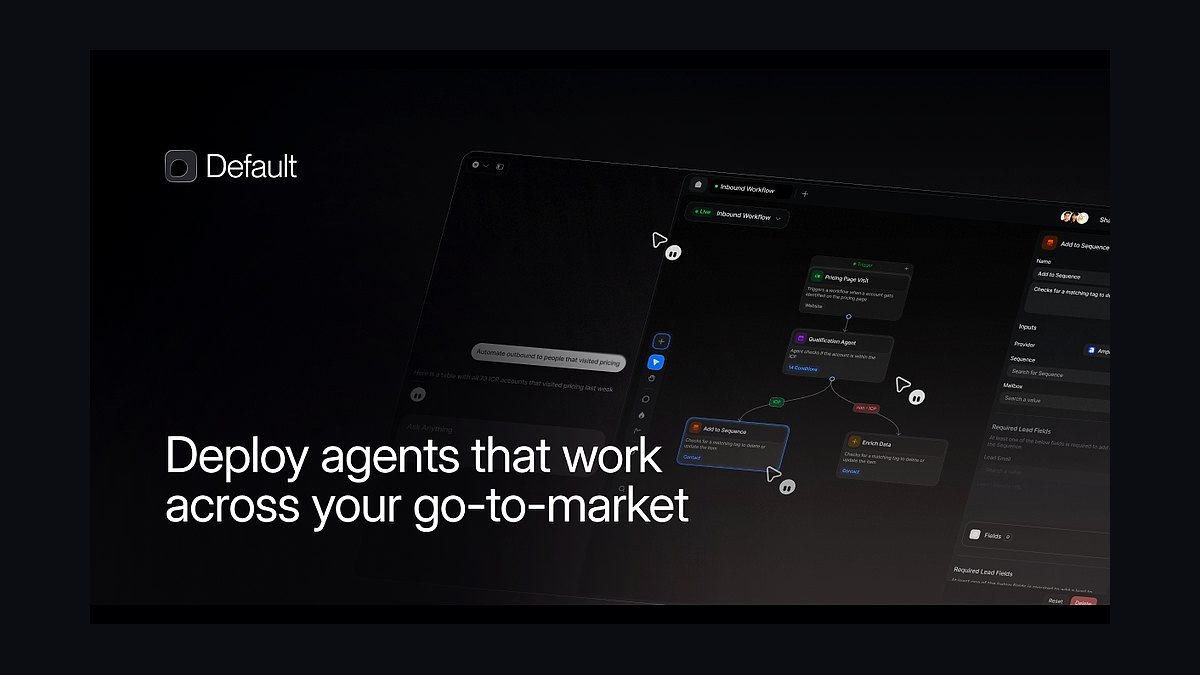
Default is an inbound go-to-market platform that unifies forms, enrichment, qualification, scheduling, and lead routing into one real-time workflow, and it is a hot RevOps tool for 2027 because it consolidates the fragmented inbound stack — the patchwork of a form tool, an enrichment vendor, a scheduler, and a routing engine — into a single system that RevOps controls without filing developer tickets. Default's premise is that the moment a high-intent lead fills out a form is the moment most pipeline leaks: enrichment lags, qualification is manual, routing rules live in three places, and the meeting gets booked hours too late. Default closes that gap by connecting capture, enrichment, qualification, scheduling, and CRM updates in one continuous real-time flow, so an inbound lead is enriched, qualified, routed to the right rep, and booked into a meeting in seconds rather than hours. It is explicitly an inbound-only platform — it does not do outbound prospecting — which is a deliberate focus that lets it own the inbound conversion path end to end. Pricing is comparatively transparent: a Startup plan around seven hundred fifty dollars a month plus roughly forty-five dollars per user, with Growth and Enterprise quoted custom, and a platform fee tied to monthly inbound volume (ranging from a couple hundred to over fifteen hundred dollars), with bundling discounts that charge a single platform fee across multiple products. For RevOps teams drowning in speed-to-lead problems and brittle routing logic, Default is the unified, ops-owned answer.
1What Default actually is
Default is an inbound GTM platform built to own the journey from "a lead lands on your site" to "a qualified meeting is on a rep's calendar." Most companies assemble that journey from separate tools — a form builder, an enrichment provider, a scheduling tool, and a routing engine like LeanData or Chili Piper — and the seams between them are where leads stall, drop, or get misrouted. Default's core idea is that those functions belong in one real-time workflow.
The platform combines forms (capture), enrichment (filling in firmographic and contact data on the inbound lead), qualification (scoring and disqualifying based on your rules), scheduling (booking the meeting instantly), and routing (assigning the lead to the right rep based on territory, segment, or round-robin). Crucially, it connects these to CRM updates so the system of record reflects the lead's journey in real time, all in a single flow designed for RevOps control rather than engineering tickets.

1.1 Why "one real-time workflow" matters
The phrase that defines Default is that it connects enrichment, routing, scheduling, and CRM updates in a single, real-time workflow designed for RevOps control, not developer tickets. This matters because the alternative — stitching four vendors together with Zapier, webhooks, and custom code — is fragile, slow, and owned by engineering. When a routing rule needs to change, RevOps files a ticket and waits. Default makes the whole inbound flow a configurable system RevOps can own and adjust directly, which is both faster operationally and more reliable.
2Where Default fits in the RevOps stack
Default occupies the inbound conversion layer — the space between marketing driving a lead to a form and that lead becoming a booked, routed meeting in the CRM. It does not replace the CRM or do outbound; it is the real-time engine that processes inbound the instant it arrives.

The diagram shows Default's core value: the entire inbound path runs as one automated, real-time flow under RevOps control. The operational payoff is speed-to-lead — the well-documented reality that inbound conversion collapses when response time stretches from seconds to hours — plus reliable, ops-owned routing that does not depend on engineering to change.
2.1 The speed-to-lead and routing problem
Default solves two structural inbound failures at once. First, speed-to-lead: a hot inbound lead that waits for manual enrichment, qualification, and routing converts far worse than one booked in seconds, and Default compresses that to real time. Second, routing fragility: routing logic scattered across tools and maintained by engineering is slow to change and prone to misrouting; Default centralizes it under RevOps. For an ops leader, owning a fast, reliable, single-workflow inbound engine is the difference between capturing inbound demand and leaking it.

2.2 Transparent-ish pricing
Default's pricing is more transparent than many competitors, though not entirely simple. The Startup plan starts around seven hundred fifty dollars a month plus roughly forty-five dollars per user billed annually, with Growth and Enterprise custom-quoted. All plans add a platform fee based on monthly inbound volume — ranging from about two hundred twenty-five to over fifteen hundred dollars — but bundling two or more products means a single platform fee rather than stacking them. Plan tiers gate enriched-lead volume and seats (Essential ~250 enriched leads / 5 seats, Growth ~1,000 / 10 seats, Enterprise unlimited / 20+ seats). RevOps should model inbound volume and enrichment needs, since those drive the platform fee and tier.
3Who Default is for
Default fits inbound-heavy revenue teams that need fast lead routing, qualification, and scheduling under one roof and want RevOps to own the workflow rather than depend on engineering. The more inbound volume you process, the more the consolidation and speed pay off.

3.1 Where it shines
The strongest fit is a company with meaningful inbound demand whose pain is speed-to-lead and brittle, multi-tool routing. For these teams, Default's unified real-time workflow books meetings faster, routes reliably, and lets RevOps change rules without tickets — replacing a fragile stack of form, enrichment, scheduler, and routing tools with one system. It also shines for ops teams frustrated by the developer dependency of cobbled-together routing.
3.2 Where it is a weaker fit
Default is a weaker fit for outbound-led teams, since it is exclusively inbound and does no prospecting. It is also less compelling for companies with low inbound volume, where the platform fee and per-seat cost are hard to justify against simpler native tools. And teams deeply invested in an existing best-of-breed routing tool may not want to consolidate, though Default's pitch is precisely that consolidation beats the patchwork.

4The 2027 edge
Default is a 2027 story because inbound conversion is increasingly won or lost in the first seconds, and the fragmented inbound stack is a liability RevOps wants to eliminate. The edge is consolidation plus ops control plus real-time speed — owning the whole inbound path in one configurable workflow rather than stitching vendors together.
4.1 The RevOps shift
The 2027 implication for RevOps is that inbound becomes a single, ops-owned system rather than an engineering-dependent patchwork. RevOps owns the forms, enrichment logic, qualification rules, routing assignments, and scheduling — adjusting them directly as the business changes, without waiting on developers. The discipline becomes designing and tuning a real-time inbound workflow and measuring speed-to-lead, routing accuracy, and booked-meeting conversion. Teams that consolidate inbound under RevOps control will book more meetings faster and adapt routing instantly, while competitors still file tickets to change a rule.

5Limits and watch-outs
The first watch-out is the inbound-only scope: Default does no outbound prospecting, so it is one part of a stack for any team whose growth depends on outbound, not a complete GTM platform. The second is the platform-fee structure — the volume-based fee on top of per-seat pricing means real cost scales with inbound volume, so RevOps must model that fee and the enriched-lead caps before committing, since heavy traffic drives both. The third is the consolidation trade-off: replacing best-of-breed point tools with one platform is efficient but concentrates dependence on Default, so weigh the lock-in against the convenience. The fourth is enrichment dependence — the qualification and routing are only as good as the enrichment data, so validate that Default's enrichment covers your market well. Finally, low-inbound-volume teams will struggle to justify the cost; Default's value compounds with volume, and a trickle of inbound does not exercise the platform enough to pay for it.
6Bottom Line
Default is a strong 2027 bet for inbound-heavy revenue teams that want to consolidate forms, enrichment, qualification, scheduling, and routing into one real-time, RevOps-owned workflow, because it closes the speed-to-lead gap and replaces brittle, engineering-dependent routing with a single configurable system. The strategic shift it embodies is inbound conversion becoming an ops-controlled system rather than a patchwork of glued-together tools and developer tickets. Buy it if you process meaningful inbound volume, suffer from speed-to-lead and routing fragility, and want RevOps to own the workflow; be cautious if your growth is outbound-led, your inbound volume is low, or you prefer to keep best-of-breed point tools over consolidating. Its differentiator is the unified, real-time, ops-owned inbound path — the fastest and most reliable way to turn a form fill into a booked meeting.

Related on PULSE
- How do you build a unified lead-to-revenue lifecycle without default CRM lifecycle stages?
- How do you build a unified lead-to-revenue lifecycle without default CRM lifecycle stages?
- How should a founder-led or early-stage sales org set up initial discount governance bands before they have reliable churn/NRR data by segment — should they default to conservative enterprise-tight rules or flexible SMB-loose bands?
- What is Chili Piper and why is it a hot RevOps inbound scheduling and routing platform for 2027?
- Which RevOps org structures in 2027 best support the shift from outbound-heavy GTM to AI-driven inbound account targeting?
- How do you design a RevOps control tower in Palantir Signals for GTM alerts that catches commission disputes on split credit before weekly commit calls for inbound SDR with parent-company rollup reporting?
FAQ
What does Default actually do that a separate form tool and scheduler can’t? Default combines form capture, lead enrichment, qualification logic, meeting scheduling, and CRM routing into a single real-time workflow. Instead of data moving slowly between separate tools, Default processes everything in seconds, so a lead can go from form submission to a booked meeting without delays or manual handoffs.
Is Default only for B2B companies with high-intent inbound leads? Yes, Default is built specifically for B2B teams that rely on inbound leads—like demo requests, contact forms, or content downloads. It is not designed for outbound prospecting or e-commerce, and its value is highest when lead speed and qualification accuracy directly impact revenue.
How does Default handle lead qualification without a separate scoring tool? Default includes built-in qualification rules that you define—based on firmographics, behavior, or custom fields—and applies them instantly when a lead submits a form. It can route qualified leads to the right rep, send unqualified leads to nurture, or trigger an alert, all without needing a separate scoring engine.
What integrations does Default support for CRM and enrichment? Default connects with major CRMs like Salesforce and HubSpot, and it works with enrichment providers such as Clearbit and ZoomInfo. The platform is designed to pull enrichment data in real time during the form submission flow, so you don’t need a separate enrichment tool running on a delay.
How transparent is Default’s pricing really? Default publishes a Startup plan around $750 per month plus roughly $45 per user, but enterprise pricing is not publicly listed. The stated range suggests a clear starting point, but larger teams should expect custom quotes that scale with lead volume and advanced features.
Can Default replace my entire inbound tech stack, or do I still need other tools? Default aims to replace the core inbound capture, enrichment, qualification, scheduling, and routing tools, but you may still need separate systems for outbound prospecting, analytics, or advanced automation. For inbound-only workflows, it can consolidate several point solutions into one platform.
Sources
- Default.com product and pricing pages on the inbound GTM platform, forms, enrichment, qualification, scheduling, and routing
- SyncGTM and Knock-AI 2026 Default reviews on pricing, platform fees, and inbound fit
- Default's own comparison content on LeanData, Chili Piper, and Qualified pricing
- Industry analysis on inbound speed-to-lead and RevOps-owned lead routing
- 2026 best-lead-routing and lead-distribution software roundups
This page will be disappearing soon. Save it to your device for $1 — or read it free while it is here.
@Kory-White- · if Venmo asks, the last 4 of my number are 2012
This page is gone.
This one is off the shelf now. $1 keeps it on your phone for good — the whole page, pictures and diagrams included.
 revopsWhat is Fullcast and why is it a hot RevOps go-to-market planning platform for 2027?
 revopsWhat is GTM efficiency — and how do you actually measure it in 2027?
 revopsHow is agentic AI changing the GTM stack and RevOps in 2026?
 revopsWhat is Cargo (GetCargo) and why is it a hot RevOps GTM engineering platform for 2027?
 revopsWhat is a sales playbook — and what actually needs to be in it in 2027?
 revopsWhat is Octave (Octave HQ) and why is it a hot RevOps GTM messaging platform for 2027?
 revopsHow do you define Pulse metrics for real-time Go-To-Market execution visibility in 2027?
 revopsHow do you build a scalable syndicate model for sharing Go-To-Market resources in 2027?
 revopsHow should a 2027 CSM build an ROI justification ahead of renewal?
 revopsWhat are the 2027 best churn-save playbooks?