


What is Relevance AI and why is it a hot RevOps AI agent-builder platform for 2027?
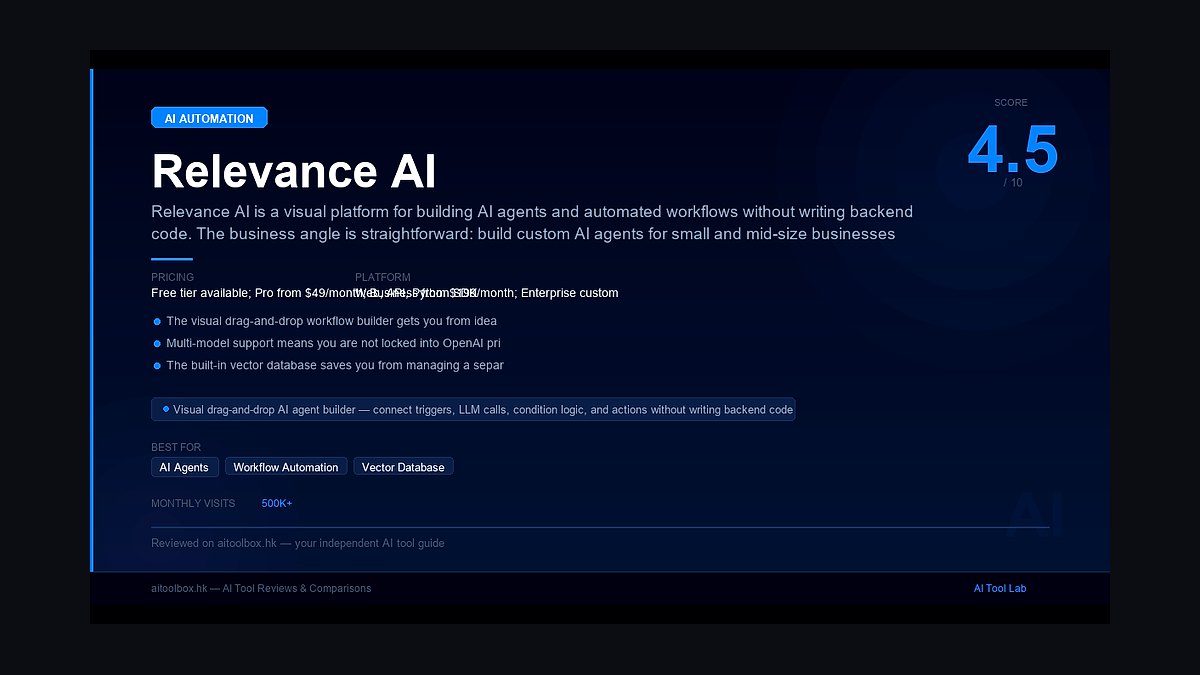
Relevance AI is a low-code platform for building an "AI workforce" — custom AI agents that perform real work across sales, marketing, operations, and support — and it is a hot RevOps tool for 2027 because it lets revenue teams build their own bespoke agents and multi-agent workflows rather than buying a fixed point tool for every task. Its defining differentiator is Multi-Agent Collaboration: you can build a "digital assembly line" where multiple agents share outputs and work in sequence, replicating an entire departmental workflow rather than automating one isolated task. The "Invent" feature lets users "vibe code" an agent from a prompt and ship it to production in minutes, and the platform offers 9,000-plus integrations so agents can read and write to almost any software — HubSpot, Salesforce, Slack, Gmail — plus 400-plus pre-built agent templates across functions. Pricing runs from Free (200 actions a month, unlimited agents, single user) through Pro at nineteen dollars a month and Team around two hundred thirty-four, to custom Enterprise, on a dual-meter model that separates platform usage (Actions) from AI compute (Vendor Credits). For RevOps, Relevance AI is the build-your-own-agent layer — the place to automate the long tail of revenue workflows that no off-the-shelf product covers, assembling custom agents instead of buying or hard-coding each process. The trade-off is that building and governing a reliable agent workforce is real work, not a turnkey purchase.
1What Relevance AI actually is
Relevance AI is an agent-builder platform — a low-code environment where you construct custom AI agents tuned to your specific business processes, rather than adopting a vendor's pre-defined automation. The framing is deliberate: it calls the result an "AI workforce," agents that deliver human-quality work on the workflows you define. Where most tools in this campaign do one job (dial, enrich, score, route), Relevance AI is the meta-layer for building agents that do whatever job you need.
The headline capability is Multi-Agent Collaboration. Rather than a single agent automating one task, Relevance AI lets you build a digital assembly line where multiple agents pass work between each other in sequence — one researches an account, another drafts outreach, another updates the CRM, another flags follow-ups — replicating an entire departmental workflow. This is the difference between automating a step and automating a process, which is what makes it powerful for the messy, multi-step workflows that RevOps actually owns.

1.1 Invent, integrations, and templates
Three things make Relevance AI accessible rather than an engineering project. Invent lets users "vibe code" an agent from a natural-language prompt, bringing it to production in minutes — describe what you want and the platform scaffolds the agent. 9,000-plus integrations let agents read and write to almost any software in your stack, so an agent can pull from HubSpot, post to Slack, and update Salesforce as part of one workflow. And 400-plus pre-built templates across sales, marketing, operations, and support give teams a starting point rather than a blank canvas. Together these lower the barrier to building real agents without a developer for every one.
2Where Relevance AI fits in the RevOps stack
Relevance AI sits as a horizontal automation-and-agent layer across the stack, connecting to the CRM, communication tools, and data sources to execute custom workflows. It does not replace any single system; it orchestrates work across them via agents you build, filling the gaps between purpose-built tools.

The diagram shows Relevance AI's value: you compose multi-agent assembly lines that execute whole workflows across your existing tools. For RevOps, this is the answer to the long tail — the dozens of bespoke processes (custom enrichment, specialized routing, internal-ops automations) that no off-the-shelf product covers and that previously required engineering or manual effort. Instead of buying ten point tools or filing ten dev tickets, RevOps builds agents.
2.1 Why build-your-own-agent matters for RevOps
The strategic argument is flexibility. The market is full of point tools that each do one thing well, but every RevOps team has workflows unique to its business that no vendor packages. Historically the choices were manual work, brittle no-code automations, or custom engineering. Relevance AI offers a fourth path: build custom agents that handle exactly your processes, including multi-step ones, without deep engineering. For RevOps, this turns the team into builders of an agent workforce rather than just buyers and integrators of tools — a meaningful expansion of what RevOps can automate.

2.2 The dual-meter pricing model
Relevance AI uses a dual-meter model that separates platform usage (Actions) from AI compute (Vendor Credits), and understanding both is critical to budgeting. Plans run from Free (200 actions a month, unlimited agents and tools, one user) through Pro at nineteen dollars (10,000 credits, scheduling), to Team around two hundred thirty-four (7,000 actions plus vendor credits, multiple build and end users), with Enterprise custom. The watch-out: because compute is metered separately as Vendor Credits, heavy or expensive-model agent runs can drive cost beyond the platform fee, so RevOps must monitor both meters as agent usage scales.
3Who Relevance AI is for
Relevance AI fits RevOps and GTM teams that have bespoke, multi-step workflows no point tool covers and the appetite to build and maintain custom agents. It rewards teams with a builder mindset and processes worth automating that fall outside packaged products.

3.1 Where it shines
The strongest fit is a RevOps or operations team with many custom, repetitive, multi-step workflows — bespoke enrichment, internal handoffs, specialized data processing — that wants to automate them without buying a tool per task or hiring engineers. For these teams, Multi-Agent Collaboration replicates whole processes, Invent and templates speed building, and the 9,000-plus integrations connect to everything. It shines where flexibility and customization matter more than a turnkey single-purpose tool.
3.2 Where it is a weaker fit
Relevance AI is a weaker fit for teams that just need one well-solved job — for dialing, buy a dialer; for enrichment, buy an enrichment tool — where a purpose-built product is simpler and more reliable than a custom agent. It is also less suited to teams without the capacity or appetite to build and govern agents; the platform is low-code but still requires design, testing, and oversight. And teams uncomfortable with the reliability variability of custom AI agents on critical processes should be cautious.

4The 2027 edge
Relevance AI is a 2027 story because the agentic shift is moving from vendor-built agents to teams building their own, and Relevance AI is a leading platform for composing custom, multi-agent workforces. The edge is Multi-Agent Collaboration plus accessible building (Invent, templates) plus near-universal integrations — letting teams automate processes, not just tasks, without engineering.
4.1 The RevOps shift
The 2027 implication for RevOps is a shift from buyer-and-integrator to builder-and-governor of an agent workforce. RevOps designs the multi-agent workflows, builds them via Invent and templates, wires them through the integration layer, and governs their reliability and cost across both meters. The discipline expands to include agent design, testing, and oversight — a genuinely new capability. Teams that learn to build a custom agent workforce will automate the long tail of revenue operations that off-the-shelf tools never reach, gaining leverage competitors who only buy point tools cannot match — provided they invest in building and governing well.

5Limits and watch-outs
The first watch-out is that building is real work: "low-code" and "vibe code in minutes" lower the barrier, but designing reliable multi-agent workflows, testing them, and maintaining them is an ongoing effort, so RevOps needs the capacity and skill to build and govern, not just a license. The second is reliability: custom AI agents can behave unpredictably, so putting them on critical revenue processes demands validation and guardrails — test thoroughly before trusting an agent with anything high-stakes. The third is the dual-meter cost: Vendor Credits (AI compute) are metered separately and can escalate with heavy or expensive-model usage, so RevOps must monitor both Actions and Credits to avoid surprise bills. The fourth is the build-versus-buy judgment — for a single well-solved job, a purpose-built tool is usually simpler and more reliable than a custom agent, so use Relevance AI for the long tail and bespoke processes, not to reinvent what point tools already do well. Finally, governance matters: an agent workforce acting across your stack needs oversight, permissions, and monitoring, which RevOps must own.
6Bottom Line
Relevance AI is a strong 2027 bet for RevOps and GTM teams with bespoke, multi-step workflows no point tool covers, because it lets them build a custom AI workforce — multi-agent assembly lines that replicate whole processes — via low-code Invent, 400-plus templates, and 9,000-plus integrations, rather than buying or hard-coding each task. The strategic shift it embodies is RevOps becoming a builder and governor of an agent workforce, automating the long tail of operations that packaged products never reach. Buy it if you have many custom processes worth automating and the capacity to build and govern agents; be cautious if you just need one well-solved job (buy the point tool), you lack the appetite to build and maintain agents, or you cannot tolerate the reliability variability and dual-meter cost. Its differentiator is build-your-own multi-agent workflows with universal integrations — the meta-layer for automating exactly the processes your business runs, with the honest caveat that an agent workforce is something you build and manage, not a turnkey purchase.

Related on PULSE
- What is Rox and why is it a hot RevOps AI revenue agent platform for 2027?
- What is Jasper and why is it a hot RevOps AI marketing platform for 2027?
- What is Writer and why is it a hot RevOps enterprise generative AI platform for 2027?
- What is Glean and why is it a hot RevOps enterprise Work AI platform for 2027?
- What is Momentum (Momentum.io) and why is it a hot RevOps AI revenue orchestration platform for 2027?
- What is ThoughtSpot and why is it a hot RevOps AI analytics platform for 2027?
FAQ
What exactly is Relevance AI? Relevance AI is a low-code platform that lets you build custom AI agents to automate tasks across sales, marketing, operations, and support. Instead of buying separate tools for each job, you create your own "AI workforce" that can work together in sequences.
How does Multi-Agent Collaboration work? You can set up multiple agents to pass outputs to each other in a chain, like a digital assembly line. For example, one agent might qualify a lead, then another drafts an email, and a third updates your CRM—all without human handoffs.
Is it really free to start? Yes, there is a Free plan that gives you 200 actions per month, unlimited agents, and access for one user. That's enough to prototype and test a few workflows before upgrading.
How many integrations does it support? Relevance AI connects with over 9,000 apps, including HubSpot, Salesforce, Slack, and Gmail. This means your agents can read and write data across your entire tech stack.
What does "vibe code" mean in the Invent feature? The Invent feature lets you describe an agent in plain English—like "create an agent that summarizes support tickets"—and it generates the agent in minutes. No coding required, just a prompt.
How is pricing structured for a team? Beyond the Free plan, Pro is $19/month, Team is around $234/month, and Enterprise is custom. The model uses two meters: Actions for platform usage and Vendor Credits for AI compute, so you only pay for what you use.
Sources
- RelevanceAI.com product and pricing pages on the AI workforce, Multi-Agent Collaboration, Invent, integrations, and templates
- Lindy and CheckThat 2026 Relevance AI pricing analyses and the dual-meter model
- ToolFountain and SalesRobot 2026 Relevance AI reviews on features and fit
- CostBench and SelectHub 2026 Relevance AI plan breakdowns
- Industry analysis on low-code agent builders and custom AI workforces for RevOps
This page will be disappearing soon. Save it to your device for $1 — or read it free while it is here.
@Kory-White- · if Venmo asks, the last 4 of my number are 2012
This page is gone.
This one is off the shelf now. $1 keeps it on your phone for good — the whole page, pictures and diagrams included.
 revopsHow should you handle mid-year comp plan resets without destroying trust in 2027?
 revopsHow should a 2027 sales org run the crisis playbook for a botched product launch?
 revopsHow should a 2027 sales org structure deal review templates?
 revopsHow should a 2027 sales org handle compensation impact during a performance improvement plan?
 revopsWhat are Tennessee Volunteers men's basketball's 2027 NIL needs and strategy?
 revopsHow do you explain a missed quarter to the board in 2027?
 revopsHow do you build a buyer persona that sales actually uses in 2027?
 revopsWhat are Tennessee Volunteers football's 2027 NIL needs and strategy?
 revopsHow should a 2027 CSM build an ROI justification ahead of renewal?
 revopsWhat are North Carolina Tar Heels men's basketball's 2027 NIL needs and strategy?