


What is Vitally and why is it a hot RevOps customer-success platform for 2027?
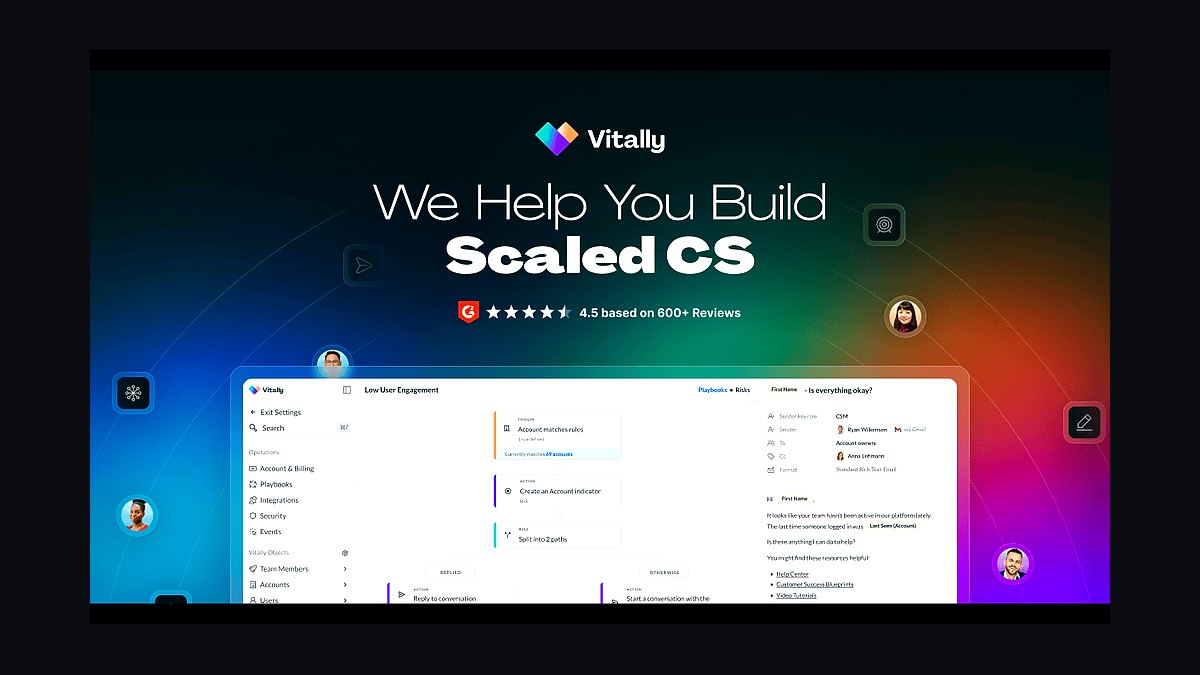
Vitally is an AI-powered customer-success platform that unifies all customer-facing data into one source of truth and layers AI for churn prediction, expansion, and prioritization, and it is a hot RevOps tool for 2027 because it delivers modern, AI-native customer-success operations — the engine for net revenue retention — without the heavyweight cost and implementation burden of legacy incumbents. Vitally pulls customer data from across the tech stack via real-time, bi-directional integrations so CS teams always work from accurate, current insight, then applies AI that predicts churn risk, uncovers expansion opportunities, and helps teams prioritize the right action at the right time. Its 2026 feature set is notably modern: a Meeting Recorder that automatically joins, transcribes, and summarizes Zoom calls; an AI Copilot that surfaces risks and key insights instantly; Hubs that let CS teams organize their book of business their own way; and powerful Playbook automation handling CSM assignment, task creation, and more. Vitally does not publish pricing but reportedly starts around two hundred ninety-nine dollars a month across three tiers (Tech-Touch, Hybrid-Touch, High-Touch) scaling by seats and managed accounts, with additional users at fifty to one hundred fifty-plus dollars each and meaningful discounts for multi-year commitments. For RevOps teams where retention and expansion grow revenue but a six-figure legacy CS platform is overkill, Vitally is the modern, AI-first alternative that operationalizes customer success at a more accessible price.
1What Vitally actually is
Vitally is a customer-success platform — the system CS teams use to manage retention, drive expansion, and operate their book of business systematically. It positions itself as AI-powered and modern, a deliberate contrast to the older, heavier incumbents, and it is built for CS teams, CS-ops leaders, and revenue-driven organizations that treat customer success as a growth function.
The foundation is unified customer data. Vitally connects to the tools across your stack — CRM, product analytics, support, billing — via real-time, bi-directional integrations, creating a single source of truth so the CS team always has accurate, current insight rather than stale or fragmented data. On that foundation it builds health and AI insight: AI that predicts churn risk, uncovers expansion opportunities, and helps CSMs prioritize the right actions at the right time. This is the core of any CS platform — knowing which accounts are at risk and which are ready to grow — delivered with a modern, AI-first approach.

1.1 The modern 2026 feature set
Vitally's 2026 features signal its modern orientation. A Meeting Recorder automatically joins, transcribes, and summarizes Zoom calls, capturing customer conversations without manual notes. An AI Copilot instantly surfaces risks and key insights from the unified data. Hubs give CS teams a flexible way to organize and manage their work, tailoring the experience to how individuals and teams run their books. And powerful Playbook automation handles the operational machinery — CSM assignment, task creation, and the repeatable workflows that keep retention systematic. Together these make Vitally feel built for how CS teams actually work in 2026, not retrofitted from an older era.
2Where Vitally fits in the RevOps stack
Vitally occupies the post-sale customer-success layer, unifying customer data and operationalizing retention and expansion alongside the CRM. As RevOps increasingly owns the full revenue lifecycle, Vitally is the engine for the retention-and-growth half of it.

The diagram shows Vitally's value: unified data feeds AI insight and health scoring, which trigger automated playbooks for risk and expansion, with meeting capture and Copilot adding insight. For RevOps, this operationalizes net revenue retention — the metric that increasingly drives valuation — through a modern, AI-native platform rather than a legacy one.
2.1 Why a modern alternative matters
The strategic argument is fit and accessibility. Net revenue retention has become a top growth priority, but the established enterprise CS platforms carry heavy cost and implementation burdens that not every team can justify. Vitally positions as the modern, AI-first alternative — accessible starting pricing, contemporary UX, and AI baked in rather than bolted on — for teams that need real CS operations without the enterprise weight. For RevOps at growing mid-market companies, Vitally makes systematic customer success attainable, closing the capability gap with larger competitors at a more reasonable cost.

2.2 Pricing
Vitally does not publish list pricing, but reported figures start around two hundred ninety-nine dollars a month, with three tiers (Tech-Touch, Hybrid-Touch, High-Touch) scaling by seats and the number of managed accounts; additional users typically run fifty to one hundred fifty-plus dollars each. Vitally strongly prefers multi-year contracts, often offering 15-to-30% lower effective annual pricing for two-to-three-year commitments. RevOps should weigh the multi-year discount against the flexibility of a shorter term, and size the tier to its account volume and touch model.
3Who Vitally is for
Vitally fits mid-market and growing SaaS companies that want modern, AI-native customer-success operations to drive retention and expansion, without the cost and complexity of a legacy enterprise platform. It rewards teams for whom NRR matters and who value contemporary UX and accessible pricing.

3.1 Where it shines
The strongest fit is a growing SaaS company with a real CS team managing meaningful account volume that wants AI-driven churn prediction, expansion insight, and automated playbooks in a modern platform. For these teams, Vitally's unified data, AI Copilot, Meeting Recorder, and flexible Hubs make CS operations effective and pleasant to use, at a price more accessible than enterprise incumbents. It shines for teams that find legacy CS platforms too heavy but have outgrown spreadsheets.
3.2 Where it is a weaker fit
Vitally is a weaker fit for the very largest enterprises with the most complex, ops-heavy retention programs that may need an incumbent's depth and breadth, and for tiny teams with few accounts where any dedicated CS platform is premature. The multi-year contract preference may also not suit teams wanting short-term flexibility. And organizations without a CS function to adopt it will not realize the value, since the platform operationalizes a team's work rather than replacing the team.

4The 2027 edge
Vitally is a 2027 story because retention is the dominant growth priority and AI-native, accessible CS platforms are displacing heavy legacy tools for the growing-company segment. The edge is modern AI-first design — unified data, predictive AI, meeting capture, flexible Hubs — at a more accessible price than incumbents, exactly what NRR-focused mid-market teams need.
4.1 The RevOps shift
The 2027 implication for RevOps is that customer-success operations become a measured, AI-driven retention engine accessible to growing companies, not just enterprises. RevOps owns the data integrations, the health-and-AI scoring, the playbook automation, and the Hubs structure, making NRR a managed system with clear inputs and outcomes. The discipline expands to include retention and expansion operations as a first-class part of RevOps — and teams that adopt a modern AI-native CS platform will compound revenue from their base while keeping cost and complexity reasonable, closing the gap with larger competitors who run heavier tools.

5Limits and watch-outs
The first watch-out is the CS-team prerequisite: Vitally operationalizes a customer-success team's work, so it delivers value only if you have a CS function to adopt it — it is not a substitute for the team. The second is the multi-year contract preference: the best pricing requires two-to-three-year commitments, so RevOps must weigh the discount against flexibility and confidence in the platform before locking in. The third is data dependence — health scores and AI predictions are only as good as the integrated data, so the bi-directional integrations must be set up and maintained well, or the insights mislead. The fourth is fit at the extremes: the largest, most complex enterprises may need an incumbent's depth, while tiny teams may not yet need a platform, so Vitally's sweet spot is the growing mid-market. Finally, like all CS platforms, adoption matters — playbooks and Copilot help only if CSMs actually use them, so RevOps must drive adoption, not just deploy the tool.
6Bottom Line
Vitally is a strong 2027 bet for mid-market and growing SaaS companies that want modern, AI-native customer-success operations to drive net revenue retention, because it unifies customer data into one source of truth and layers AI for churn prediction, expansion, and prioritization — with Meeting Recorder, AI Copilot, flexible Hubs, and playbook automation — at a more accessible price than legacy incumbents. The strategic shift it embodies is AI-native CS becoming the attainable NRR engine for growing companies, with RevOps owning the retention-and-expansion operations. Buy it if you have a CS team, NRR is a growth priority, and you want modern UX and accessible pricing over enterprise weight; be cautious if you are a very large enterprise needing maximal depth, a tiny team without a CS function, or unwilling to commit to the multi-year terms that unlock the best pricing. Its differentiator is modern, AI-first customer success — the accessible retention engine for the segment legacy platforms price out.

Related on PULSE
- What is Gainsight and why is it a hot RevOps customer-success platform for 2027?
- How do you diagnose whether your churn is a product problem or a customer-success problem?
- What is Loom and why is it a hot RevOps async video platform for 2027?
- What is HubSpot (Smart CRM platform) and why is it a hot RevOps all-in-one platform for 2027?
- What is Octave (Octave HQ) and why is it a hot RevOps GTM messaging platform for 2027?
- What is Openprise and why is it a hot RevOps data automation platform for 2027?
FAQ
Does Vitally replace my entire CRM or help desk? No, Vitally is not a full CRM or help desk replacement. It integrates deeply with tools like Salesforce, HubSpot, and Zendesk to pull customer data into a single customer-success workspace. You keep your existing systems for sales and support, while Vitally focuses on post-sale engagement and retention.
How accurate is Vitally's AI for churn prediction? The AI churn predictions are generally reliable but not perfect—accuracy depends heavily on the quality and completeness of your integrated data. Most users report that the model catches obvious at-risk accounts well, but false positives can occur with sparse or inconsistent data. It's best used as a prioritization signal, not a definitive forecast.
Can small teams or startups afford Vitally? Yes, the entry-level Tech-Touch tier reportedly starts around $299 per month, which is accessible for smaller teams. However, that base price covers only a limited number of seats and may lack advanced features like the Meeting Recorder or AI Copilot. Scaling to Hybrid-Touch or High-Touch tiers increases costs significantly, so startups should evaluate their needs carefully.
How long does it take to set up and see value? Initial setup typically takes one to three weeks for basic integrations and data mapping. Most teams start seeing actionable insights—like churn risks or expansion cues—within the first month. Full playbook automation and custom Hub configurations can take an additional few weeks to refine.
Does Vitally work well with non-SaaS or B2C businesses? Vitally is designed primarily for B2B SaaS companies with subscription models and named accounts. It can technically support other business types, but its features—like expansion scoring and playbook automation—are optimized for recurring revenue and account-based customer success. B2C or transactional businesses may find the platform less natural to adapt.
What happens to my data if I cancel Vitally? You can export all your data—including notes, playbook histories, and AI-generated insights—at any time via standard CSV or API exports. Vitally does not lock data in, but you lose access to the platform's real-time integrations and AI features immediately after cancellation. There are no long-term data retention fees reported.
Sources
- Vitally.io product pages on the AI-powered CS platform, Meeting Recorder, AI Copilot, Hubs, and Playbooks
- G2 and Capterra 2026 Vitally pricing data and customer reviews
- Vendr and SoftwareAdvice 2026 Vitally pricing and tier analyses
- Salesforge and Puzzle Inbox 2026 Vitally feature, pros, and cons breakdowns
- Industry analysis on net revenue retention and modern AI-native customer success
This page will be disappearing soon. Save it to your device for $1 — or read it free while it is here.
@Kory-White- · if Venmo asks, the last 4 of my number are 2012
This page is gone.
This one is off the shelf now. $1 keeps it on your phone for good — the whole page, pictures and diagrams included.
 revopsWhat are LSU Tigers football's 2027 NIL needs and strategy?
 revopsHow should a 2027 CS team respond to a coordinated customer revolt?
 revopsHow should a 2027 sales org structure deal review templates?
 revopsHow should a 2027 RevOps team write a sunset SOP for a legacy GTM tool?
 revopsHow do you design the PLG-to-sales handoff in 2027?
 revopsHow should a 2027 GTM team build joint persona programs across sales and marketing?
 revopsHow should a 2027 sales enablement team run content audits at scale?
 revopsHow do you operate sales during a system outage during end-of-quarter in 2027?
 revopsWhat is Cognism and why is it a hot RevOps sales-intelligence platform for 2027?
 revopsWhat are Penn State Nittany Lions football's 2027 NIL needs and strategy?