


How do you set up a deal-desk in 2027?
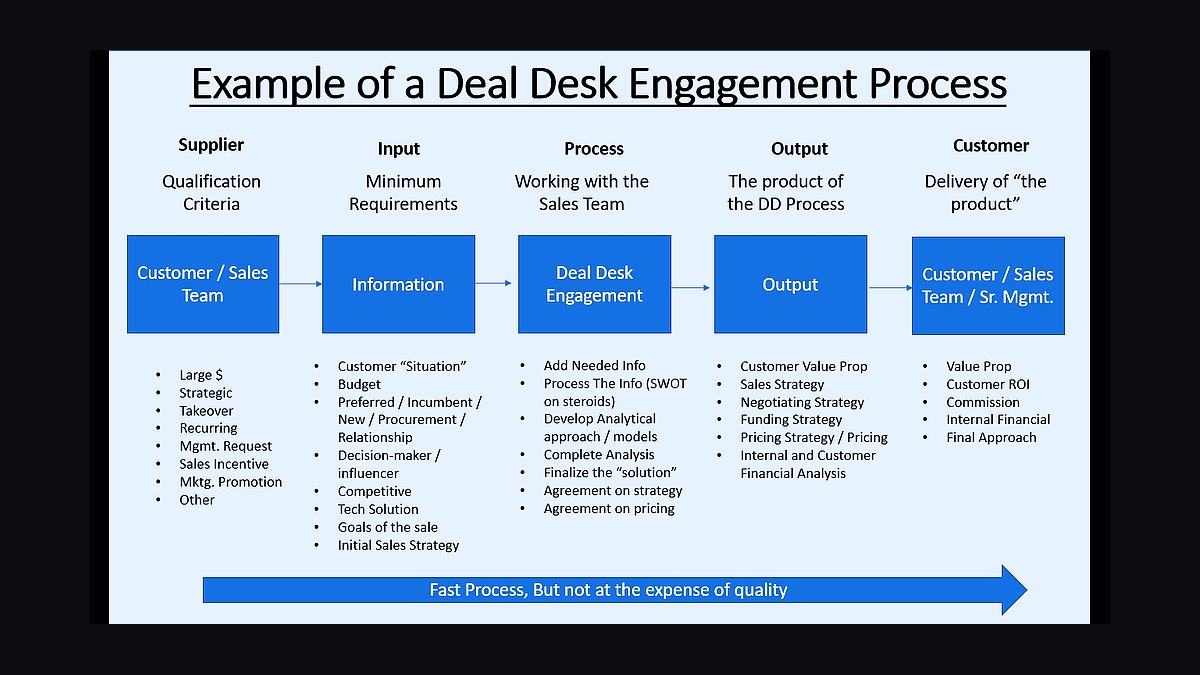
A 2027 deal desk is the cross-functional approval engine — typically RevOps + Finance + Legal + CS + Product — that owns every non-standard deal: discounts above policy, custom terms, multi-year price locks, custom SLAs, and any clause Legal has not pre-approved. Build it in five layers: (1) a written charter that defines what is "standard" vs "non-standard" and who can approve what, (2) a tiered approval ladder keyed to discount %, ACV, and term length (e.g., <10% AE-self, 10-20% manager, 20-30% VP Sales + Finance, >30% CRO + CFO), (3) a 24-48 hour cycle-time SLA with auto-escalation and same-day turnaround for clean standard deals, (4) a tool stack — DealHub or Salesforce CPQ for quoting, PandaDoc or DocuSign for proposals, Ironclad for CLM, Slack plus Default for routing — and (5) an analytics layer tracking cycle time (median + p90), discount drift, approval mix, leakage, and win-rate-by-discount-band. The 2026/2027 shift is agentic deal desk: Salesforce Agentforce, DealHub AI, and Ironclad AI now auto-draft quotes, route by risk score, and flag non-standard clauses before a human sees them — collapsing 14-day approval cycles to 14 minutes for low-risk deals while concentrating human attention on the strategic 10-15% that actually need it.
1The Deal Desk Charter: What You Are and What You Are Not
The first deliverable of a deal desk build is a two-page charter signed by the CRO, CFO, General Counsel, and Chief Customer Officer. Without it, the desk becomes a bottleneck Slack channel that AEs route around.
The charter answers four questions. Mission: protect margin, accelerate cycle time, ensure contract enforceability, and standardize commercial terms. Scope: which deals route through the desk and which do not. Authority: who can approve what dollar amount, what discount %, what term length. Cadence: SLAs, escalation paths, and the weekly governance review.

1.1 What "Non-Standard" Means in 2027
A deal is non-standard — and routes to the desk — if it includes any of: a discount above 10% off list, a multi-year commitment with price lock, payment terms beyond Net-30, a custom SLA, free add-ons or modules, a feature commitment with a delivery date, a most-favored-nation clause, liability caps above standard, or any legal clause not pre-approved in the Ironclad playbook. Everything else flows through CPQ auto-quote with no human approval.
1.2 Who Sits on the Desk
A modern B2B SaaS deal desk has five named owners: the Deal Desk Manager (RevOps), a Finance Partner (margin and revenue recognition), a Legal Partner (contract terms), a CS Partner (delivery feasibility), and a Product Partner (custom feature commitments). At companies under $50M ARR, this is often 2-3 people wearing 5 hats; above $100M ARR, it is typically a dedicated 4-6 person team.

2The Tiered Approval Ladder
The single most important deal-desk design decision is approval tier depth. More than three tiers for standard deals signals broken process. Build the ladder against three dimensions — discount %, ACV, and term length — and resolve to the highest tier triggered.
2.1 The Reference Ladder
Tier 1 — AE Self-Approve: discount <10%, ACV <$50K, term 1 year, all standard clauses. AE quotes in CPQ, sends via PandaDoc, no desk review. Same-day turnaround.

Tier 2 — Sales Manager: discount 10-20%, ACV $50K-$250K, term up to 2 years. Routes to the AE's direct manager with a 24-hour SLA. Auto-approved if no response in 24 hours and discount is <15%.
Tier 3 — Deal Desk + VP Sales: discount 20-30%, ACV $250K-$1M, term up to 3 years, or any custom clause Legal has pre-approved as "yellow." Routes to the Deal Desk Manager, Finance Partner, and VP Sales with a 48-hour SLA.

Tier 4 — CRO + CFO: discount >30%, ACV >$1M, term >3 years, any "red" legal clause, any MFN, any liability cap change. Routes to CRO, CFO, General Counsel with a 72-hour SLA maximum.
2.2 The Approval Workflow
3The Cycle-Time SLA and Why Every Day Matters
Every day of delay in deal approval correlates with a 3-5% drop in close rate — published in multiple 2026 RevOps benchmark studies. That makes cycle time a revenue line item, not an ops metric.

3.1 Target SLAs by Tier
Tier 1: same-day, often <1 hour with CPQ auto-quote. Tier 2: 24 hours with 24-hour auto-escalation to skip-level. Tier 3: 48 hours with 36-hour escalation. Tier 4: 72 hours maximum, with daily standup escalation. p90 cycle time — the painful tail — is the metric that catches the deals AEs route around.
3.2 The Escalation Mechanics
Every approval timer fires a Slack ping at 50% of SLA, a manager ping at 80%, and an auto-routing to backup approver at 100%. Default and LeanData handle the routing; Salesforce Flow runs the timers. The Deal Desk Manager reviews all escalations weekly and tunes thresholds.

3.3 The Forbidden Pattern: Email Approvals
The single fastest way to break a deal desk is allowing email approvals. They cannot be audited, cannot be timed, and cannot be rolled into CLM. Every approval flows through CPQ → Slack → Salesforce field update → Ironclad → DocuSign. No exceptions.
4The 2027 Tool Stack
4.1 CPQ and Quoting
Salesforce CPQ remains the enterprise default for >$100M ARR Salesforce shops. DealHub has emerged as the 2026/2027 challenger — Gartner Peer Insights ranks it consistently in the top three CPQ vendors, with native AI-powered approval routing and subscription billing in one platform. HubSpot Commerce Hub owns the <$50M ARR segment. Conga CPQ holds the manufacturing/industrial vertical.

4.2 Proposal and Signature
PandaDoc handles proposal automation and e-signature in one tool — strong for SMB/mid-market at $59-$99/user/month. DocuSign CLM is the enterprise standard for signature plus contract storage. Adobe Acrobat Sign is the Microsoft ecosystem default.
4.3 Contract Lifecycle Management
Ironclad is the 2026/2027 CLM leader — its AI Assist auto-redlines against the playbook, flags non-standard clauses, and routes to Legal only when needed. Icertis owns the Fortune 500 and manufacturing segments. LinkSquares and ContractWorks serve mid-market with simpler workflows.

4.4 Routing and Approval Orchestration
Default, LeanData, and Slack Workflow Builder handle the approval-routing logic. Salesforce Agentforce and DealHub AI now ship native agentic approval drafting — the AI proposes the approval decision and a human confirms.
5The Metrics That Run the Desk
A deal desk without weekly metrics is a service ticket queue. The five KPIs that matter:

Cycle time tracks median and p90 per tier; flag any tier where p90 > 2x median. Discount drift measures the variance from policy in similar deals; >5 percentage points is a sign of an untrained AE bench or a broken floor price. Approval mix should be 70/20/8/2 across Tiers 1-4; if Tier 4 exceeds 15%, the ladder is mis-calibrated. Leakage — value lost when the executed contract differs from the approved quote — should be <2%; above that, the CLM enforcement layer is broken. Win rate by discount band is the margin-protection ceiling: most teams find a plateau at 18-22% discount where additional concession does not move win rate, and that becomes the floor price.
6The 2026/2027 Pivot: Agentic Deal Desk
The most consequential shift since the CPQ era is agentic deal desk. DealHub AI, Salesforce Agentforce, and Ironclad AI now auto-draft the quote, risk-score the deal against historical patterns, and route only the strategic 10-15% to a human. Case studies from DealHub (Socure) and Zams show 14-day approval cycles collapsing to 14 minutes for low-risk standard deals. The Deal Desk Manager's role shifts from approver-of-everything to policy-tuner and escalation-arbiter — fewer tickets, higher leverage.

FAQ
What is the most common mistake when setting up a deal desk? The most common mistake is skipping the charter and trying to build the process around tools first. Without a clear definition of "standard" vs. "non-standard" and explicit approval tiers, teams end up with confusion, delays, and inconsistent deal terms. A written charter should be the first deliverable, not an afterthought.
How long does it typically take to get a deal desk fully operational? Most organizations can build the core process and tooling in 4 to 8 weeks, but full adoption and optimization often take 3 to 6 months. The initial setup depends on how much clean data you have about past deals and how quickly cross-functional stakeholders align on the charter and approval ladder.
What tools are essential for a 2027 deal desk? The core stack usually includes a CPQ tool like Salesforce CPQ or DealHub for quoting, a CLM platform like Ironclad for contract lifecycle management, and a routing layer like Slack or Default for approvals. In 2027, agentic AI tools (e.g., Salesforce Agentforce, DealHub AI) are becoming standard for auto-drafting low-risk quotes and flagging non-standard clauses.
How do you decide which deals need human approval vs. automation? The decision is typically based on three criteria: discount percentage relative to policy, annual contract value (ACV), and term length. Deals under a certain threshold (e.g., <10% discount, <$50k ACV, 12-month term) can be auto-approved by AI, while anything above triggers a tiered human approval ladder. The exact thresholds vary by company size and risk tolerance.
What metrics should a deal desk track to prove its value? Key metrics include median and p90 cycle time, discount drift (how much actual discounts deviate from policy), approval mix (percentage auto-approved vs. human-approved), leakage (deals that bypass the desk), and win rate by discount band. Tracking these helps identify bottlenecks and justify the desk's impact on revenue velocity and margin.
How does a deal desk handle custom SLAs or non-standard legal clauses? Custom SLAs and non-standard legal clauses are flagged by the CLM tool (e.g., Ironclad or a similar platform) before the deal reaches human reviewers. The system routes them to Legal for pre-approval or to a predefined escalation path. In 2027, AI can often suggest fallback language based on past approved terms, reducing Legal's review time to minutes for low-risk modifications.
Bottom Line
A 2027 deal desk runs on a tiered approval ladder, a 24-48 hour cycle-time SLA, an agentic CPQ-CLM stack, and a weekly five-KPI scorecard — with agentic routing carrying 85-90% of standard deals end-to-end. The single most important habit: publish weekly cycle time, discount drift, and approval mix to the CRO, CFO, and VP Sales together — visibility forces tuning, and tuning is the only thing that keeps the desk from re-bottlenecking as deal volume scales.
Related on PULSE
- What data sources are most effective for training AI models to predict next best action in complex enterprise deals?
- How does the expanding size of B2B buying committees increase the risk of vendor consolidation paralysis?
- Which vendor consolidation strategies are failing most often when integrating AI sales tools into existing stacks?
- Why are longer sales cycles now correlating with a shift from pipeline velocity to deal value predictability?
- What specific metrics are B2B RevOps teams using to measure AI's impact on lead quality in the top-of-funnel?
Sources
- DealHub — 2026 AI-powered CPQ documentation, Socure case study, Gartner Peer Insights reviews
- Ironclad — CLM AI Assist product documentation and 2026 contracting benchmarks
- PandaDoc — Proposal and e-signature pricing, deal-desk integration guides
- Salesforce — CPQ and Agentforce 2026 release notes and deal-desk implementation blog
- Umbrex — Deal Desk Playbook: KPIs, exceptions, and leakage analytics
- ExecViva — Deal Desk KPIs Executive Guide for accelerating deals
- Zams — "From 14 Days to 14 Minutes" agentic deal-desk case study
- Forrester and Gartner — 2026 CPQ Magic Quadrant and CLM Wave reports
- HubSpot — 2026 State of Sales Report on cycle-time and approval friction
- ScaleVP and OpenView — 2026 B2B SaaS pricing and discount benchmark data
People also search for: set up a deal-desk · how to set up a deal-desk · set up a deal-desk guide
This page will be disappearing soon. Save it to your device for $1 — or read it free while it is here.
@Kory-White- · if Venmo asks, the last 4 of my number are 2012
This page is gone.
This one is off the shelf now. $1 keeps it on your phone for good — the whole page, pictures and diagrams included.
 revopsHow do you structure a quarterly business review (QBR) in 2027?
 revopsHow do you build a renewal-risk scoring model in 2027?
 revopsHow do you build a SDR-to-AE pass-off process in 2027?
 revopsHow do you do effective territory management in 2027?
 revopsHow do you do effective sales call planning in 2027?
 revopsHow do you handle the death of the MQL in 2027?
 revopsHow do you transition from sales-led to PLG (product-led growth) in 2027?
 revopsHow do you build a sales operations stack from scratch in 2027?
 revopsHow do you measure agentic-AI ROI in RevOps in 2027?
 revopsHow do you build a competitive intel program in 2027?