


What does multi-agent orchestration look like in production in 2027?
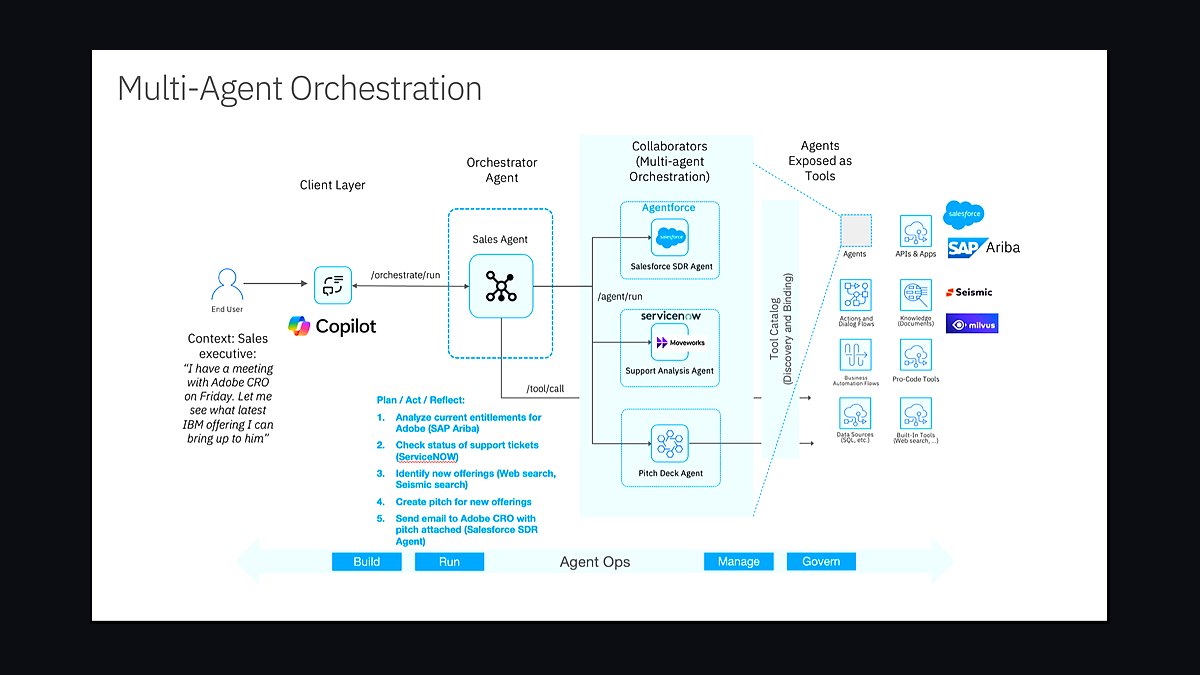
In 2027, multi-agent orchestration has matured into a real engineering discipline. The 2027 frameworks: LangGraph (LangChain) for state-machine-based agent flows, CrewAI for role-based agent teams, Microsoft AutoGen for conversational agent collaboration, OpenAI Swarm for lightweight handoff patterns, Anthropic's Claude Computer Use SDK for browser-driven agents, Google ADK (Agent Development Kit) for Vertex AI agent deployment, and Pydantic AI for type-safe agent definitions. Multi-agent systems work best for decomposable tasks where specialized subagents outperform a monolithic prompt — research, content generation, software engineering, customer support triage.
1When Multi-Agent Helps (and When It Hurts)
%20What%20does%20multi-agent%20orchestratio%2C%20realistic%20magazine%20style%2C%20warm%20light%2C%20no%20text%2C%20no%20watermark?width=1200&height=675&nologo=true&model=flux&seed=52333)
Multi-agent helps when:
- Task decomposes naturally into specialized subtasks (research → write → edit).
- Subagents need different prompts, tools, or models.
- Parallel execution speeds up wall-clock time.
- Different subagents need different trust/permission levels.
Multi-agent hurts when:
- Task is simple enough for a single LLM call.
- Inter-agent communication overhead exceeds work output.
- Failure cascades because of complex handoff logic.
- Cost balloons (each agent call multiplies token usage).
The 2027 rule of thumb: start with single-agent; reach for multi-agent only when single-agent demonstrably fails.

2The Framework market
LangGraph is the 2027 leader for production multi-agent systems. State-machine model with explicit nodes (agents) and edges (transitions). Strong observability via LangSmith.
CrewAI is the role-based framework — define "Researcher," "Writer," "Editor" agents and let them collaborate. Easier mental model for non-engineers.
Microsoft AutoGen focuses on conversational collaboration patterns and code execution. Strong for code-generation agent teams.
OpenAI Swarm is the lightweight framework — minimal handoff patterns; built by OpenAI to demo Assistants API patterns.

Anthropic Claude Computer Use SDK is for agents that drive browsers and desktop GUIs.
Google ADK (Agent Development Kit) is Vertex AI's enterprise-grade agent platform with Gemini-native integration.
Pydantic AI brings type-safe agent definitions; growing fast for Python engineering teams that already use Pydantic.

2.1 Picking a Framework
- LangGraph if you want production-grade state management + LangSmith observability.
- CrewAI if non-engineers will model the agent flows.
- AutoGen if code generation is the core use case.
- Google ADK if you're Vertex AI-native.
- Pydantic AI if type safety matters and your team is Pydantic-fluent.
3Common Multi-Agent Patterns
Researcher–Writer–Editor: specialized agents for content production. Researcher gathers facts; Writer drafts; Editor reviews.
Triage–Specialist: triage agent classifies incoming requests; specialist agents handle each category.

Plan–Execute–Verify: planner agent decomposes the task; executor agents do the work; verifier agent checks output.
Voting / Ensemble: N parallel agents tackle the same task; aggregator picks the best or merges.
Supervisor–Worker: supervisor delegates subtasks to worker agents; aggregates results.
4Production Considerations
Observability is critical. Use LangSmith, Langfuse, or Arize Phoenix to trace every agent interaction. Without traces, debugging multi-agent systems is impossible.

Cost monitoring. Multi-agent multiplies token usage by N (number of agents) plus inter-agent communication overhead. A 5-agent system can cost 10x a single-agent equivalent.
Latency. Inter-agent handoffs add latency. Parallel execution is the optimization — run independent agents concurrently.
Failure modes. Agent loops (one agent calls another in cycles), context-window overflow (accumulated history exceeds limits), tool-call failures cascading.

4.1 Guardrails
Every agent flow needs:
- Max-iteration limit (cap agent loops at 10–20 steps).
- Cost ceiling (kill the flow if it exceeds $X).
- Human-in-the-loop checkpoints for high-stakes actions.
- Audit logging of every agent decision.
5Real-World Use Cases in 2027
- Software engineering — Cognition Devin, Anthropic Claude Code, Cursor, Cline run multi-agent code generation + verification flows.
- Customer support triage — agents classify, route, draft responses, escalate.
- Research and writing — Perplexity Pro Search, Anthropic Claude Projects, OpenAI Deep Research orchestrate multi-step research flows.
- Sales operations — agents draft outbound, score leads, prep meeting notes.
How Observability and Debugging Evolved for Multi-Agent Systems
By 2027, traditional logging and tracing tools have proven insufficient for multi-agent orchestration. The core challenge is that agents don’t just execute linear code paths — they negotiate, delegate, and sometimes contradict each other. Production teams now rely on agent-native observability platforms that capture three distinct layers of telemetry.
First, intent tracing has replaced simple span-based tracing. Tools like Arize AI’s agent monitoring module and LangSmith’s multi-agent viewer record not just which agent called which tool, but *why* — the reasoning chain that led to a delegation decision. When a research agent passes a query to a summarization agent, the trace includes the original user intent, the intermediate findings, and the summarization parameters. This makes debugging hallucinations or misattributions tractable: you can replay the exact conversation history that caused a wrong conclusion.

Second, coordination dashboards show real-time agent state machines. In production deployments using LangGraph or Microsoft AutoGen, operators see each agent’s current status (idle, processing, waiting for response, blocked) alongside the shared memory state. When a payment processing agent stalls because a compliance agent hasn’t approved a transaction, the dashboard highlights the dependency chain. Teams can set agent SLAs — for example, “the triage agent must respond within 2 seconds, or escalate to a fallback agent.” Breaches trigger automated rollbacks or human-in-the-loop interventions.
Third, conversation replay has become standard. Every multi-agent session is recorded as a structured transcript, not just logs. Teams can scrub through a session second-by-second, seeing each agent’s input, output, confidence score, and tool calls. This is especially critical for regulated industries like healthcare and finance, where audit trails must show exactly which agent made which decision and why. The leading platforms now offer natural language search over agent conversations — an operator can type “show me all cases where the refund agent overrode the fraud detection agent” and get instant results.
The practical impact is measurable. Organizations using agent-native observability report 40-60% faster mean-time-to-resolution for agent failures compared to those still using generic logging. The hidden cost of multi-agent systems in 2027 is no longer the compute — it’s the debugging time. Teams that invest in these observability tools early see significantly lower operational overhead per agent deployment.

The Human-in-the-Loop Patterns That Actually Work
The 2027 reality is that fully autonomous multi-agent systems remain rare outside narrow domains. Most production deployments use structured human-in-the-loop (HITL) patterns that balance autonomy with safety. The industry has converged on three proven patterns, each suited to different risk profiles.
The escalation gate pattern is the most common. Agents operate autonomously within defined boundaries — a customer support agent can issue refunds up to $100, a content agent can publish drafts to staging but not production. When an agent encounters a decision outside its authority, it pauses and creates an escalation ticket. The human operator sees a summary: “Agent A wants to approve a $500 refund for customer X, citing policy Y. Reason: customer has been a subscriber for 5 years.” The operator can approve, deny, or modify the request, and the agent continues. This pattern reduces human involvement by 70-80% compared to full manual workflows, while maintaining control over high-stakes decisions.
The review-and-approve loop is used for multi-step creative or analytical tasks. A research agent gathers data, a writing agent drafts a report, and a compliance agent checks for regulatory issues — but the final output goes to a human reviewer before delivery. The key innovation in 2027 is intelligent summarization: the human doesn’t see the full 50-page report. Instead, they see a one-page executive summary with flagged risks, confidence scores per section, and specific questions the agents couldn’t resolve. The reviewer can click into any section to see the full reasoning chain. This pattern is standard in legal document review, financial reporting, and medical diagnosis support.

The supervisor agent pattern uses a dedicated agent to monitor and coordinate other agents, with a human as the ultimate fallback. The supervisor agent tracks each sub-agent’s performance metrics, detects when an agent is stuck in a loop or producing low-quality output, and can dynamically reassign tasks or spin up replacement agents. If the supervisor itself encounters an unresolvable conflict — for example, two sub-agents produce contradictory conclusions with equal confidence — it escalates to a human with a structured comparison. This pattern is popular in software engineering teams where multiple code-generation agents work on different modules simultaneously.
The critical lesson from production deployments is that HITL must be designed into the agent architecture, not bolted on later. Teams that try to add human oversight after building a fully autonomous system typically end up with brittle workarounds. The most successful implementations define escalation thresholds, human response time expectations, and fallback behaviors during the system design phase. In practice, this means every agent’s prompt includes explicit instructions about when to pause and wait for human input, and the orchestration framework enforces these rules at the infrastructure level.
The Economics of Running Multi-Agent Systems at Scale
By 2027, the cost structure of multi-agent orchestration has become predictable enough for serious financial planning. The economics break down into three main categories: inference costs, coordination overhead, and failure costs.
Inference costs are the most visible but often not the largest. Each agent call to a frontier model (GPT-5, Claude 4, Gemini Ultra) costs between $0.01 and $0.50 per call, depending on context length and output tokens. A typical customer support triage system might make 5-15 agent calls per conversation — one for intent classification, one for knowledge retrieval, one for response generation, one for quality check, and possibly escalation calls. At $0.10 average per call and 10 calls per conversation, that’s $1.00 per resolved ticket. For a company handling 100,000 tickets per month, that’s $100,000 in model inference alone. However, many organizations have reduced this by 40-60% using caching layers (reusing common responses) and smaller specialist models for routine tasks — a fine-tuned 7B parameter model might cost $0.002 per call for intent classification.
Coordination overhead is the hidden cost that surprises most teams. Every agent-to-agent communication, shared memory update, and state transition consumes compute resources. In 2027, the orchestration framework itself typically costs $0.001 to $0.01 per agent interaction, depending on the complexity of the coordination logic. For a system with 10 agents making 100 interactions per task, that’s $0.10 to $1.00 in overhead per task. This becomes significant when running thousands of concurrent agent sessions. Leading teams now profile their orchestration overhead just as they profile model inference, and many have switched to lighter-weight frameworks like Pydantic AI or custom Rust-based orchestrators for latency-sensitive applications.
Failure costs are the most variable and often the most damaging. When a multi-agent system produces a wrong answer — especially in regulated domains — the cost can be orders of magnitude higher than the direct compute. A misdiagnosis in a medical triage system could lead to patient harm and liability. A hallucinated financial recommendation could trigger regulatory fines. Production teams now budget 10-20% of their total multi-agent spend for monitoring, testing, and fallback systems. This includes running continuous evaluation suites that test agents against edge cases, maintaining shadow deployments that compare agent outputs to human decisions, and paying for human reviewers to spot-check a random sample of agent interactions.
The pragmatic takeaway for 2027: a well-optimized multi-agent system in production typically costs $0.50 to $3.00 per completed task, depending on complexity and quality requirements. This is often 5-10x cheaper than the equivalent human-only workflow, but 2-3x more expensive than a well-tuned single-agent system. The premium is justified when the task genuinely benefits from specialized expertise — and the key to profitability is ruthlessly optimizing the ratio of agent calls to successful outcomes.
FAQ
What exactly is multi-agent orchestration in production? It’s the practice of coordinating multiple AI agents, each with a specialized role or model, to complete complex tasks. In production, this means using frameworks like LangGraph or CrewAI to manage state, handoffs, and error recovery automatically, so the system runs reliably at scale.
Which frameworks are most common for production use in 2027? Popular choices include LangGraph for state-machine flows, CrewAI for role-based teams, and Microsoft AutoGen for conversational collaboration. Others like OpenAI Swarm and Google ADK are also used, depending on the need for lightweight handoffs or cloud-native deployment.
How do agents communicate and share context in production? Agents typically pass structured messages or share a common state store, often via a framework’s built-in memory or a database. This ensures each agent has the necessary context without duplicating work, and failures in one agent don’t break the whole system.
What kinds of tasks benefit most from multi-agent orchestration? Tasks that are decomposable into subtasks, like research with fact-checking, content generation with editing, or customer support triage with escalation. Monolithic prompts struggle here, but specialized agents can handle each part more accurately and efficiently.
How do you handle errors or agent failures in production? Frameworks include retry logic, fallback agents, and human-in-the-loop approvals for critical steps. Monitoring and logging are essential, so teams can trace failures to a specific agent or state transition and adjust prompts or routing rules.
Is multi-agent orchestration expensive to run at scale? Costs vary widely based on model choice and task complexity, ranging from a few cents per simple workflow to several dollars for heavy research or code generation tasks. Many teams use smaller, cheaper models for routine subtasks and reserve larger models for complex reasoning, balancing performance and budget.
Bottom Line
Multi-agent orchestration in 2027 is a real engineering discipline. Start single-agent; reach for multi-agent only when decomposition demonstrably wins. LangGraph leads for production; CrewAI for accessibility. Observability, cost monitoring, and guardrails are non-negotiable. The frameworks have matured — the discipline of when to use them lags.
Related on PULSE
- Why are traditional BANT and MEDDIC frameworks failing to predict outcomes in 2027's multi-agent buying environments?
- Can a 2027 RevOps team align sales and marketing with only one AI orchestration platform after consolidation?
- What is revenue orchestration and why does RevOps need it in 2027?
- What is Momentum (Momentum.io) and why is it a hot RevOps AI revenue orchestration platform for 2027?
- Should Salesloft pivot from sequencing to AI orchestration?
- What replaces traditional workflow if AI agents handle process orchestration?
Sources
- LangChain — LangGraph Documentation and Multi-Agent Patterns
- CrewAI — Role-Based Multi-Agent Framework Documentation
- Microsoft — AutoGen Documentation and Code-Gen Agent Patterns
- OpenAI — Swarm Lightweight Handoff Framework
- Anthropic — Claude Computer Use SDK Documentation
- Google — ADK Agent Development Kit Reference
- Pydantic AI — Type-Safe Agent Framework Documentation
- LangSmith — Multi-Agent Trace Reference
- Cognition AI — Devin Multi-Agent Architecture Disclosures
- Anthropic — Claude Code Multi-Agent Engineering Reference
This page will be disappearing soon. Save it to your device for $1 — or read it free while it is here.
@Kory-White- · if Venmo asks, the last 4 of my number are 2012
This page is gone.
This one is off the shelf now. $1 keeps it on your phone for good — the whole page, pictures and diagrams included.
 revopsHow do you set up RevOps for a PLG company in 2027?
 revopsHow do you calculate and improve pipeline coverage ratio in 2027?
 revopsHow do you achieve EU AI Act compliance in 2027?
 revopsWhat is revenue orchestration and why does RevOps need it in 2027?
 revopsHow do you run a customer expansion playbook in 2027?
 revopsHow do you build a lead routing system in 2027?
 revopsHow do you evaluate and buy RevOps software in 2027?
 revopsHow do you forecast new business pipeline in 2027?
 revopsHow do you keep CRM data clean when reps use AI note-takers in 2027?
 revopsHow do you build a lead scoring model that sales trusts in 2027?