


How do you implement the NIST AI Risk Management Framework in 2027?
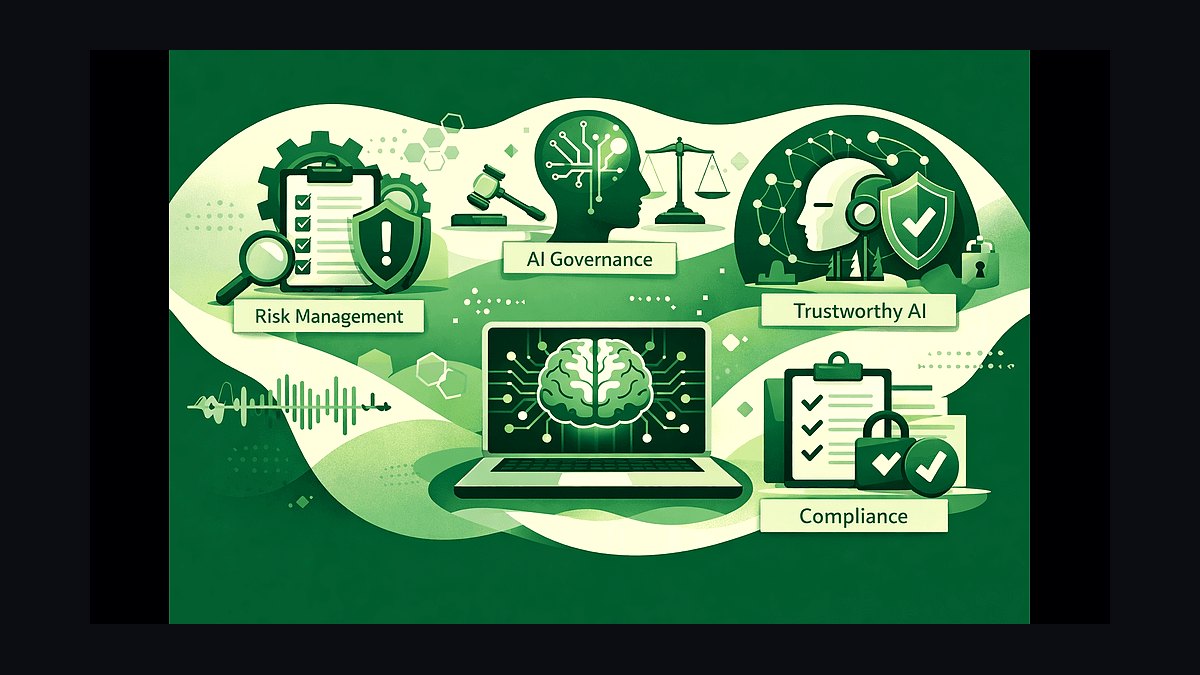
In 2027, the NIST AI Risk Management Framework (AI RMF 1.0) is the de-facto US AI governance reference. Released January 2023, expanded with the Generative AI Profile in July 2024, it provides a voluntary but widely-adopted structure for managing AI risks. The framework has four core functions: GOVERN (governance structures, policies, accountability), MAP (context, intended use, stakeholders, risks), MEASURE (metrics, evaluation, ongoing monitoring), and MANAGE (prioritize, treat, respond, monitor risks). Federal agencies (per OMB M-24-10 and NSM-10) require AI RMF alignment; federal contractors must demonstrate compliance; enterprise procurement increasingly asks for it.
1The Four Functions
1.1 GOVERN
- Establish AI governance structures.
- Define roles, responsibilities, accountability.
- Set risk tolerance and risk acceptance criteria.
- Document policies and procedures.
- Train staff on AI risk management.
1.2 MAP
- Identify intended use and context.
- Identify stakeholders and impacted populations.
- Identify potential harms and benefits.
- Document model architecture, training data, dependencies.
- Map to laws and regulations (GDPR, HIPAA, EU AI Act, sectoral rules).
1.3 MEASURE
- Establish metrics for accuracy, robustness, bias, security.
- Conduct evaluations across diverse scenarios.
- Test for adversarial robustness.
- Monitor production performance.
- Measure stakeholder impact.
1.4 MANAGE
- Prioritize risks for treatment.
- Apply mitigations (technical, policy, human oversight).
- Establish incident response procedures.
- Communicate risks to stakeholders.
- Continuously monitor and update risk register.

2The Generative AI Profile (NIST AI 600-1)
Released July 2024, this profile addresses GenAI-specific risks:
- Confabulation / hallucination.
- CBRN (Chemical, Biological, Radiological, Nuclear) misuse.
- Data privacy violations.
- Environmental impact.
- Information integrity (deepfakes, misinformation).
- Information security.
- Intellectual property risks.
- Obscene, degrading, abusive content.
- Toxicity, bias, homogenization.
- Value chain risks.
- Excessive agency.
For each, the profile lists specific risk-management actions across GOVERN, MAP, MEASURE, MANAGE.
3OMB M-24-10 and Federal Adoption
OMB Memorandum M-24-10 (March 2024) requires federal agencies to:
- Designate Chief AI Officers.
- Inventory AI use cases.
- Adopt minimum risk-management practices for rights-impacting and safety-impacting AI.
- Align with NIST AI RMF.
- Publish AI use-case inventories annually.
OMB M-24-18 (extending M-24-10) added AI acquisition requirements for federal procurement.

4AI RMF vs ISO/IEC 42001 vs EU AI Act
These frameworks complement rather than substitute:
- NIST AI RMF — voluntary, US-origin, principles-based, broadly applicable.
- ISO/IEC 42001 — international, certifiable management system standard.
- EU AI Act — regulatory, EU-origin, classification-based, prescriptive for high-risk.
Most enterprises adopt all three in 2027 to satisfy regulators, certifiers, and procurement.

5Practical Implementation
5.1 Step 1: Establish Governance
- Assign AI Risk Officer or Chief AI Officer.
- Form AI Governance Committee.
- Adopt AI Use Case Inventory.
5.2 Step 2: Map Each Use Case
- Document intended use.
- Identify stakeholders and impacts.
- Classify by risk tier (informed by EU AI Act + sector-specific rules).
5.3 Step 3: Measure
- Define metrics per use case.
- Run pre-deployment evaluations.
- Stand up production monitoring.
5.4 Step 4: Manage
- Apply mitigations.
- Document residual risk acceptance.
- Establish incident response.
- Continuously monitor.

6AI RMF Toolchain
Drata — SOC 2 + NIST AI RMF compliance module. Vanta — multi-framework including AI RMF. OneTrust — AI governance + privacy. Credo AI — AI-specific governance platform. complete AI — AI risk + EU AI Act + AI RMF. IBM watsonx.governance — enterprise AI governance. Microsoft Responsible AI Standard — internal Microsoft framework aligned with AI RMF. Google Responsible AI Practices — published framework.
7Federal Contractor Requirements
If you sell AI to the federal government (post-OMB M-24-10):
- Demonstrate AI RMF alignment in proposals.
- Provide AI use-case documentation.
- Support agency conformance reviews.
- Comply with rights-impacting AI requirements.
Key Technical Controls and Automation Tools for AI RMF Compliance in 2027
Implementing the NIST AI RMF in 2027 requires more than policy documents—it demands technical controls embedded directly into AI development pipelines. The most effective implementations leverage automated tooling to address the framework's core functions at scale.
For the GOVERN function, organizations deploy AI governance platforms that enforce policy-as-code. These tools integrate with CI/CD pipelines to automatically check that every model version has documented purpose, intended use, and stakeholder review before deployment. Common technical controls include:

- Role-based access controls with separation of duties for model development, testing, and deployment
- Automated logging of all governance decisions, including who approved which risk tolerance levels
- Version-controlled AI model registries that maintain immutable audit trails
- Policy enforcement gates that block deployment if required documentation is missing
For the MAP function, automated model cards and system cards have become standard. These structured documents, generated by scanning training data, model architecture, and deployment context, provide consistent risk context. Tools in this space automatically:
- Detect and document training data sources, collection methods, and known biases
- Map intended uses against documented limitations and contraindications
- Identify downstream dependencies and third-party model components
- Generate stakeholder impact assessments based on deployment context
For the MEASURE function, continuous monitoring platforms have matured significantly. These tools track model performance metrics, drift indicators, and fairness metrics in production. Typical implementations include:

- Real-time performance dashboards showing accuracy, precision, recall, and latency
- Automated fairness testing across protected attributes, with configurable thresholds
- Drift detection algorithms that flag distribution shifts in input data or predictions
- Adversarial robustness testing suites that probe models for vulnerabilities
For the MANAGE function, automated risk treatment workflows connect monitoring outputs to incident response. When a metric exceeds its threshold, the system can:
- Automatically log the incident with full context
- Notify designated risk owners via configured channels
- Apply pre-approved mitigations (e.g., model rollback, input filtering, output blocking)
- Track remediation actions through to resolution
In 2027, the gap between organizations that merely document AI RMF alignment and those that actually achieve it often comes down to automation maturity. Companies spending in the range of $50,000–$200,000 annually on governance tooling typically achieve more consistent compliance than those relying on manual processes, though costs vary significantly based on the number of models and deployment contexts.

Common Implementation Pitfalls and How to Avoid Them
Organizations implementing the NIST AI RMF in 2027 frequently encounter several recurring challenges that can derail even well-planned efforts. Understanding these pitfalls—and how to address them—can save months of wasted effort.
Pitfall 1: Treating AI RMF as a checkbox exercise. The most common failure mode is creating documentation that satisfies auditors without actually changing how AI systems are developed and deployed. Organizations that produce beautiful risk registers but never update them based on real incidents are particularly vulnerable. The fix is to integrate RMF requirements into existing development workflows rather than creating parallel processes. For example, instead of a separate AI risk review meeting, add risk assessment as a required step in existing sprint retrospectives or release planning sessions.
Pitfall 2: Overlooking the "voluntary" nature. While the AI RMF is technically voluntary for most private sector organizations, many teams misinterpret this to mean compliance is optional. In practice, federal contractors, healthcare providers, financial institutions, and companies seeking enterprise customers increasingly face contractual requirements for AI RMF alignment. The practical approach is to treat the framework as a baseline that will likely become mandatory in your sector within 2–3 years. Organizations that invest early typically spend 30–50% less on eventual compliance than those that wait for regulatory mandates.
Pitfall 3: Underinvesting in the GOVERN function. Teams often jump straight to measuring and managing risks without establishing proper governance structures. This leads to fragmented efforts where different business units define risk differently, use incompatible tools, and produce unconsolidated reporting. The solution is to invest in governance infrastructure first—even if it means delaying technical implementation. A clear AI governance policy, defined roles (AI ethics officer, model risk manager, technical review board), and standardized templates should precede any risk measurement activities.

Pitfall 4: Ignoring third-party and open-source AI risks. Many organizations focus exclusively on internally developed models while neglecting AI components embedded in vendor products or open-source libraries. In 2027, a typical enterprise application might incorporate AI from 5–15 different sources, each with its own risk profile. The fix is to extend your AI RMF implementation to cover all AI components, regardless of source. This means requiring vendors to provide AI RMF alignment documentation as part of procurement, and scanning open-source models for known vulnerabilities before integration.
Pitfall 5: Treating risk measurement as a one-time activity. Organizations that measure model fairness or robustness only during development often discover that production performance degrades over time. The corrective approach is to establish continuous monitoring with automated alerts, not periodic manual reviews. Budget for ongoing monitoring costs—typically 15–30% of the initial implementation budget annually—to maintain effective risk management throughout the model lifecycle.
Pitfall 6: Failing to connect AI risk to enterprise risk management. AI RMF implementations that operate in isolation from broader enterprise risk frameworks create confusion and duplication. The better approach is to map AI RMF risk categories to existing enterprise risk taxonomies, ensuring that AI risks appear in the same risk registers and reporting dashboards as other operational risks. This integration also helps secure executive attention and resources by demonstrating how AI risks connect to business objectives.

Measuring Implementation Success: Metrics and Maturity Models
Implementing the NIST AI RMF is not a binary achievement—it's a journey toward increasing maturity. Organizations in 2027 use structured maturity models to assess their progress and identify improvement areas.
The AI RMF Maturity Model typically has four levels:
- Level 1 (Initial): Ad-hoc AI risk management with no formal processes. Documentation exists but is inconsistent. Risks are identified reactively after incidents occur.
- Level 2 (Defined): Basic governance structures exist. Risk assessments are performed for new AI systems, but processes are manual and not consistently followed. Some monitoring is in place.
- Level 3 (Managed): Integrated governance with automated controls. Risk assessments are embedded in development pipelines. Continuous monitoring covers most production models. Risk treatment plans exist and are tracked.
- Level 4 (Optimized): Proactive risk management with predictive capabilities. Automated controls adapt to changing risk landscapes. Lessons learned systematically improve processes. AI risk management is fully integrated with enterprise risk management.
Key metrics organizations track include:

- Coverage rate: Percentage of AI systems with completed risk assessments. Target for Level 3: >90% of production models.
- Assessment timeliness: Average time from model deployment to completed risk assessment. Target: within 2 weeks of deployment.
- Incident response time: Average time from risk threshold breach to mitigation. Target: under 4 hours for critical systems.
- Documentation completeness: Percentage of required documentation fields populated. Target: >95%.
- Audit pass rate: Percentage of internal or external audits that find no material gaps. Target: >80%.
- Risk treatment completion: Percentage of identified risks with approved treatment plans implemented. Target: >85% within 30 days.
Benchmarking data from 2026–2027 suggests that organizations at Level 3 maturity typically spend 0.5–1.5% of their AI development budget on risk management activities. Those at Level 4 may spend slightly more (1–2%) but experience fewer incidents and lower incident response costs. Organizations at Level 1 or 2 often face 3–5x higher incident-related costs.
Practical assessment approach: Most organizations conduct self-assessments quarterly using a standardized questionnaire aligned to each RMF function. Third-party assessments happen annually or when significant changes occur (new regulatory requirements, major model deployments, or incidents). The assessment results directly inform the next quarter's implementation priorities, creating a continuous improvement cycle.
Common maturity targets by sector in 2027: Federal agencies and their contractors typically target Level 3 within 12–18 months of starting implementation. Healthcare and financial services organizations aim for Level 3 within 18–24 months. Other sectors may target Level 2 as an initial goal, with plans to reach Level 3 within 3 years. Organizations that skip levels—for example, jumping from Level 1 directly to Level 3 without establishing governance—consistently struggle and often regress within 6–12 months.
FAQ
What is the NIST AI RMF and why does it matter in 2027? The NIST AI Risk Management Framework is a voluntary set of guidelines for managing AI risks, structured around four core functions: GOVERN, MAP, MEASURE, and MANAGE. By 2027, it has become the de facto standard in the US, with federal agencies, contractors, and many enterprises requiring alignment for procurement and compliance.
Do I need to follow the NIST AI RMF if my company is not a federal contractor? While not mandatory for all, many large enterprises and regulated industries now ask for AI RMF alignment in procurement contracts. Even if you’re not a federal contractor, adopting the framework can help you demonstrate responsible AI practices and reduce liability risks.
How long does it take to implement the NIST AI RMF? Implementation timelines vary widely based on organization size and AI maturity. A small team might complete initial alignment in 3–6 months, while a large enterprise could take 12–18 months or more for full integration across all AI systems.
What are the main challenges in implementing the framework? Common challenges include defining clear roles and accountability (GOVERN), accurately mapping AI use cases and risks (MAP), establishing reliable metrics for measurement (MEASURE), and integrating risk treatment into existing workflows (MANAGE). Many organizations also struggle with resource constraints and lack of AI expertise.
Does the NIST AI RMF require specific tools or software? No, the framework is tool-agnostic. You can implement it using spreadsheets, dedicated risk management platforms, or custom solutions. The key is to document processes, metrics, and decisions consistently across the four functions.
How does the NIST AI RMF relate to other AI regulations, like the EU AI Act? The NIST AI RMF is US-focused and voluntary, while the EU AI Act is mandatory for certain high-risk AI systems in Europe. However, many organizations find that implementing the NIST AI RMF helps them prepare for EU AI Act compliance, as both emphasize risk management, transparency, and accountability.
Bottom Line
NIST AI RMF in 2027 is the US AI governance reference. Four functions (GOVERN, MAP, MEASURE, MANAGE) + the GenAI Profile (NIST AI 600-1) frame the discipline. Federal contractors are required; enterprise procurement increasingly asks. Use it alongside ISO/IEC 42001 and EU AI Act for full coverage. Drata, Vanta, OneTrust, Credo AI offer AI RMF compliance modules.
Related on PULSE
- How do you implement a data warehouse for RevOps in 2027?
- How do you implement MEDDICC across a sales team in 2027?
- What new qualification framework best predicts a deal's progression through an AI-mediated B2B funnel?
- What specific changes to the MEDDIC framework are necessary for 2027’s AI-mediated discovery calls?
- How do you build a repeatable sales coaching framework?
- How should a 2027 RevOps leader build a consolidation decision framework for the GTM tech stack?
Sources
- NIST — AI Risk Management Framework (AI RMF 1.0)
- NIST — Generative AI Profile (NIST AI 600-1)
- OMB — Memorandum M-24-10 on Federal AI Use
- OMB — Memorandum M-24-18 on AI Acquisition
- White House — National Security Memorandum 10 (NSM-10)
- ISO/IEC 42001 — AI Management System Standard
- European Union — Artificial Intelligence Act (Regulation (EU) 2024/1689)
- Microsoft — Responsible AI Standard Reference
- Google — Responsible AI Practices Reference
- IBM — watsonx.governance Reference
People also search for: implement the nist ai risk management framework · how to implement the nist ai risk management framework · implement the nist ai risk management framework guide
This page will be disappearing soon. Save it to your device for $1 — or read it free while it is here.
@Kory-White- · if Venmo asks, the last 4 of my number are 2012
This page is gone.
This one is off the shelf now. $1 keeps it on your phone for good — the whole page, pictures and diagrams included.
 revopsHow do you achieve EU AI Act compliance in 2027?
 revopsWhat are the AI model card requirements in 2027?
 revopsHow do you build a deal desk in 2027?
 revopsHow do you set up revenue reporting dashboards in 2027?
 revopsHow do you measure ROI on AI in sales in 2027?
 revopsHow do you calculate and improve pipeline coverage ratio in 2027?
 revopsHow do you build a RevOps forecast model finance will trust in 2027?
 revopsHow do you run RevOps as an internal service team in 2027?
 revopsHow do you align sales and customer success in 2027?
 revopsHow is AI changing RevOps analytics and reporting in 2027?