


CRO compensation — fractional, full-time, equity in 2027
Quality
Certified
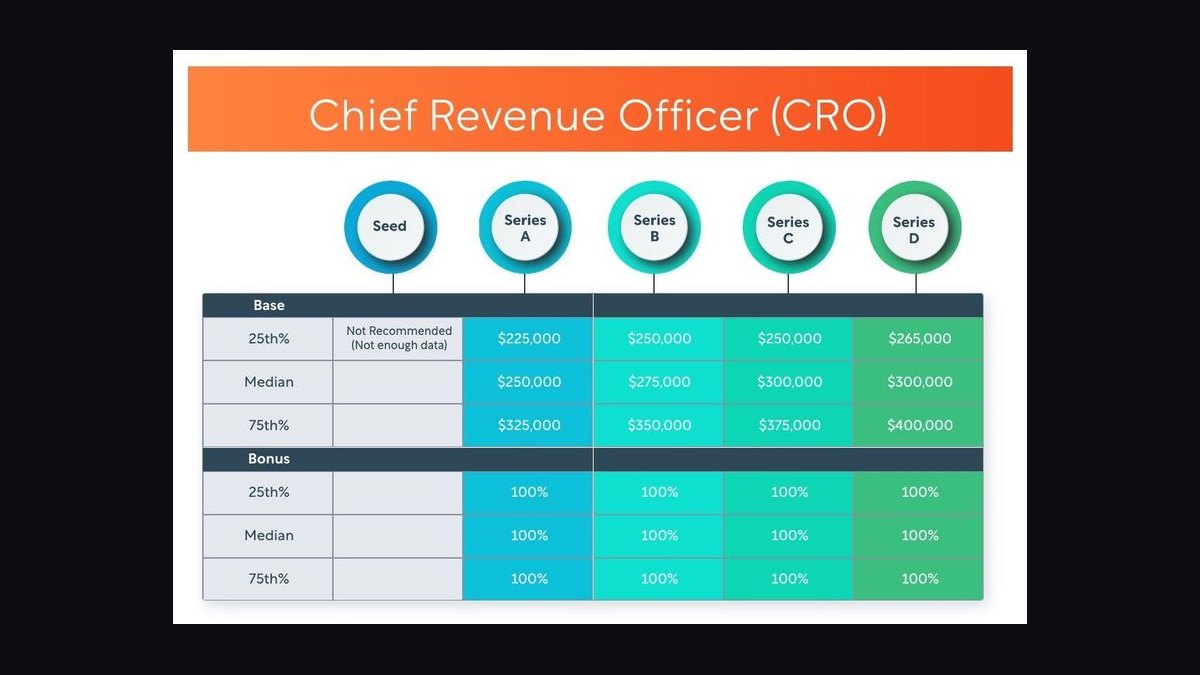
CRO compensation in 2027 splits three ways: full-time CROs at venture-backed B2B SaaS earn roughly $600K–$1.2M loaded in year one (base $400K–$550K, bonus $200K–$300K, 0.5%–2.0% equity, plus benefits and recruiter fees); fractional CROs earn $8K–$25K monthly retainers ($96K–$300K annualized) often with 0.25%–0.5% advisory equity; advisor-only operators take 0.1%–0.5% equity with no cash.
The scenario: a $14M ARR company choosing between three CRO structures
Picture a B2B SaaS company at $14M ARR, growing 45% year over year, with a founder still running sales and a board that just approved a plan to reach $30M ARR within 24 months. The board asks one question: do we hire a full-time CRO, bring in a fractional operator, or trade equity to an advisor who opens doors?
The math looks deceptively simple until you load it. A full-time CRO at this stage carries a base of $400K–$500K, a target bonus of $200K–$300K tied to ARR plan attainment, an equity grant of 1.0%–2.0% vesting over four years with a one-year cliff, roughly $60K in benefits and 401k match, a recruiter fee of 25%–30% of first-year OTE ($150K–$200K one-time), and a severance reserve the board must hold of 6–12 months of OTE ($350K–$700K sitting on the balance sheet). Year-one cash out the door lands between $810K and $1.06M loaded, before the equity dilution is even priced.
A fractional CRO at the same company runs $15K–$20K per month for two to three days a week — $180K–$240K annualized — plus perhaps 0.25%–0.5% advisory equity if cash is tight. An advisor-only structure costs 0.1%–0.25% equity and no cash, but delivers a monthly call and occasional introductions, not operating leadership.
The trap is treating these as interchangeable. They are not. A full-time CRO is a bet that the revenue motion needs a permanent owner who builds the machine, manages the team, and owns the number in the board deck. A fractional CRO is a bet that the company needs senior judgment applied surgically — pricing, segmentation, comp design, a sales process rebuild — without a permanent headcount line. An advisor is a bet on network and pattern recognition, not execution. Choosing wrong costs $400K–$700K in year one and, more painfully, six to twelve months of momentum the company cannot recover.
The rest of this page breaks down how each structure actually pays, what the 2027 benchmarks look like by stage, where the trade-offs bite, and the pitfalls that quietly destroy CRO relationships.
How the three CRO compensation structures actually work
The mechanism differs at the level of what the company is buying. Full-time buys ownership and continuity. Fractional buys senior capability on a schedule. Equity-only buys access and credibility. Each has a distinct cash-flow shape, a distinct equity shape, and a distinct failure mode.
Full-time CRO mechanics

A full-time CRO package has five moving parts. Base salary is the fixed floor, paid semi-monthly. Target bonus is variable, usually paid quarterly against ARR plan attainment, with accelerators above 100% of plan (1.5x–2.0x is common for exceeding plan by 120%+). Equity is a grant of restricted stock, stock options, or RSUs, vesting over four years with a one-year cliff — meaning nothing vests until month 13, then 25% vests, then monthly or quarterly thereafter. Benefits and 401k match add roughly $60K annually for a senior executive. And the recruiter fee, 25%–30% of first-year OTE, is a one-time cost the company eats at signing.
The bonus is where the leverage lives. A CRO with a $450K base and a $250K target bonus has $700K OTE. If the company hits 120% of plan, the bonus could pay $375K–$500K depending on accelerator structure, pushing total cash to $825K–$950K. If the company hits 80%, the bonus might pay $150K–$200K, and the CRO's total cash drops to $600K–$650K. The variable portion is designed to make the CRO's paycheck move with the company's outcome — but only if the plan is set correctly and the accelerators are real, not decorative.
Fractional CRO mechanics
A fractional CRO engagement is a services contract, not employment. The standard structure is a monthly retainer for a defined number of days per month — typically two to three days a week, or eight to twelve days a month. The retainer covers operating work: pipeline reviews, forecast calls, comp plan design, hiring support, board prep, and hands-on deal coaching. Day rates of $2,500–$5,000 exist for project work or short bridges, and they annualize higher than retainers because the firm rewards commitment with a discount.
Advisory equity in a fractional engagement is usually 0.25%–0.5% with a one-year cliff and four-year vest, granted as options or restricted stock. It is not a substitute for the retainer; it is a sweetener for cash-constrained companies and a signal of alignment. Performance-tied structures are increasingly common: a $10K–$15K monthly base retainer plus a $25K–$50K success fee on a Series B close plus 2% of net new ARR above plan. That structure aligns the fractional CRO with the outcome the company actually cares about.
Equity-only and advisor mechanics

A pure board advisor takes 0.1%–0.25% advisory equity with a one-year cliff and four-year vest, no cash. The time commitment is a monthly call and occasional check-ins — not operating. An operating advisor, often a fractional CRO transitioning out of an engagement, takes 0.25%–0.5% advisory equity plus occasional consulting at $3K–$5K per day, with a weekly call and quarterly board meeting. A lead operator at a pre-Series A startup that cannot afford a retainer might take $5K–$10K per month cash plus 0.5%–1.0% equity vesting over two to four years.
The mechanism to understand: equity-only structures transfer risk from the company to the operator. The operator is betting the equity will be worth more than the cash they forgo. That bet only makes sense when the operator has independent wealth, believes deeply in the company, or is stacking advisory roles across a portfolio.
Real numbers: 2027 benchmarks by stage and structure
Benchmarks are the anchor for any negotiation. The 2027 data clusters into five company stages for full-time CROs, three engagement models for fractional, and three advisor tiers. Every number below is a range, not a point — the spread reflects geography, company trajectory, and the CRO's track record.
Full-time CRO compensation by stage
Seed and Series A ($1M–$10M ARR). Most companies at this stage should not hire a full-time CRO — fractional is the right move. The few that do typically pay $300K–$400K base, $150K–$250K bonus, and 1.5%–3.0% equity, often with a founding-team-style equity slug if hired pre-Series B. Total year-one comp lands at $475K–$650K, plus a $100K–$150K recruiter fee.
Series B ($10M–$25M ARR). This is the most common stage to hire a full-time CRO. Compensation runs $400K–$500K base, $200K–$300K bonus, and 1.0%–2.0% equity. Total year one: $600K–$800K plus a $150K–$200K recruiter fee plus $60K benefits, landing at $810K–$1.06M loaded. Per the Bridge Group 2027 SaaS Sales Compensation Report, this is the modal CRO comp band.
Series C ($25M–$75M ARR). Compensation lifts as scale demands an experienced public-company-track CRO. Typical: $450K–$550K base, $250K–$350K bonus, 0.5%–1.5% equity. Total year one: $700K–$900K loaded.
Series D and pre-IPO ($75M–$200M ARR). CROs at this stage typically have a public-company exit on their resume. Compensation: $500K–$650K base, $300K–$450K bonus, 0.4%–1.0% equity. Total year one: $800K–$1.1M loaded, plus acceleration clauses on equity in IPO scenarios.
Public company ($200M+ ARR). Public-company CRO compensation is anchored by RSU grants. Base plus bonus runs $1M–$1.5M, and annual RSU grants run $3M–$10M+ depending on company size and CRO seniority. Levels.fyi and public company proxy statements (10-K, DEF 14A) are the data sources.
Fractional CRO compensation bands
Fractional CRO retainers in 2027 run $8K–$25K per month, with the Series A–Series B sweet spot at $15K–$20K per month for two to three days a week. Sales Xceleration lands at $10K–$15K per month; CRO Syndicate, Chief Outsiders, Pavilion Helm independents, Winning by Design, and Force Management Consulting cluster at $15K–$25K per month. Day rates run $2,500–$5,000 per day, used for project work or short bridges. Advisory equity, when included, is 0.25%–0.5% with a one-year cliff and four-year vest.
Equity-only and advisor bands
A pure board advisor takes 0.1%–0.25% advisory equity with a one-year cliff and four-year vest, no cash. An operating advisor takes 0.25%–0.5% advisory equity plus occasional consulting at $3K–$5K per day. A lead operator at a pre-Series A startup takes $5K–$10K per month cash plus 0.5%–1.0% equity vesting over two to four years.
Hidden costs that change the comparison

Recruiter fees run 25%–30% of first-year OTE. For a $700K OTE CRO, that is $175K–$210K one-time. Severance reserves of 6–12 months of OTE ($350K–$700K for a $700K OTE CRO) sit on the balance sheet and cannot be deployed elsewhere. Acceleration clauses on equity trigger on change-of-control — single-trigger (acceleration on acquisition alone) or double-trigger (acquisition plus termination). Single-trigger 100% acceleration is increasingly rare; double-trigger 100% acceleration is standard at Series C and above. Bonus clawbacks tied to forecast accuracy, NRR, or cohort retention are increasingly common at Series B and above, typically with a 12-month clawback window. Benefits and 401k add roughly $60K per year for a senior executive.
Trade-offs and alternatives: which structure fits which stage
The trade-off is not "which is cheaper." It is "which structure matches the company's actual constraint." A company with a broken sales process and a founder who cannot let go needs a fractional operator to rebuild the machine before a full-time CRO can run it. A company with a working motion and a team of 25 reps needs a full-time CRO to own the number. A company that needs two enterprise logos opened needs an advisor with the right network, not a full-time hire.
When full-time wins
Full-time wins when the revenue motion is proven, the team is large enough to need permanent leadership (typically 15+ quota-carrying reps), the company is on a board-visible ARR plan, and the CRO will own hiring, comp design, forecasting, and board reporting. The loaded cost of $810K–$1.06M at Series B is justified when the CRO can move the ARR plan by $5M–$10M. The trade-off is commitment: a full-time CRO who does not work out costs the company the recruiter fee, the severance reserve, and six to twelve months of momentum.
When fractional wins

Fractional wins when the company needs senior judgment but not a permanent headcount line — typically at $5M–$15M ARR, or when the founder is still the best salesperson and needs a coach, not a replacement. The trade-off is bandwidth: a fractional CRO at two days a week cannot run a 30-person sales org. The fractional model saves $400K–$700K in year one versus a full-time hire, but the company must be honest about what it is buying: diagnosis, design, and hands-on support, not full ownership.
When equity-only wins
Equity-only wins when the company cannot afford cash and the operator has independent wealth or a portfolio of advisory roles. The trade-off is alignment: an advisor with 0.1% equity has limited incentive to do operating work. Equity-only structures are best for network access, board-level credibility, and pattern recognition — not execution.
The hybrid alternative
The most common 2027 structure is a hybrid: a fractional CRO at $15K–$20K per month plus 0.25%–0.5% advisory equity, converting to a full-time offer if the engagement works. This de-risks the hire for both sides. The company sees the CRO operate before committing to a full package; the CRO sees the company's real numbers before betting their career on it. The conversion typically happens at 6–12 months, with the fractional period credited toward vesting.
Common pitfalls and how to avoid them
Pitfall 1: Hiring full-time too early. A company at $6M ARR with a founder-led sales motion does not need a $700K OTE CRO. It needs a fractional operator to build the process, then a full-time CRO to run it. Hiring full-time too early burns $400K–$700K and often ends in a 9–12 month failed hire. The fix: prove the motion with a fractional engagement before committing to a full-time package.
Pitfall 2: Underpricing equity at the early stage. Seed and Series A CROs should be getting 1.5%–3.0% equity, not 0.5%. The equity is the wealth-creation lever; under-granting it means the CRO is working for cash comp that does not reflect the risk. The fix: benchmark equity against Carta's 2027 SaaS Executive Compensation Report and grant at the top of the band for the first revenue executive.
Pitfall 3: Ignoring the severance reserve. Boards that do not reserve 6–12 months of OTE for a CRO hire are surprised when the hire fails and the company owes $350K–$700K with no budget line. The fix: book the severance reserve at signing, not at termination.
Pitfall 4: Bonus plans with no accelerators. A CRO bonus that pays 100% at 100% of plan and caps at 100% removes the upside that motivates a top operator. The fix: set accelerators at 1.5x–2.0x for exceeding plan by 120%+, and make sure the plan is measurable quarterly, not annually.
Pitfall 5: Acceleration clauses that never trigger. Single-trigger acceleration is rare; double-trigger is standard. A CRO who negotiates single-trigger 100% acceleration at Series C is an outlier. The fix: negotiate double-trigger with a 12-month tail, and get it in writing before signing.
Pitfall 6: Clawbacks that punish the wrong thing. A bonus clawback tied to forecast accuracy can punish a CRO for a market downturn they did not cause. The fix: tie clawbacks to controllable metrics (NRR, cohort retention, pipeline coverage) rather than macro outcomes.
Pitfall 7: Fractional engagements with no conversion path. A fractional CRO who does great work but has no path to full-time will leave for a full-time role elsewhere. The fix: define the conversion terms — timing, comp band, equity credit — in the original engagement letter.
Pitfall 8: Advisor equity with no vesting. Advisory equity granted without a cliff or vest is a gift, not an incentive. The fix: standard one-year cliff, four-year vest, with a defined scope of work.
Pitfall 9: Geographic discounting that insults the candidate. Remote-first companies that apply a 10%–15% base salary discount for candidates outside major hubs are increasingly losing top CROs to companies that do not. The fix: hold equity grants constant across geographies and apply geographic adjustments only to base, if at all.
Pitfall 10: Recruiter fees paid on OTE, not base. A 30% fee on a $700K OTE is $210K; on a $450K base it is $135K. The fee structure matters. The fix: negotiate the fee basis before signing the search agreement.
Related questions
What is the typical full-time CRO compensation at a Series B company in 2027?
Series B CROs earn $400K–$500K base, $200K–$300K target bonus, and 1.0%–2.0% equity over four years with a one-year cliff. Loaded year-one cost including recruiter fee and benefits lands at $810K–$1.06M. This is the modal CRO comp band per the Bridge Group 2027 report.
How does fractional CRO compensation compare to full-time?
Fractional CROs earn $8K–$25K per month ($96K–$300K annualized) plus optional 0.25%–0.5% advisory equity. Full-time CROs earn $600K–$1.2M loaded year one. Fractional saves $400K–$700K in year one but delivers senior judgment on a schedule, not full ownership of the revenue number.
Can a CRO work on an equity-only basis?
Yes. Equity-only and advisor CROs — often post-exit operators — take 0.1%–0.5% advisory equity with a one-year cliff and four-year vest, no cash. This structure suits operators with independent wealth or a portfolio of advisory roles, and companies that need network access more than operating leadership.
What equity range is typical for a late-stage or post-IPO CRO?
Series D and pre-IPO CROs get 0.4%–1.0% equity. Post-IPO public-company CROs get annual RSU grants of $3M–$10M+ alongside $1M–$1.5M base plus bonus. Public-company comp is disclosed in DEF 14A proxy filings and tracked on Levels.fyi.
How do severance reserves and acceleration clauses affect CRO comp?
Boards reserve 6–12 months of OTE for CRO severance ($350K–$700K at $700K OTE), which sits on the balance sheet. Acceleration clauses — double-trigger 100% is standard at Series C+ — determine whether unvested equity vests on change-of-control. Both are material to total cost.
FAQ
What is the total compensation range for a full-time CRO at a venture-backed B2B SaaS company in 2027? Full-time CRO total compensation at a venture-backed B2B SaaS company runs $600K–$1.2M loaded in year one. That includes base of $400K–$550K, target bonus of $200K–$300K tied to ARR plan attainment, equity of 0.5%–2.0% vesting over four years with a one-year cliff, roughly $60K in benefits and 401k match, a recruiter fee of 25%–30% of OTE, and a severance reserve of 6–12 months of OTE.
How does fractional CRO compensation differ from full-time CRO compensation? Fractional CROs earn a monthly retainer of $8K–$25K, which annualizes to $96K–$300K, and often receive 0.25%–0.5% advisory equity in cash-constrained startups. Full-time CROs earn $600K–$1.2M loaded year one. Fractional engagements are services contracts for two to three days a week, not employment, and they save the company $400K–$700K in year one versus a full-time hire.

What equity ranges are typical for a CRO at a late-stage or post-IPO company? At Series D or late-stage private companies, CRO equity grants range from 0.4% to 1.0% of the company. For post-IPO public companies, annual RSU grants run $3M–$10M or more, alongside base salary of $800K–$1.5M plus bonus. Public-company CRO comp is disclosed in DEF 14A proxy filings and tracked on Levels.fyi.
Can a CRO work on an equity-only basis, and what does that look like? Yes. Equity-only or advisor CRO roles exist, typically for post-exit operators who do not need cash compensation. They receive 0.1%–0.5% advisory equity with a one-year cliff and four-year vesting, and no cash salary or retainer. Pure board advisors take 0.1%–0.25%; operating advisors take 0.25%–0.5% plus occasional consulting at $3K–$5K per day.
What hidden costs should a board budget for when hiring a full-time CRO? Beyond base, bonus, and equity, boards should budget a recruiter fee of 25%–30% of first-year OTE ($150K–$300K one-time), a severance reserve of 6–12 months of OTE ($350K–$700K sitting on the balance sheet), benefits and 401k match of roughly $60K per year, and potential signing bonuses of $50K–$150K at Series C and above. Acceleration clauses and bonus clawbacks also carry economic cost.
How does CRO compensation vary by company type — bootstrapped, PE-backed, venture-backed, public? Bootstrapped and PE-backed companies pay higher cash and lower equity — base $450K–$600K, bonus $250K–$350K, equity 0.25%–0.75% or profit-sharing. Venture-backed SaaS pays lower base and higher equity — base $400K–$500K, bonus $200K–$300K, equity 1.0%–2.0%. Public companies anchor to peer comp disclosed in proxy statements, with RSU grants of $3M–$10M+ annually.
Sources
- Bridge Group 2027 SaaS Sales Compensation and Benchmarks Report — https://www.bridgegroupinc.com
- Pavilion 2026 GTM Compensation Survey — https://www.joinpavilion.com
- OpenComp 2027 SaaS Executive Compensation Benchmarks — https://www.opencomp.com
- Carta 2027 SaaS Executive Compensation Report — https://carta.com
- Levels.fyi public-company CRO RSU and total compensation data — https://www.levels.fyi
- U.S. Securities and Exchange Commission EDGAR (DEF 14A proxy filings) — https://www.sec.gov/edgar
- Bessemer Venture Partners Cloud Index — https://www.bvp.com
- Sales Xceleration published fractional pricing — https://salesxceleration.com
- Heidrick & Struggles CRO search practice — https://www.heidrick.com
- Russell Reynolds Associates executive search — https://www.russellreynolds.com
Related on PULSE
- How do you benchmark equity vs cash compensation for a first dedicated RevOps hire?
- How do you structure equity vesting and performance bonuses for fractional CROs?
- What AI tools should every Chief Revenue Officer actually deploy in their stack in 2027?
- How does a Chief Revenue Officer build a board update that doesn't get them fired in 2027?
- How does a CRO partner with the CFO on bookings, ARR, and revenue translation in 2027?
This page will be disappearing soon. Save it to your device for $1 — or read it free while it is here.
@Kory-White- · if Venmo asks, the last 4 of my number are 2012
This page is gone.
This one is off the shelf now. $1 keeps it on your phone for good — the whole page, pictures and diagrams included.
 revopsHow much does a fractional CRO cost in 2027?
 revopsFractional CRO for B2B SaaS startups under $10M ARR
 revopsFractional CRO vs full-time CRO — which should you hire?
 revopsSigns you need a CRO (not just a VP of Sales)
 revopsWhat's the ROI of a fractional CRO in 2027?
 revopsWhen should you hire a fractional CRO in 2027?
 revopsHow to evaluate a fractional CRO — 15 interview questions in 2027
 revopsWhat is a fractional CRO in 2027?
 revopsBest fractional CRO firms in 2027
 revopsWhat does a fractional CRO do in the first 90 days in 2026?