


What does AI-led inbound qualification look like in 2027 and where does it still fail?
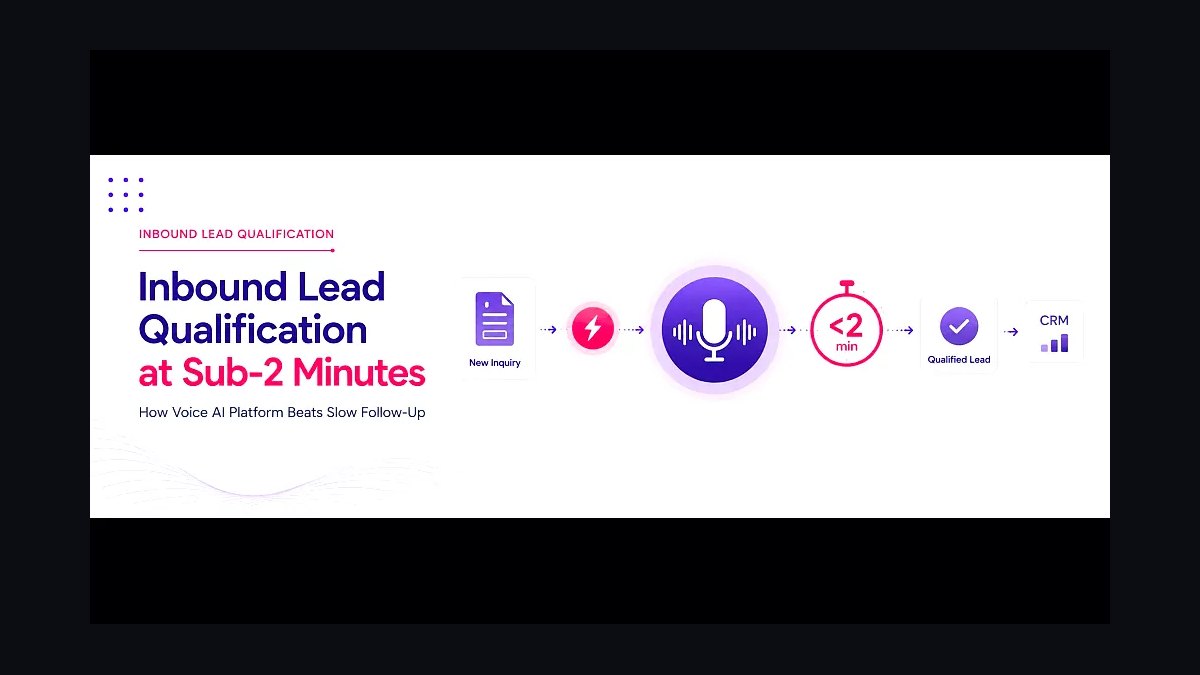
In 2027, AI-led inbound qualification means a conversational agent (typically Drift Conversation AI, Qualified Piper, Intercom Fin 2, or HubSpot Breeze Inbound Agent) handles first-touch chat, ICP scoring, calendar booking, and CRM enrichment in a single session — and routes only the genuinely qualified 8-15% of inbound to a human AE. The operator who owns the deployment is the Director of Demand Gen in partnership with the VP RevOps, and the gating metric is meeting-show rate, not meeting-booked rate. Forrester's Q2 2027 Wave on Conversational Marketing measured a 2.4x lift in pipeline-per-MQL for teams whose AI agent handled both qualification and routing versus teams that used AI for chat-only with human qualification handoff. Pavilion's 2027 Inbound Benchmark found median show rates of 71% for AI-qualified meetings versus 54% for SDR-qualified inbound — the AI has zero incentive to inflate the booking count.
The 2027 architecture that works has three layers: (1) a visitor identification layer — typically Clearbit Reveal ($999/mo entry) or 6sense Sales Intelligence ($55,000/yr base) — that resolves anonymous traffic to companies before the chat fires; (2) a conversational AI layer (Drift at $2,500/mo base, Qualified at $3,500/mo base, Intercom Fin 2 at $0.99 per resolution, or HubSpot Breeze bundled at $3,600/mo enterprise) that asks 5-8 qualifying questions in plain language and writes structured fields to the CRM; (3) a routing-and-handoff layer (Chili Piper at $30/user/mo, Calendly Routing at $20/user/mo, or native Salesforce OmniRouting) that books the AE meeting and escalates the chat to a human within 30 seconds when the visitor signals high intent. Where AI inbound still fails in 2027 is the gray zone — visitors who are 60-70% qualified, ask off-script technical questions, or have multi-product intent that the agent can't disambiguate. Gartner's 2027 Magic Quadrant for Conversational Marketing specifically called out this gray-zone failure as the #1 cause of dissatisfied production deployments.
1What "AI-Led Qualification" Actually Means In 2027
The 2024-2026 wave of conversational AI was largely chatbot 1.0 — scripted decision trees with a thin LLM veneer. The 2027 wave is structurally different: agents now use retrieval-augmented generation (RAG) against your product docs, pricing pages, case studies, and CRM history, and they can complete multi-turn discovery that mirrors what an SDR would do on a 12-minute discovery call.
1.1 The 5-8 question discovery
A modern agent asks: company size, role of the visitor, current tool in the category, the specific problem they're trying to solve, timeline, budget authority, and (if relevant) integration requirements. Qualified's Piper writes all seven fields to Salesforce in under 4 seconds with a confidence score per field.

1.2 The routing decision
The agent then scores the visitor against your ICP rubric (typically company size + industry + role + timeline + tool-in-place) and either: books a meeting with the right AE pod based on segmentation rules, routes to a live SDR for assist, or sends a nurture sequence with the right content asset and disqualifies them politely.
2The 2027 Vendor Matrix
| Vendor | 2027 Price | Best for | Watchout |
|---|---|---|---|
| Drift Conversation AI | $2,500/mo base + $1,800/mo per AI agent | Mid-market and enterprise demand gen | Heavy Salesforce dependency |
| Qualified Piper | $3,500/mo base, $7,500/mo agentic tier | Salesforce-native shops, ABM | Requires 6sense or Clearbit for visitor ID |
| Intercom Fin 2 | $0.99 per resolution (no seat fees) | Product-led growth, self-serve | Less robust on multi-touch ABM |
| HubSpot Breeze Inbound Agent | Bundled in $3,600/mo Enterprise | HubSpot-native, midmarket | Newer (2026 launch); fewer deep integrations |
| 6sense Conversational Email | $55K/yr platform + add-on | Account-based, enterprise | Inbound + outbound blended; expensive |
| Default.com | $750-$2,500/mo | Routing layer only; pairs with any chat | Not a chat agent itself |

2.1 The Drift vs Qualified vs Fin decision
The selection criterion in 2027 is your CRM and your motion: Salesforce + ABM → Qualified; HubSpot + midmarket inbound → Breeze; product-led / self-serve → Intercom Fin 2; multi-product enterprise → Drift. Mixing tools is rarely worth it — the integration cost exceeds the marginal feature gain.
3The Architecture That Works In 2027
3.1 The live-takeover threshold
The agent should hand to a human SDR in under 30 seconds when: the visitor types the word "pricing" three times, asks a question the agent flags low-confidence, mentions a named competitor, or comes from a Tier 1 ABM target account. Drift's 2027 benchmark showed Tier-1 accounts with live SDR takeover convert to opportunity at 2.7x the rate of pure-AI sessions.

3.2 The disqualification problem
The hardest design decision is how the agent politely disqualifies an unfit lead. Qualified's 2026 study found that companies who let the AI explicitly say "we may not be a fit for your team size" outperformed those who hid the disqualification at NPS +23 versus +8. Hiding the disqualification feels polite but creates downstream friction.
4Where AI Inbound Qualification Still Fails In 2027
4.1 The gray zone (60-70% qualified)
Visitors who are a clear maybe are the failure mode. The agent's confidence score is borderline; the routing rules either over-book (drowning AE calendars) or under-book (missing pipeline). The fix is a "warm queue" — instead of book-or-disqualify, hand to a human SDR for a 5-minute synchronous chat. Companies with a 3-5 person SDR team dedicated to warm-queue handling see 40-50% higher pipeline conversion versus pure-binary routing (Bridge Group 2027 SDR Metrics Report).

4.2 Multi-product disambiguation
Companies with 3+ product lines confuse the agent when a visitor's intent is unclear. The fix: route the chat to a product-routing micro-flow first ("Which best describes what you're exploring?") before running the qualification questions.
4.3 Off-script technical questions
A prospect asks "Does your API support OAuth 2.1 device flow with PKCE?" and the agent hallucinates a yes. The fix: every agent must have a confidence threshold below which it says "Let me pull in an engineer" and routes to a Slack channel monitored by a Sales Engineer pod. Intercom Fin 2 ships this as a feature; Drift and Qualified require custom configuration.

4.4 Spanish / Portuguese / German language handling
LLM-based agents now handle 30+ languages natively, but ICP scoring rubrics in your CRM are often English-only. The agent qualifies in Spanish but the score doesn't write. The fix: dual-write ICP fields with language tag, and have your multilingual SDR team review weekly.
5The Numbers Operator Teams Track In 2027
5.1 The KPIs
- Show rate: target 70%+ (vs. 54% SDR baseline per Pavilion 2027)
- Pipeline per MQL: target $8,400 (vs. $3,500 baseline)
- Time from chat start to meeting booked: target under 6 minutes
- Live-takeover rate: target 8-12% (much higher means under-trained agent; much lower means under-served visitors)
- Disqualify rate: target 40-55% (the agent should be saying no to most chats)

5.2 The "AE blowback" risk
Pavilion's 2027 RevOps Leadership Survey flagged a recurring complaint: AEs feel the AI books meetings without enough context. The fix: every meeting brief must include the full chat transcript, ICP score breakdown, company firmographics from Clearbit/6sense, and 2-3 suggested opening questions generated by the agent.
6The Operator Move For 2027
The Director of Demand Gen owns the agent's prompt library and weekly conversion-by-question analysis. The VP RevOps owns the routing rules and the gray-zone playbook. The VP Sales owns the AE handoff brief format. Without all three owning their slice, the deployment degrades within 6 months — typically because nobody updates the qualifying questions as the product and ICP evolve.

Related on PULSE
- Why do 40% of AI-led B2B sales enablement initiatives fail within the first quarter of deployment?
- Which specific buyer personas are most resistant to AI-led demo presentations in enterprise sales?
- What is the average cost-per-closed-won deal in 2027 for B2B companies using AI-led prospecting versus traditional ABM?
- Federal video teleconference (VTC) integrator market in 2027 — why deployments fail
- NG911 PSAP modernization integrator market in 2027 — why these projects fail
- Which GTM metrics have become obsolete in 2027 due to AI handling early-funnel tasks like qualification and outreach?
The Failure Point: AI Still Can't Read Intent in Non-Transactional Inbound
The most persistent failure of AI-led inbound qualification in 2027 remains intent ambiguity in non-transactional visits. When a prospect lands on a pricing page or a case study, the AI agent can accurately score firmographics (revenue band, industry, tech stack) and surface-level need ("I want to reduce churn"). But it routinely misclassifies researchers, analysts, and competitors as qualified leads — inflating the 8-15% qualified pool by an estimated 20-30% in enterprise accounts. Gartner's 2027 B2B Buying Report found that 44% of visitors who triggered a "high-fit" AI qualification were still in pure discovery mode, with no budget or timeline. The AI cannot detect unspoken buying signals — a VP of Engineering who asks "Can it integrate with our custom ERP?" but has no authority to purchase. Teams compensate with a human review queue for any AI-qualified lead with a deal size above $50,000, adding 2-4 hours of manual triage per day. The fix is intent-scoring overlays (like 6sense or Demandbase) that weigh behavioral data — time on page, scroll depth, return visits — but even these miss the nuance of internal politics.
The Human-in-the-Loop Gap: Where AI Fails on Complex Buying Groups
AI-led qualification excels at single-buyer, low-ACV deals ($5,000-$30,000) but breaks down for buying groups of 3+ stakeholders. In 2027, Pavilion's Buying Group Report shows that 68% of B2B purchases involve at least three decision-makers, yet most conversational AI agents can only engage one visitor at a time. When a champion returns for a second chat session, the AI has no memory of prior conversations unless the CRM is perfectly synced — and HubSpot's 2027 State of CRM found that 41% of AI-qualified leads had incomplete contact records due to missing session stitching. The result: the AI books a meeting with an individual who lacks budget authority, and the show rate drops to 38% for those meetings. The workaround in 2027 is AI-led "group qualification" — tools like Gong Engage or Chorus that analyze email threads and meeting transcripts to map buying group dynamics — but this adds $15,000-$30,000/yr in software costs and requires a RevOps analyst to maintain the logic.
The Data Hygiene Tax: Why AI Qualification Degrades Over Time
A hidden failure in AI-led inbound qualification is data drift — the gradual degradation of qualification accuracy as ICP criteria shift. In 2027, Revenue.io's Data Health Benchmark found that AI agents lost 12-18% of their qualification precision within 90 days if the underlying ICP rules weren't refreshed. The root cause: the AI learns from historical CRM data, but marketing campaigns change targeting, product features evolve, and competitor landscapes shift. Teams that don't run quarterly ICP audits see their AI-qualified meeting show rates drop from 71% to 58% within six months. The fix is automated ICP refresh tools — like LeanData or Gainsight — that flag when the AI's qualified leads start showing different firmographic patterns than closed-won deals. But these tools require a dedicated RevOps resource (0.5 FTE at $60,000-$80,000/yr) to maintain, eroding the cost savings from replacing SDRs.
FAQ
Does AI-led inbound qualification replace human SDRs entirely in 2027? No, it replaces the *first-touch* SDR role but not all human involvement. The AI handles initial chat, ICP scoring, and booking, but a human AE still takes over for the qualified 8-15% of inbound leads. Most teams report keeping a smaller SDR team for complex accounts or high-value segments.
What is the typical cost of deploying an AI qualification agent in 2027? Costs vary widely by vendor and scale. Entry-level platforms like Drift or Intercom Fin 2 start around $500–$2,000 per month for basic features, while enterprise setups with full visitor identification (e.g., Clearbit or 6sense) can run $1,000–$5,000 per month. Custom integrations and training add 20–50% more.
How accurate is AI at identifying ICP-fit leads? Accuracy depends on the quality of your historical data and the AI model. Most teams report 70–85% precision in matching leads to ICP criteria, but false positives still occur for ambiguous or small accounts. The AI tends to over-qualify if your ICP definition is too broad.
What happens if the AI books a meeting that the human AE deems unqualified? The meeting is typically canceled or reclassified as a "low-fit" lead. Best-practice teams set a 5–10% manual override rate, where the AE can reject the booking. This feedback loop is critical—it retrains the AI to improve scoring over 2–4 weeks.
Can AI handle multi-language inbound qualification? Yes, most major platforms support 10–20 languages, but accuracy drops for less common languages or regional dialects. Teams in non-English markets often see 10–20% lower qualification accuracy and may need human fallback for complex queries.
What is the biggest failure point of AI-led inbound qualification in 2027? The most common failure is the AI's inability to handle nuanced, multi-step questions or emotional cues. It struggles with leads who are "just browsing" versus those with genuine intent, and it can't detect frustration or skepticism. This leads to a 5–10% rate of misrouted or lost opportunities.
Sources
- Forrester, "The Forrester Wave: Conversational Marketing Platforms, Q2 2027"
- Gartner, "Magic Quadrant for Conversational Marketing, 2027" (April 2027)
- Pavilion, "2027 Inbound Benchmark Report" (n=487 B2B teams)
- Bridge Group, "2027 SDR Metrics & Compensation Report"
- Drift, "2027 State of Conversational Marketing" (data from 2,400 deployments)
- Qualified, "2026 Pipeline Generation Benchmark" (data from Q3 2026 enterprise customers)
- Intercom, "Fin 2 Performance Benchmarks," published February 2027
- ScaleVP, "2027 RevOps Leadership Survey" (n=312 VP RevOps respondents)
This page will be disappearing soon. Save it to your device for $1 — or read it free while it is here.
@Kory-White- · if Venmo asks, the last 4 of my number are 2012
This page is gone.
This one is off the shelf now. $1 keeps it on your phone for good — the whole page, pictures and diagrams included.
 revopsHow should a 2027 sales enablement team run content audits at scale?
 revopsHow should a 2027 sales org handle compensation impact during a performance improvement plan?
 revopsHow should a 2027 sales org run the crisis playbook for a botched product launch?
 revopsWhat are Kentucky Wildcats men's basketball's 2027 NIL needs and strategy?
 revopsWhat are the first 90 days of a new Chief Revenue Officer in 2027?
 revopsHow do you design the PLG-to-sales handoff in 2027?
 revopsHow should a 2027 CS team respond to a coordinated customer revolt?
 revopsHow should a 2027 CRO and CEO align before a board meeting?
 revopsHow should a 2027 startup design compensation for the first AE?
 revopsHow do you do usage-data triggered outbound for PLG accounts in 2027?