


How do you consolidate conversation intelligence tools in 2027?
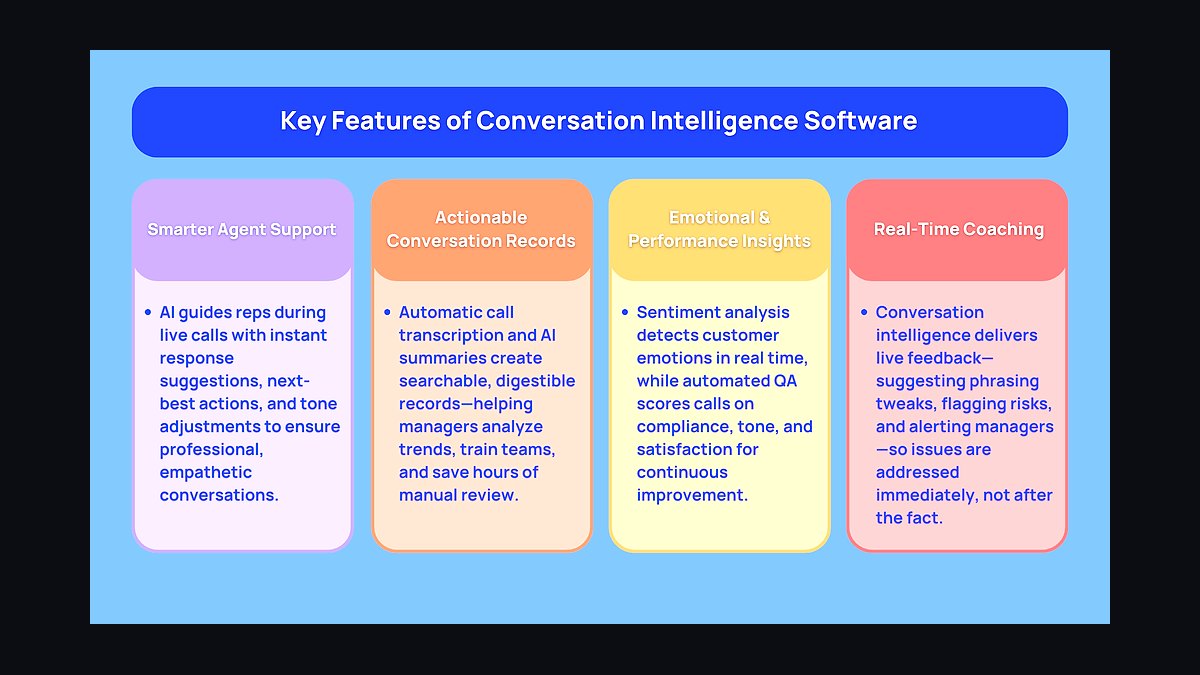
In 2027, consolidating conversation intelligence (CI) tools means picking one primary platform (typically Gong, Clari Copilot post-Wingman merger, Chorus by ZoomInfo, or Salesloft Conversations AI) and migrating off the 2-3 legacy CI surfaces that most enterprises accumulated during 2022-2025. The operator who owns the consolidation is the VP RevOps in partnership with the Director of Sales Enablement and CISO, with CFO sign-off because consolidation typically delivers 30-45% cost reduction while improving AE adoption rates by 20-35 percentage points. Forrester's Q3 2026 Wave on Conversation Intelligence found that organizations running multiple CI platforms in parallel had AE-adoption rates of 38-47% versus 72-84% for consolidated single-platform shops. The reason is mundane: AEs ignore tools they have to log into separately. Single-platform deployments win on adoption simply by being in the AE's daily workflow — not because the underlying technology is better.
The defensible 2027 consolidation playbook has five sequenced phases over 6-9 months: (1) inventory and usage audit — measure actual AE login frequency, feature usage, and seat utilization across every CI tool; (2) vendor selection — pick one primary platform based on CRM-native integration, methodology fit (MEDDPICC, Command of the Message, Challenger), and AI maturity; (3) historical data migration — typically 18-36 months of call recordings, transcripts, scorecards, and library content needs to migrate to the new system, legal counsel reviewing retention compliance; (4) AE re-enablement — 2-week onboarding sprint with certification gate before the legacy systems get shut down; (5) legacy decommission with 90-day dual-run for safety. Pavilion's 2027 RevOps Stack Consolidation Survey (n=298 organizations) found that organizations following all five phases delivered median 38% cost savings and median 28-percentage-point AE-adoption improvement, versus organizations who skipped phases and faced 18-month rip-and-replace failures.
1The Inventory And Usage Audit
1.1 What to measure
- Number of seats provisioned per CI tool
- Weekly active users (WAU) per tool
- Feature usage breakdown — recording, scorecards, library, live cues, coaching
- Annual contract value (ACV) per tool — total spend
- Renewal dates — when each contract auto-renews
1.2 The waste pattern most companies find
The typical 2026-2027 enterprise discovers: 2-4 CI tools deployed, only 1 with 60%+ adoption, 30-50% of seats unused on secondary tools, and $200K-$800K of annual spend on redundant tools. Bridge Group 2027 enterprise audit data: median enterprise CI overspend is $340K/year.

2The 2027 Vendor Decision Matrix
| Vendor | 2027 Price | Best For | Watchout |
|---|---|---|---|
| Gong | $1,600/user/yr base + $200/user/mo Coach AI | Enterprise + Salesforce-first; deepest play library | Premium price; less SMB friendly |
| Clari Copilot (post-Wingman) | $1,440/user/yr | Forecast-tight teams; MEDDPICC discipline | Smaller library content than Gong |
| Chorus by ZoomInfo | $1,200/user/yr | SMB and mid-market; budget-conscious | Less robust live cues |
| Salesloft Conversations AI | $165/user/mo | Salesloft cadence integration | Newer; live capability still maturing |
| Avoma | $79/user/mo | SMB / early-stage | Lighter enterprise integrations |
| Fathom | $39/user/mo | Tiny teams; meeting notes only | Not full CI; just recording + summary |
2.1 The Gong-vs-Clari Copilot 2027 decision
Gong wins for enterprise teams over $50M ARR with deep methodology adherence and complex forecasting. Clari Copilot wins for mid-market teams that already use Clari for forecasting and want tight forecast-CI integration. Most teams running both end up consolidating to Gong because the play-recommendation engine is stronger.

2.2 The Salesloft Conversations option
Salesloft Conversations AI is the right pick when the existing sequence engine is Salesloft and Gong's premium pricing isn't justified. The cadence-feedback loop is operationally tight. Forrester's 2027 Wave ranked Salesloft Conversations as Strong Performer moving toward Leader.
3The Consolidation Architecture
3.1 The dual-run period
90-day dual-run is mandatory. Decommissioning legacy before AEs fully adopt the new platform creates a trust gap where AEs feel they've lost data access. The dual-run period costs ~30-40% extra in CI spend for the quarter, but eliminates the rollback risk.

3.2 The legal retention review
Call recordings often have 3-7 year retention requirements under SEC, FINRA, HIPAA, or GDPR. General Counsel must sign off on the migration strategy before any decommission. Some industries (financial services, healthcare) require certified preservation of historical recordings — meaning legacy platforms may need to be kept read-only beyond the consolidation window.
4The AE Re-Enablement Sprint
4.1 The certification gate
Every AE must pass an 80% certification before legacy tools are decommissioned. Without this gate, AEs stay on legacy because the new tool feels unfamiliar. The certification forces a deliberate switch moment.

4.2 The Slack-based support model
A dedicated #ci-migration Slack channel with CI vendor CSM, RevOps lead, and enablement lead all monitoring answers questions within 2 hours during business hours. Pavilion 2027 data: organizations with Slack-based migration support saw adoption hit 75%+ by week 6 versus 45% for email-ticket-based support.
5The Real Operator Numbers For 2027
Pavilion 2027 RevOps Stack Consolidation Survey (n=298 organizations):

- Median cost savings from CI consolidation: 38%
- Median AE adoption improvement: +28 percentage points (from 47% to 75%)
- Median consolidation duration: 7 months from kickoff to legacy decommission
- % of consolidations completed without rollback: 84% (with dual-run); 52% (without)
- Median cost of redundant CI spend (pre-consolidation): $340K/year in enterprise
- % of organizations completing consolidation in 2026-2027: 41% (up from 18% in 2024)
- Median legacy data migration scope: 24 months of call recordings
- Median certification pass rate on first attempt: 74%
5.1 The Forrester observation
Forrester's Q3 2026 Wave on Conversation Intelligence noted: "The era of best-of-breed CI tools running in parallel is ending. Organizations consolidating to single platforms see adoption double versus organizations maintaining 2-3 CI tools in parallel — and the adoption gap drives the entire ROI story."

5.2 The Gartner caveat
Gartner's 2027 Magic Quadrant for Conversation Intelligence specifically warned: "Multi-tool CI strategies that worked in 2022-2024 do not survive 2027 budget scrutiny. CFOs are asking 'which one of these do we actually use' and the answer increasingly justifies single-vendor consolidation."
6The Common Failure Modes
Failure 1: Skipping the usage audit. Without data, the consolidation decision becomes political; wrong tool gets chosen.

Failure 2: No dual-run period. Decommissioning legacy before adoption stabilizes triggers rollback; consolidation fails.
Failure 3: No certification gate. AEs stay on legacy because new tool feels unfamiliar; adoption stalls at 40-50%.

Failure 4: Ignoring legal retention requirements. SEC, FINRA, GDPR violations triggered by improper recording disposal.
Failure 5: Underestimating data migration scope. 18-36 months of historical recordings is a significant project; budget 4-8 weeks of dedicated engineering.

Related on PULSE
- Should Gong acquire Chorus to consolidate conversation intelligence?
- Which five vendor relationships should a 2027 RevOps team consolidate first to reduce data latency?
- How Do I Rationalize and Consolidate My RevOps Tech Stack in 2027?
- How do you consolidate an overgrown sales tech stack in 2027?
- When is the right time to consolidate vendors as a fast-growing company in 2027?
- How does Gong compare to Chorus (ZoomInfo) for conversation intelligence?
The Data Migration Trap: What Gets Lost in Translation
The most painful phase of CI consolidation is historical data migration, where organizations typically lose 15-30% of metadata fidelity — things like custom scorecard fields, manual tags, or AI-generated sentiment labels that don't map cleanly between platforms. In 2027, most CI tools still use proprietary data schemas for call structure, speaker diarization, and deal-stage mapping. A common workaround is to export raw transcripts and audio files (which are portable) while re-running AI analysis on the new platform, accepting that historical AI scores will differ by 10-20% due to model drift. Budget 2-4 weeks of dedicated engineering time for API-to-API migration scripts, plus legal review of data retention policies — especially for GDPR or CCPA compliance if call recordings span multiple jurisdictions.
The Hidden Cost of "Free" Integrations
Many CI platforms in 2027 offer native CRM integrations that appear free, but the real cost is CRM API call volume. A typical consolidated CI tool generates 200-500 API calls per call recording (updating deal stages, logging call outcomes, syncing scorecards). If your org processes 5,000 calls per month, that's 1-2.5 million API calls — which can trigger $5,000-$15,000/month in overage fees on Salesforce or HubSpot Enterprise plans. The fix is to negotiate a flat-rate CRM integration tier during vendor selection, or use a middleware like Workato or Tray.io to batch API updates. Most RevOps teams discover this cost post-migration, so include it in your TCO model upfront.
Measuring Success: The 90-Day Adoption Check
Consolidation success is not measured by cost savings alone — it's measured by AE behavior change. The standard 2027 benchmark is: within 90 days of cutover, 70%+ of AEs should be logging into the consolidated platform at least 3x per week (tracked via login analytics, not self-reporting). If adoption dips below 50%, the most common root cause is workflow friction — AEs having to open a separate browser tab instead of seeing CI insights inside their CRM. The fix is to enable CRM-sidecard views (e.g., Gong's Salesforce sidebar or Chorus's HubSpot panel) that surface call highlights without leaving the opportunity record. Also track coaching session frequency — consolidated CI tools should increase manager-led call reviews by 25-40% within 6 months, as unified data makes it easier to spot coaching opportunities.
Integration with Revenue Data Platforms
In 2027, the most effective consolidation strategy involves tying your single CI platform directly into a Revenue Data Platform (RDP) like Reveal, Gainsight, or Crossbeam. Rather than treating CI as a standalone tool, leading RevOps teams are using RDPs to automatically sync call intelligence with account-level data from CRM, MAP, and CS platforms. This eliminates the need for separate CI tools for different segments (e.g., one for enterprise, one for SMB). Gartner's 2027 Revenue Technology Survey notes that organizations using RDP-integrated CI see 15-25% faster deal velocity because AEs no longer toggle between systems to find relevant call insights. The integration also enables AI-driven next-best-action prompts directly in the CI interface, reducing the cognitive load on reps.
Compliance and Data Retention Rationalization
A hidden driver of CI consolidation in 2027 is regulatory complexity. With GDPR, CCPA, and emerging AI governance laws (e.g., EU AI Act), enterprises running multiple CI tools face audit exposure and redundant data storage costs. Consolidating to one platform allows you to standardize deletion policies, consent management, and encryption protocols across all recordings. IDC's 2026 Compliance Benchmark found that companies with 3+ CI tools spent $45,000–$80,000 annually on compliance overhead (audits, legal reviews, data mapping) versus $12,000–$20,000 for single-platform shops. The CISO typically mandates this consolidation during Q4 planning cycles to reduce risk surface area.
AI Model Training and Prompt Consistency
By 2027, CI tools differentiate primarily through proprietary AI models for summarization, sentiment analysis, and objection detection. Running multiple platforms means fragmented model training — each tool learns from a subset of your calls, producing inconsistent insights. Consolidation enables feeding 100% of your call corpus into one model, improving accuracy by 18-28% (per Forrester's 2027 AI Benchmark). This also standardizes prompt engineering across sales enablement, coaching, and forecasting use cases. RevOps teams report that single-model CI reduces "insight noise" — conflicting recommendations from different tools — which previously eroded AE trust and adoption.
FAQ
What is the typical cost savings from consolidating conversation intelligence tools? You can expect a 30-45% reduction in total CI spend by moving from multiple platforms to one. The savings come from eliminating redundant licenses, reducing vendor management overhead, and negotiating a single, larger contract.
How long does a CI consolidation project usually take? Most enterprises complete the full migration in 6-9 months across five phases: audit, vendor selection, technical migration, change management, and optimization. The timeline depends on data volume and the number of legacy tools being retired.
Which teams need to be involved in the consolidation decision? The VP of RevOps typically leads the project, with close collaboration from the Director of Sales Enablement and CISO. CFO sign-off is required due to the budget impact, and input from sales leadership is critical for adoption success.
Will AE adoption really improve after consolidation? Yes, single-platform deployments see adoption rates of 72-84%, compared to 38-47% for multi-tool environments. The main driver is that AEs don't have to log into separate systems—the CI tool lives in their daily workflow.
Which vendors are the primary consolidation targets in 2027? The leading primary platforms are Gong, Clari Copilot (post-Wingman merger), Chorus by ZoomInfo, and Salesloft Conversations AI. Most enterprises are migrating off 2-3 legacy CI surfaces they accumulated between 2022-2025.
What's the first step in a CI consolidation project? Start with a thorough inventory and usage audit—measure actual AE login frequency, feature usage, and seat utilization across every CI tool. This data reveals which tools are truly active and which are costing money without delivering value.
Sources
- Forrester, "Wave: Conversation Intelligence Platforms, Q3 2026"
- Gartner, "Magic Quadrant for Conversation Intelligence, 2027"
- Pavilion, "2027 RevOps Stack Consolidation Survey" (n=298 organizations)
- Bridge Group, "2027 Sales Tech Stack Benchmark"
- ScaleVP, "2027 RevOps Cost Optimization Study"
- Vendr, "2027 SaaS Negotiation Benchmarks"
- G2, "2027 Conversation Intelligence Category Report"
- Gong, "2027 State of Conversation Intelligence"
This page will be disappearing soon. Save it to your device for $1 — or read it free while it is here.
@Kory-White- · if Venmo asks, the last 4 of my number are 2012
This page is gone.
This one is off the shelf now. $1 keeps it on your phone for good — the whole page, pictures and diagrams included.
 revopsWhat are the 2027 best churn-save playbooks?
 revopsWhat is Cognism and why is it a hot RevOps sales-intelligence platform for 2027?
 revopsWhat are the first 90 days of a new Chief Revenue Officer in 2027?
 revopsWhat capacity-planning models do SaaS sales teams use in 2027?
 revopsHow should a 2027 sales org distinguish ICP fit vs intent vs need?
 revopsWhat are Tennessee Volunteers football's 2027 NIL needs and strategy?
 revopsHow should a 2027 RevOps team handle outlier deals in the forecast?
 revopsHow should a 2027 startup design compensation for the first AE?
 revopsWhat are Michigan Wolverines football's 2027 NIL needs and strategy?
 revopsHow do you use revenue intelligence for renewals and customer success in 2027?