


How should a 2027 partner team split partner-led vs partner-influenced revenue?
Quality
Certified
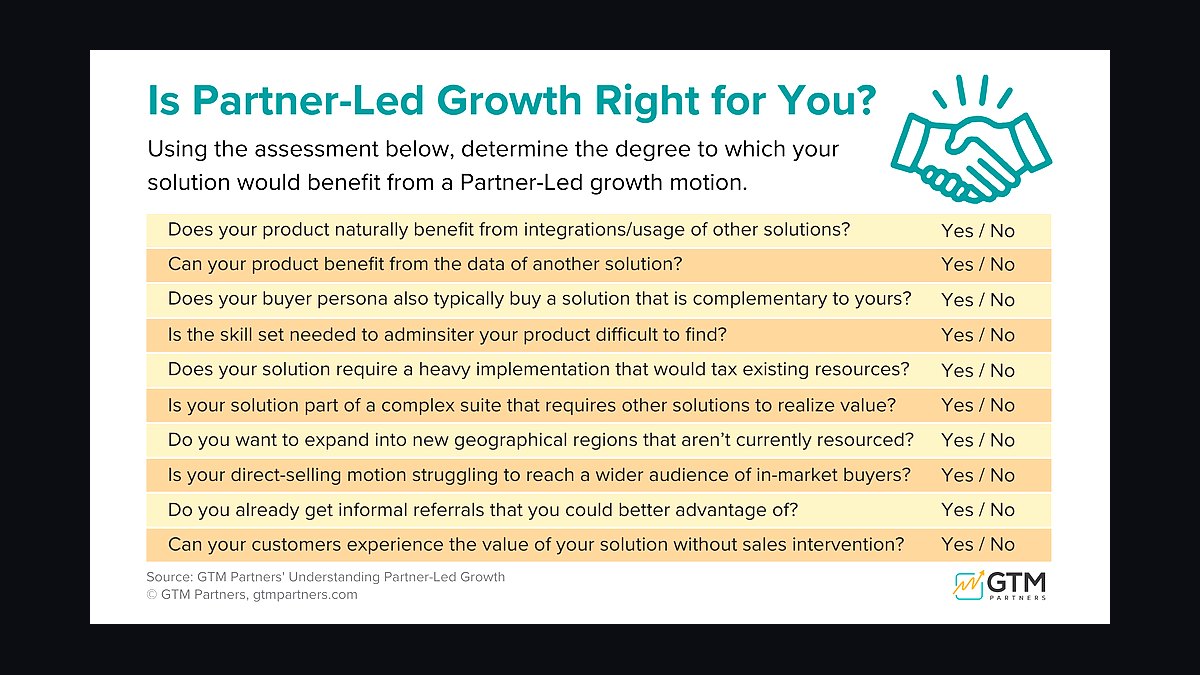
A 2027 partner team splits partner-led vs partner-influenced revenue by assigning one primary credit category per deal, then weighting comp, quota, and tier credit to match. Partner-led means the partner ran the commercial close; partner-influenced means the partner materially advanced a deal your team closed. Document both, audit quarterly, and align internal rep comp so nobody fights the credit.
What partner-led and partner-influenced actually measure — and why the distinction carries so much weight
The partner-led versus partner-influenced split is a grading system for commercial ownership, not a yes/no flag stapled to an opportunity record. It answers a narrower question than "did a partner touch this deal?" — it answers "who carried the deal across the line, and how much of the commercial burden did each side absorb?" That distinction drives four downstream systems at once: partner payout, internal rep payout, quota retirement, and partner tier progression. Get it wrong and all four drift together.
The working taxonomy most 2027 partner teams converge on has four buckets, not two:
- Partner-sourced — the partner originated the opportunity. Deal registered, customer relationship started with the partner, your team did not know the opportunity existed.
- Partner-led — the partner ran the commercial conversation: scoping, pricing negotiation, implementation commitment. This often overlaps with partner-sourced, but not always. A vendor-sourced lead routed to a partner who then closes it is partner-led on a vendor-sourced deal.
- Partner-influenced — the partner materially advanced a deal your team closed. They introduced the economic buyer, delivered independent technical validation, ran a proof of concept, or advised on architecture. They did not own the close.
- Vendor-direct — no partner role at all.
Why the split matters more in 2027 than it did three years ago: channel revenue is now a large enough share of most mid-market and enterprise books that misattribution is a material P&L event, not a rounding error. Partner-sourced and partner-led deals typically carry 15–40% margin to the partner depending on tier. Partner-influenced deals typically carry a 5–15% referral fee. On a $250K ACV deal, the gap between calling it partner-led and calling it partner-influenced is roughly $25K–$60K of partner economics. That is enough money to start a fight, and enough money that the fight will happen whether or not you have a policy.

There is also a behavioral layer. Internal account executives respond to their own comp plan before they respond to any channel strategy memo. If your rep earns the same on a partner-influenced deal as on a fully direct deal, the rational move is to keep the partner out of the room. Most partner programs that stall do not stall because partners disengage — they stall because the internal team quietly routes around them. The split is the mechanism that makes collaboration pay for the person who has to do the collaborating.
The third reason is trust. Partners talk to each other, and they compare notes on how vendors credit them. A partner who believes their contribution will be undercounted will either stop bringing you deals or start building leverage by going direct to the customer and forcing your hand. Both outcomes are expensive. Predictable, published attribution rules are cheaper than almost any other retention tactic in a channel program.
The distinction also feeds tier progression. If partner-influenced credit counts toward tier thresholds at full weight, partners can climb tiers on light-touch activity and unlock margin they did not earn. If it counts at zero, partners stop logging introductions that genuinely open doors. Most programs land on a weighted scheme: partner-led and partner-sourced count at 100% toward tier thresholds, partner-influenced counts at 25–50%, vendor-direct counts at zero.
The step-by-step process for running the split

A working split is a process, not a policy document. The order matters, because each step constrains the next.
Step 1 — Define the categories in writing, with examples and counter-examples. Write down what partner-led means and, just as important, what it does not mean. "Partner introduced us to the customer" is not partner-led. "Partner ran the pricing negotiation and signed the implementation SOW" is. Publish three real examples per category from your own closed deals, redacted. Teams that skip the counter-examples spend the next two quarters arguing about edge cases that a single sentence would have settled.
Step 2 — Set the registration window and the exclusivity period. Partner-led registration must happen before your internal team has materially engaged the account. Most programs use a 14–30 day exclusive protection window once a registration is approved. During that window the internal team cannot override the lead. If the internal team has to step in to close, the deal downgrades to partner-influenced — and that downgrade rule needs to be written down before it happens, not negotiated during a forecast call.
Step 3 — Require a contribution record within 5 business days. This is the single highest-leverage rule in the whole system. If a partner's involvement is not logged in the PRM within five business days of the first substantive interaction, the deal defaults to vendor-direct. Five days is short enough that memory is still accurate and long enough that nobody has to file paperwork mid-meeting. Partners and reps both have an incentive to log immediately, because the default is unfavorable to both.

Step 4 — Capture two-sided attestation at close. Every closed deal gets an attribution record naming the category, the specific activities that justify it, and confirmations from both the partner and the internal rep. Single-sided attestation — partner self-reporting only — drifts toward over-attribution within two to three quarters. The internal rep's concurrence is what keeps it honest.
Step 5 — Apply the comp weights. Partner-led on a partner-sourced deal pays full tier margin. Partner-led on a vendor-sourced deal pays roughly 70–80% of full tier margin, because the partner closed but did not originate. Partner-influenced pays a referral fee, typically 5–15% of first-year ACV. Vendor-direct pays nothing to the partner.
Step 6 — Apply the internal rep weights. This is where most programs underinvest. On partner-influenced deals, the internal rep should keep near-full quota credit and receive a commission multiplier — commonly 1.2x to 1.5x — so involving a partner is worth more to them than going alone. On partner-led deals, quota credit is often split, with the rep who managed the partner relationship receiving a defined share.
Step 7 — Audit quarterly. Pull a random 5–10% of attributed deals and re-examine the evidence against the category definitions. Publish the results internally, including corrections. An unaudited attribution program drifts toward over-attribution with near-mechanical reliability.
Step 8 — Reconcile at the monthly channel-and-sales review. The VP of Channel and the VP of Sales review the attribution dashboard together, monthly, with the authority to correct categories. Disagreements that cannot be resolved at that level escalate to a joint review, not to whoever shouts loudest.
The sequence matters because steps 2 and 3 create the evidence base that steps 4 through 6 depend on. Skip the registration window and you will be adjudicating he-said-she-said claims at close. Skip the five-day logging rule and your contribution records become reconstructions written by whoever wants the credit most.
Costs, timelines, and typical ranges

Attribution programs are cheap to design and expensive to run badly. Here is what the numbers typically look like across a mid-market or enterprise partner organization.
Partner payout ranges. Full tier margin for reseller, systems integrator, and consultant partners generally runs 15–40% of first-year contract value, with the rate rising by tier. Partner-led on a vendor-sourced deal typically pays 70–80% of that tier rate. Partner-influenced referral fees generally land between 5% and 15% of first-year ACV, with the higher end reserved for contributions that clearly shortened the sales cycle or unlocked an executive relationship. Marketplace-attributed deals sit outside this structure entirely, because the marketplace takes a platform cut rather than a partner margin.
Internal rep comp impact. On partner-led deals, internal reps commonly receive 5–10% of deal value as an overlay or finder's commission, and quota credit is frequently split with the rep who managed the partner relationship. On partner-influenced deals, reps keep near-full quota credit — often 100% — plus a 1.2x to 1.5x commission multiplier. On vendor-direct deals, standard rates apply with no multiplier. The multiplier is the cheapest lever you have for changing rep behavior, because it costs only the delta on deals that would have been smaller or slower without the partner.
Implementation timeline. A four-category model with written definitions, a registration window, a five-day logging rule, and two-sided attestation typically takes one to two quarters to design and one to two quarters to stabilize. Expect the first quarter after launch to produce a spike in disputes — that is normal and it means the definitions are being tested. Programs that see no disputes in the first quarter usually have definitions so vague that nobody can tell whether they were applied correctly.

Tooling cost. Modern PRM platforms and CRM attribution workflows ship native support for multi-partner registration, contribution forms, and category tagging. The build cost is mostly configuration and change management, not licensing. The larger hidden cost is the analyst or ops time to run the quarterly audit — budget roughly 0.2 to 0.5 FTE for a program with a few hundred attributed deals per year.
Dispute resolution cost. Programs with explicit edge-case policies resolve attribution disputes in a matter of days. Programs that handle each case ad hoc take weeks, and the cost is not just the delay — it is the internal selling time burned in the argument and the partner trust spent in the meantime. A single unresolved conflict can cost several thousand dollars in lost productivity before it costs a dollar of revenue.
Reporting cadence costs. A monthly attribution dashboard reviewed jointly by channel and sales leadership is the minimum viable cadence. Quarterly channel mix reviews should show the percentage of total revenue in each category. A mature channel program typically targets 30–50% of total revenue as partner-attributed across sourced, led, and influenced combined. Annual reviews cover channel investment ROI, category trends, tier movements, and the comp implications for the internal team.
What you should not try to save money on. Do not skip the audit. Do not skip the internal rep multiplier. Do not skip the counter-examples in your definitions. Each of those three shortcuts saves a small amount of design time and costs multiples of that in disputes, disengagement, and rework.
Where teams get it wrong

Vague definitions passed off as policy. "Partner contributed meaningfully" is not a rule. It is an invitation for both sides to argue from self-interest. Every category needs a test that a third party could apply to a closed deal and reach the same answer.
Single-category thinking. Treating every deal as either partner or direct erases the middle. Partner-influenced is the largest bucket in most mature programs and the one most likely to be undercounted, because the internal rep has no incentive to volunteer it and the partner may not know the deal closed.
One-sided attestation. When only the partner attests, over-attribution is the predictable result. When only the internal rep attests, under-attribution is the predictable result. Two-sided confirmation is the only version that holds.
No audit. Attribution programs without a review cycle drift. The drift is not dramatic in any single quarter, which is exactly why it goes unnoticed until a partner escalates.
Internal comp that ignores the split. If your rep's payout does not change when a partner is involved, your rep's behavior will not change either. Aligned comp is the whole game.
Retroactive claims with no window. A partner who waits to see which deals close before claiming influence is not acting in bad faith — they are responding to your rules. A strict 30-day post-close window with documented evidence predating the close date eliminates the incentive. If the evidence is strong, a partial goodwill credit of 25–50% of the standard influenced rate is reasonable; the full rate is not.
Multi-partner deals with no proportional rule. When two partners touch one deal, the absence of a predefined contribution split guarantees that at least one partner feels cheated. Assign the sourcing partner 40–50% of the partner commission, the technical contributor 30–40%, and split the remainder among additional contributors.

Ignoring platform fees in co-sell. On a co-sell deal involving a hyperscaler marketplace, the platform fee — often 10–15% of deal value — should be deducted before the partner's percentage is calculated, not after. On a $100K deal with a 10% platform fee, a 15% partner-led commission applies to $90K, not $100K. Calculating on the gross figure double-dips and makes your economics unsustainable at scale.
No source expiration. Sourcing credit that never expires lets a partner sit on a registration indefinitely. A 180-day inactivity expiration, after which the deal reverts to vendor-direct unless the partner re-engages materially, keeps registrations honest.
Decision framework: when to choose what
The category definitions are fixed, but how aggressively you weight them should flex with your channel maturity and your mix of partner types.
If your program is early-stage and partners are scarce, weight partner-led generously. Pay full tier margin on partner-led deals regardless of who sourced, and set the internal rep multiplier at the high end — 1.5x — to force collaboration habits before they calcify. You are buying behavior, and behavior is cheapest to buy early.
If your program is mature and partner-sourced volume is high, tighten the partner-led-on-vendor-source rate toward 70% of tier margin. At scale, the difference between sourcing and closing is a real cost difference, and partners who only close should not earn the same as partners who originate.
If your internal team is resistant, do not lead with policy. Lead with the multiplier. Publish the comp plan change first, then the attribution rules, then the audit. Reps who see their own number go up on partner-influenced deals will adopt the logging discipline faster than any mandate produces.

If your partners are predominantly OEMs, this framework mostly does not apply. OEM partners typically receive an embedded revenue share on units or seats rather than deal-level attribution. The four-category model is built for resellers, systems integrators, consultants, and managed service providers.
If your partners are predominantly managed service providers, expect a higher share of partner-led deals and a lower share of partner-influenced, because MSPs typically own the customer relationship end to end. Set your tier thresholds accordingly rather than penalizing them for a mix that reflects their business model.
If marketplace deals are material to your revenue, carve them out as a separate category with its own economics. Do not force them into the four-category model, because the margin structure is fundamentally different.
The framework should be reviewed annually, not quarterly. Quarterly changes to attribution weights destroy the predictability that makes the system valuable in the first place. Annual adjustments, announced in advance with the new rates effective at the start of a period, preserve trust while still letting the program evolve.
Related questions
Should partner-influenced credit count toward partner tier thresholds?
Count it, but at a discount. Most programs weight partner-led and partner-sourced at 100% toward tier progression and partner-influenced at 25–50%. Full weight lets partners climb tiers on light-touch activity; zero weight discourages the introductions that open enterprise doors.
How long should sourcing credit last before it expires?

Typically 180 days of partner inactivity. After that the deal reverts to vendor-direct unless the partner re-engages materially with documented activity. A shorter window punishes long enterprise cycles; a longer one lets stale registrations block your pipeline.
Does the split change for deals closed through a cloud marketplace?
Yes. Marketplace deals belong in a separate category because the platform takes a cut rather than a partner margin. Deduct the platform fee — often 10–15% — before calculating any partner percentage, so your economics stay sustainable.
Who breaks a tie when the partner and the internal rep disagree on the category?
A joint review by the VP of Channel and the VP of Sales, with the attribution record and activity log as evidence. Escalating to a single function — channel or sales — guarantees the outcome is read as biased by the other side.
Should AI suggest the attribution category?
It can flag likely categories from activity patterns and surface missing evidence, which is useful. It should not make the final call. Nuance in commercial ownership is exactly the kind of judgment automated pattern-matching misreads most often.
FAQ
What is the single most important rule in a partner-led versus partner-influenced split? The five-business-day logging rule. If a partner's involvement is not documented in the PRM within five business days of the first substantive interaction, the deal defaults to vendor-direct. It is short enough to be accurate, long enough to be practical, and unfavorable enough to both sides that everyone complies.
How do we compensate internal reps so they actually involve partners?

Apply a 1.2x to 1.5x commission multiplier on partner-influenced deals and keep the rep's quota credit at or near 100%. On partner-led deals, pay a 5–10% overlay and split quota credit with the rep who manages the partner relationship. Without a multiplier, the rational rep behavior is to keep partners out.
What counts as material contribution for partner-influenced credit? Introducing the economic buyer, delivering independent technical validation, running a proof of concept, advising on architecture, or providing an industry-specific reference the customer actually used. A casual mention of your product in an unrelated conversation, a logo on the partner's website, or a link on a partner's resource page does not count.
How do we handle two partners on one deal? Use proportional attribution defined before the deal closes. The sourcing partner typically takes 40–50% of the partner commission, the technical contributor 30–40%, and any additional contributors split the remainder. The PRM should allow multiple partners to register against one opportunity with predefined percentages.
How often should we audit attribution? Quarterly, sampling 5–10% of attributed deals and re-checking the evidence against the category definitions. Publish the findings and any corrections internally. Unaudited programs drift toward over-attribution within two to three quarters, and the drift is invisible until a partner escalates.
Can a partner claim influence after the deal has already closed? Only within a strict 30-day window, and only with documented evidence — emails, meeting invites, demo recordings — that predates the close date. If the evidence holds up, a partial credit of 25–50% of the standard influenced rate is reasonable. The full rate is not, because it rewards waiting to see which deals land.
Sources
- Pavilion — Channel and partner resources
- Forrester — Channel and partner research
- Gartner — Sales and channel research
- Harvard Business Review — Sales and channel strategy
- Salesforce — Partner relationship management
- HubSpot — Partner program resources
- Bridge Group — Sales and channel benchmarks
- AWS Partner Network
- Microsoft Partner Network
Related on PULSE
- How should a 2027 RevOps team split marketing-sourced vs marketing-influenced revenue?
- How should a 2027 channel team resolve partner overlap after an acquisition?
- How should a 2027 partner team segment VAR vs MSP partner archetypes?
- What's the right sales manager span of control — and when do you split a team?
- How do I split a single sales team into segment-based teams?
This page will be disappearing soon. Save it to your device for $1 — or read it free while it is here.
@Kory-White- · if Venmo asks, the last 4 of my number are 2012
This page is gone.
This one is off the shelf now. $1 keeps it on your phone for good — the whole page, pictures and diagrams included.
 revopsWhat's the right interview process for hiring a great B2B SaaS AE in 2027?
 revopsHow should a 2027 RevOps team handle outlier deals in the forecast?
 revopsWhat is lemlist and why is it a hot RevOps multichannel outreach platform for 2027?
 revopsHow should a 2027 startup run a founder-shadow program for the first AE?
 revopsWhat's a healthy AE ramp time — and how do you actually design ramp in 2027?
 revopsHow should a 2027 RevOps team handle international forecast complexity?
 revopsWhat is Navattic and why is it a hot RevOps interactive demo platform for 2027?
 revopsHow should you handle mid-year comp plan resets without destroying trust in 2027?
 revopsHow should a 2027 RevOps team build an ICP scoring rubric?
 revopsHow do you operate sales during a system outage during end-of-quarter in 2027?