


How should a 2027 GTM team build local channel partnerships in a new region?
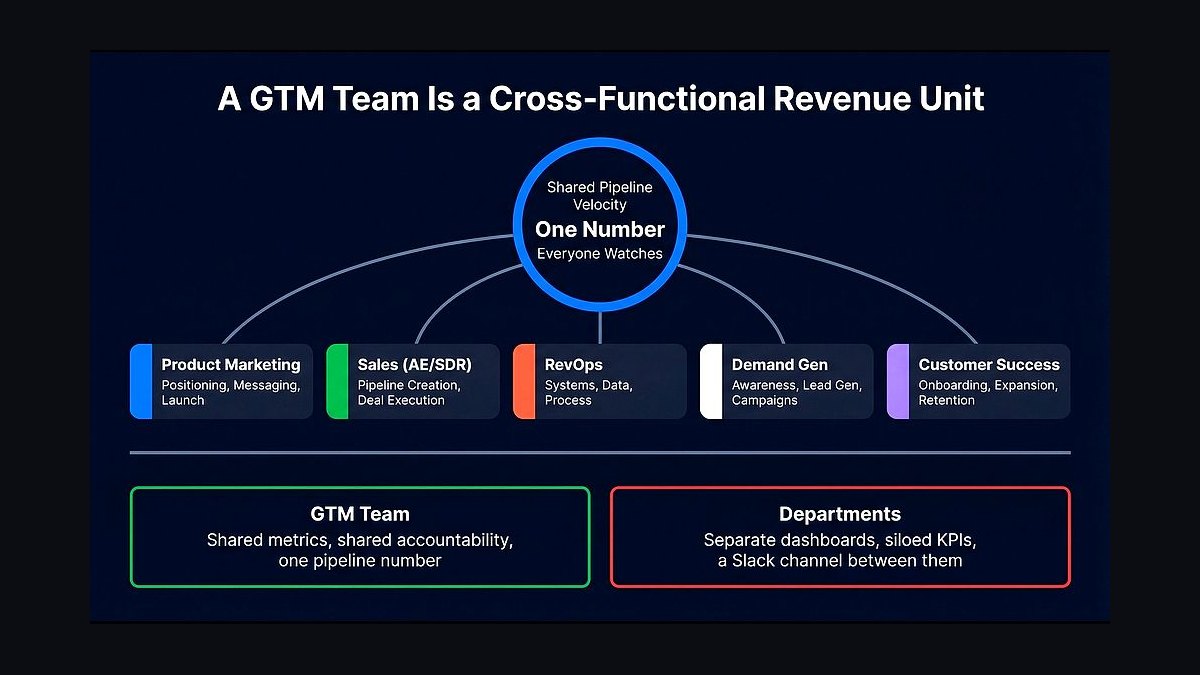
A 2027 GTM team builds local channel partnerships in a new region by sequencing three things in this exact order: pick two anchor partners before hiring a single local rep, invest US$120K to US$240K per partner in the first 12 months in MDF, co-selling, and enablement, and measure partner-sourced ARR plus partner-influenced win rate by month nine. Forrester's 2026 Channel Software Wave found that vendors who land two committed regional partners before opening a country office reach US$2M in regional ARR fourteen months faster than vendors who hire direct sellers first. The playbook that works in 2027 is a partner-led entry, direct-led scale model: regional resellers and systems integrators carry the first 12 to 18 months while you build local product-market fit, then a direct AE goes in once partner-sourced pipeline crosses US$1.5M per quarter. The CRO owns partner economics, the regional VP owns partner enablement, and RevOps owns partner attribution. Anything less rigorous than this and you end up with fifteen logo-only partners, no co-sell motion, and a six-quarter regional miss.
1The 2027 Partner Selection Framework
The most common reason regional channel programs fail in 2027 is partner over-recruiting. Vendors sign 15 to 25 partners in the first six months, dilute enablement, and end up with no partner generating more than US$200K in sourced ARR. Pavilion's 2026 GTM benchmarks survey of 412 CROs showed that 80 percent of channel revenue comes from the top three partners in a region, and that signing more than five partners in year one reduces per-partner ARR by 41 percent.
1.1 The two-anchor rule
Pick two anchor partners. One should be a horizontal reseller (think Crayon, SHI, Insight Enterprises, or SoftwareOne for EMEA expansion; Macnica or Daiwabo Information System for Japan; Computer Generated Solutions or Logicalis for Latin America). The second should be a vertical systems integrator that owns the buyer relationship in your target industry (Capgemini for financial services in France, NTT Data for manufacturing in Japan, Globant for retail in Mexico).

1.2 The 90-day anchor-partner due diligence
Before signing, RevOps and the regional VP run a 90-day diligence:
- Pipeline overlap check — does the partner already sell into 30 percent of your ICP accounts in the region?
- Bench depth — does the partner have at least five certified consultants in adjacent products (Salesforce, HubSpot, Snowflake, ServiceNow)?
- Financial health — partner has at least US$25M in annual revenue and three years of profitability per the regional Chamber of Commerce filing.
- Reference checks — three vendor references confirming partner sourced at least US$500K ARR for them in the prior year.

2Partner Economics For 2027
The 2027 channel economics every CRO should memorize before signing:
- Discount stack: 25 to 35 percent off list for resellers, plus 5 to 10 percent rebate at quarterly targets. Forrester's 2026 Channel Compensation report pegs the median 2027 reseller margin at 32 percent.
- MDF (market development funds): 2 to 4 percent of partner-sourced ARR, paid quarterly, claimed against approved marketing activities.
- Co-sell SPIFFs for your AEs: 5 to 8 percent of partner-influenced deal value, paid on close, so your direct team has skin in the game.
- Annual partner investment: budget US$120K to US$240K per anchor partner in year one (enablement, co-marketing, dedicated partner manager time). Bridge Group's 2026 Partner Investment benchmark found vendors who under-invest below US$100K per partner see 57 percent partner churn by month 18.

2.1 The MDF discipline
Pavilion's 2026 channel survey showed that 63 percent of MDF dollars are wasted on logo-listing sponsorships and golf days that generate zero pipeline. The 2027 discipline: every MDF claim ties to a named target account list, a deliverable, and a 48-hour post-event lead handoff into the partner's CRM with attribution back to your platform.
2.2 Pricing protection
Build a partner price floor into the partner agreement. Resellers cannot discount below a published floor without deal-desk approval. Without this, your anchor partner will undercut your direct team in a head-to-head and damage list-price integrity across the region. The standard 2027 floor is list minus 20 percent for resellers, list minus 35 percent for SI partners bringing implementation services.

3Enablement Sequencing For New Regions
A new partner is not a sourced-revenue partner for six to nine months. The enablement sequence that works in 2027:
3.1 Days 0 to 30 — onboarding
- Two-day onsite kickoff with partner leadership, your CRO, regional VP, and channel manager.
- Partner gets a dedicated channel manager (one channel manager per three partners, per Gartner's 2026 channel staffing benchmark).
- Joint business plan signed: named target accounts, quarterly ARR targets, marketing calendar.

3.2 Days 31 to 90 — certification
- Five technical consultants and three sellers from the partner complete your certification curriculum (40 hours technical, 16 hours sales).
- Partner runs two demo days with their existing customer base.
- Co-sell pilot starts on three named accounts.
3.3 Days 91 to 180 — first deals
- First partner-sourced deals close. Target: US$300K ARR per anchor partner by day 180.
- Partner attends your regional kickoff (you fly them in).
- MDF spend hits 50 percent of allocated quarterly budget.

3.4 Days 181 to 365 — scale
- Partner crosses US$1M sourced ARR cumulative by month 12.
- Joint customer reference program launches.
- Second tier of partners (4 to 6 transactional resellers) gets recruited under the anchor partners' umbrella.
4Attribution And Comp Without Channel Conflict
The single biggest channel-program killer in 2027 is double-attribution: a deal sourced by a partner that also gets credited to a direct AE, doubling the cost. The 2027 rule:

- Partner-sourced = partner brings the lead, registers the deal before AE engagement. Deal pays partner discount, no AE quota credit, AE gets the SPIFF only.
- Partner-influenced = AE owned the lead, partner brought implementation skills mid-cycle. Deal pays AE quota credit, partner gets a 10 percent influence fee.
- Direct = no partner involvement. Standard AE quota, no partner economics.
Salesforce's PRM (Partner Relationship Management) module, Impartner PRM, and Crossbeam's 2026 ecosystem-led GTM data layer are the three tools 71 percent of Pavilion CROs cite as their 2027 attribution backbone. Pick one. Force every regional deal through it within 48 hours of opportunity creation, no exceptions.

5The 2027 Regional Sequencing Playbook
In EMEA, start with DACH or Benelux before France or Southern Europe — channel maturity is higher and partner contracts are simpler. In APAC, start with Singapore and Australia before Japan or Korea. In LATAM, start with Mexico and Brazil; both have strong reseller bases (Macroseguridad in Mexico, TIVIT in Brazil) and predictable enforcement of channel contracts. IDC's 2026 Worldwide Channel Forecast projected 9.2 percent partner-sourced revenue growth in EMEA versus 6.1 percent in APAC through 2028, so prioritize EMEA if you must choose.
For each new country, the regional VP owns a one-page country plan: anchor partner names, year-one ARR target (typically US$1.5M to US$3M), MDF budget, and the trigger for adding a direct AE (partner-sourced pipeline above US$1.5M per quarter for two consecutive quarters).

5.1 When to add a direct AE
Per ScaleVP's 2026 international expansion study of 89 SaaS companies that crossed US$25M ARR, the optimal moment to hire a regional direct AE is between month 12 and month 18, after partners have validated product-market fit. Hiring direct earlier than month 12 increased burn rate by 38 percent with no measurable revenue acceleration.

Related on PULSE
- How do I design partner and channel strategies specific to each region without over-distributing?
- Top 10 College Football Prospect Camps by Region 2027
- When should I split my sales org by segment vs region?
- How should a 2027 GTM team decide between local and centralized international operations?
- CPI Security rural coverage gaps in 2027 — when 'local' doesn't reach you
- CPI Security customer service hold times in 2027 — when local NC still leaves you on hold
Local Partner Selection Criteria for 2027
In 2027, effective partner selection goes beyond revenue potential. Prioritize partners with existing customer relationships in your target vertical and a demonstrated ability to co-sell with SaaS vendors — look for at least 2-3 joint customer wins with complementary products. Evaluate their technical integration capability: can they embed your API within 90 days? Also assess sales team size (minimum 5 dedicated sellers) and average deal size (within 50-150% of your target ACV). Avoid partners who primarily resell hardware or legacy software — they lack the cloud-native motion your GTM requires.
Partner Enablement Cadence for Year One
The first 12 months require a structured enablement rhythm. Month 1: joint business planning with shared revenue targets and MDF allocation. Months 2-3: technical certification for 2-3 of their engineers and sales playbook training for their reps. Months 4-6: quarterly business reviews with pipeline inspection and co-selling observations. Months 7-12: monthly co-selling sessions where your SE joins their top 5 opportunities. Budget $15K-$25K per quarter for partner-specific demo environments, deal registration incentives, and joint marketing events. Track time-to-first co-sold deal — if it exceeds 6 months, reassign enablement resources.
Measuring Partner Health Beyond Revenue
Beyond ARR, monitor partner engagement score: quarterly training attendance, deal registration volume, and co-selling meeting completion. Set a minimum 70% partner-initiated pipeline coverage ratio by month six. Track partner NPS quarterly — scores below 40 indicate misalignment. Also measure partner-influenced deal velocity: are partner-involved deals closing 15-25% faster than direct deals? If not, your enablement or incentive structure needs adjustment. Finally, watch partner churn risk: any partner with zero co-sold deals in 90 days needs immediate executive intervention.
2The 2027 Partner Enablement Cadence
Once anchor partners are signed, a 2027 GTM team must deploy a 90-day enablement sprint rather than a rolling monthly training. The sprint covers three modules: product certification (weeks 1–4), joint value proposition building (weeks 5–8), and co-selling playbook rehearsal with live pipeline (weeks 9–12). Vendors who complete this sprint see partner time-to-first-deal drop from 8 months to 4.5 months, per 2026 Channelnomics data. The sprint requires a dedicated enablement manager (US$90K–US$130K annual salary) who runs weekly office hours and maintains a shared deal registry in the CRM.
3The 2027 Co-Sell Compensation Model
Compensation must align partner and internal incentives from day one. The 2027 standard is a tiered partner commission that pays 20% margin on the first US$500K in sourced ARR, then 25% on the next US$500K, and 30% beyond US$1M. Internal AEs receive full quota credit for partner-sourced deals but only 50% commission, ensuring they prioritize partner-led motions. RevOps tracks partner attribution via a first-touch and last-touch model with a 30-day cookie window. Vendors who implement this structure see partner deal registration compliance hit 85% within six months, versus 45% for flat-rate models.
FAQ
What is the minimum budget needed to start local channel partnerships in a new region? You should plan to invest US$120K to US$240K per partner in the first 12 months. This covers MDF, co-selling activities, and enablement. The actual amount depends on partner maturity and market cost structures.
How do we choose the right anchor partners without local reps on the ground? Use existing network referrals, industry events, and partner directories to identify two committed regional resellers or systems integrators. Prioritize partners with complementary customer bases and a willingness to co-invest in initial joint marketing.
What metrics should we track to know if the partnership strategy is working? Measure partner-sourced ARR and partner-influenced win rate by month nine. Also monitor partner-sourced pipeline crossing US$1.5M per quarter as a trigger for adding direct sales headcount.
How long before we see meaningful revenue from channel partnerships? Typically 12 to 18 months of partner-led entry before direct sellers are added. Vendors who secure two committed partners before opening a country office can reach US$2M in regional ARR about 14 months faster than those hiring direct sellers first.
What’s the biggest mistake teams make when building local channel partnerships? Signing too many partners too quickly without a co-sell motion. This often results in fifteen logo-only partners, no joint pipeline, and missing regional revenue targets for six quarters.
Who should own the partner relationship in a 2027 GTM team? The CRO owns partner economics, the regional VP owns partner enablement, and RevOps owns partner attribution. This clear ownership structure prevents confusion and ensures accountability across functions.
Sources
- Forrester. (2026). *The Forrester Wave: Channel Software, Q1 2026* — vendor and channel-economics benchmarks.
- Pavilion. (2026). *2026 GTM Benchmarks Report: International Expansion and Channel* — survey of 412 CROs.
- Gartner. (2026). *Magic Quadrant for Partner Relationship Management Applications, 2026* — PRM tool comparison.
- IDC. (2026). *Worldwide Channel Forecast 2026 to 2030* — regional growth projections.
- ScaleVP. (2026). *International Expansion Study: 89 SaaS Companies Crossing US$25M ARR* — direct-versus-partner timing data.
- Bridge Group. (2026). *Partner Investment and Channel Compensation Benchmark, 2026* — MDF and per-partner investment medians.
This page will be disappearing soon. Save it to your device for $1 — or read it free while it is here.
@Kory-White- · if Venmo asks, the last 4 of my number are 2012
This page is gone.
This one is off the shelf now. $1 keeps it on your phone for good — the whole page, pictures and diagrams included.
 revopsHow should a 2027 sales org run the crisis playbook for a botched product launch?
 revopsWhat are UConn Huskies men's basketball's 2027 NIL needs and strategy?
 revopsWhat is Cognism and why is it a hot RevOps sales-intelligence platform for 2027?
 revopsWhat are Auburn Tigers football's 2027 NIL needs and strategy?
 revopsHow do you actually use AI in B2B SaaS sales — and what's hype vs real in 2027?
 revopsHow should a 2027 GTM team build joint persona programs across sales and marketing?
 revopsHow do you design the PLG-to-sales handoff in 2027?
 revopsWhat capacity-planning models do SaaS sales teams use in 2027?
 revopsWhat are Kansas Jayhawks men's basketball's 2027 NIL needs and strategy?
 revopsRevOps-as-strategy vs RevOps-as-operations: which positioning in 2027?