


How should a 2027 sales org choose between Sandler Challenger and MEDDPICC coaching frameworks?
A 2027 sales org chooses between Sandler, Challenger, and MEDDPICC coaching frameworks by matching framework to deal complexity, average sales cycle, and buyer sophistication, not by debating which is universally best. The 2027 rule of thumb from Pavilion's 2026 Methodology Benchmark of 411 GTM teams: use Sandler for transactional SMB and mid-market velocity (under 60-day cycles, US$10K to US$50K ACV); use Challenger for complex, change-the-buyer-belief deals in commoditized markets (US$50K to US$250K ACV); use MEDDPICC for enterprise B2B with named procurement, security review, and CFO sign-off (US$100K+ ACV, 4+ month cycles). The most common 2027 architecture is a hybrid: MEDDPICC as the qualification scaffold across the whole org, Challenger as the messaging discipline at discovery and demo, Sandler as the pricing and negotiation playbook at close. The CRO and VP enablement pick the primary framework, RevOps embeds it into Salesforce or HubSpot pipeline stages, and first-line managers coach against it weekly.
1The Three Frameworks In 2027 Plain English
1.1 Sandler
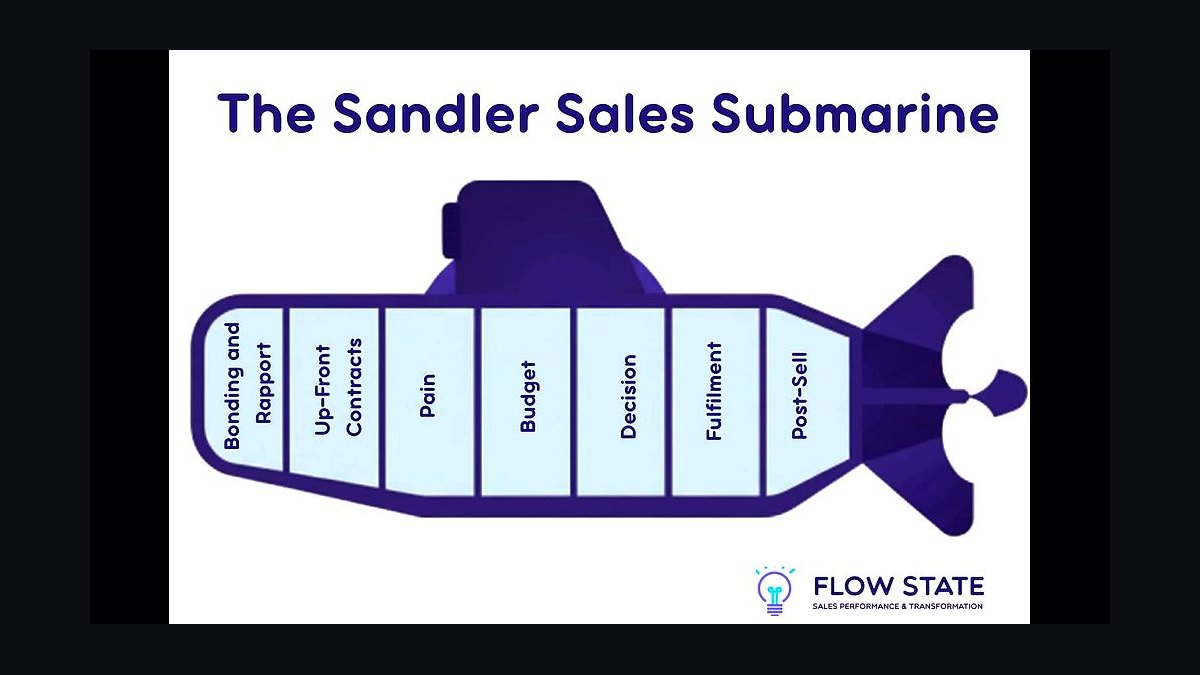
Created by David Sandler in 1967, refreshed in the 2010s with the Sandler Selling System submarine. Sandler's modern 2027 application focuses on pain funnels, up-front contracts, and qualifying out hard. The submarine has seven compartments: bonding and rapport, up-front contract, pain, budget, decision, fulfillment, post-sell. The Sandler operator quals out budget-misaligned deals in the first conversation.
- Strengths: pace, budget discipline, prospect respect.
- Weaknesses: light on enterprise multi-threading; light on procurement complexity; light on competitive displacement.
- Right for: SMB velocity, mid-market self-service expansion, channel-led sales motions, financial services and insurance verticals.

1.2 Challenger
Coined by Brent Adamson and Matt Dixon at CEB in 2011 (now Gartner). The five Challenger rep profiles (Hard Worker, Relationship Builder, Lone Wolf, Reactive Problem Solver, Challenger) frame the original research; the Challenger profile teaches the customer something new, tailors the conversation to economic value, and takes control of the discussion. Modernized in 2024 as Challenger Sale 2.0 with a "Commercial Insight" framework.
- Strengths: messaging discipline, reframes status-quo bias, creates urgency in commoditized markets.
- Weaknesses: requires deep customer insight, hard to teach junior AEs, can backfire with sensitive buyers.
- Right for: mid-market and enterprise commoditized markets (cloud infrastructure, marketing tech, observability), category-creation plays, deals where status quo is the biggest competitor.

1.3 MEDDPICC
Evolved from MEDDIC (Metrics, Economic Buyer, Decision Criteria, Decision Process, Identify Pain, Champion) at PTC in the 1990s, expanded to MEDDPICC with Paper Process and Competition. The 2027 enterprise standard for qualification and forecast discipline.
- Strengths: clarity on enterprise decision dynamics; forecastability; champion development.
- Weaknesses: pure qualification framework, not a messaging framework; can become checklist theater if not coached well.
- Right for: enterprise B2B, deals with formal procurement, security review, CFO sign-off, multi-quarter cycles.

2The Hybrid Architecture Most 2027 Orgs Run
Forrester's 2026 Methodology Wave found that 63 percent of B2B SaaS companies above US$25M ARR run a hybrid framework rather than purist single-methodology adoption. The hybrid that works:
2.1 The hybrid stack
- MEDDPICC — the qualification and forecast scaffold across all segments. Every deal carries MEDDPICC fields in Salesforce or HubSpot. Pipeline reviews and forecast calls reference MEDDPICC.
- Challenger — the messaging and discovery discipline. Reps are trained to bring Commercial Insight to every discovery call, reframe the buyer's status quo, and tailor value conversations to the economic buyer.
- Sandler — the negotiation and close discipline. Up-front contracts on every multi-stakeholder meeting; pain funnels at discovery to qualify out; budget conversations early; control of the close.

2.2 What each role learns
- BDR/SDR — Challenger discovery openings + Sandler qualifying-out muscle.
- AE mid-market — Challenger messaging + MEDDPICC qualification + Sandler negotiation.
- AE enterprise — MEDDPICC mastery (full Champion development, Paper Process mapping, Competition mapping) + Challenger insight delivery + Sandler price discipline.
- CSM — Sandler pain funnel for renewal risk discovery + Challenger reframing for expansion.
3Choosing The Primary Framework
3.1 The four-question selection test
Run these four questions across your deal cohort to pick a primary:

- What is the average sales cycle? Above 4 months → MEDDPICC backbone. Below 60 days → Sandler velocity.
- What is the average deal size? Above US$100K ACV → MEDDPICC. Under US$50K → Sandler.
- Is the buyer's biggest competitor status quo or another vendor? Status quo → Challenger. Named competitor → MEDDPICC with Challenger discovery.
- Does procurement, security, or finance always join? Yes → MEDDPICC. No → Sandler or Challenger.
3.2 Real-world picks by company type
- Snowflake / Databricks (data infrastructure, US$200K+ ACV) — MEDDPICC primary, Challenger messaging, formal Champion development. Snowflake's well-known sales academy heavily codifies MEDDPICC.
- HubSpot (mid-market SMB SaaS, US$5K to US$50K ACV) — Sandler primary with hybrid messaging. HubSpot publishes Sandler-influenced training material to their partner network.
- Gong / Clari (revenue intelligence, US$50K to US$150K ACV) — Challenger primary, MEDDPICC overlay for forecast discipline.
- Salesforce (enterprise SaaS, US$100K+ ACV) — MEDDPICC primary, Challenger for category creation in newer products (Data Cloud, Agentforce).

4Implementation And Measurement
Picking the framework is 20 percent of the work; implementation is the other 80.
4.1 The 12-month rollout
- Months 1 to 2 — CRO selects primary, enablement chooses certified training partner (Sandler, Challenger Inc., Force Management for MEDDPICC, Winning by Design for hybrid).
- Months 3 to 4 — Train all AEs (2-day kickoff, 8 hours weekly reinforcement for 4 weeks).
- Month 5 — Embed framework fields into Salesforce or HubSpot (MEDDPICC checklist on every opportunity above US$50K).
- Months 6 to 9 — Manager certification (all first-line managers certified to coach the framework before they coach reps).
- Months 10 to 12 — Quarterly framework audits by RevOps; correlate framework adoption with win rate, cycle time, and ACV.

4.2 What to measure
- Field completion rate — what percent of opportunities have all MEDDPICC fields filled? Target above 85 percent for deals above US$50K.
- Win-rate lift — deals with full MEDDPICC versus partial. Bridge Group's 2026 data shows a 23-percent win-rate lift for fully qualified versus partial deals.
- Forecast accuracy — Commit accuracy quarter over quarter should improve 5 to 10 points within two quarters of adoption.
- Cycle time — should compress 8 to 15 percent within three quarters as qualifying out gets sharper.
- Manager certification rate — 100 percent of front-line managers certified before quarterly performance reviews.
5Avoiding The Most Common 2027 Mistakes
5.1 Mistake — adopting a framework and abandoning it after 6 months
The single biggest failure mode. Forrester's 2026 Methodology Wave found that 47 percent of B2B SaaS companies abandon their chosen framework within 18 months because executive sponsorship lapses. Fix: tie the CRO scorecard to framework-adoption metrics for the first 24 months.

5.2 Mistake — picking the framework the VP enablement learned at their last job
Frameworks must fit the buyer, not the trainer. A VP enablement from Oracle pushing MEDDPICC on a US$15K-ACV PLG company is a costly mismatch. Use the four-question test as the objective filter.
5.3 Mistake — turning MEDDPICC into checklist theater
Reps fill the fields to make the manager happy; the answers do not reflect deal reality. Fix: first-line manager weekly Gong-driven audit of MEDDPICC quality, not just completeness.

5.4 Mistake — over-investing in the framework, under-investing in coaching
Buying a US$200K Force Management contract with no manager coaching practice is wasted money. The framework is the language; coaching is the muscle.
5.5 Mistake — Challenger without enablement support
Challenger requires Commercial Insight content. If marketing does not produce insight assets (third-party data, industry benchmarks, point-of-view content), reps cannot Challenger and fall back to product pitch. Build the insight engine alongside the methodology.

Related on PULSE
- How do we operationalize sales methodology (MEDDPICC, Challenger, Sandler) without killing rep morale?
- How do we apply Challenger, Sandler, and other sales methodologies to strengthen win-loss discovery and competitive positioning?
- How should a 2027 sales org choose between MEDDIC MEDDPICC SPIN and Challenger?
- What is an inbound qualification framework, and which one actually works (BANT, MEDDPICC, Sandler, etc.)?
- What is the Sandler Selling methodology in plain English?
- How do MEDDPICC and Challenger frameworks guide interview questions to assess deal methodology maturity?
2Coaching Implications by Framework Choice in 2027
The framework you choose dictates how you coach, not just what you sell. Sandler coaching in 2027 focuses on conversation discipline: managers role-play the "up-front contract" and "pain funnel" in weekly 15-minute drills, grading reps on how quickly they get a prospect to say "no" to a bad fit. Challenger coaching emphasizes teaching, tailoring, and taking control: managers review call recordings for rep ability to reframe buyer assumptions and present a commercial insight that challenges status quo. MEDDPICC coaching is pipeline hygiene and evidence-gathering: managers audit each deal's "identified pain" and "champion" fields in the CRM, requiring reps to upload a signed procurement timeline or a security questionnaire receipt before moving to stage 3. In 2027, the most effective sales orgs run weekly 30-minute "deal review" sessions where the manager picks one framework lens per deal (e.g., "today we're MEDDPICC-ing the 'paper process' metric on Deal A") rather than trying to coach all three simultaneously.
3Common Pitfalls When Mixing Frameworks in 2027
The 2027 hybrid approach fails when orgs overlay all three frameworks without role clarity. First pitfall: reps confuse Challenger's "teach" with Sandler's "up-front contract" — they try to challenge the buyer before establishing rapport, causing early friction. Second pitfall: MEDDPICC becomes a checkbox exercise — reps fill in "identified pain" with generic phrases like "needs efficiency" rather than the specific, quantified metric that Challenger would demand. Third pitfall: managers coach the framework, not the rep — they ask "did you use the Sandler submarine?" instead of "did you get the prospect to admit they can't solve this themselves?". The 2027 fix: assign one framework per deal stage. Use Challenger in discovery (weeks 1-2), MEDDPICC in evaluation (weeks 3-6), and Sandler in negotiation (weeks 7+). This prevents cognitive overload and gives managers a clear weekly coaching focus.
FAQ
What if our sales cycles are longer than 60 days but our ACV is under $50K? For deals under $50K ACV that stretch beyond 60 days, the issue is usually process friction, not framework choice. Sandler’s up-front contract and mutual action plan can compress those cycles, while MEDDPICC may add unnecessary administrative overhead. Test Sandler first, then layer in only the MEDDPICC elements (like identified pain) that your team actually uses.
Can we switch frameworks mid-year without disrupting our team? Yes, but only if you treat it as a phased rollout over 90 days, not a cutover. Start with the coaching framework (Sandler or Challenger) as a messaging overlay, keep MEDDPICC as the qualification backbone, and retire the old framework gradually. Expect a 20–30% dip in pipeline velocity for the first 30 days as reps unlearn old habits.
Do we need a dedicated sales enablement person to make this work? For orgs under 20 reps, the VP of Sales or CRO can coach the framework directly if they have prior experience with it. For orgs above 20 reps, a dedicated enablement manager is strongly recommended—without one, framework adoption typically drops below 40% within six months. Fractional enablement is a viable option for teams of 10–30 reps.
How do we measure whether the framework is actually improving results? Track three leading indicators: win rate on stage-3+ deals, average deal cycle length by segment, and rep confidence scores from weekly coaching calls. Lagging metrics like total revenue are too noisy. A 10–15% improvement in win rate or a 15–20% reduction in cycle time within 90 days is a realistic benchmark for a well-executed rollout.
What if our buyers are already familiar with one of these frameworks? That’s actually an advantage—use their familiarity to accelerate trust. If a buyer knows MEDDPICC, share your qualification criteria openly during discovery; if they know Challenger, lead with a commercial insight that challenges their status quo. The framework is a tool for your team’s consistency, not a secret weapon. Buyers rarely penalize you for using a methodology they recognize.
Is there a risk of overcomplicating things by combining all three? Yes—the most common mistake in 2027 is trying to use all three simultaneously without clear boundaries. The safe hybrid is: MEDDPICC for qualification and pipeline hygiene, Challenger for the first two calls (discovery and demo), and Sandler for pricing and negotiation. If your team can’t articulate which framework applies to which stage, simplify to two at most.
Sources
- Pavilion. (2026). *Methodology Benchmark: 411 GTM Teams* — framework selection patterns by ACV and segment.
- Forrester. (2026). *Sales Methodology Wave 2026* — hybrid adoption and abandonment rates.
- Bridge Group. (2026). *Sales Training and Methodology Benchmark* — win-rate lift and spend medians.
- Gartner. (2026). *Sales Methodology and Coaching Survey* — Challenger framework outcomes data.
- Force Management. (2026). *Command of the Message and MEDDPICC Outcomes Report* — implementation outcome benchmarks.
- Winning by Design. (2026). *SaaS Sales Methodology Adoption Study* — PLG plus sales-led hybrid patterns.
This page will be disappearing soon. Save it to your device for $1 — or read it free while it is here.
@Kory-White- · if Venmo asks, the last 4 of my number are 2012
This page is gone.
This one is off the shelf now. $1 keeps it on your phone for good — the whole page, pictures and diagrams included.
 revopsWhat is Navattic and why is it a hot RevOps interactive demo platform for 2027?
 revopsWhat are Tennessee Volunteers men's basketball's 2027 NIL needs and strategy?
 revopsHow do you do usage-data triggered outbound for PLG accounts in 2027?
 revopsWhat are the basic qualifying criteria for a sales deal in 2027?
 revopsHow do you design the PLG-to-sales handoff in 2027?
 revopsWhat are North Carolina Tar Heels men's basketball's 2027 NIL needs and strategy?
 revopsHow do you compare quotas across sales segments in 2027?
 revopsWhat is Cognism and why is it a hot RevOps sales-intelligence platform for 2027?
 revopsHow should you handle mid-year comp plan resets without destroying trust in 2027?
 revopsHow should a 2027 CSM build an ROI justification ahead of renewal?