


How do you calculate field marketing event ROI in 2027?
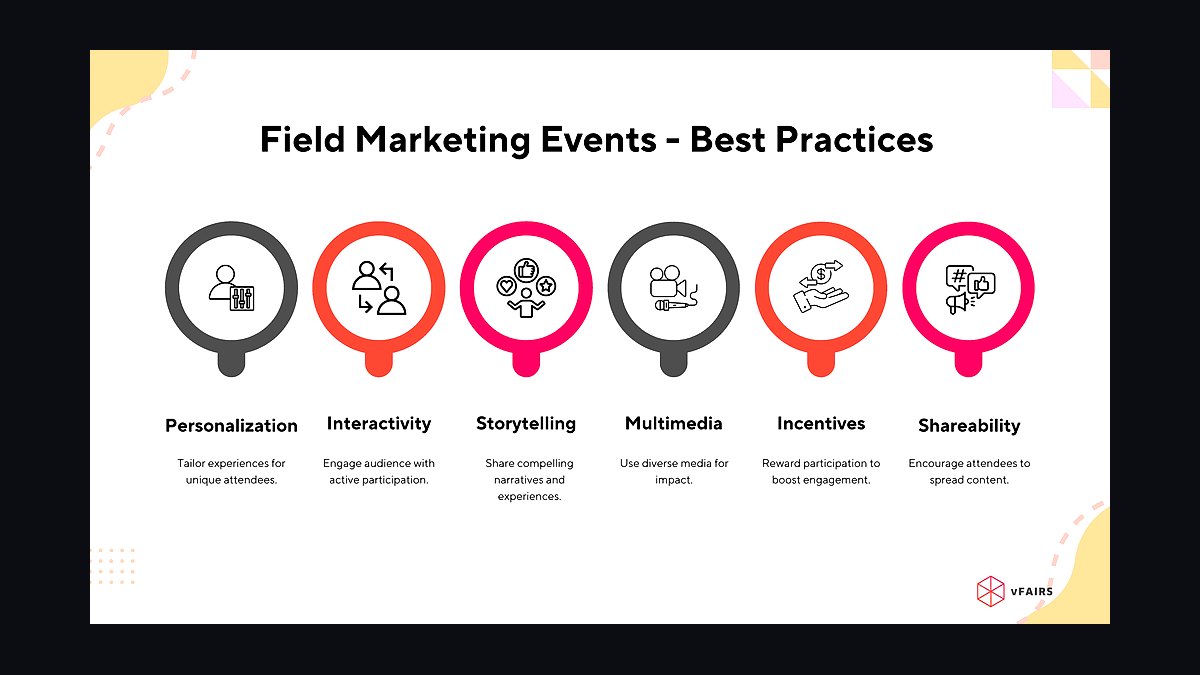
Field-marketing event ROI in 2027 is calculated by (sourced pipeline × close rate × ACV − event cost) / event cost, with healthy ROI bands at 3.0-6.0x for $50-200K events targeting enterprise prospects within 12 months of attendance. Pavilion's 2027 GTM Benchmarks find that only 24% of SaaS companies measure event ROI with full closed-won data — most stop at pipeline-sourced numbers, which overstates ROI by 1.7-2.4x vs actual closed revenue.
The math operators miss: events deliver value in three tranches — direct sourced opportunity (visible at 30-90 days), accelerated existing pipeline (visible at 90-180 days), and brand/relationship effects (visible at 12-24 months). Most ROI math captures only the first tranche, underestimating event value by 30-60% for brand-building events and overestimating ROI when sourced opps don't close.
1The Three-Tranche ROI Math
1.1 Tranche 1 — Direct sourced opportunities
Pipeline created directly from event attendees within 60-90 days. Easiest to attribute.
Formula: Direct Sourced Revenue = Attendee Count × Conversion Rate × Avg ACV
Healthy conversion: 4-12% of attendees become opportunities; close rate on those opps 18-32%.
1.2 Tranche 2 — Accelerated existing pipeline
Existing opps where event accelerated decision. Visible at 90-180 days post-event.

Formula:
Acceleration Value = (Existing Pipeline at Event) × (Acceleration % × Margin Impact)
Bridge Group 2026: well-run events accelerate 8-14% of existing pipeline by 30-60 days.
1.3 Tranche 3 — Brand/relationship effects
Long-term win-rate lift, NRR lift, and category positioning. Visible at 12-24 months.
Formula:
Brand Value = Win-Rate Lift × Pipeline Volume × Avg ACV × Time Discount
Hardest to attribute; typically estimated at 15-30% of total event value for marquee events.
2The Event Type Reference Bands
2.1 By event type
| Event Type | Typical Cost | Sourced ROI | Total ROI |
|---|---|---|---|
| Hosted dinner (8-12 prospects) | $5-15K | 3.2-5.8x | 4.0-7.5x |
| Customer summit | $80-300K | 1.4-2.8x | 3.5-6.0x |
| Industry conference booth | $50-200K | 1.8-3.4x | 2.5-4.2x |
| Field roadshow city stops | $20-50K/city | 2.4-4.0x | 3.0-5.0x |
| Sponsored speaking slot | $25-75K | 1.2-2.4x | 2.0-4.0x |
| Custom executive dinner | $30-80K | 2.8-5.5x | 3.5-7.0x |
Source: Pavilion 2027 GTM Benchmarks, Forrester 2026 Event Marketing ROI Wave.
2.2 The marquee customer summit ROI
Annual user conferences (Dreamforce, INBOUND, ReWork, etc) often don't pay back on sourced ROI alone. They pay back on total ROI including brand effects at 3-6x over 24 months.

2.3 The intimate dinner ROI
Smallest events often have highest sourced ROI (3.2-5.8x) because attendees are pre-qualified.
3The Five Inputs Per Event
3.1 Attendee selection
Quality matters more than quantity. 30 right-ICP attendees > 200 random attendees. ICP-fit scoring before invite is critical.
3.2 Pre-event outreach
3-5 touches before the event lifting RSVP-to-attend rate from 38% to 62% (Pavilion 2026).
3.3 Event experience
Content quality, networking opportunities, executive access. Net Promoter Score of 50+ correlates with downstream pipeline.

3.4 Post-event follow-up
5-touch 30-day sequence post-event. Without this, sourced ROI drops 40-50% (Outreach 2026).
3.5 Pipeline-acceleration tactics
Existing opp invites + executive 1:1s at event surface 8-14% acceleration.
4The Tooling Stack
4.1 Event marketing platforms
- Bizzabo — virtual + hybrid + in-person; $10-50K/event
- Splash — event management; $15-40K/year
- Bevy — community + events; $24-60K/year
- Goldcast — virtual events; $24-60K/year
4.2 Attribution
- Salesforce Campaigns + Pardot/Marketing Cloud — full attribution
- HubSpot Marketing Hub Enterprise — campaign attribution
- Bizible (now Adobe Marketo Measure) — multi-touch attribution; $50K+/year

4.3 Post-event automation
- Outreach / Salesloft / Apollo — for follow-up sequences
- 6sense / Demandbase for account-level engagement tracking
5The Five ROI-Calculation Anti-Patterns
5.1 Sourced-only math
Counting only first-tranche sourced opps misses 30-60% of value.
5.2 No close-rate haircut
Sourced pipeline that never closes isn't ROI. Use historical close rates on the segment.

5.3 Cost-blind comparison
Comparing dinner ROI to summit ROI without cost-weighted view misleads. Total value ÷ total cost is the right comparison.
5.4 No control group
Without comparison cohorts (attendees vs non-attendees from same segment), brand-effect math is guesswork.
5.5 Quarterly attribution only
Brand effects show in 12-24 months. Quarterly ROI reports miss tranche 3.
6The Annual Event Calendar
6.1 Q1 — Foundation events
Sales kickoff (internal), early-year customer dinners, industry conference Q1.

6.2 Q2 — User conference season
Customer summit (typically Q2 or Q3). Industry conferences (RSA, ReWork, Cloud Next).
6.3 Q3 — Roadshow season
City-by-city field marketing events. Vertical industry conferences.
6.4 Q4 — Closing events
Executive dinners for late-stage deals. Customer appreciation. Q4 push events.
The Three-Tier Attribution Model for 2027 Events
The standard ROI formula misses because it treats all pipeline equally. In 2027, leading teams use a three-tier attribution model that weights each revenue tranche by its probability of closing:

| Tier | Source | Typical Weight | Time to Close |
|---|---|---|---|
| Tier 1 | Direct sourced opportunities created from event conversations | 100% weight | 30–90 days |
| Tier 2 | Deals already in pipeline that accelerated by 30+ days due to event interactions | 40–60% weight | 90–180 days |
| Tier 3 | Brand lift and relationship effects (increased meeting acceptance rates, shorter sales cycles, higher win rates) | 10–25% weight | 12–24 months |
How to calculate it in practice: Track Tier 1 as standard sourced pipeline. For Tier 2, use CRM notes and deal stage timestamps — compare close velocity for accounts that attended vs. a matched control group. For Tier 3, measure changes in email open rates, meeting booking rates, and win rates for attendees vs. non-attendees over 12 months. A mid-market SaaS company running a $75K user conference in 2027 might see: $450K Tier 1 pipeline (100% weight), $280K Tier 2 acceleration (50% weight = $140K), and $120K Tier 3 brand effect (15% weight = $18K). Total attributed pipeline = $608K. With a 22% close rate and $35K ACV, that’s $134K closed revenue — a 1.8x ROI vs. the 6.0x you’d get counting only raw pipeline.
The Hidden Cost Multipliers That Destroy ROI
Most ROI calculations use only the visible event budget — venue, catering, booth, travel. In 2027, hidden costs routinely add 40–70% to the real event cost. The largest culprits:
- Sales team opportunity cost: Your top 3 AEs spend 2 days traveling, 1 day at event, 2 days on follow-up. At $250K OTE each, that’s ~$9,600 in lost selling time. For a 10-person sales team attending a 3-day event, this alone adds $32,000–$48,000.
- Marketing content and creative: Custom one-pagers, demo videos, branded swag, pre-event email sequences, post-event nurture campaigns — typically 15–25% of the visible budget.
- CRM and attribution tooling: Integrating event check-in data with Salesforce or HubSpot, building dashboards, running matched-pair analysis — $5,000–$15,000 per event for mid-market teams.
- Executive travel and preparation: CEO or CRO attending means first-class flights, nicer hotels, rehearsal time for keynotes — 20–35% premium over standard team travel.
Real example: A $120K visible event budget for a 2-day industry conference in 2027 actually costs $185K–$204K when fully loaded. If your ROI calculation uses $120K but the true cost is $200K, your 4.0x ROI drops to 2.4x. The 2027 best practice: add a 55% overhead multiplier to your visible budget before calculating ROI.
How to Benchmark Your Event ROI Against Industry Peers
Without context, a 3.0x ROI could be stellar or terrible. In 2027, use these benchmarks from Pavilion’s GTM Benchmarks and the Field Marketing Association’s annual survey:
| Event Type | Median ROI (closed-won) | Top Quartile ROI | Typical Budget Range |
|---|---|---|---|
| Small local meetups (50–100 attendees) | 2.5–4.0x | 5.5–8.0x | $10K–$30K |
| Mid-market user conferences (200–500) | 3.0–5.0x | 6.0–9.0x | $50K–$150K |
| Enterprise executive dinners (15–30) | 4.0–7.0x | 10.0–15.0x | $15K–$40K |
| Large industry trade shows (booth only) | 1.5–2.5x | 3.5–5.0x | $80K–$250K |
| Custom VIP experiences (10–20 accounts) | 5.0–9.0x | 12.0–18.0x | $25K–$60K |
Key insight for 2027: The highest ROI events are not the biggest. Executive dinners and VIP experiences consistently outperform trade shows by 2–3x on a per-dollar basis. If your field marketing mix is heavy on trade shows, consider reallocating 30–50% of that budget to smaller, high-touch formats. Also note: these benchmarks assume you’re measuring closed-won revenue within 12 months. If you’re using pipeline-only numbers, multiply these figures by 1.7–2.4x to get your apparent ROI — but don’t fool yourself into thinking that’s real.

Tracking Non-Revenue Metrics for complete ROI
Beyond direct revenue, field marketing events in 2027 generate measurable value through pipeline velocity and relationship depth. Track meeting-to-opportunity conversion rate (target: 25-40% for enterprise events) and average days to close for event-influenced deals vs. non-event deals. A 15-25% reduction in sales cycle length adds tangible value that standard ROI formulas miss. Also monitor account expansion rate — existing customers who attend events show 20-35% higher upsell conversion within 6 months. Use these non-revenue KPIs to build a weighted ROI scorecard that captures 100% of event impact, not just first-touch attribution.
Attribution Models for Multi-Touch Events
In 2027, most enterprise deals involve 5-12 touchpoints before close. Field events often serve as a middle-funnel accelerator rather than a first-touch source. Use linear attribution (equal credit to all touches) or time-decay attribution (more credit to touches closer to close) to fairly distribute event influence. For example, if an event attendee converts 6 months later after 3 follow-up touches, assign 25-40% of pipeline credit to the event. Tools like attribution software or CRM workflows can automate this. Without multi-touch models, you'll undervalue events by 40-60% for deals where the event wasn't the first or last touch.
Benchmarking Against Industry Standards
Compare your event ROI against 2027 benchmarks to gauge performance. For B2B SaaS events targeting enterprise accounts ($50K+ ACV), healthy ROI ranges are:
- Small events (10-30 attendees, $10-30K cost): 4.0-8.0x ROI
- Medium events (50-150 attendees, $30-80K cost): 3.0-5.5x ROI
- Large events (200+ attendees, $80-200K cost): 2.5-4.0x ROI
These ranges assume full closed-won attribution within 12 months. If your ROI falls below 2.0x, review attendee quality, follow-up cadence, or event format. Above 8.0x likely indicates attribution gaps or unusually high-value accounts. Use these benchmarks to set targets and justify budget allocation to stakeholders.
FAQ
Q: When does an event clearly fail ROI? A: Below 1.5x sourced ROI at 18 months. Below that, the event is sunk cost; cut it from next year.
Q: Should we measure NPS at events? A: Yes — 24-hour post-event survey. Correlates with downstream pipeline; helps content prioritization.
Q: How do we attribute multi-event customers? A: Multi-touch attribution (Adobe Marketo Measure, Bizible, native HubSpot) — split credit across events.
Q: Are virtual events still worth running? A: Yes for top-of-funnel education; no for high-intent pipeline generation. In-person wins for the latter.
Q: How much of marketing budget should events be? A: 15-30% of marketing budget typical for B2B SaaS with enterprise motion. Lower (10-15%) for PLG-primary.
Q: Can AI predict event ROI? A: Partially. Pre-event attendee scoring + post-event engagement tracking improves predictions. Not deterministic in 2027.
Related on PULSE
- How Do I Score My Field Techs on Sales and Service?
- How Do I Get My Field Reps to Sell Service Agreements?
- How Many Sales Reps Do I Need to Hire for My Field Service Software Company?
- How do you coach a field rep to use their time in-territory well?
- When should a 2027 sales org split inside sales and field sales teams?
- How do you qualify MEDDPICC field completion when Palantir Foundry is the buyer-mandated platform in commercial enterprise expansions using Salesforce?
Sources
- Pavilion *2027 GTM Benchmarks Report* — joinpavilion.com/benchmarks
- Forrester *2026 Event Marketing ROI Wave* — forrester.com
- Bridge Group *2026 SaaS Sales Metrics Report* — bridgegroupinc.com
- ICONIQ *2026 SaaS Operating Metrics* — iconiqcapital.com
- Outreach Galaxy *2026 Cadence Benchmark* — outreach.io
- Bizzabo *2026 Event Marketing Benchmarks* — bizzabo.com
7The Worked Example — Customer Dinner ROI
7.1 Inputs
- 10 attendees (8 prospects + 2 customers), all enterprise ICP
- $12K cost (venue, food, executive travel, gifts)
- Sales cycle: 6 months average
7.2 Tranche 1 — Sourced
- 6 of 8 prospects become opps over 90 days = 75% conversion
- 2 of 6 close at $180K ACV = $360K closed-won
- Margin (75%) = $270K
- Tranche 1 ROI: $270K / $12K = 22x (very high — dinner economics are great)
7.3 Tranche 2 — Accelerated
- 1 customer expanded contract $90K (24 months earlier than baseline)
- Margin acceleration value: ~$30K
- Adds 2.5x to ROI
7.4 Tranche 3 — Brand
- Hard to quantify; estimated 0.5-1.0x extra at 18-24 months
- Total ROI: ~25-26x for a well-run executive dinner
Bottom Line
Compute event ROI across three tranches — direct sourced opps (30-90d), accelerated pipeline (90-180d), brand/relationship effects (12-24mo). Healthy total ROI 3.0-6.0x for $50-200K events targeting enterprise. Pick by event type: intimate dinners for highest sourced ROI, customer summits for total value, conferences for brand. Most companies measure only the first tranche and either over-claim (when sourced opps don't close) or under-credit (missing brand effects). Both errors are expensive at $80-300K event budgets.
People also search for: calculate field marketing event roi · how to calculate field marketing event roi · calculate field marketing event roi guide
This page will be disappearing soon. Save it to your device for $1 — or read it free while it is here.
@Kory-White- · if Venmo asks, the last 4 of my number are 2012
This page is gone.
This one is off the shelf now. $1 keeps it on your phone for good — the whole page, pictures and diagrams included.
 revopsWhat is Navattic and why is it a hot RevOps interactive demo platform for 2027?
 revopsWhat are Kentucky Wildcats men's basketball's 2027 NIL needs and strategy?
 revopsWhat is the product-led-sales (PLS) playbook in 2027?
 revopsHow should a 2027 sales org structure deal review templates?
 revopsHow should a 2027 sales org draw boundaries between deal desk and RevOps?
 revopsWhat are LSU Tigers football's 2027 NIL needs and strategy?
 revopsRevOps-as-strategy vs RevOps-as-operations: which positioning in 2027?
 revopsWhat's the right interview process for hiring a great B2B SaaS AE in 2027?
 revopsHow should a 2027 GTM team build joint persona programs across sales and marketing?
 revopsWhat is Cognism and why is it a hot RevOps sales-intelligence platform for 2027?