


What is NRR (Net Revenue Retention) and what is a healthy benchmark in 2027?
%20and%20what%20is%20a%20healthy%20benchmark%20in%202027%3F%2C%20realistic%20magazine%20style%2C%20warm%20light%2C%20no%20text%2C%20no%20watermark%2C%20no%20words?width=1200&height=675&nologo=true&model=flux&seed=44667)
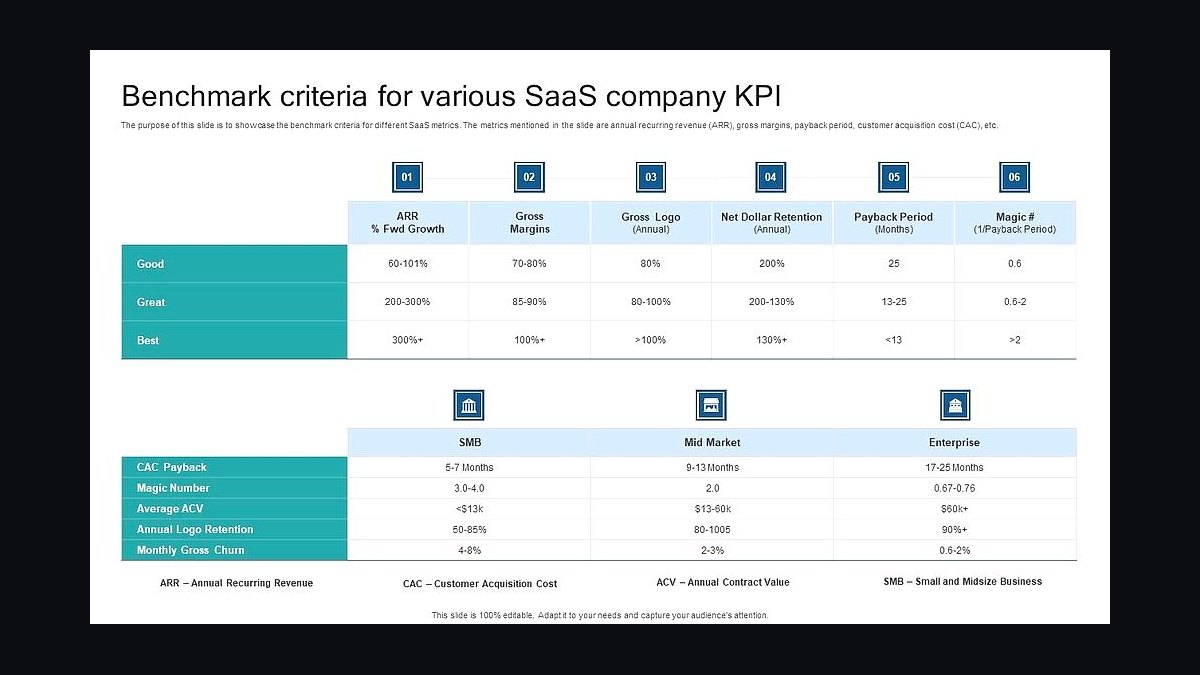
Net Revenue Retention (NRR) measures what happens to a cohort of customers' revenue 12 months later — including expansion, churn, and downgrades — divided by what they started at. In 2027, the healthy operator benchmark is 108-118% for mid-market SaaS (per Bridge Group and High Alpha), 118-130% for enterprise SaaS (Snowflake reported 126% in Q1 FY2027, Cloudflare 118%), and 97-105% for SMB SaaS. Anything below 100% means your install base is shrinking before you sell a single new logo, which is the single fastest way to kill a SaaS company in 2027's tighter funding market.
1The NRR Formula (And the Three Mistakes That Inflate It)
1.1 The textbook formula
%20and%20what%20is%20a%20healt%2C%20realistic%20magazine%20style%2C%20warm%20light%2C%20no%20text%2C%20no%20watermark?width=1200&height=675&nologo=true&model=flux&seed=71314)
NRR = (Starting ARR + Expansion - Downgrades - Churn) / Starting ARR
That "Starting ARR" is the annualized recurring revenue of the cohort of customers you had exactly 12 months ago. New logos signed in the period do NOT count. This is the formula used by public filers like Snowflake, Datadog, Cloudflare, and HubSpot, and the one Pavilion uses in its annual benchmark report.

1.2 The three ways operators accidentally inflate it
First, including new logos in the numerator — this turns NRR into a vanity growth metric. Second, excluding "non-renewal pending" accounts as if they don't count — Bain's 2026 SaaS retention study found this trick adds 4-7 points of false NRR. Third, measuring NRR on bookings instead of revenue — bookings include multi-year contract pull-forwards that mask real expansion.
1.3 NRR vs. GRR (the cleaner partner metric)
Gross Revenue Retention (GRR) caps at 100% — it excludes expansion. A company with 125% NRR and 78% GRR is masking heavy churn with aggressive upsell. Top-quartile public SaaS in 2027 runs GRR of 92-95% per Software Equity Group. Always look at NRR and GRR together — that ratio is the truth serum.

2The 2027 Benchmark Table (By Segment and Stage)
2.1 By customer segment (ACV-based)
Per the 2026 High Alpha SaaS Benchmarks Report (formerly OpenView, 9th annual edition, n=1,800+ companies):
- Enterprise SaaS (ACV >$100K): median 118%, top quartile 130%+
- Mid-Market SaaS ($25K-$100K ACV): median 108%, top quartile 122%
- SMB SaaS (<$25K ACV): median 97%, top quartile 111%
- PLG / self-serve: median 102%, top quartile 118%

2.2 By ARR stage
- $1M-$5M ARR: 104-110% is healthy (per Pavilion); high churn is normal at this stage
- $5M-$20M ARR: 110-118% healthy; expansion motion should be hardening
- $20M-$50M ARR: 115-125% healthy; CS-driven expansion playbooks expected
- $50M+ ARR: 120%+ for category leaders, 108-115% for the rest
2.3 By public-company comparable (Q1 2027 calendar)
- Snowflake: 126% (Q1 FY2027, consumption pricing model)
- Cloudflare: 118% dollar-based net retention (Q1 2026)
- Datadog: ~115% (down from 130% in 2022 peak, per most recent 10-Q)
- HubSpot: ~104% (lower because SMB-heavy)
- MongoDB: ~118%

The directional message from 2027 earnings calls: NRR is 3-8 points below 2022 peaks across the board because net new seat expansion has slowed post-AI-driven seat consolidation.
3Why NRR Matters More Than Almost Any Other SaaS Metric
3.1 The valuation premium
Software Equity Group's 2026 SaaS valuation study found that SaaS companies with NRR above 120% trade at a 63% revenue-multiple premium vs. the SaaS median. The same study showed sub-100% NRR companies trade at a 45% discount. NRR is the single strongest predictor of multiple expansion — stronger than growth rate alone.

3.2 The compounding effect
A company at 120% NRR doubles install-base revenue every 3.8 years without selling a new logo. A company at 95% NRR is bleeding 5% per year before they spend a dollar on new-logo CAC. Over 5 years that's a 27% gap in install-base revenue. This is why Aaron Ross wrote in the 2026 update to *Predictable Revenue* that "expansion is the new top of funnel."
3.3 The cash efficiency story
Bain's 2026 RevOps benchmark found that expansion ARR costs 0.3x to acquire vs. new-logo ARR at 1.2x CAC. So a dollar of expansion is 4x more efficient than a dollar of new ACV. In 2027's higher-interest-rate environment, this efficiency gap is what separates Rule of 40 winners from the layoff list.

4The Diagnostic — Why Is Your NRR Below Benchmark?
4.1 If your GRR is the problem
Logo churn is killing you. Fix it with: a 30-60-90 onboarding scorecard (the Gainsight Health Score model), executive sponsorship matching for accounts >$50K ACV, and renewal forecasting 120 days out (not 30). Lincoln Murphy's rule still holds in 2027: "customers churn because they didn't get the outcome they bought."
4.2 If expansion is the problem
You have a packaging problem, not a CS problem. Re-tier so the next tier is 1.6-2.0x the previous tier's ACV and gates at least one feature your top 20% of customers will absolutely demand. HubSpot, Notion, and Linear all reshaped pricing tiers in 2026 specifically to manufacture this expansion lane.

4.3 If downgrades are the problem
You over-sold the initial deal. Common in 2026-2027 post-ZIRP cleanup — buyers right-sized seat counts. Fix by moving to consumption or hybrid pricing (Snowflake / Twilio / Cloudflare model) so usage growth automatically lifts ARR without a sales motion.
5The 2027 Operator Playbook to Move NRR by 10 Points
5.1 Build a Customer Success quota (not a CSAT goal)
Rod Cherkas ("The Customer Success Economy" author) argues in his 2026 updates that CSMs should carry 30-40% of OTE in expansion quota when ACV is >$30K. Gong's 2026 RevOps benchmark found that CS-quota-carrying orgs ran NRR 8 points higher than peer orgs without it.

5.2 Run structured QBRs with a value-realization framework
Use MEDDPICC (by Andy Whyte) on every expansion deal — same rigor as new logo. Force Management's "Command of the Message" framework, applied to renewals, lifted NRR 5-7 points in the Pavilion 2026 case-study cohort.
5.3 Instrument product usage and trigger expansion plays
Connect product telemetry to your CRM — Gainsight, Vitally, or Catalyst are the standard 2027 tools. The trigger play: when a customer crosses 80% of plan utilization for 3 consecutive months, auto-route an expansion task to the AE. Clari's 2026 NRR research showed this single play moves NRR 3-5 points.

5.4 Audit your pricing twice per year
In 2027's AI-disrupted market, pricing models go stale in 6-9 months. Patrick Campbell (ProfitWell / Paddle) recommends quarterly van Westendorp pricing studies on the top 10% of accounts. Rev2 consultants found pricing audits unlocked 6+ points of NRR in 60% of their 2026 client engagements.
5.5 Implementation flow
Why NRR Matters More Than GRR in 2027
While Gross Revenue Retention (GRR) only tracks revenue lost to churn and downgrades, NRR captures the full picture by including expansion revenue from upsells, cross-sells, and price increases. In 2027's capital-constrained environment, investors prioritize NRR because it reveals whether your existing customer base is growing or shrinking. A company with 90% GRR but 120% NRR is far healthier than one with 95% GRR and 98% NRR — the first is generating organic growth, while the second is slowly eroding. Top-tier venture firms now set minimum NRR thresholds of 110% for Series A and above, and public market analysts use NRR as a key predictor of future free cash flow. For bootstrapped SaaS companies, maintaining NRR above 105% is often the difference between needing outside funding and achieving sustainable self-funding growth.

How to Diagnose and Improve a Below-Benchmark NRR
If your NRR sits below 100%, the root cause typically falls into one of three buckets: excessive logo churn, heavy discounting at renewal, or failure to expand existing accounts. Start by segmenting your customer base by cohort age and ACV — often, the lowest NRR comes from customers acquired in the last 12 months who were poorly qualified. Fix this by tightening your ICP and implementing a 90-day onboarding success milestone. For expansion, introduce a structured "land and expand" playbook: identify the top 20% of accounts by usage and assign dedicated CSMs to map cross-sell opportunities. Price optimization also matters — companies that implement annual inflation-adjusted price increases of 5-7% see a direct 2-4 point lift in NRR without additional churn. Finally, consider moving from monthly to annual contracts; annual billing typically improves NRR by 3-5 points due to reduced downgrade frequency and higher expansion attachment rates.
The Role of AI and Automation in 2027 NRR Optimization
By 2027, AI-powered customer health scoring has become table stakes for top-quartile NRR performance. Leading SaaS companies now deploy predictive models that flag accounts with a >30% probability of downgrade or churn 60-90 days in advance, enabling proactive intervention. Automated expansion engines — triggered by product usage thresholds, team size changes, or feature adoption — can generate 15-25% more expansion revenue per account compared to manual outreach alone. For example, a usage-based pricing company might automatically offer a higher-tier plan when a customer exceeds 80% of their current limit for two consecutive months. However, over-automation carries risk: companies that rely solely on AI without human relationship management often see NRR drop 2-3 points due to impersonal renewal experiences. The sweet spot in 2027 combines AI-driven signal detection with human-led strategic conversations for the top 15% of accounts by revenue.
FAQ
What is the difference between NRR and GRR? NRR (Net Revenue Retention) includes expansion revenue from upsells and cross-sells, while GRR (Gross Revenue Retention) only accounts for churn and downgrades. NRR can exceed 100% if expansion outpaces losses, whereas GRR caps at 100% and typically ranges from 85-95% for most SaaS companies.
Why is NRR below 100% dangerous for a SaaS business? An NRR below 100% means your existing customer base is shrinking in revenue year-over-year, forcing you to acquire more new customers just to stay flat. In 2027's tighter funding market, investors prioritize efficiency, and a shrinking install base signals product-market fit issues or poor retention practices.
What NRR range is considered "healthy" for enterprise SaaS in 2027? Enterprise SaaS companies typically target an NRR between 118-130%, with top performers like Snowflake reporting 126% and Cloudflare at 118%. This range reflects strong expansion from upselling and cross-selling within large accounts, offsetting any churn.
Can SMB SaaS ever achieve an NRR above 100%? Yes, but it's harder due to smaller contract sizes and higher churn rates. Healthy SMB SaaS benchmarks in 2027 range from 97-105%, meaning many companies hover near or slightly above 100%. Achieving above 110% in SMB is rare and often requires a land-and-expand strategy with high-volume usage-based pricing.
How do you calculate NRR for a cohort of customers? Take the total recurring revenue from a specific customer cohort at the start of a 12-month period, then measure that same cohort's revenue 12 months later—including expansions, downgrades, and churn. Divide the ending revenue by the starting revenue and multiply by 100 to get the percentage.
What factors most influence a company's NRR in 2027? Key drivers include product stickiness (usage frequency), expansion opportunities (upsells, cross-sells, price increases), and customer success effectiveness. Macroeconomic conditions also play a role—during tighter funding, enterprises may consolidate vendors, hurting NRR, while usage-based pricing can boost it if customers scale usage.
Bottom Line
In 2027, NRR is the single most important SaaS metric — more predictive of valuation than growth rate, more efficient than new-logo CAC, and more compounding than any other lever you control. The healthy benchmark is 108-118% for mid-market, 118-130% for enterprise, and 95-105% for SMB. If you're below those bands, diagnose churn vs. expansion vs. downgrades, fix the binding constraint, and re-baseline quarterly. The CRO who moves NRR by 10 points typically moves company valuation by 40-60% — and that, in any market, is the highest-leverage thing a revenue leader can do.
Related on PULSE
- What is the 2027 Net Revenue Retention (NRR) benchmark for B2B SaaS?
- What is CAC payback period and what is a healthy benchmark in 2027?
- What are healthy stage-to-stage conversion rates for SaaS sales in 2027?
- What is pipeline coverage ratio and what is a healthy number in 2027?
- What is a healthy win rate by segment (SMB / Mid-Market / Enterprise) in 2027?
- What is a healthy sales quota attainment distribution in 2027?
Sources
- 2026 High Alpha SaaS Benchmarks Report (formerly OpenView, 9th annual edition) — segment NRR medians
- Pavilion 2026 B2B SaaS Performance Benchmarks — ARR-stage NRR ranges
- Software Equity Group 2026 Public SaaS Valuation Report — 63% multiple premium analysis
- Bain & Company 2026 SaaS Retention Study — formula audit + CAC efficiency multiples
- Snowflake Q1 FY2027 Earnings (May 2026) — 126% NRR disclosure
- Cloudflare Q1 2026 Earnings — 118% DBNR + RPO disclosure
- Gong 2026 RevOps Benchmark Report — CS quota correlation with NRR
- Rod Cherkas, "The Customer Success Economy" (2026 update) — CS comp design
- Clari 2026 Revenue Operations Research — product telemetry trigger plays
- Bridge Group 2026 SaaS Sales Compensation Report — expansion AE quotas
This page will be disappearing soon. Save it to your device for $1 — or read it free while it is here.
@Kory-White- · if Venmo asks, the last 4 of my number are 2012
This page is gone.
This one is off the shelf now. $1 keeps it on your phone for good — the whole page, pictures and diagrams included.
 revopsWhat are Florida Gators football's 2027 NIL needs and strategy?
 revopsHow do you operate sales during a system outage during end-of-quarter in 2027?
 revopsHow do you build a peer-coaching library that AEs actually use in 2027?
 revopsWhat are the 2027 best churn-save playbooks?
 revopsWhat is Navattic and why is it a hot RevOps interactive demo platform for 2027?
 revopsHow should a 2027 CS team respond to a coordinated customer revolt?
 revopsWhat are North Carolina Tar Heels men's basketball's 2027 NIL needs and strategy?
 revopsHow should a 2027 sales and marketing team run joint forecasting?
 revopsWhat capacity-planning models do SaaS sales teams use in 2027?
 revopsHow should a 2027 sales org run the crisis playbook for a botched product launch?