


How do you build a customer health score in 2027?
Published June 13, 2026 · Updated June 13, 2026
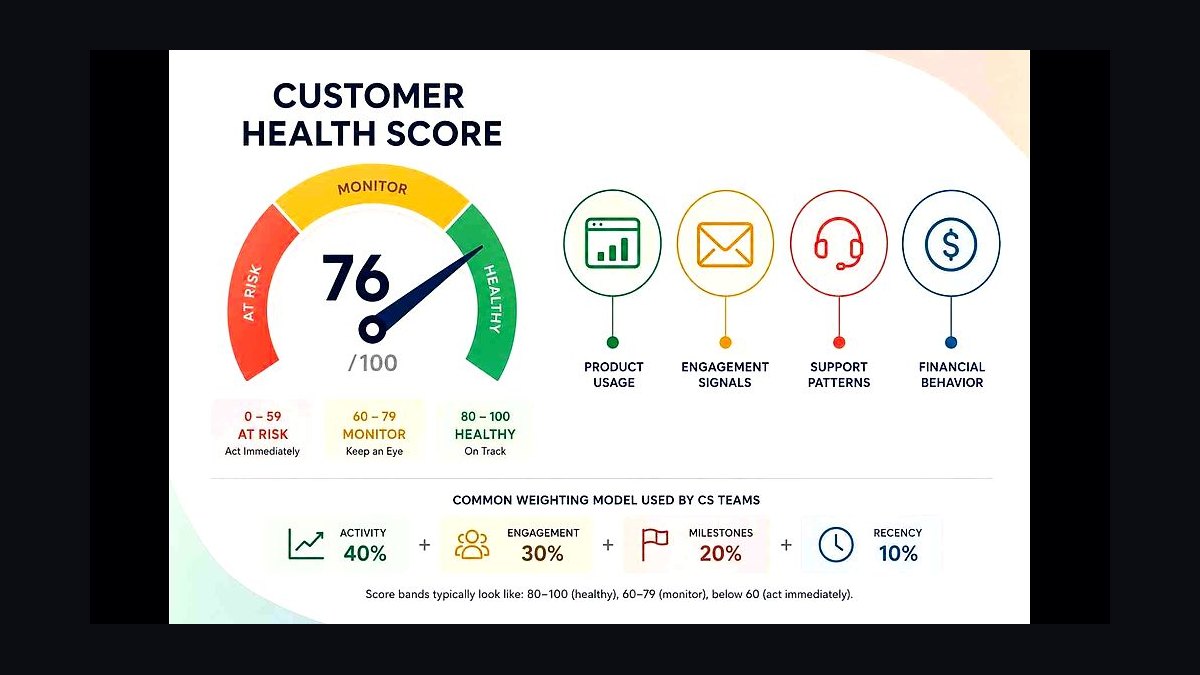
You build a customer health score in 2027 by combining usage, engagement, support, relationship, and commercial signals into a weighted composite that is validated against real churn-and-expansion outcomes and tied to specific actions for each band. A health score is only useful if it predicts what actually happens (churn, expansion, renewal) and triggers a response. The build has five steps: choose the predictive signals, weight them from historical data, combine them into a banded score (green/yellow/red), validate it against known outcomes, and attach a playbook to each band. The most common failure is a score built from intuition — equal points for "logged in" and "attended a QBR" — that looks reasonable and predicts nothing. The 2027 best practice uses outcome-validated weighting (often AI-assisted) and treats the score as a living model retuned as the product and customer base evolve.
1Choose Signals That Actually Predict
A good health score draws from five signal categories:
- Usage/adoption — logins, active users, feature breadth and depth. The strongest single predictor for most products.
- Engagement — QBR attendance, email responsiveness, training participation.
- Support experience — ticket volume, severity, and sentiment.
- Relationship strength — number and seniority of contacts, champion presence, executive alignment.
- Commercial signals — payment timeliness, contract value trend, expansion history.

The mistake is overweighting whatever is easy to measure (logins) and ignoring harder but more predictive signals (champion presence, depth of adoption). Choose signals by predictive power, not by availability.
2Weight From Historical Data, Not Intuition
The credibility of a health score comes from data-driven weighting. Pull your history of churned, retained, and expanded accounts, and analyze which signals and thresholds actually preceded each outcome. Weight the score by those real correlations. If accounts with fewer than three contacts churn at triple the rate, relationship breadth deserves heavy weight. Intuition-based equal weighting ("everything counts for 10 points") produces a score that feels fair and predicts poorly. Let the outcomes set the weights.

2.1 Segment the Model
A single score across all customers misleads, because health looks different by segment. An enterprise account with deep adoption but one quiet quarter is not the same risk as an SMB with the same pattern. Build segment-specific scores (or segment-specific thresholds) so the model reflects how each customer type actually behaves.
3Band the Score and Make It Actionable
Translate the composite into bands — green, yellow, red — because a raw number does not drive behavior but a band does. Each band must map to a specific action: green accounts get expansion and advocacy plays, yellow accounts get proactive outreach, red accounts get a defined rescue motion. A health score that does not change what CS does on Monday morning is a dashboard ornament. The action mapping is what makes the score operational.

4Validate Against Real Outcomes
Before trusting the score, back-test it. Would it have correctly flagged the accounts that actually churned last year as red, and the ones that expanded as green? Measure its predictive accuracy — what share of churned accounts were red beforehand, and what share of red accounts actually churned. A score that fails this test needs reweighting. Validation is the step that separates a real predictive instrument from a plausible-looking guess, and it is the step most teams skip.
5Avoid the Common Health-Score Traps
Three traps undermine health scores:

- The vanity-signal trap — overweighting easy metrics (logins) over predictive ones (champion presence, adoption depth).
- The static-model trap — building it once and never retuning as the product, pricing, or customer base shifts.
- The no-action trap — producing a score nobody acts on.
Avoid them by validating, retuning, and hard-wiring the score to playbooks.

6The 2027 AI-Assisted Health Score
In 2027, predictive health scoring is increasingly machine-learning-driven. Platforms like Gainsight, Catalyst, and Planhat train models on your own account history to find non-obvious risk patterns and weight signals automatically — often outperforming hand-built scores. The cautions are the same as any AI in RevOps: keep the score explainable (CS must understand why an account is red to act on it) and validate the model's predictions against outcomes. Use AI to sharpen the weighting and surface patterns, but keep human judgment and clear action mapping in the loop. A practical 2027 pattern is to run the AI model and the rule-based score side by side for a quarter, comparing which better predicted actual outcomes before trusting the model fully — the AI score earns its place by beating the human-built one on real churn, not by being newer. Until it demonstrably wins on your own data, treat the AI output as one input alongside the validated rule-based score rather than a replacement for it.
7Bottom Line
Build a customer health score by choosing predictive signals across usage, engagement, support, relationship, and commercial categories; weighting them from real churn-and-expansion history; banding the score into green/yellow/red mapped to specific playbooks; and validating it against known outcomes. Segment the model, retune it as things change, and in 2027 use AI to sharpen the weighting while keeping it explainable. A health score earns its place only when it predicts real outcomes and changes what CS does — anything less is a number on a dashboard.

Related on PULSE
- What is a customer health score — and how do you build one that actually predicts churn?
- How should a 2027 CS team design a customer health score?
- How should we structure a customer health score that tracks both product engagement and commercial indicators?
- How do you build a customer health scoring model in 2027?
- How does the 2027 vendor consolidation wave redefine ideal customer profile scoring for platform health checks?
- How do you operationalize customer health scores beyond login frequency and NPS?
Common Pitfalls That Invalidate Customer Health Scores
Even with a well-designed framework, several recurring mistakes can render a health score misleading or useless. The most frequent pitfall is over-relying on a single signal — for example, treating daily active users (DAU) as a proxy for overall health without accounting for feature adoption depth or sentiment. A customer might log in daily but only use a basic feature set, indicating stagnation rather than genuine engagement. Another common error is ignoring recency: a score that weights all historical data equally will miss sudden shifts. A customer who was healthy six months ago but has stopped logging in for 30 days should trigger a warning, but a flat average would mask that decline.
Data silos also undermine accuracy. If your product usage data lives in one system, support tickets in another, and billing in a third, manual reconciliation leads to stale or inconsistent scores. By 2027, leading teams use integration tools (e.g., APIs or no-code connectors) to refresh signals daily or in real time. A less obvious trap is confirmation bias in weighting: teams often assign high weight to metrics they personally track (e.g., CSM sentiment) while undervaluing objective signals like payment delays or support ticket volume. This produces a score that feels right to the team but fails to predict churn. Finally, static thresholds are dangerous. A “green” score of 80 might work for a mature product but become meaningless after a major feature launch or pricing change. Health models should be recalibrated at least quarterly against actual outcomes to stay predictive.
How to Validate and Iterate Your Health Score Model
Validation is the step most teams skip, yet it determines whether your score is a decision-making tool or a vanity metric. The gold-standard approach is backtesting: take historical data from the past 6–12 months, apply your proposed score model, and check how well it predicted known events like churn, downgrades, or expansions. A useful benchmark is that a validated score should correctly flag at least 70–80% of churners at least 30 days before they cancel, with a false-positive rate below 20%. If your model misses churners or flags too many false alarms, adjust weights or add new signals.
A/B testing is another powerful technique. Split your customer base into two groups: one where CSMs act on the health score, and one where they use their usual judgment. After three months, compare churn rates and expansion revenue. If the health-score group shows measurably better outcomes (e.g., 10–15% lower churn), the model is adding value. You can also run seasonality checks: a score that works during a growth quarter may fail during a downturn or after a product change. For example, if you launch a new pricing tier, historical usage patterns may no longer predict health accurately — requiring a model refresh.
Finally, human-in-the-loop feedback is essential. Have CSMs tag accounts where the score disagrees with their intuition, then review those cases monthly. Patterns in the mismatches (e.g., “score says red but customer just signed a multi-year renewal”) reveal blind spots. Over time, this feedback loop refines the model, making it both more accurate and more trusted by the team.
Integrating Health Scores into Automated Workflows
A health score that sits in a dashboard without triggering action is wasted potential. By 2027, the most effective teams embed health scores into automated playbooks that route accounts to the right intervention at the right time. For example, when a score drops from green to yellow, an automation can immediately assign a CSM task, send a personalized email to the customer’s executive sponsor, or schedule a check-in call. For red accounts, the system might escalate to a senior CSM or trigger a discount offer to prevent churn.
Slack or Teams integrations are common: a webhook can post a daily digest of accounts that moved bands, with a one-click option to create a follow-up task. More advanced setups use predictive routing — if the score indicates a high expansion opportunity, the system automatically assigns the account to a growth specialist rather than a retention-focused CSM. This ensures resources match the risk or opportunity.
To avoid alert fatigue, set minimum thresholds before triggering actions. A single day of low usage shouldn’t trigger a call, but three consecutive weeks in yellow should. Also, build escalation rules for rapid declines: if a score drops from green to red within 7 days, bypass normal workflows and notify a manager immediately. The goal is to make the health score operational — not just informative — by connecting it directly to your CRM, support ticketing, and communication tools. This turns a static metric into a dynamic driver of customer outcomes.
FAQ
What’s the easiest way to start building a health score if I have no historical churn data? You can begin with a simple composite of three signals: login frequency, support ticket volume, and payment timeliness. Assign equal weights initially, then manually review a handful of churned versus retained accounts to adjust the weighting. This gives you a rough baseline you can improve once you have six to twelve months of outcome data.
How often should I retune the health score model? Most teams revalidate the model quarterly or after any major product release, pricing change, or shift in customer segment. A score built in 2027 that isn’t retuned at least twice a year will drift as usage patterns and support behaviors evolve.
Do I need AI or machine learning to build a useful health score? No, but AI helps. A manual weighted sum of five to ten signals often achieves 70–80% predictive accuracy against churn. Machine learning can push that into the 85–95% range by uncovering non‑linear interactions (e.g., low usage + high support tickets is worse than either alone). Start simple, then layer in ML if you have the data volume.
What’s the most common mistake that makes a health score useless? Using intuition-based equal weights without validation. For example, giving ten points for “logged in yesterday” and ten points for “attended a QBR” often produces a score that looks reasonable but fails to predict churn. The fix is to test each signal’s correlation with actual renewal outcomes and adjust weights accordingly.
How do I tie a health score to actual team actions? Define a playbook for each band: green accounts get automated upsell triggers, yellow accounts receive a proactive check‑in from the CSM within five business days, and red accounts trigger an executive escalation and a retention offer. Without these action links, the score is just a dashboard decoration.
Can a health score predict expansion revenue, not just churn? Yes, and that’s a 2027 best practice. Include signals like feature adoption breadth, NPS trend, and support satisfaction score. Weight them to predict both contraction risk and expansion likelihood. A single score can then guide retention plays for at‑risk accounts and growth plays for healthy ones.
Sources
- Gainsight, Catalyst, and Planhat health-scoring documentation, 2026–2027
- Pavilion 2026 RevOps customer-success and health-score survey
- Gartner research on customer health scoring and retention, 2026
- ChurnZero and Totango health-score and churn-prediction research, 2026–2027
- OpenView and SaaStr net-retention and CS benchmarks, 2026
- The Bridge Group customer-success operating benchmarks, 2026–2027
Customer health score review / reviews / rating / review 2027 / review of customer health scores
People also search for: build a customer health score · how to build a customer health score · build a customer health score guide
This page will be disappearing soon. Save it to your device for $1 — or read it free while it is here.
@Kory-White- · if Venmo asks, the last 4 of my number are 2012
This page is gone.
This one is off the shelf now. $1 keeps it on your phone for good — the whole page, pictures and diagrams included.
 revopsHow do you align sales and customer success in 2027?
 revopsHow do you build a renewals process that prevents surprise churn in 2027?
 revopsHow do you build a customer handoff process from sales to CS in 2027?
 revopsHow is AI changing customer success in 2027?
 revopsHow do you reduce churn with RevOps in 2027?
 revopsWhat is predictive churn modeling in 2027 and which tools lead?
 revopsHow do you onboard a RevOps analyst in 2027?
 revopsWhat is the 2027 typical CSM comp plan with NRR component?
 revopsHow do you evaluate and buy RevOps software in 2027?
 revopsWhat is the 2027 Net Revenue Retention (NRR) benchmark for B2B SaaS?