


How do you do account scoring for ABM in 2027?
Published June 13, 2026 · Updated June 13, 2026
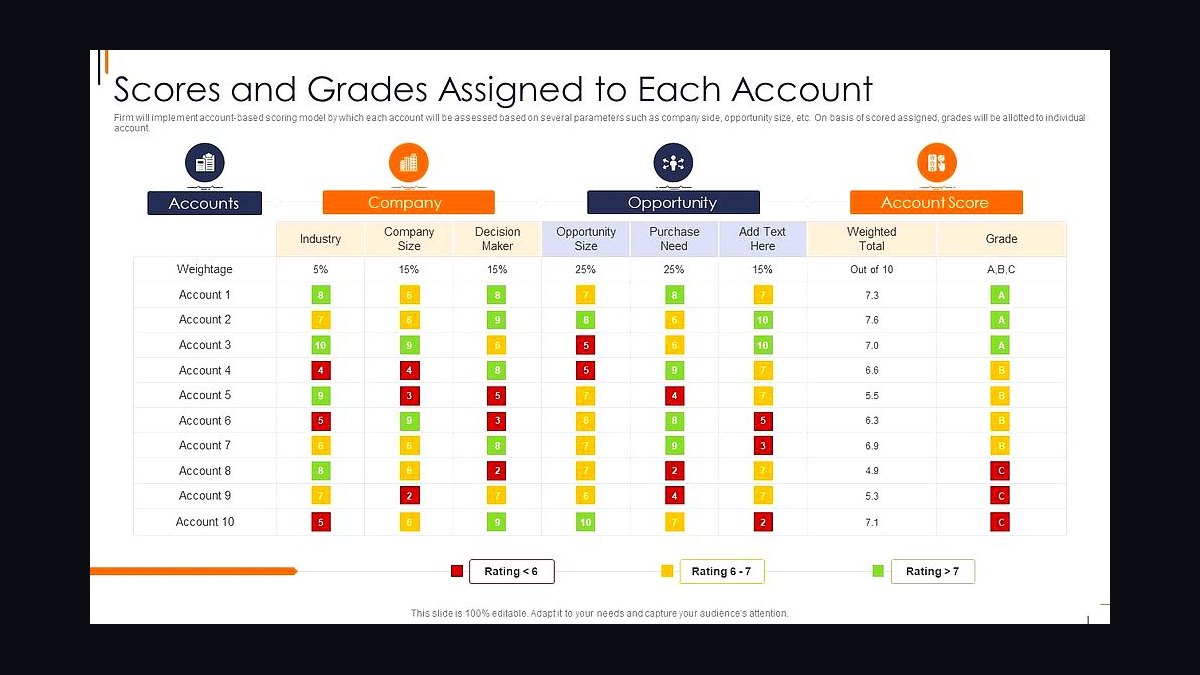
You do account scoring for ABM in 2027 by combining account fit (how well an account matches your ICP) with account intent and engagement (how in-market and engaged the account is) into a tiered score that prioritizes which target accounts get the most resources. Account scoring for account-based marketing answers the question ABM lives or dies on: which accounts deserve our limited high-touch effort right now? The model has two axes: fit (firmographic, technographic, ICP match — is this an account we should win?) and intent/engagement (are they researching, engaging, showing buying signals — are they ready now?). Combine them into tiers (1:1, 1:few, 1:many) that determine resourcing. The 2027 advantage is AI and intent data that score the whole target list continuously and surface which accounts are heating up. The cardinal mistake is scoring on fit alone (targeting great-fit accounts that are not in-market) or intent alone (chasing engaged accounts that will never be good customers).
1Score Two Axes: Fit and Intent
ABM account scoring rests on two distinct axes:
- Fit — how well the account matches your ICP (firmographics, technographics, segment). Answers "should we win this account?"
- Intent and engagement — whether the account is showing buying signals (third-party intent, web visits, content engagement, event attendance). Answers "are they in-market now?"

A great-fit account with no intent is a nurture/target-later account; a high-intent account with poor fit is usually a trap. The accounts worth your most expensive ABM effort are high-fit AND high-intent. Scoring both axes — and combining them — is what makes ABM account scoring actually prioritize correctly.
2Build the Fit Score From ICP Data
The fit axis comes directly from your validated ICP. Score accounts on firmographic (size, industry, geography), technographic (tools that signal complementary fit), and ICP-attribute match. Use enrichment and account data (from ZoomInfo, Clearbit, 6sense) to score the whole target universe. The fit score should reflect where you actually win and retain, derived from your best-customer analysis — not aspiration. A well-built fit score concentrates ABM on accounts you can genuinely win, which is the precondition for ABM ROI. Validate that high-fit accounts truly close and retain better.

3Add the Intent and Engagement Score
The intent/engagement axis captures timing — which fit accounts are active now. Sources: third-party intent data (accounts researching your category, via 6sense, Bombora, Demandbase), first-party engagement (web visits, content consumption, email and event engagement), and explicit buying signals (pricing-page visits, demo requests). This axis tells ABM when to strike — a high-fit account that suddenly shows category intent is the moment for a coordinated 1:1 play. Combining timing (intent) with fit is what makes ABM efficient rather than a constant high-touch effort on accounts that may not be ready.
4Combine Into Resource Tiers
The point of scoring is resource allocation. Combine fit and intent into tiers that determine ABM treatment:

- Tier 1 (1:1) — highest-fit, highest-priority accounts get fully personalized, high-touch ABM (custom content, executive engagement, dedicated plays).
- Tier 2 (1:few) — strong-fit accounts grouped by similarity get semi-personalized programs.
- Tier 3 (1:many) — broader fit accounts get scaled, lightly personalized ABM.
The score determines which tier an account lands in and therefore how much expensive human and creative effort it receives. This tiering is the operational payoff of account scoring — it ensures the costliest ABM goes only to the accounts that justify it, while lower tiers get efficient scaled treatment. Intent can promote an account to a higher tier when it heats up.

5Keep It Dynamic, Not Static
ABM account scores must be dynamic. Fit is relatively stable, but intent and engagement change constantly — an account dormant last month may be deep in research today. Score continuously so accounts move between tiers as their intent shifts, and trigger ABM plays when an account crosses a threshold (high-fit account starts showing strong intent → activate 1:1 play). A static annual scoring exercise misses the timing that makes ABM effective. The 2027 standard is always-on scoring that surfaces in-market fit accounts in real time, so ABM and sales engage at the moment of peak readiness rather than on a fixed calendar.
6Use AI and Intent Data in 2027
AI and intent data define modern ABM scoring. Predictive models score the entire target universe for fit and likelihood-to-buy, finding lookalikes and surfacing non-obvious high-potential accounts. AI processes intent signals at scale, identifying which accounts are genuinely in-market now and predicting which are about to be. Platforms like 6sense and Demandbase combine predictive fit scoring, intent, and engagement into unified account scores and even recommend the next play. The result is ABM scoring that is continuous, predictive, and timing-aware — far beyond manual fit-scoring. RevOps governs these models and ensures the scores drive coordinated sales-and-marketing action.

6.1 Align Sales and Marketing Around the Account Score
ABM account scoring only delivers value when sales and marketing act on it together — the score is the shared prioritization that coordinates the two functions, which is the entire premise of account-based GTM. This requires deliberate alignment: sales and marketing must agree on the scoring model and the tier definitions, so both are working the same priority accounts with a shared definition of what "Tier 1" means and what treatment it gets. When a high-fit account shows strong intent, the score should trigger a coordinated play — marketing runs air cover (targeted ads, personalized content) while sales runs ground game (executive outreach, tailored sequences) against the same account at the same time. Without this coordination, account scoring becomes just another marketing artifact sales ignores, and the ABM investment is wasted. Build the operational connective tissue: shared account lists and tiers visible to both teams, agreed triggers and plays for when accounts cross thresholds, joint account planning for Tier 1 accounts, and shared metrics (account engagement, pipeline, and revenue by tier) that both functions own together. The most effective 2027 ABM programs treat the account score as the single shared prioritization that orchestrates sales and marketing motion — both teams point their respective firepower at the same scored accounts at the same time, which is what produces the coordinated, multi-threaded pressure that ABM is supposed to create. Account scoring done in a marketing silo, where marketing scores accounts that sales never sees or trusts, produces no ABM lift; account scoring as a shared sales-and-marketing operating system produces the concentrated, coordinated effort on winnable in-market accounts that makes ABM work. RevOps is the natural owner of this alignment, since it sits between both functions and owns the scoring model and the data.
7Bottom Line
Do ABM account scoring by combining fit (ICP match) and intent/engagement (in-market signals) into tiered scores that allocate resources — 1:1 for the highest-priority accounts, 1:few and 1:many below. Build fit from your validated ICP and intent from third-party and first-party signals, keep the scoring dynamic so accounts move tiers as intent shifts, and use AI and intent platforms to score continuously and predictively. Above all, make the score the shared prioritization that aligns sales and marketing to hit the same winnable, in-market accounts together. Account scoring is the engine that points scarce ABM effort at exactly the accounts that justify it, at the moment they are ready.

Related on PULSE
- What specific 2027 vendor consolidation is breaking your ABM platform's account enrichment?
- When ABM and sales ops collide on account priorities, how do you resolve which accounts get heavy resourcing?
- What vendor consolidation moves are most likely to disrupt existing ABM workflows in 2027?
- Top 10 signals that your ABM list needs a complete refresh
- What is the average cost-per-closed-won deal in 2027 for B2B companies using AI-led prospecting versus traditional ABM?
- What is ABM (Account-Based Marketing) and how do you actually run it?
Common Pitfalls in 2027 ABM Scoring
Even with advanced AI, several scoring traps remain common in 2027. Over-indexing on intent data alone is the top mistake — just because an account is researching a competitor or searching for a solution doesn't mean they fit your ICP or have budget. Another frequent error is static scoring — setting scores once and never updating them. In 2027, leading teams refresh scores at least weekly, often daily, using real-time signals from CRM, MAP, and third-party intent sources. Ignoring negative signals is also costly: accounts that churned, have poor support history, or are in a contraction phase should have their scores automatically dampened. Finally, scoring without a feedback loop from closed-won/lost data means your model becomes stale. The best ABM teams in 2027 run quarterly model audits, comparing predicted scores against actual outcomes to recalibrate fit and intent weights.
Building a 2027 Account Scoring Framework
A practical 2027 scoring framework starts with fit criteria weighted by historical win rates. Typical fit factors include industry (weight 20–30%), company size/revenue (15–25%), technology stack (10–20%), and geographic region (5–10%). Intent signals — like content consumption, keyword searches, or ad clicks — typically get 20–40% weight. Engagement with your brand (website visits, demo requests, meeting attendance) adds another 10–20%. Tier thresholds are then set: accounts scoring above 80 (out of 100) become 1:1 targets, 50–80 become 1:few, and below 50 go into 1:many nurture. In 2027, many teams also add a propensity-to-buy score (0–100) from predictive models, which is multiplied by the fit score to create a final priority score. This prevents wasting high-touch effort on accounts that are great fits but have zero near-term buying intent.
Integrating Scoring with ABM Orchestration
Account scoring in 2027 is useless without automated orchestration. Once scores are calculated, they should trigger playbooks in your ABM platform. For example, an account crossing the 1:1 threshold automatically enrolls in a sequence of personalized ads, direct mail, and SDR outreach. A sudden intent spike (score jump of 15+ points in a week) triggers an alert to the account team within 24 hours. Conversely, accounts dropping below a score threshold are moved to a lower-touch nurture track. The most sophisticated teams use score decay — engagement signals older than 90 days lose 50% of their value — to prevent stale accounts from staying in high-touch tiers. This dynamic orchestration ensures your ABM resources always flow to the accounts most likely to convert, not just the ones that were hot six months ago.
FAQ
What’s the difference between account fit and intent scoring? Fit scoring evaluates how well an account matches your ideal customer profile using firmographic and technographic data. Intent scoring measures buying signals like content consumption, search activity, or engagement with your brand. In 2027, both are combined into a single tiered score to prioritize accounts that are both a good fit and actively in-market.
How often should account scores be updated? In 2027, scores should update continuously or at least weekly, as AI-powered intent data feeds can surface changes in real time. Static monthly scoring is outdated because buying signals can appear and fade quickly, especially in fast-moving B2B segments.
What data sources are used for intent signals? Common sources include third-party intent data providers (tracking topic research across the web), first-party engagement data from your website and ads, and even public signals like job postings or funding announcements. No single source is perfect, so a blend of 3-5 sources is typical for reliable intent detection.
How do you avoid over-scoring large accounts that aren’t ready? By weighting engagement recency and frequency more heavily than account size or past revenue. A large account with no recent buying signals should score lower than a mid-market account showing strong intent. The 2027 approach uses decay models that reduce score value for stale engagement.
Can account scoring work for small ABM programs with limited data? Yes, but the model should start simple—using just firmographic fit and basic web engagement (e.g., page visits, form fills). As you collect more data over 3-6 months, you can layer in intent sources and machine learning. Even a basic two-axis score beats no scoring at all.
What’s the biggest mistake teams make with ABM scoring? Relying solely on fit scores and ignoring intent, or vice versa. A perfect-fit account with zero buying signals will waste your sales team’s time, while a highly engaged account that doesn’t fit your ICP will churn quickly. The 2027 best practice is to never score on one axis alone.
Sources
- 6sense, Demandbase, and Bombora ABM account-scoring and intent documentation, 2026–2027
- Pavilion 2026 RevOps and ABM account-scoring survey
- Gartner research on account-based marketing and account scoring, 2026
- Forrester research on ABM tiering and intent data, 2026–2027
- ZoomInfo and Clearbit account-fit and enrichment guidance, 2026
- ABM Leadership Alliance and ITSMA account-scoring benchmarks, 2026–2027
ABM account scoring review / reviews / rating / review 2027 / review of ABM account scoring
This page will be disappearing soon. Save it to your device for $1 — or read it free while it is here.
@Kory-White- · if Venmo asks, the last 4 of my number are 2012
This page is gone.
This one is off the shelf now. $1 keeps it on your phone for good — the whole page, pictures and diagrams included.
 revopsHow do you operationalize account-based marketing in 2027?
 revopsWhat is the 2027 state of 6sense vs Demandbase in account intelligence?
 revopsWhat is Marketing Sourced Pipeline vs Sales Sourced Pipeline in 2027?
 revopsWhat is the 2027 ICP rebuild trend driven by AI signal data?
 revopsHow do you build a lead-to-revenue waterfall in 2027?
 revopsHow do you forecast new business pipeline in 2027?
 revopsHow do you govern AI use across a revenue team in 2027?
 revopsHow do you evaluate and buy RevOps software in 2027?
 revopsDo you need a revenue data platform in 2027?
 revopsWhat RevOps metrics should you report to the board in 2027?