


What is a GTM engineer and why is the role exploding in 2027?
Quality
Certified
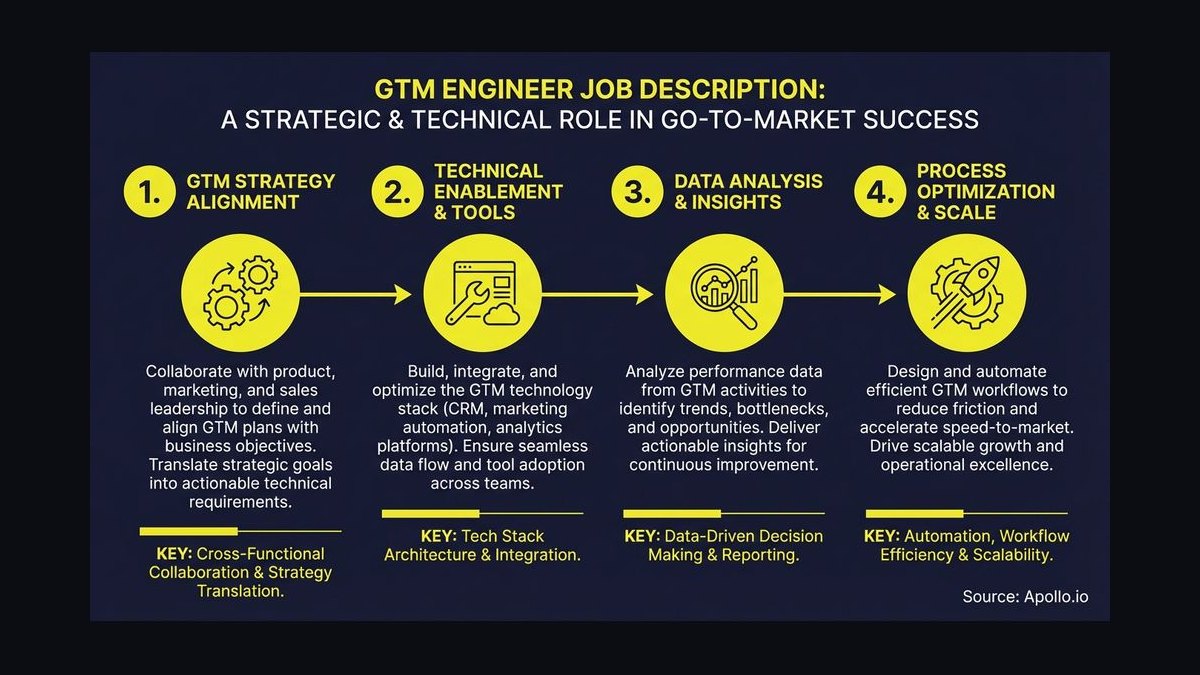
A GTM engineer is a technical go-to-market builder who programs the revenue motion — constructing automated, AI-powered systems for signal detection, data enrichment, lead scoring, routing, and personalized outreach using tools like Clay, LLM workflows, APIs, and no-code automation. The role is exploding in 2027 because AI made go-to-market programmable, cold outbound collapsed under deliverability pressure, and the efficiency mandate rewards systems over headcount. One GTM engineer can now do pipeline work that previously required a team of SDRs and ops staff.
What a GTM engineer is and why it matters
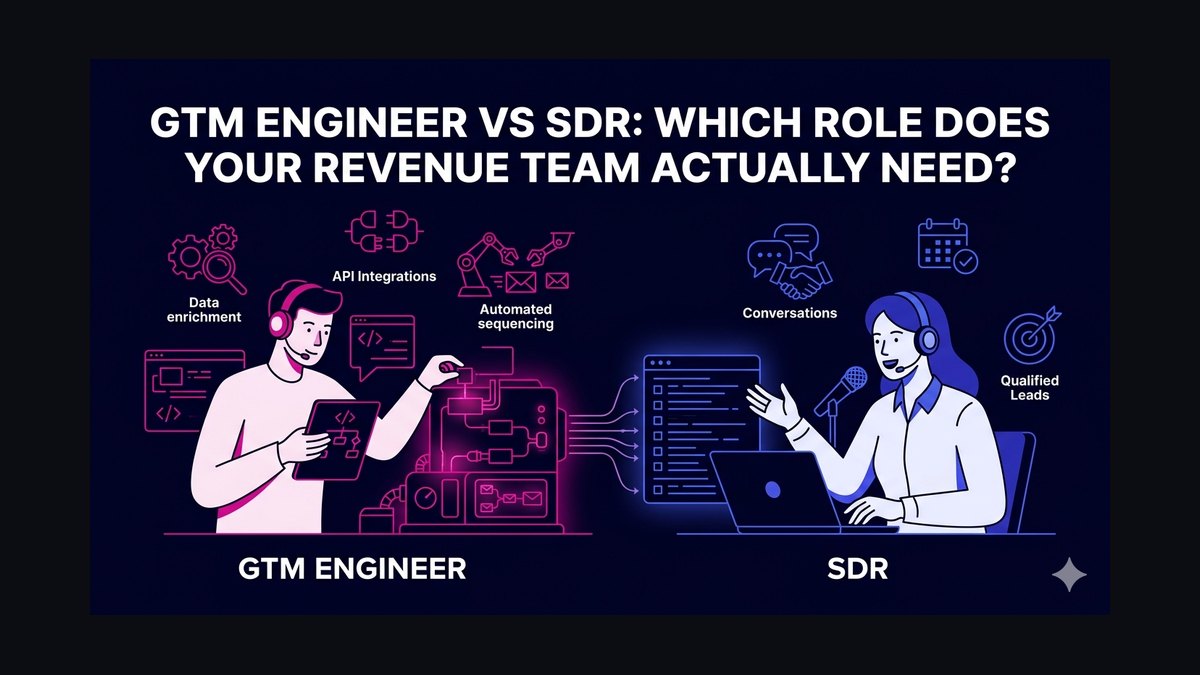
A GTM engineer is a builder, not an operator. Where a traditional SDR manually prospects and a traditional RevOps analyst manually configures tools, the GTM engineer constructs automated systems that do the work — enrichment pipelines, signal-based outbound machines, AI scoring workflows, and routing logic stitched across the stack. Their output is not calls made or tickets closed; it is working systems that generate and process pipeline continuously without proportional human labor.
The distinction matters because it changes what a revenue org can afford to do. A traditional pipeline-generation motion scales linearly: more pipeline requires more SDRs, more managers, more ops support, more tool licenses, and more coordination overhead. A GTM-engineered motion scales sub-linearly: the same builder can add a new signal source, a new ICP segment, or a new personalization layer without adding headcount. That asymmetry is the entire strategic argument for the role.
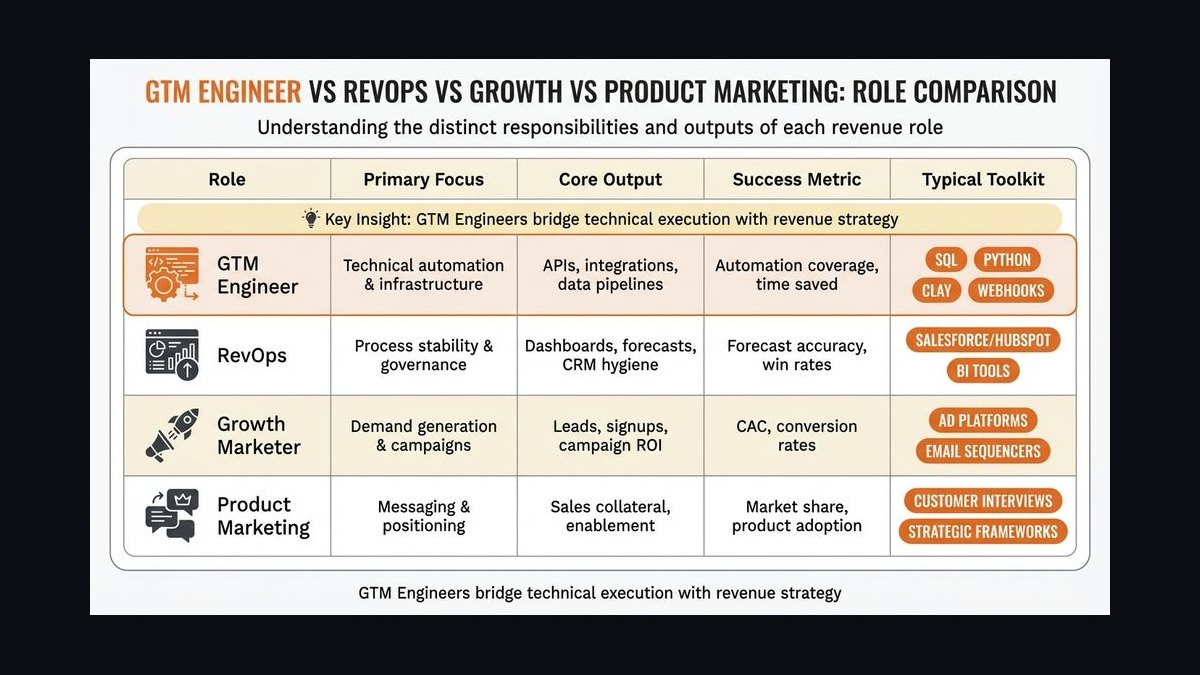
Practically, the GTM engineer sits at the intersection of three disciplines that used to be separate jobs. From RevOps they inherit the systems mindset — data governance, CRM hygiene, attribution logic, and the discipline of measuring what actually drives revenue. From growth they inherit the experimentation instinct — rapid testing of channels, messages, and segments, with a willingness to kill what does not work. From engineering they inherit the technical toolkit — API integration, data transformation, workflow orchestration, and increasingly prompt engineering and LLM orchestration.
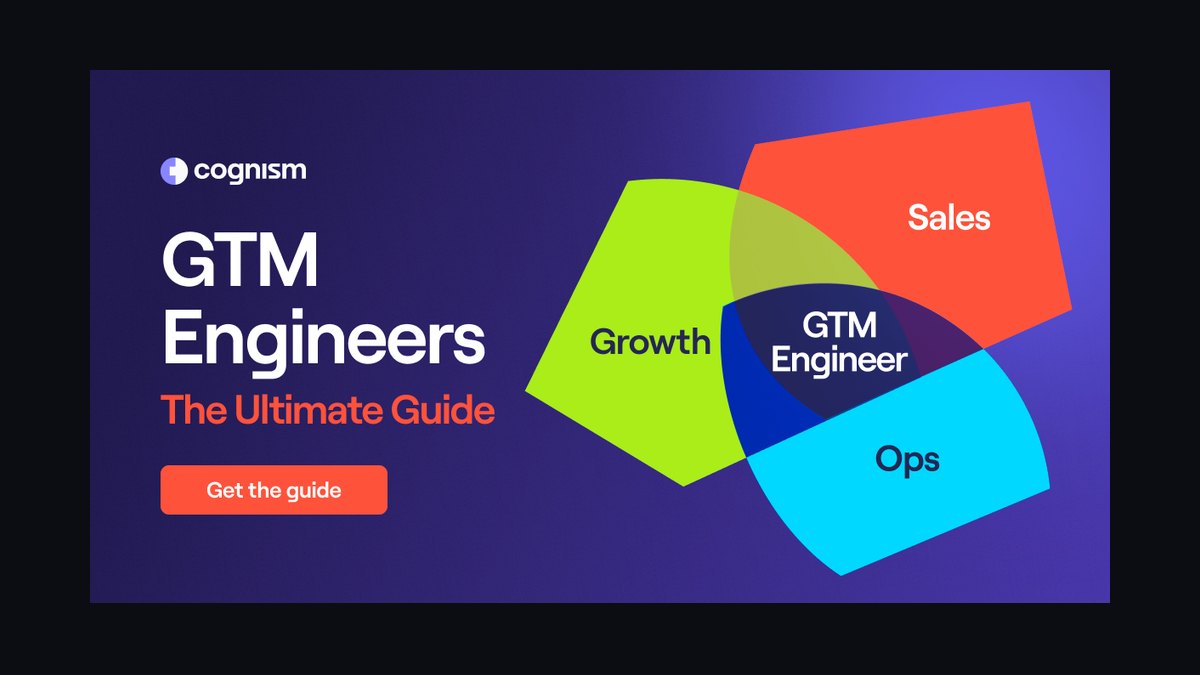
The reason this convergence became possible rather than aspirational is that the tooling caught up. Platforms like Clay combined data enrichment, AI research, and workflow automation into a single buildable surface, which meant a technically-minded operator could construct a functioning pipeline system without a dedicated data engineering team. That lowered the barrier enough that the role could proliferate beyond a handful of well-funded startups.
Why it matters to a revenue leader in 2027 comes down to leverage. If a single GTM engineer can replace the manual prospecting output of three to five SDRs while also improving targeting precision, the ROI calculation is not close. The role is not a replacement for sellers — it is a replacement for the manual, repetitive, low-judgment work that was never the best use of a seller's time in the first place. That is why the title has moved from novelty to line item on revenue org charts.
The step-by-step process a GTM engineer follows
The work of a GTM engineer is not ad hoc. It follows a repeatable build sequence, and understanding that sequence is the fastest way to understand what the role actually produces day to day.
Step 1 — Define the ICP and the signal thesis. Before touching a tool, the GTM engineer works with sales and marketing leadership to specify who the system should target and what observable events indicate buying readiness. Signals typically fall into a handful of categories: hiring activity, funding events, technology stack changes, leadership transitions, product launches, and intent data from third-party providers. The output of this step is a written thesis: "We believe companies that just raised a Series B and are hiring SDRs are in-market for our product within 90 days."
Step 2 — Build the data foundation. The engineer assembles the source list — CRM records, web traffic, third-party intent feeds, job boards, technographic databases — and normalizes it. This is where most of the invisible work happens. Deduplication, firmographic enrichment, domain matching, and field standardization determine whether everything downstream works or produces garbage.
Step 3 — Construct the enrichment and scoring pipeline. Using a platform like Clay or an equivalent, the engineer chains enrichment steps: pull company data, pull contact data, run AI research on the account, score fit against the ICP definition, and flag disqualifiers. Scoring is usually a weighted composite rather than a single metric, and it is tuned iteratively as conversion data comes back.
Step 4 — Automate the engagement layer. Once accounts are scored, the system routes high-fit accounts into personalized outreach sequences. AI drafts the first-touch copy using account-specific research; the engineer builds guardrails so the output stays on-brand and compliant. Lower-fit accounts go into nurture or are suppressed entirely.
Step 5 — Wire routing and CRM sync. Qualified accounts and contacts get routed to the right rep based on territory, segment, or account ownership. The engineer ensures bidirectional sync so that activity, engagement, and outcomes flow back into the CRM and into the scoring model.
Step 6 — Instrument, measure, and iterate. Every stage gets tracked: signal-to-account match rate, enrichment hit rate, score-to-meeting conversion, meeting-to-opportunity conversion. The engineer reviews these weekly and adjusts thresholds, adds or removes signal sources, and rewrites prompts that are underperforming.
The loop at the end is the part most teams underestimate. A GTM-engineered system is not a one-time build; it is a living pipeline that requires weekly tuning. The engineer who builds it and then walks away has built a depreciating asset. The engineer who instruments it and iterates has built a compounding one.
Costs, timelines, and typical ranges
Budgeting for GTM engineering requires separating the cost of the person from the cost of the stack, because both are real and both vary widely.
On the people side, compensation for a GTM engineer in 2027 typically lands between a senior RevOps analyst and a mid-level software engineer. In North American markets, base salaries commonly fall in the range of $120,000 to $180,000, with total compensation reaching $150,000 to $220,000 when bonus and equity are included. The variance is driven less by years of experience than by demonstrated ability to ship working systems — a builder with a public portfolio of Clay workflows and automation builds commands a premium over a generalist with a similar tenure.

On the tooling side, the stack is usually modest relative to the headcount it replaces. A core setup — an enrichment and orchestration platform, an automation layer, an AI model subscription, and intent data — commonly runs $1,500 to $6,000 per month depending on data volumes and the number of seats. Intent data providers and premium enrichment credits are the two line items that scale fastest, and they are the two most likely to surprise a team that did not model usage growth.
Timelines depend on scope. A single, well-defined use case — say, a signal-based outbound workflow for one ICP segment — can be scoped, built, and producing meetings in four to eight weeks. A full pipeline architecture spanning multiple segments, routing logic, CRM integration, and reporting typically takes three to six months to reach steady state. The first thirty days are almost always data work; teams that expect to see outreach flowing in week two are usually disappointed.
The comparison that matters is against the alternative. Replacing the pipeline output of a GTM-engineered system with human labor typically means three to five SDR hires, each carrying a fully-loaded cost of $80,000 to $120,000 annually, plus management overhead and ramp time. Even at the high end of the GTM engineer compensation range, the system-based approach is materially cheaper within the first year and dramatically cheaper thereafter, because the system does not ramp, churn, or require a new hire every time pipeline targets increase.

There are also costs that do not show up on a spreadsheet. The engineer needs access to production data, which means security review and permissions work. The automated outreach needs legal and compliance review, particularly around consent and opt-out handling. And the system needs an owner after launch — if the GTM engineer leaves, someone has to inherit the workflows, which means documentation is not optional.
Where teams get it wrong
Most GTM engineering initiatives that fail do so for predictable reasons, and almost none of them are technical.
Hiring for the title instead of the output. Teams post a job description full of tool names and hire someone who has used those tools but never shipped a system that produced revenue. The better screen is a portfolio: what did you build, what did it produce, and what did you change when it underperformed? Tool familiarity is table stakes; systems judgment is the differentiator.
Building before defining the signal thesis. A common failure mode is a technically impressive workflow pointed at the wrong accounts. The engineer automates outreach to a list that was never qualified, and the result is faster bad outreach. The signal thesis has to come first, and it has to be agreed on by sales leadership, not invented by the builder in isolation.

Ignoring deliverability until it breaks. Automated outbound at volume will destroy domain reputation if it is not carefully managed. Teams that skip domain warmup, sending limits, bounce handling, and suppression list hygiene discover the problem only after their primary domain is burned. Deliverability is a design constraint, not a post-launch fix.
Letting the system drift from the CRM. When the GTM-engineered pipeline operates as a parallel universe outside the CRM, reporting breaks, attribution becomes impossible, and leadership loses trust in the numbers. Bidirectional sync is not a nice-to-have.
Underinvesting in iteration. The most expensive mistake is treating the build as a project with an end date. Scoring thresholds decay, signal sources go stale, and message performance degrades. A system without a weekly review cadence is a system that is quietly getting worse.
Skipping governance. Automated outreach touches real prospects and carries real legal exposure. Consent, opt-out honoring, data retention, and AI disclosure requirements vary by jurisdiction. RevOps should own the governance layer around the GTM engineer's systems, not leave it to the builder to self-police.
Measuring activity instead of outcomes. Emails sent and accounts enriched are vanity metrics. The numbers that matter are meetings booked from the system, pipeline created, and conversion rate at each stage. Teams that optimize for volume rather than conversion end up with a high-output system that produces nothing.
Decision framework: when to choose what

Not every revenue org should hire a GTM engineer, and the ones that should often should not hire one first. The decision turns on volume, motion type, and existing data maturity.
The logic behind the branches is straightforward. If outbound is not a meaningful part of the motion — for example, a purely product-led or partner-led business — the immediate ROI of a dedicated GTM engineer is lower, and the same skills are better applied to product data and lifecycle automation. If outbound is central but volume is modest, a fractional builder or an agency can deliver most of the value without a full-time hire. If volume is high but the underlying data is a mess, the engineer will spend their first quarter cleaning up instead of building, which is a poor use of an expensive hire.
The internal-upskilling path is underused and often the highest-ROI option. A strong RevOps analyst who already understands the data model, the CRM, and the revenue motion can often learn the automation and AI tooling faster than an external engineer can learn the business context. The trade-off is time: upskilling takes three to six months before the person is shipping at full velocity, whereas an experienced external hire ships in weeks. Teams with runway should weigh that against the retention benefit of promoting from within.
The dedicated-hire path makes sense when outbound volume is high, data is clean, and there is no internal candidate with the right combination of technical aptitude and GTM judgment. In that scenario, the hire pays for itself quickly, and the surrounding RevOps function provides the governance and strategy that keeps the system aligned with the business.
Whichever path is chosen, the decision should be revisited annually. A fractional engagement that works at $5M ARR may not work at $20M, and an internal upskill that stalls may need to be supplemented with an external hire. The framework is a starting point, not a permanent answer.
Related questions

How does a GTM engineer differ from a RevOps analyst?
A RevOps analyst administers processes, maintains data quality, and reports on performance. A GTM engineer builds automated systems that perform the pipeline work itself — enrichment, scoring, routing, and outreach — rather than supporting the humans who do it manually. The engineer is more technical and more builder-oriented.
Do you need to know how to code to be a GTM engineer?
Not strictly, but it helps. Most day-to-day work happens in visual platforms and no-code automation tools. However, basic Python or SQL fluency dramatically expands what is possible, especially for custom API integrations, data transformation, and debugging workflows that the visual tools cannot handle cleanly.
Can a GTM engineer replace SDRs entirely?
Rarely entirely, but often substantially. A well-built system can handle prospecting, enrichment, initial personalization, and routing, which covers a large share of traditional SDR workload. Human sellers remain essential for discovery, relationship-building, and complex conversations. The realistic outcome is a smaller, more senior SDR team supported by a system.
What is the first thing a new GTM engineer should build?

A single, narrowly scoped signal-based workflow for one ICP segment. Proving the model end to end — signal to enrichment to outreach to meeting — surfaces data problems, integration gaps, and messaging issues early, before those problems are replicated across a dozen workflows. Start narrow, then generalize.
FAQ
What technical skills are essential for a GTM engineer? Core skills include data enrichment and orchestration platforms, API integration, workflow automation tools, and increasingly LLM orchestration and prompt design. Basic SQL or Python fluency is common and increasingly expected. Just as important is the judgment to know which signals and metrics actually correlate with revenue, because a technically flawless system pointed at the wrong accounts produces nothing.
How does a GTM engineer differ from a traditional RevOps role? RevOps focuses on process design, data hygiene, tool administration, and reporting. A GTM engineer programs the go-to-market motion itself, building automated workflows that replace manual tasks rather than supporting the people who perform them. The roles overlap heavily on data and CRM knowledge, but the GTM engineer spends most of their time building rather than administering.
Can a small company justify hiring a GTM engineer?

Often yes, particularly if outbound is a primary pipeline source and the team is lean. A single GTM engineer can automate prospect identification, enrichment, and initial outreach, which may replace the output of several SDR hires. For companies below a certain outbound volume, a fractional builder or agency engagement is usually the more efficient first step.
What tools does a GTM engineer commonly use? Enrichment and orchestration platforms, CRM systems like Salesforce or HubSpot, automation tools for stitching workflows, AI services for research and personalization, and API connectors for integration. Intent data providers and technographic databases round out the stack. The specific mix varies by company size and motion, but automation and AI sit at the center of nearly every setup.
Is the GTM engineer role a temporary trend or a lasting shift? It appears to be a lasting shift. The underlying drivers — AI making go-to-market work programmable, deliverability pressure killing manual spray-and-pray outbound, and efficiency mandates rewarding systems over headcount — are structural rather than cyclical. As long as those conditions hold, the role's value proposition strengthens rather than weakens.
How does a GTM engineer improve sales team performance? By automating prospect identification, enrichment, scoring, and first-touch outreach, the GTM engineer frees sellers to spend their time on high-value conversations. The system delivers warmer, signal-qualified leads with context attached, which typically improves conversion rates and reduces the time reps spend on low-probability cold outreach.
Sources
- https://www.clay.com/
- https://www.gartner.com/en/sales
- https://www.forrester.com/research/
- https://openviewpartners.com/blog/
- https://www.bvp.com/atlas
- https://www.pavilion.com/
- https://www.revopscoop.com/
- https://n8n.io/
- https://www.saastr.com/
- https://www.bridgegroupinc.com/
Related on PULSE
- What is a Solutions Architect and how does the role differ from a Sales Engineer?
- Is a Workato Sales Engineer role still good for my career in 2027?
- Is a Outreach Solutions Engineer role still good for my career in 2027?
- How do you design a RevOps control tower in Palantir Signals for GTM alerts that catches renewal ghosting in CRM before weekly commit calls for BDR-to-AE split with no data engineer?
- Is the 2027 trend of AI-coded product demos reducing or increasing the need for sales engineer intervention?
- How do you coach a sales engineer to sell, not just demo?
This page will be disappearing soon. Save it to your device for $1 — or read it free while it is here.
@Kory-White- · if Venmo asks, the last 4 of my number are 2012
This page is gone.
This one is off the shelf now. $1 keeps it on your phone for good — the whole page, pictures and diagrams included.
 revopsHow do you measure ROI on AI in sales in 2027?
 revopsHow is AI changing FP&A and revenue planning in 2027?
 revopsWhat is the Model Context Protocol (MCP) and why does it matter for RevOps in 2027?
 revopsHow do you govern AI use across a revenue team in 2027?
 revopsHow is AI reshaping RevOps team structure and headcount in 2027?
 revopsHow are voice AI agents changing sales calls in 2027?
 revopsHow is AI agent pricing shifting from per-seat to consumption and outcome-based models in 2027?
 revopsWhich RevOps tasks should you automate with AI in 2027?
 revopsHow is AI changing sales territory and quota planning in 2027?
 revopsHow are RevOps teams using AI to forecast revenue more accurately in 2027?