

Should I open a independent auto repair shop in 2027?
 Curated byKory White · Fractional CRO · Maryland
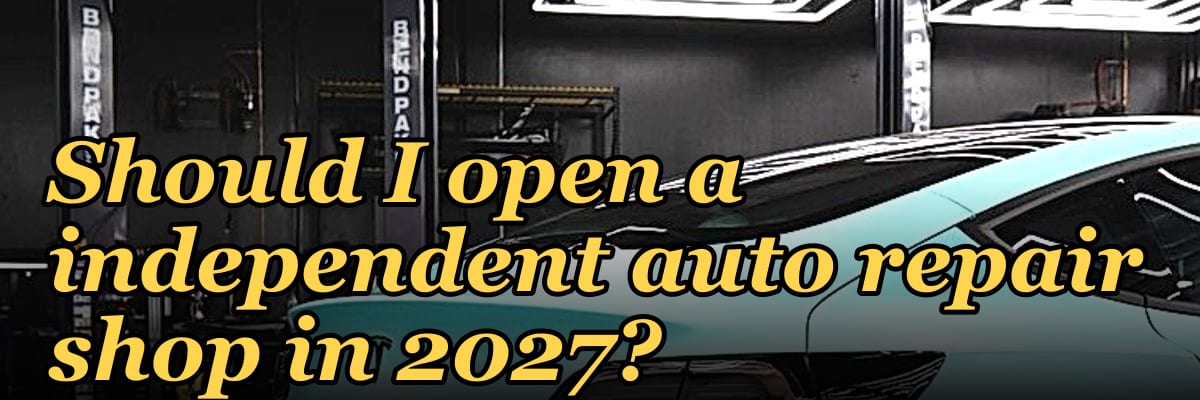
Yes — open an independent auto repair shop in 2027 if you are an ASE-certified tech with 8+ years of wrench time, $180K-$350K in liquid capital, a signed 2,400+ sq ft lease in a county with 50,000+ registered vehicles, and a written EV/ADAS upskilling plan. The U.S. auto mechanics industry hit $89.6 billion in 2026 (IBISWorld, 303,000 shops, avg $1.226M revenue) and the average vehicle on the road is now 12.6 years old (S&P Global Mobility, 2026) — a tailwind for independents. Realistic startup is $180K-$380K all-in, breakeven 14-22 months, Year-1 owner cash flow $45K-$95K, Year-3 $120K-$220K if you hit 65% labor utilization and 55% gross margin. Skip this if you are not a journeyman tech, cannot finance $180K, or sit in a market dominated by dealer service lanes plus three Christian Brothers within five miles.
The Real Numbers
Independent auto repair (NAICS 811111) is fragmented — the top 50 chains own less than 9% of revenue (IBISWorld 2026). That is what makes a well-run independent viable. Here are the real 2027 build-out numbers for a 3-bay, 2,400 sq ft shop in a Tier-2 metro:
| Line item | Low | High | Source / Notes |
|---|---|---|---|
| Lease deposit + 3 mo rent (2,400 sq ft @ $1.40-$2.20/sf NNN) | $14,000 | $26,000 | LoopNet 2026 industrial-flex comps |
| 2-post lifts (3 @ Rotary SPOA10 or BendPak XPR-10A) | $24,000 | $48,000 | Rotary Lift / BendPak 2026 list |
| Air compressor (Quincy QGS-15, 15 HP rotary screw) + plumbing | $9,000 | $16,000 | Quincy 2026 dealer pricing |
| Diagnostic scan tools (Snap-on Zeus + Autel MaxiSys Ultra) | $8,500 | $14,500 | Snap-on / Autel MSRP 2026 |
| Tire changer + balancer (Hunter TCX59 + Road Force Elite) | $18,000 | $32,000 | Hunter Engineering 2026 |
| AC machine (Robinair AC1234-6) + brake lathe + press | $11,000 | $18,000 | Robinair / Ammco list |
| Hand tools + roll cabs (Snap-on or Matco starter kit x2 techs) | $14,000 | $28,000 | Snap-on truck pricing 2026 |
| Mitchell1 ProDemand + Manager SE (annual) | $3,400 | $4,800 | Mitchell1 2026 subscription |
| Initial parts inventory + WorldPac/NAPA account | $12,000 | $22,000 | WorldPac terms 2026 |
| Build-out (paint booth optional, oil/waste systems, signage) | $22,000 | $55,000 | Contractor bids 2026 |
| Insurance (garage keepers + GL + WC, 12 mo) | $9,000 | $14,000 | Federated Insurance quotes 2026 |
| Working capital (6 mo payroll cushion @ 2 techs + advisor) | $35,000 | $80,000 | Owner-tested |
| Total all-in | $180,000 | $358,300 |
Revenue and margin reality for an independent in steady state (Year 2-3), per IBISWorld 2026, Identifix benchmarks, and the 2024 RepairPal Industry Report (3,300 shops):
- Year-1 revenue: $280K-$520K (ramp; 35-50% bay utilization)
- Year-2 revenue: $580K-$880K
- Year-3 revenue: $850K-$1.4M (small-shop band, IBISWorld)
- Effective labor rate (ELR): $145-$185/hr in 2027 (up from $128 in 2024 per Ratchet+Wrench)
- Parts gross margin: 38-46%; labor gross margin: 70-78%
- Blended gross margin: 52-58% (best-in-class)
- EBITDA margin: 8-15% (average); 18-22% (top-quartile) — Jaken Equities valuation data 2026
- Owner take-home Year 3: $120K-$220K on $900K revenue at 14-18% EBITDA
- Payback: 24-40 months on full $250K investment
Who Wins With This Business
You win if you check most of these boxes:
- ASE Master Tech (A1-A8) with 5-10 years of journeyman experience — you can diagnose without paying a more expensive tech to do it
- You already have a book of 80-200 repeat customers from a prior dealer or independent gig who will follow you
- You are willing to be the service advisor for the first 18 months — advisor labor is the #1 hidden cost killer for new shops
- Your market has 50,000+ registered vehicles in a 7-mile radius and fewer than 4 chain competitors (Christian Brothers, Midas, Meineke, Big O, Take 5)
- You have $80K+ in liquid cash on top of the $180K startup so you can survive a slow Q3 without a panic discount
- You have a written EV plan: ASE xEV Level 1 done, Level 2 scheduled, Hunter HawkEye XL or Autel IA900 ADAS calibration target by Year 2
- You will run a digital vehicle inspection (DVI) workflow from day one — AutoVitals, Mobile Manager Pro, or Tekmetric show 22-38% higher ARO (average repair order) versus paper inspections per AutoVitals 2026 case data
- You will quote at $155+ ELR and hold it — discounting under $135 makes the math impossible
Who Loses With This Business
- First-time business owners who are not techs — you will be at the mercy of every $32/hr B-tech you hire, and labor is 55%+ of cost
- Anyone counting on Year-1 owner draw above $40K — the math does not work; you eat ramen for 18 months
- Markets with > 5 chain competitors within five miles — Christian Brothers Automotive (916 U.S. locations as of 2026 FDD), Take 5 Oil Change, and Midas have brand recall and warranty rails you cannot match
- Operators who skip Mitchell1 ProDemand to "save $3,400/yr" — your techs will look up specs on YouTube and waste 18 minutes per ticket
- Shops that refuse to add EV/hybrid service — by 2027 the U.S. EV+hybrid parc will cross 28M vehicles (BloombergNEF Electric Vehicle Outlook 2026), and ICE-only shops will hit a ceiling
- Anyone signing a lease over $2.40/sf NNN in a Tier-3 market — rent above 6% of revenue is a slow death
- Owners who try to run a Goodyear or NAPA franchise instead — the franchise fees and tire-purchase requirements compress margin to 6-9% net
2027 Market Conditions
The independent auto repair market in 2027 has five live tailwinds and three real headwinds.
Tailwinds:
- Average vehicle age = 12.6 years (S&P Global Mobility 2026), an all-time high. New-car prices stayed above $48,500 average transaction price (Kelley Blue Book Q1 2026), so consumers keep repairing instead of replacing.
- Dealer-service-lane backlog: dealers are squeezing techs out via flat-rate cuts, so independents are absorbing both customers and labor — the ASE 2026 Tech Shortage Report estimates a 642,000-tech U.S. shortfall.
- Insurance-pay collision and mechanical warranty work is growing — CCC Intelligent Solutions reports 11.3% YoY claim-count growth in 2025.
- ELR has risen from $108 (2019) to $145+ (2026) per Ratchet+Wrench, faster than wage inflation, expanding labor margin.
- OEM right-to-repair settlements (Massachusetts Data Access Law, 2026) are forcing more telematic data into independent hands.
Headwinds:
- ADAS calibration gates 30%+ of repairs — windshields, bumpers, suspension. Without a Hunter, Autel, or Bosch ADAS rig ($45K-$110K), you sublet the work and lose margin.
- EV transition — by 2030 BloombergNEF projects 40% of new sales electric. Brake jobs and oil changes shrink; HV battery and software dominate.
- Parts inflation — OEM list rose 6.2% YoY in 2025 (Aftermarket Logistics Index). Your matrix has to keep up or your GP slides.
The 90-Day Decision Tree
- Days 1-15 — TAM and capital lock. Pull NHTSA registration counts for your county. Confirm 50,000+ vehicles in a 7-mile radius. Run a CoStar or LoopNet scan for 2,200-2,800 sq ft industrial-flex at under $2.20/sf NNN. Get a SBA 7(a) pre-qualification letter from Live Oak Bank or Huntington (the two biggest SBA auto-repair lenders in 2026). Confirm $180K-$250K approved.
- Days 16-30 — Entity, EIN, insurance. File LLC, get EIN, open business checking at a bank with WorldPac and NAPA ACH support (Chase, US Bank). Bind garage keepers legal liability ($500K), general liability ($1M/$2M), workers comp, and commercial auto with Federated, Universal Underwriters, or Hartford. Premium runs $9K-$14K/yr.
- Days 31-45 — Sign lease, pull permits. Negotiate 3-5 months free rent for build-out. Pull occupancy, environmental, oil-water separator, and waste-tire permits. Most markets require EPA SPCC plan for compressors and waste oil.
- Days 46-60 — Order equipment. Lifts on 6-week lead time in 2026 — order Rotary or BendPak first. Stand up Mitchell1 Manager SE or Tekmetric as your shop management system. Open WorldPac, NAPA, O'Reilly First Call, and Advance Auto Pro accounts.
- Days 61-75 — Hire and train. Hire 1 B-tech ($28-$36/hr) and 1 lube tech ($18-$22/hr). You run service advisor. Run ASE xEV Level 1 training for the whole crew before any car comes in.
- Days 76-90 — Soft open. Invite your 80-person repeat list with a 15% labor coupon, capped at $200. Launch Google Business Profile, RepairPal Certified application, and AAA Approved Auto Repair application. Target 40 paying ROs in week one, $160+ ARO by week four. Track bay utilization daily — under 55% by day 90 means a marketing pivot.
Alternative Plays
If the independent-shop math worries you, consider:
- Mobile mechanic LLC — $35K-$60K startup (van, scan tool, hand tools). Lower revenue ceiling ($180K-$300K solo) but zero rent and zero advisor cost. Wrench (acquired by Cox Automotive) and YourMechanic show the model.
- Take 5 Oil Change franchise — $1.7M-$2.4M startup per 2026 FDD, but EBITDA margins 22-28% and the model is operator-light. Brand has 800+ locations as of 2026.
- Christian Brothers Automotive franchise — $520K-$650K startup (Item 7, 2026 FDD), median gross sales $1.97M (Item 19, 2026 FDD) — the most lucrative full-service franchise in the category, but requires evangelical alignment and a six-figure liquidity test.
- Acquire an existing shop — 3.0x-4.5x SDE (seller's discretionary earnings) is the going multiple per BizBuySell 2026 and Jaken Equities. A $700K-revenue shop with $140K SDE sells for $420K-$630K and you start cash-flowing month one.
- Specialty niche (EV-only, European, fleet) — fewer competitors but a 2-3 year customer-education ramp. Tesla-only shops like Gruber Motors prove the niche has gross margins of 60%+.
FAQ
How much money do I really need to start an independent auto repair shop in 2027? You'll need $180,000 to $380,000 in liquid capital to cover equipment, lease deposits, permits, insurance, and initial inventory. This range assumes you're not taking on heavy debt for fancy builds—used lifts and basic scan tools keep costs manageable.
What kind of profit can I expect in the first year? Owner cash flow typically ranges from $45,000 to $95,000 in Year 1, assuming you're working full-time in the shop and hitting around 65% labor utilization. It's lean—most owners reinvest heavily into tools and marketing early on.
How long until the shop breaks even? Breakeven usually lands between 14 and 22 months, depending on your local market demand and how quickly you build a repeat customer base. Shops in areas with older car populations tend to reach breakeven faster.
Do I need to be a certified mechanic to open this shop? Yes, strongly recommended—most successful owners are ASE-certified techs with at least 8 years of hands-on experience. Without that background, you'll struggle to diagnose issues, manage techs, or earn customer trust.
Will electric vehicles kill the independent repair market? Not soon—EVs are growing but still a small slice of the total U.S. fleet, and the average vehicle on the road is over 12 years old. However, you should have a written plan to train on EV and ADAS systems within 2–3 years to stay relevant.
What market conditions make this a bad idea? Avoid opening if your area is saturated with dealer service lanes and three or more chain shops (like Christian Brothers) within five miles, or if your county has fewer than 50,000 registered vehicles. Also skip it if you can't finance $180,000 or aren't willing to work 60-hour weeks initially.
Bottom Line
Open the shop if you are a Master Tech with $180K-$250K liquid capital, a 50K-vehicle TAM, a portable customer list, and a written EV/ADAS roadmap. Year-3 owner take-home of $120K-$220K is realistic on $900K revenue at 15% EBITDA if you hold a $155+ effective labor rate, run DVI from day one, and refuse to discount below a $135 ELR floor. Pass on the deal if you are not a tech, are short on capital, or sit in a market already saturated by Christian Brothers, Take 5, and Midas. The independent auto repair model is less profitable than a top franchise (Christian Brothers Item 19 median: $1.97M) but 2-3x more capital-efficient — the trade is autonomy and 65% lower startup, in exchange for slower brand build and harder hiring. For an experienced tech with a customer book, the independent path is the higher IRR.
Related on PULSE
- What Service Fees Should an Auto Repair Shop Charge?
- How Do I Negotiate a Lease and Buildout for an Auto Repair Shop?
- How do you start an auto repair shop in 2027?
- Should I open a independent tire shop in 2027?
- Should I open a independent coffee shop in 2027?
- Should I open a independent laundromat in 2027?
Sources
- IBISWorld Auto Mechanics in the US Industry Report (1689), 2026
- IBISWorld Car Body Shops in the US Industry Report (1694), 2026
- S&P Global Mobility — Average Age of Light Vehicles in the U.S., 2026 release
- ASE 2026 Technician Shortage Report (National Institute for Automotive Service Excellence)
- ASE xEV Electrical Safety Certification Standards, Version 1
- Mitchell1 ProDemand 2026 subscription pricing and Manager SE estimating guide
- Jaken Equities — How to Value an Auto Repair Shop: Revenue and EBITDA Multiples, 2026
- RepairPal Industry Report 2024 (3,300+ shops)
- Christian Brothers Automotive 2026 Franchise Disclosure Document, Items 7 and 19
- Take 5 Oil Change 2026 Franchise Disclosure Document, Items 7 and 19
- BloombergNEF Electric Vehicle Outlook 2026
- Kelley Blue Book Average Transaction Price Report, Q1 2026
- Ratchet+Wrench 2026 Effective Labor Rate Survey
- CCC Intelligent Solutions Crash Course Report 2026
- Federated Insurance Garage Keepers Legal Liability Quote Guide, 2026
- Pacific ABS Auto Repair Shop Break-Even Analysis Guide 2026
This page will be disappearing soon. Save it to your device for $1 — or read it free while it is here.
@Kory-White- · if Venmo asks, the last 4 of my number are 2012
This page is gone.
This one is off the shelf now. $1 keeps it on your phone for good — the whole page, pictures and diagrams included.
 pulse-qHow Do I Get My Furniture Reps to Sell Protection Plans in 2026?
 pulse-qShould I open or buy a Club Car Wash franchise in 2027?
 pulse-qShould I open or buy a Crunch Fitness franchise in 2027?
 pulse-qShould I open or buy a Servpro franchise in 2027?
 pulse-qShould I open or buy a Lee’s Famous Recipe Chicken franchise in 2027?
 pulse-qShould I open or buy a Bojangles franchise in 2027?
 pulse-qShould I open or buy a Drybar franchise in 2027?
 pulse-qShould I open or buy a 100% Chiropractic franchise in 2027?
 pulse-qHow Many Sales Reps Do I Need to Hire for My Promotional Products Company in 2026?
 pulse-qShould I open or buy a Bio-One franchise in 2027?