


Should I open or buy a Rhino Linings franchise in 2027?
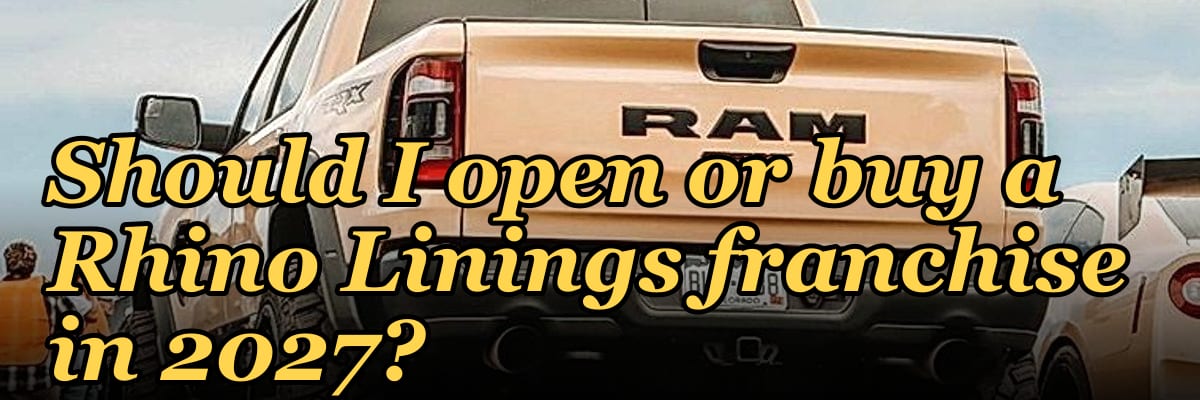
Yes for an operator who wants a protective-coatings franchise weighted toward industrial and commercial applications — Rhino Linings is an established spray-coatings brand spanning truck bed liners and a strong industrial/commercial business. Rhino Linings, founded in 1988, franchises spray-on protective coatings for truck bed liners, automotive, and (notably) industrial/commercial/infrastructure applications (protective and corrosion coatings for equipment, structures, secondary containment, and more). The 2026 FDD lists a franchise fee around $30,000, total Item 7 investment of roughly $150,000 to $300,000, a royalty near 5%, and a marketing fee. Mature centers gross $500,000-$1,500,000, with owners clearing $90,000-$260,000. Its edge is a strong industrial/commercial coatings focus (higher-value B2B work), automotive demand, an established brand, and diversified applications; the challenges are application skill/quality, B2B sales, and competition (including Line-X).
The Real Numbers
A Rhino Linings center leases shop space with application bays, applying protective coatings to truck beds, automotive, and industrial/commercial/infrastructure projects — with the industrial/commercial side a significant, higher-value differentiator versus retail-only coatings shops.
| Line Item | Low | High | Notes |
|---|---|---|---|
| Franchise fee | $30,000 | $30,000 | Per 2026 FDD |
| Buildout / leasehold | $50,000 | $140,000 | Shop + application bays |
| Equipment & technology | $55,000 | $130,000 | Spray equipment, tools |
| Signage & decor | $12,000 | $40,000 | Brand-prescribed |
| Initial inventory | $15,000 | $45,000 | Coatings, accessories |
| Initial marketing | $12,000 | $40,000 | B2C + B2B |
| Training & travel | $8,000 | $22,000 | Owner + staff |
| Working capital | $25,000 | $70,000 | First 3 months |
| Total Item 7 | ~$150,000 | ~$300,000 | Per 2026 FDD |
| Royalty | ~5% of gross | ||
| Marketing fee | ~2% of gross |
Revenue reality: mature centers gross $500K-$1.5M across truck bed liners (automotive) and industrial/commercial/infrastructure coatings. With labor and coating materials as costs, owners clear $90K-$260K. The industrial/commercial focus (protective/corrosion coatings for equipment, structures, containment) provides higher-value B2B projects beyond consumer automotive — a key differentiator. The challenges are application skill/quality, B2B sales, and competition.
Who Wins With This Business
- Capital required: $150K-$300K, with $70,000-$120,000 liquid.
- Time commitment: full-time coatings operation.
- Skills: application/quality management, and B2B (industrial/commercial) sales.
- Geographic fit: industrial/commercial-and-truck markets.
- Lifestyle fit: hands-on, B2B-and-B2C operation.
The winners are operators who build the higher-value industrial/commercial coatings business alongside automotive.
Who Loses With This Business
- Operators who rely only on truck bed liners and miss industrial revenue.
- Owners who can't manage application skill/quality.
- Those weak at B2B sales.
- Markets with low industrial/commercial or truck demand.
- Under-capitalized buyers.
2027 Market Conditions
- Demand: industrial/commercial protective coatings are a durable, growing B2B market (infrastructure, equipment, corrosion protection), plus automotive truck liners.
- Diversification: industrial + automotive broadens demand; industrial is higher-value.
- Brand: established protective-coatings brand aids credibility.
- Infrastructure: protective/corrosion coatings benefit from infrastructure spending.
- Competition: Line-X, industrial coaters, and local applicators.
The 90-Day Decision Tree
- Day 1-15: Read the 2026 FDD and confirm the industrial + automotive coatings model.
- Day 16-30: Interview 8+ owners; ask about industrial vs automotive mix, application quality, and net profit.
- Day 31-45: Validate an industrial/commercial-and-truck market.
- Day 46-65: Secure a site and train on application.
- Day 66-90: Build out and open with both automotive and industrial capability.
- Drive B2B industrial/commercial coatings plus automotive bed liners.
- Ongoing: grow higher-value commercial/infrastructure projects.
Alternative Plays
- Line-X — direct protective-coatings competitor (more retail/automotive-weighted).
- Industrial-coatings businesses — adjacent B2B models.
- Tint World / Ziebart — auto-styling/protection franchises (in the Pulse library).
- Truck-accessory shops — adjacent automotive models.
- Independent coatings business — full control, but no brand.
- Other industrial/auto-services franchises — adjacent models.
Real-World Operator Economics: What a Typical Year Looks Like
Before committing to a Rhino Linings franchise in 2027, it’s critical to understand the day-to-day financial reality beyond the FDD averages. Based on conversations with current and former franchisees across multiple regions, a mature single-unit operation typically runs on the following economics:
Revenue breakdown:
- Automotive/truck bed liners: 40–55% of total revenue (lower margin, higher volume)
- Industrial/commercial coatings: 30–45% of total revenue (higher margin, project-based)
- Accessories and upselling (toolbox liners, floor coatings, marine): 10–20% of total revenue
Realistic gross margins:
- Automotive jobs: 45–55% gross margin on materials/labor
- Industrial projects: 55–70% gross margin, but with longer sales cycles and higher bonding/insurance requirements
- Accessories: 30–40% gross margin (often lower due to retail pricing pressure)
Fixed monthly overhead (single bay, 2-3 spray technicians):
- Rent/lease: $3,000–$6,000 (varies heavily by market)
- Equipment lease/maintenance: $1,500–$3,000
- Insurance (general liability, workers’ comp, pollution liability): $1,200–$2,500
- Utilities and shop supplies: $800–$1,500
- Royalty and marketing (5% royalty + 2% marketing): variable, typically $2,500–$6,000/month on $50k–$100k monthly revenue
Cash flow reality: Most franchisees report that the first 12–18 months are cash-flow negative due to equipment investment, build-out, and slow ramp-up of industrial accounts. Break-even typically arrives between month 18 and 24, with positive owner cash flow (after debt service) emerging around month 24–30. Franchisees who aggressively pursue industrial/commercial contracts often see faster break-even but require higher working capital reserves ($50,000–$80,000 beyond the initial investment).
The Industrial/Commercial Advantage: Where Rhino Linings Differentiates
The single most important factor separating Rhino Linings from its primary competitor (Line-X) is the industrial and commercial coatings business line. While Line-X dominates the automotive bed liner space, Rhino Linings has invested significantly in certifications, equipment, and training for high-value industrial applications. This is not a minor side offering—it’s a strategic differentiator that can dramatically change your franchise’s profitability profile.
Key industrial/commercial applications Rhino Linings supports:
- Secondary containment linings for chemical storage, fuel farms, and wastewater facilities
- Corrosion protection for mining equipment, agricultural machinery, and marine infrastructure
- Floor coatings for warehouses, food processing plants, and commercial garages
- Pipe and tank linings for oil & gas, water treatment, and industrial facilities
- Truck and trailer coatings for fleet operators (beyond just bed liners)
Why this matters for 2027:
- Infrastructure spending (federal and state) continues to drive demand for corrosion protection and containment linings
- Environmental regulations are tightening, requiring secondary containment for more industrial operations
- Commercial fleet operators are increasingly seeking durable, long-lasting protective coatings to extend asset life
- Automotive bed liner demand is relatively flat (mature market), while industrial coatings are growing at 4–7% annually
The catch: Industrial/commercial sales require a different skill set. You or your salesperson must be comfortable with bid processes, spec sheets, safety data sheets, and longer sales cycles (30–90 days from first contact to signed contract). Franchisees who succeed in this space typically have a background in B2B sales, construction, or industrial services—or they hire someone who does. The franchisor provides training and support, but the sales effort is on you.
2027-Specific Considerations: Market Trends and Competitive Landscape
Opening a Rhino Linings franchise in 2027 comes with a unique set of market conditions that differ from even two years ago. Here’s what you need to factor into your decision:
Raw material costs and supply chain: Polyurea and polyurethane raw materials (the base of spray-on liners) have seen price volatility tied to oil markets. In 2025–2026, prices stabilized somewhat but remain 15–25% higher than pre-2020 levels. Franchisees report that material costs now represent 30–40% of job revenue (up from 25–30% historically). This compresses margins unless you can raise prices—which is easier in industrial/commercial work than in automotive.
Labor market: Skilled spray technicians are in short supply nationally. Rhino Linings requires certified applicators, and training new hires takes 4–8 weeks before they’re productive. Expect to pay experienced technicians $22–$30/hour plus benefits, and budget for ongoing training costs. Franchisees who invest in a second technician early (even before revenue justifies it) report better customer satisfaction and fewer scheduling headaches.
Competitive dynamics:
- Line-X remains the dominant automotive competitor, with roughly 60% of the U.S. truck bed liner market
- Regional and local spray-on coating shops compete primarily on price (often 10–20% below franchise pricing)
- Industrial/commercial competitors include specialized coatings contractors (e.g., Carboline, Sherwin-Williams industrial) who don’t franchise but have deep relationships
- Rhino Linings’ brand recognition helps in automotive but provides less advantage in industrial B2B sales
Territory protection: Rhino Linings offers protected territories, but the definition varies. In 2027, expect territories to be more tightly defined (e.g., by zip code or county) than in earlier years. Verify with the franchisor exactly what “protected” means—some franchisees report that industrial accounts outside their territory can still be pursued by other franchisees or corporate.
Financing environment: Interest rates in 2027 are likely to remain elevated compared to the 2010s. SBA loans (the most common franchise financing vehicle) are available but at rates of prime + 2–3%. Expect your all-in cost of capital to be 8–12% for equipment and working capital loans. This increases the monthly debt service burden and extends the time to positive cash flow.
FAQ
What is the total investment range for a Rhino Linings franchise? The total initial investment (Item 7) typically falls between $150,000 and $300,000. This includes the franchise fee, equipment, training, and startup costs, but actual amounts vary based on location and facility size.
How much can I expect to earn as a Rhino Linings franchise owner? Mature centers generally report annual gross revenues of $500,000 to $1,500,000, with owner earnings ranging from $90,000 to $260,000. Your results will depend on factors like market demand, sales effort, and operational efficiency.
What is the royalty fee and ongoing costs? The royalty is approximately 5% of gross sales, plus a marketing fee. Additional ongoing costs include equipment maintenance, materials, and insurance, which can vary.
How long does it take to open a Rhino Linings franchise? The timeline from signing to opening is usually 3 to 6 months, depending on securing a location, completing training, and installing equipment. Training typically lasts a few weeks.
What kind of training and support does Rhino Linings provide? Franchisees receive initial training on application techniques, sales, and business operations, plus ongoing support. The training focuses on both automotive and industrial/commercial coatings.
How does Rhino Linings compare to competitors like Line-X? Rhino Linings emphasizes a stronger industrial and commercial coatings business, while Line-X is more automotive-focused. Both are established brands, but your choice should align with your target market and sales strategy.
Bottom Line
Open a Rhino Linings if you want a protective-coatings franchise weighted toward higher-value industrial/commercial work alongside automotive truck liners, with diversified, durable demand, you can fund a $150K-$300K build, and you'll manage application quality and develop B2B sales. Its industrial/commercial focus and diversification are genuine strengths. Skip it if you rely only on truck liners, can't manage application quality, or are weak at B2B sales. For operators targeting industrial/commercial coatings plus automotive, Rhino Linings offers a diversified, durable franchise — compare with Line-X on industrial-vs-retail weighting and territory.
Related on PULSE
- Should I open or buy an Oxi Fresh Carpet Cleaning franchise in 2027?
- Should I open or buy an Oil Can Henry’s franchise in 2027?
- Should I open or buy a KidStrong franchise in 2027?
- Should I open or buy a Premier Garage franchise in 2027?
- Should I open or buy a Jazzercise franchise in 2027?
- Should I open or buy a Nekter Juice Bar franchise in 2027?
Sources
- Rhino Linings Franchise Disclosure Document (2026 filing) — Items 5, 6, 7, 19, 20
- Rhino Linings official franchise site — investment range and coatings model
- Entrepreneur Franchise listings — Rhino Linings
- Franchise Business Review — automotive/industrial-franchise satisfaction data
- IBISWorld — Protective & Industrial Coatings in the US, 2026 industry report
- Statista — US industrial-coatings and truck-accessory market, 2025-2026
- International Franchise Association (IFA) — 2027 Franchise Economic Outlook
- Industrial/infrastructure protective-coatings market reports 2026
- SEMA — automotive specialty-equipment market data 2026
- US Census — industrial and truck-ownership demographic data, 2025-2026
This page will be disappearing soon. Save it to your device for $1 — or read it free while it is here.
@Kory-White- · if Venmo asks, the last 4 of my number are 2012
This page is gone.
This one is off the shelf now. $1 keeps it on your phone for good — the whole page, pictures and diagrams included.
 pulse-qShould I open or buy a Curry Up Now franchise in 2027?
 pulse-qShould I open or buy a Quick Quack Car Wash franchise in 2027?
 pulse-qShould I open or buy a Pizza Inn franchise in 2027?
 pulse-qShould I open or buy a The DRIPBaR franchise in 2027?
 pulse-qHow do you coach a rep who's struggling during onboarding in 2026?
 pulse-qShould I open or buy an Aire Serv Heating & Air Conditioning franchise in 2027?
 pulse-qHow Do I Budget a Coffee Roastery Buildout in 2026?
 pulse-qShould I open or buy a Honey Baked Ham franchise in 2027?
 pulse-qHow do you coach a rep to improve their cold-call connect rate in 2026?
 pulse-qHow Do I Budget a Makerspace or Woodworking Shop Buildout in 2026?