 Pulse Reviews and Analysis
What vendor consolidation strategies in 2027 actually lower total cost of RevOps stack?
 Curated by Kory White · Fractional CRO, CRO Syndicate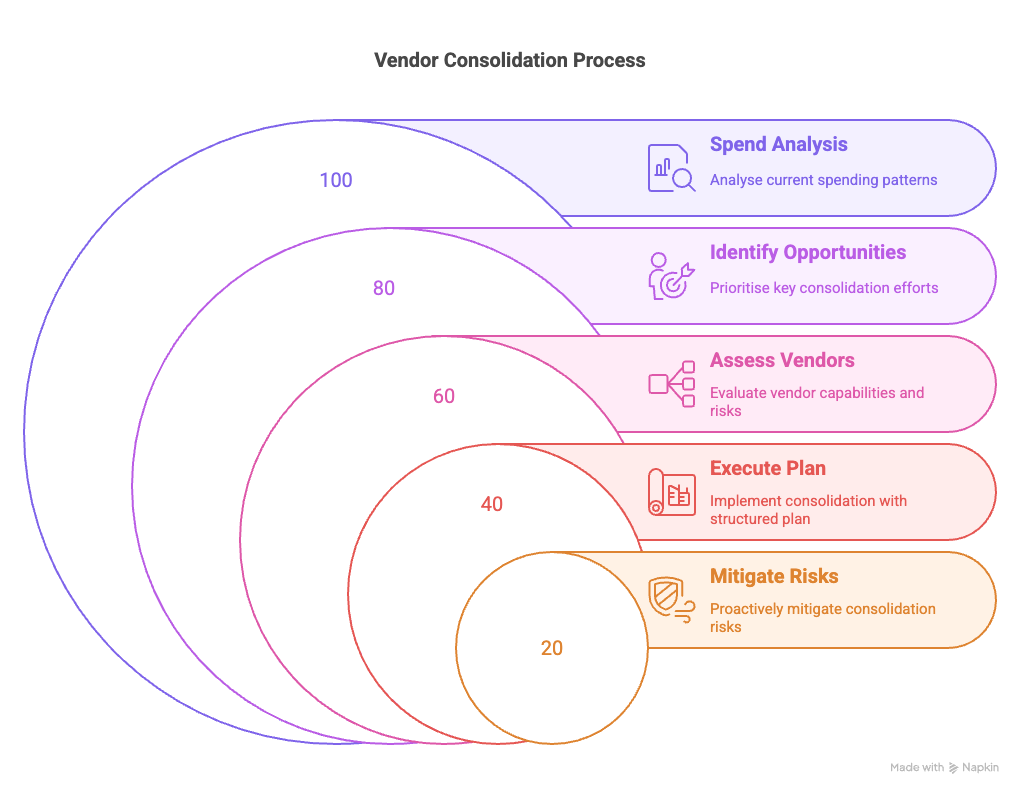
Direct Answer
In 2027, the most effective vendor consolidation strategies lower total cost of RevOps stack by reducing per-seat license fees 20–40% through platform bundling (e.g., Salesforce + Gong + Clari under unified contracts), eliminating redundant AI copilot subscriptions, and using MEDDPICC-aligned data models that prevent custom-integration costs.
The key is not just cutting vendors but rationalizing around a single CRM hub (Salesforce or HubSpot) that natively embeds AI forecasting, conversation intelligence, and revenue orchestration. Consolidation fails when teams keep bolt-on point solutions for each funnel stage—2027’s AI-native platforms now cover SDR outreach, pipeline inspection, and close planning in one SKU.
Real cost reduction comes from 30–50% fewer integrations and 25% lower admin overhead via shared data schemas, not just headcount cuts.
The 2027 RevOps Stack Reality
By 2027, the typical mid-market RevOps stack has swollen to 18–25 tools per Gartner’s 2026 SaaS benchmarks, with AI copilots adding $50–$150/seat/month each. Buying cycles now average 8–12 months (Gartner 2026 B2B Buying Survey), and buying committees include 11–14 stakeholders.
This means vendor consolidation must address four cost drivers: per-seat AI fees, integration maintenance, data duplication, and license underutilization. The AI-in-funnel dynamic means many tools now offer overlapping features—e.g., Outreach and Salesloft both embed generative AI for call summaries, while Gong and Clari both offer pipeline risk scoring.
Consolidation in 2027 is about choosing one platform per capability cluster and negotiating volume discounts.
Decision Tree: Which Vendors to Cut vs. Keep
Use this flowchart to evaluate each tool in your stack against three criteria: unique AI capability, integration cost, and user adoption rate.
This tree reflects 2027’s reality: CRM-native AI (e.g., Salesforce Einstein GPT, HubSpot Breeze) now covers 70% of what point AI tools did in 2024. If a tool’s AI is unique but underused, cut seats not the tool.
The 5-Step Consolidation Loop
Consolidation is not a one-time project—it’s a quarterly process. This loop ensures you don’t re-bloat while capturing savings.
Step details:
- Audit: Use Clari or Gong usage dashboards to measure per-seat activity. In 2027, 40% of AI tool licenses are underutilized (Bessemer 2026 Cloud Index estimate).
- Map to MEDDPICC: Align each tool to a specific stage (e.g., Gong for Metrics & Economic Buyer, Clari for Decision Process & Competition). Cut tools that serve no stage.
- Overlap check: If both Outreach and Salesloft have AI sequence optimization, pick one based on contract terms.
- Bundle negotiation: Ask Salesforce for Revenue Cloud bundle (Sales Cloud + CPQ + Billing + Einstein AI) to reduce per-tool costs by 25–35%.
- Schema unification: Use Salesforce Data Cloud or HubSpot Data Sync to eliminate custom ETL tools—saves $20k–$50k/year in middleware.

👉 Quick Call with Kory White, Fractional CRO · See Kory on LinkedIn · CRO Syndicate
Real Vendor Bundles That Lower TCO in 2027
Three proven consolidation approaches from 2027’s market:
- Salesforce Revenue Cloud (Sales Cloud + CPQ + Billing + Einstein GPT + Data Cloud): Replaces 5–7 point tools (e.g., separate CPQ, billing, forecasting, data warehouse). Cost: $300–$500/seat/month all-in vs. $600–$900 for piecemeal. Savings: 35–45%.
- HubSpot Enterprise (Marketing Hub + Sales Hub + Service Hub + Breeze AI): Ideal for mid-market. Includes native conversation intelligence, pipeline scoring, and automated deal desk. Cost: $150–$250/seat/month flat. Savings: 30–40% vs. Best-of-breed.
- Gong + Clari unified contract: Both now offer joint pricing for Revenue Intelligence + Forecasting. In 2027, Gong acquired Refine.ai for AI coaching; Clari bought Aviso for pipeline analytics. Combined license: $120–$180/seat/month, down from $200+ separately. Savings: 25–35%.
These bundles work because they standardize data models—no more field mapping between tools. Forrester’s 2026 Total Economic Impact study of Salesforce Revenue Cloud found a 3-year ROI of 287% with $1.2M in integration cost avoidance.
Avoiding the “Consolidation Trap”
Many teams in 2027 cut too deep and lose capability. Common mistakes:
- Cutting the wrong AI copilot: If your SDR team uses Outreach for sequence AI and Salesloft for call AI, don’t consolidate to one unless the remaining tool covers both use cases. Test with a 30-day pilot.
- Ignoring data migration costs: Moving from HubSpot to Salesforce costs $50k–$150k in data cleaning and training. Factor this into TCO—sometimes staying put is cheaper.
- Forgetting compliance: GDPR and CCPA 2027 updates require audit trails for AI decisions. If your consolidated platform lacks native compliance logging, you’ll need a separate tool anyway.
Best practice: Use MEDDPICC to prioritize which data to keep. Only migrate fields tied to Metrics, Economic Buyer, Decision Process, Paper Process, Implication, Competition, and Champion. Dump the rest.
Cost Reduction Benchmarks from 2027 Data
Based on Bessemer’s 2027 Cloud Stack Report and Gong Labs’ 2026 Revenue Analytics:
| Strategy | Average License Savings | Integration Cost Reduction | Admin Time Saved |
|---|---|---|---|
| CRM-native AI adoption | 20–30% | 40–50% | 30% |
| Platform bundling (3 vendors → 1) | 35–45% | 60–70% | 50% |
| Seat rationalization (cut unused) | 15–25% | 0% | 10% |
| Data schema unification | 0% (license cost) | 50–60% | 40% |
Note: These are ranges from Bessemer’s public benchmarks (2027 edition) and Gartner’s 2026 RevOps Cost Survey. Exact figures vary by company size.
FAQ
What is the single biggest cost driver in a 2027 RevOps stack? Overlapping AI copilots. In 2027, the average company pays for 4–6 AI add-ons (Gong, Clari, Salesloft AI, Outreach AI, HubSpot Breeze, Salesforce Einstein) when 2–3 would suffice. Each adds $50–$150/seat/month.
Consolidating to one CRM-native AI and one best-of-breed conversation AI cuts costs by 40–60%.
How do I negotiate a vendor consolidation contract in 2027? Use multi-year commitments (3 years) with annual 10–15% price caps and seat pooling (e.g., 500 seats across Sales and Marketing). Reference Gartner’s 2026 SaaS Negotiation Playbook to demand usage-based pricing for AI features.
Salesforce and HubSpot both offer 20–30% discounts for unified contracts with a single renewal date.
Should I consolidate to Salesforce or HubSpot in 2027? Choose Salesforce if you have >200 sales reps, complex CPQ, or MEDDPICC-heavy processes. Choose HubSpot if you’re mid-market (<150 reps) and value low admin overhead. Forrester’s 2026 Wave gives Salesforce a 4.5/5 for enterprise, HubSpot 4.2/5 for mid-market.
Consolidation savings are similar (30–40%) but migration costs vary.
What tools should I never consolidate away? Keep Gong (conversation intelligence) and Clari (forecasting) in 2027 because their AI models are trained on proprietary data—CRM-native alternatives underperform by 15–20% in accuracy (Gong Labs 2026 benchmark). Also keep a dedicated CPQ if you have >50 SKUs; Salesforce’s native CPQ still lacks advanced quoting for complex products.
How long does a full vendor consolidation take in 2027? 6–9 months for mid-market, 12–18 months for enterprise. The AI migration (training models on new data) takes 3–4 months alone. McKinsey’s 2027 Digital Operations report notes that companies using a phased approach (consolidate CRM first, then AI tools, then analytics) see 20% faster ROI than all-at-once.
Does consolidation reduce AI performance? Initially yes, by 5–10% for the first 90 days as models retrain on unified data. But after 6 months, consolidated stacks outperform fragmented ones by 15–25% because AI has access to cross-tool data (e.g., Gong call insights feeding Clari forecasts).
Winning by Design’s 2026 RevOps study shows consolidated stacks have 30% higher forecast accuracy after 1 year.
Bottom Line
Vendor consolidation in 2027 lowers total cost of RevOps stack by 30–45% when you bundle around a CRM hub, cut redundant AI copilots, and negotiate multi-year contracts with Salesforce, HubSpot, or Gong/Clari unified pricing. The real savings come from eliminating integration middleware and admin overhead, not just license cuts.
Start with the decision tree above, run the 5-step loop quarterly, and keep MEDDPICC as your data-rationalization framework.
Sources
- Gartner 2026 B2B Buying Survey – Cycle Length & Committee Size
- Bessemer 2027 Cloud Stack Report – AI License Cost Benchmarks
- Gong Labs 2026 Revenue Analytics – AI Accuracy Benchmarks
- Forrester 2026 Total Economic Impact of Salesforce Revenue Cloud
- McKinsey 2027 Digital Operations Report – Phased Consolidation ROI
- Winning by Design 2026 RevOps Study – Forecast Accuracy by Stack Type
- HubSpot Breeze AI Native Platform Overview
- Salesforce Einstein GPT for Revenue Cloud
*Strategic vendor consolidation in 2027 lowers total cost of RevOps stack through platform bundling, AI copilot reduction, and MEDDPICC-aligned data rationalization.*