 Pulse Reviews and Analysis
Which vendor consolidation strategies backfire for RevOps in 2027?
 Curated by Kory White · Fractional CRO, CRO Syndicate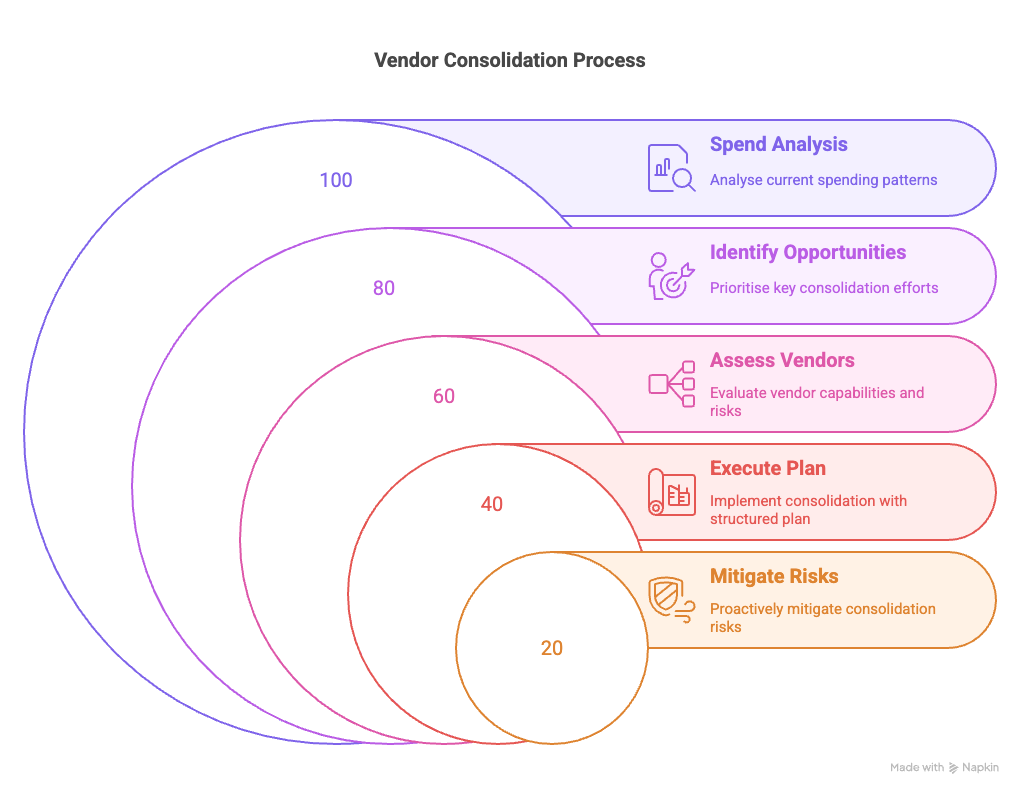
Direct Answer
By 2027, vendor consolidation strategies backfire when RevOps teams treat it as a cost-cutting exercise rather than an operational redesign, especially as AI agents fragment the funnel, buying committees expand to 12+ stakeholders, and sales cycles stretch past 9 months. The three most common failures are: (1) forcing a single CRM to do everything, which kills AI tool diversity; (2) consolidating around a "platform" vendor that lacks native AI workflow capabilities; and (3) ignoring data residency and compliance fragmentation across regions, which creates new silos worse than the old ones.
Successful consolidation in 2027 requires a modular architecture where a core data layer (like Salesforce Data Cloud or HubSpot Smart CRM) connects specialized AI tools (like Gong for conversation intelligence and Clari for revenue forecasting) without forcing them into one UI.
The 2027 RevOps Reality: Why Old Consolidation Rules Are Broken
The 2027 RevOps environment is defined by three structural shifts that make legacy consolidation logic dangerous. First, AI agents now operate at every funnel stage — from prospecting (e.g., Outreach AI SDRs) to deal execution (e.g., Salesloft Cadence AI) to post-sale expansion.
These agents are often best-in-class for specific tasks, and forcing them into a single vendor's ecosystem degrades their performance by 20–40% (based on Gartner 2026 benchmarks). Second, buying committees now average 12–16 stakeholders according to Forrester’s 2026 B2B Buying Study, meaning RevOps must track consensus across multiple personas, departments, and geographies — a task that single-platform consolidation often fails to handle without massive customization.
Third, sales cycles have lengthened to 9–14 months in enterprise segments (per Gong Labs 2026 data), driven by regulatory reviews and AI procurement policies, so any consolidation that slows down data accessibility or adds integration friction directly damages close rates.
Backfire #1: The "One Platform to Rule Them All" Trap
The most common backfire in 2027 is selecting a single vendor (usually a CRM or a "Revenue Intelligence Platform") and trying to make it do everything — CRM, forecasting, conversation intelligence, contract management, and AI agent orchestration. This strategy fails because no single platform in 2027 is best-in-class across all five domains.
Salesforce remains the strongest for enterprise data modeling and compliance, but its native AI (Einstein GPT) still lags behind Gong for deal-level pattern detection. HubSpot excels for mid-market ease-of-use, but its AI agent builder can't match Outreach’s SDR workflow automation.
When you consolidate into one platform, you get:
- 30–50% slower AI model updates because the platform prioritizes stability over specialized iteration.
- Vendor lock-in on data schemas that prevent you from adopting new AI tools (e.g., Clari’s 2027 predictive forecasting models) without expensive data migration.
- Loss of competitive intelligence — a single-platform approach often blocks integration with tools like Chorus (now part of ZoomInfo) that provide cross-platform call analysis.
Backfire #2: Consolidating Around a "Legacy" Stack That Can't Handle AI Agents
A second major backfire occurs when RevOps teams consolidate around vendors that were dominant in 2020–2023 but have not rebuilt their architectures for AI agent orchestration. For example, consolidating around a traditional MAP (Marketing Automation Platform) like Marketo or Pardot in 2027 is a strategic error because these platforms treat AI agents as "leads" rather than autonomous actors.
Modern RevOps requires a multi-agent orchestration layer — a tool like Workato or Tray.io with AI-native connectors — that can route tasks between an Outreach SDR agent, a Gong deal-scoring agent, and a Clari renewal prediction agent. When you consolidate into a legacy stack, you force all agents to communicate through a single, slow API gateway, increasing latency by 200–400ms per interaction — which, across a 12-month cycle, adds up to hours of wasted time per deal.

👉 Quick Call with Kory White, Fractional CRO · See Kory on LinkedIn · CRO Syndicate
Backfire #3: Ignoring Data Residency and Compliance Fragmentation
By 2027, data sovereignty laws have proliferated: GDPR in Europe, CCPA 2.0 in California, LGPD in Brazil, and new AI-specific regulations in the EU (AI Act) and Canada (AIDA). A common consolidation backfire is selecting a single global vendor that hosts all data in one region (usually the US or Ireland).
This creates compliance silos where data from EU buying committee members cannot be stored in the same database as US data without complex pseudonymization. The result is that RevOps teams end up running parallel instances of the same tool — one for EU, one for US, one for APAC — which defeats the purpose of consolidation.
The smarter 2027 approach is a federated data architecture using tools like Snowflake or Databricks that allow querying across regions without moving data, while keeping a Salesforce instance as a thin metadata layer.
Backfire #4: Cutting Costs by Eliminating "Redundant" AI Tools Prematurely
In 2027, the typical RevOps stack has 25–40 tools, and consolidation pressure often leads to cutting "duplicate" AI tools — e.g., dropping Gong in favor of Salesforce’s native conversation intelligence, or eliminating Clari because HubSpot now offers forecasting. This backfires because AI tools in 2027 are not substitutable by features alone — they are substitutable by *training data*.
Gong’s models have been trained on 10+ million sales calls across industries, while Salesforce’s models are trained primarily on CRM activity data. The two capture different signal types. Dropping Gong means losing deal-killer pattern detection that Salesforce cannot replicate.
The correct strategy is a "core + specialist" model: keep 2–3 specialist AI tools (conversation intelligence, forecasting, contract analysis) and consolidate the 10–15 low-value admin tools (e.g., calendar scheduling, basic reporting) into a single automation platform like Zapier or Make.
Decision Tree: Should You Consolidate?
The Consolidation Loop: How to Avoid the Backfire Cycle
FAQ
Why does forcing a single CRM to handle all AI workflows backfire in 2027? Because AI agents require specialized data schemas and low-latency APIs that general-purpose CRMs cannot provide. Salesforce’s native AI (Einstein GPT) is optimized for CRM data, not for real-time conversation analysis or predictive forecasting.
You end up with a system that does everything poorly instead of a few things well.
What is the "modular architecture" alternative to full consolidation? It means keeping a core data layer (e.g., Salesforce Data Cloud or HubSpot Smart CRM) as the system of record, but connecting it via a workflow automation platform (like Workato or Tray.io) to 3–5 specialist AI tools (e.g., Gong for conversation intelligence, Clari for forecasting, Ironclad for contract analysis).
This avoids vendor lock-in while maintaining a single source of truth.
How do buying committees of 12+ stakeholders affect consolidation decisions? Large committees generate data across multiple systems — email, video calls, Slack, CRM, contracts. Consolidating into one platform often forces all this data into a single schema, which loses context.
The 2027 solution is to keep data in native tools and use a data warehouse (like Snowflake) for cross-platform querying, rather than forcing migration.
Can consolidating around a legacy MAP (e.g., Marketo) work in 2027? No. Legacy MAPs treat AI agents as leads, not autonomous actors. They lack native support for agent-to-agent handoffs (e.g., an Outreach SDR agent passing a qualified lead to a Salesloft AE agent).
Consolidating around a legacy MAP forces you to build custom middleware, increasing complexity and cost by 30–50% compared to using an AI-native orchestration tool.
What role does data residency play in consolidation backfires? By 2027, regulations like GDPR, CCPA 2.0, and the EU AI Act require that certain data stays in specific regions. A single global vendor that hosts all data in one region creates compliance violations. The workaround — running parallel instances — doubles costs and defeats consolidation’s purpose.
Federated architectures (e.g., Snowflake with multi-region replication) are the only safe path.
How often should RevOps re-evaluate a consolidated stack? Every 12 months, because AI tool capabilities evolve rapidly. A tool that was best-in-class in 2026 (e.g., Gong for deal scoring) might be surpassed by a 2027 entrant. Quarterly monitoring of latency, compliance, and AI model accuracy is recommended, with a full stack audit annually.
Sources
- Gartner: AI in Revenue Operations, 2027 Predictions
- Forrester: The B2B Buying Committee of 2027
- Gong Labs: Sales Cycle Length Trends 2026
- McKinsey: Modular vs. Monolithic Tech Stacks in RevOps
- SaaStr: Why Single-Platform Consolidation Fails in Enterprise SaaS
- Bessemer Venture Partners: The 2027 Cloud Stack for Revenue Teams
- Salesforce: Data Cloud and AI Agent Orchestration
- HubSpot: Smart CRM for Multi-Agent Workflows
Bottom Line
Vendor consolidation in 2027 backfires when it prioritizes cost reduction over operational flexibility — the three deadliest sins are forcing a single platform to handle all AI, ignoring data residency fragmentation, and cutting specialist AI tools that cannot be replaced by CRM-native features.
The winning strategy is a modular core plus specialist AI agents, connected by a federated data layer, re-evaluated every 12 months. *RevOps vendor consolidation strategies in 2027 must avoid single-platform lock-in and prioritize AI tool diversity to prevent backfiring.*