
How should deal-desk approval authority be structured to prevent pricing hero-culture?
 Curated byKory White · Fractional CRO · Maryland
 PULSEKNOWLEDGE LIBRARY
Quality
Certified

Deal-desk approval authority should be structured with clear, tiered thresholds based on deal size, margin impact, and risk, requiring at least two independent approvers for any exception. This prevents any single person from overriding standard pricing, which curbs hero-culture by making price deviations a team-based, auditable process. Authorities should be set by role with hard caps that cannot be escalated unilaterally.
The Hero-Culture Problem and How Authority Structure Solves It
Pricing hero-culture emerges when one operator or executive holds final say on every pricing exception. Without a structured authority matrix, deal-desk becomes a political bottleneck where reps learn to appeal to the one person who says yes most often. Pricing deviations turn into favor-trades rather than governance decisions, and the designated hero becomes burned out from constant approval requests. Finance loses the ability to predict margin because outcomes depend on who asks and what mood they are in. At $50M ARR and beyond, having one person responsible for every yes-or-no decision becomes operationally impossible.
A structured authority matrix solves this by distributing decision-making across multiple tiers, each with defined thresholds and independent approvers. No single person can override standard pricing because every exception requires team-based review. The matrix creates predictability for sales reps, accountability for approvers, and auditability for finance. When authority is tied to objective criteria like ACV, discount percentage, and margin impact rather than personal relationships, the hero-culture loses its oxygen.
Building the Authority Matrix by Deal Size and Risk
The foundation of any deal-desk authority structure is a tiered matrix that maps approval levels to specific deal conditions. For SaaS companies between $10M and $100M ARR, a four-tier system is standard. Tier 1 covers standard asks where the deal-desk operator can approve independently without escalation. Tier 2 handles larger discounts and requires manager review. Tier 3 involves major deviations that need VP Sales and Finance approval together. Tier 4 is reserved for strategic, high-risk decisions requiring CEO or board visibility.
The thresholds should be based on ACV, discount depth, and margin impact rather than rep tenure or who asks nicely. A typical matrix sets Tier 1 for deals with ACV under $50k or discounts up to 10%. Tier 2 covers ACV between $50k and $250k with discounts of 10-20%. Tier 3 handles ACV over $250k or discounts of 20-30%. Tier 4 is triggered by discounts over 30% or negative margin deals. This structure ensures that approximately 70% of deals resolve at Tier 1, 20% at Tier 2, and the remaining 10% at higher tiers.
Tier 1 Authority: Deal-Desk Operator
The deal-desk operator should be empowered to approve approximately 70% of all deals independently without escalation. This tier covers standard contract terms including net 30 payment, 12-month auto-renew clauses, and discounts up to 10%. Operators can approve payment terms like net 30, net 45, and quarterly installments. They handle MSA modifications involving standard riders such as HIPAA compliance, SOC 2 attestation, and data residency requirements. Scope clarifications like add-on seats and extra user licenses fall within their authority.
Operators must have hard boundaries they cannot cross. They cannot approve discounts exceeding 10%, which must escalate to Tier 2. Multi-year commitments with step-down pricing require manager review because the margin implications compound over time. Negative-margin deals auto-escalate to finance regardless of deal size. These boundaries prevent the operator from becoming a hero who quietly approves increasingly aggressive discounts.
The key rule for Tier 1 is that operator approval is binding and final. No rep can escalate a Tier 1-approved deal to a manager unless new material facts emerge, such as a competitor lowering their price or the customer reducing their budget. If a rep tries to shop approvals, the manager must refuse and direct them to resubmit with updated information. This stops the practice of seeking a more favorable approver.
Tier 2 Authority: Deal-Desk Manager
The manager tier handles approximately 20% of deals that require additional scrutiny. This includes discounts between 10% and 20% that need deal justification covering logo value, reference customer potential, or expansion opportunity. Custom payment terms such as 50/50 upfront splits, installment plans, and usage-based pricing floors require manager approval. Contract deviations involving security requirements, custom SLAs, or specific data handling provisions fall here.
Expansion deals where the new contract value is less than the base ARR require special attention. For example, a customer expanding from $30k to $25k due to consolidation might be acceptable, but the manager must document the rationale. Managers cannot approve discounts over 20%, negative-margin deals, or deals with less than 50% expected renewal rate. These boundaries prevent the manager from becoming a bottleneck or a hero in their own right.
To prevent hero-culture at this level, approval authority should rotate or be shared. If one manager consistently handles Tier 2 approvals, they risk becoming the new hero. Rotating responsibility weekly or monthly forces consistency and prevents any single person from being the go-to approver. A backup manager should be designated for each rotation period so that absences do not create bottlenecks.
Tier 3 Authority: VP Sales and Finance
The executive pair tier handles approximately 8% of deals involving major deviations. Discounts between 20% and 30% require a written deal summary covering competitive pressure, land account size, and multi-year upsell plan. Deals where margin falls to 20-35% when the standard is 40% or higher need executive review. Custom SLAs offering 99.9% uptime guarantees or sub-four-hour response times require VP approval. Multi-year deals with aggressive step-down pricing, such as 25% discount in year one followed by 15% and 0% in subsequent years, need careful margin analysis.
The critical feature of this tier is that two executives must approve together. No single VP can approve alone. This dual-approval requirement is the strongest defense against hero-culture because it forces collaboration and shared accountability. The VP Sales brings customer and competitive context, while Finance brings margin and risk analysis. Their combined judgment prevents any one executive from becoming the hero who single-handedly approves aggressive deals.
VP Sales and Finance cannot approve negative-margin deals or discounts exceeding 30%. Those require CEO visibility. This hard boundary ensures that the most extreme pricing decisions are reserved for the highest level of the organization, where strategic considerations like board references or investor relationships can be weighed against financial impact.
Tier 4 Authority: CEO and Board
Fewer than 2% of deals should reach Tier 4, which is reserved for strategic, high-risk approvals. Discounts exceeding 30% typically require CEO sign-off, often because the deal serves a strategic purpose like landing a board reference customer or satisfying an investor relationship. Negative-margin deals are rare and require board visibility because they directly impact company financials. Deals that violate core terms, such as custom SLAs requiring 99.95% uptime, unlimited support, or zero margin, need CEO review.
Category A customers, defined as strategic accounts that the CEO personally wants to win, also fall here. These deals often involve competing against a major competitor where pricing is a weapon rather than a margin decision. The CEO must document the strategic rationale and ensure the board is informed of any material financial impact.
The CEO tier exists to handle genuine exceptions, not to serve as an appeal mechanism for deals rejected at lower tiers. If a deal is rejected at Tier 3, it cannot be escalated to the CEO without new material facts. This rule prevents reps from bypassing the matrix by going straight to the top.
Key Rules to Prevent Hero-Culture
Five structural rules ensure the authority matrix works as designed. First, approval is a binding decision, not a recommendation. Once a tier approves or denies, the decision stands unless new material facts emerge. Reps cannot shop for a more favorable approver. Second, every approval must have a written record in the CRM including the approval level, approver name, date, and justification if the discount exceeds 5%. This creates an audit trail that finance can review and prevents reps from claiming verbal approvals.
Third, approval authority must rotate or be shared, not hoarded. If one operator or manager becomes the hero, rotate Tier 2 approvals weekly or monthly. This forces consistency and prevents any single person from being the bottleneck. Fourth, escalation must have a time limit. Tier 1 approvals should complete within one business day, Tier 2 within two business days, and Tier 3 within one business day. If not approved by day three, the deal is auto-declined to prevent infinite waiting.
Fifth, approval criteria must be transparent, not secret. The sales team should see the approval matrix in Slack, Salesforce, or the employee handbook. Reps should know exactly what conditions trigger each tier and what documentation they need. No surprises and no off-platform Slack approvals. Transparency removes the mystery that enables hero-culture to thrive.
Real-World Deal Examples
Consider a deal for Acme Corp with $45k ACV, a 12% discount, and a two-year term. The ACV of $45k and discount of 12% place it at Tier 2, requiring manager approval. The rep submits via CRM with a note explaining that the customer is comparing to a competitor and the 12% discount will close the deal. The account has $200k in multi-year expansion potential. The manager reviews within two business days and approves because the margin remains at 38% after discount and the expansion plan is justified. The deal closes with a CRM record showing Tier 2 approval, manager name, date, and justification.
Now consider a Tech Startup deal with $80k ACV, a 25% discount, and a three-year term with step-down pricing. The ACV of $80k and discount of 25% place it at Tier 3, requiring VP Sales and Finance approval. The rep submits documentation showing the customer is an AI startup that will serve as a strategic reference. The customer is willing to commit to three years. The step-down pricing has been modeled with margins of 28% in year one, 36% in year two, and 42% in year three. VP Sales and Finance approve together, citing the reference value and three-year lock as justification for the aggressive year-one discount. The step-down pricing recovers margin by year three.
Common Pitfalls in Authority Structure Design
Even with a clear matrix, deal-desk authority can unintentionally reinforce hero-culture if the structure has loopholes. The first common mistake is allowing escalation by persistence. If a rep can re-submit the same deal to a different approver or keep escalating until they get a yes, you have effectively created a hero-funnel. Authority must be sticky: once a deal is rejected at Tier 2, it cannot be re-submitted at Tier 3 without new material facts like a competitor term sheet. Without this rule, the persistent rep bypasses governance and the hero becomes whoever caves last.
The second mistake is missing deal-type distinctions. A flat ACV-only matrix ignores risk. A $100k renewal with 90% gross margin is safer than a $100k new logo with 40% margin. Without separate authority for margin impact, operators approve high-risk deals they should not, then feel pressured to save them later. Best practice is to add a second axis for margin floor, such as requiring Finance VP approval for any deal below 60% gross margin regardless of ACV.
The third mistake is having no audit trail for soft approvals. Verbal approvals, Slack messages, or just-this-once exceptions that bypass the system are the hero-cultures oxygen. Authority structure must mandate that every approval, even urgent ones, is logged in the CRM or CPQ within 24 hours with the approvers name, deal ID, and rationale. Without this, the hero operates invisibly and the matrix becomes a suggestion.
Balancing Speed vs. Governance Without Creating Bottlenecks
A common fear when tightening authority is that deal-desk will slow down sales velocity. The solution is not to loosen authority but to design for rapid, low-friction governance. Pre-approved playbooks for common patterns grant automatic approval up to a higher threshold for deals that fit predefined profiles like competitive displacement, multi-year commitment, or upsell to a reference account. This removes the bottleneck for 60-70% of standard exceptions while keeping the matrix intact for true outliers.
Time-boxed escalation paths prevent busy executives from becoming de facto heroes by simply ignoring requests until they become urgent. Set mandatory SLAs for each tier, such as four hours for response and 24 hours for decision at Tier 3. If the approver misses the window, the deal auto-escalates to the next tier. This prevents one person from slowing down the entire process.
Monthly authority audits review the approval log for patterns. Is one person approving 80% of Tier 3 deals? Are certain reps constantly hitting the same exception? If so, adjust the matrix or retrain the team. The goal is to keep authority as a system, not a person, so speed comes from predictability rather than from a single heros availability.
Related questions
How do you implement deal-desk approval tiers in Salesforce?
Configure approval processes in Salesforce using the built-in approval framework. Assign each tier to a specific approval queue with defined entry criteria based on ACV, discount percentage, and margin fields. Use process builder or flow to route deals automatically.
What is the ideal deal-desk team size for a $50M ARR company?
A team of three to five people typically works: one deal-desk operator handling Tier 1, one manager for Tier 2, and VP Sales and Finance for Tier 3. Add a dedicated analyst if deal volume exceeds 200 per month.
How do you handle urgent deals that need same-day approval?
Create an expedited path with shorter SLAs and a designated backup approver at each tier. Urgent deals must still follow the matrix; no verbal approvals bypass the system. Log the approval in CRM within one hour of the decision.
What metrics track deal-desk authority effectiveness?
Track approval cycle time per tier, percentage of deals approved at each level, discount depth variance by tier, and margin leakage over time. Also monitor the number of deals that attempt to shop approvals across tiers.
How do you train sales reps on the authority matrix?
Publish the matrix in the sales handbook and CRM with clear examples. Run quarterly training sessions where reps practice submitting deals at different tiers. Include the matrix in new hire onboarding and test comprehension with a short quiz.
FAQ
What is pricing hero-culture, and why is it bad? Hero-culture happens when one person becomes the go-to approver for all pricing exceptions. It creates a political bottleneck, leads to favor-trading, burns out that operator, and makes margin prediction impossible, especially as you scale past $50M ARR.
How do I decide who gets approval authority in the matrix? Base it on deal size, discount depth, and margin impact, not on tenure or who asks nicely. A deal-desk operator handles standard asks, while VP Sales and Finance step in for major deviations. Each tier has hard boundaries.
What percentage of deals should each tier handle? Aim for roughly 70% of deals resolved at the operator level, about 20% at the manager level, and the remaining 10% escalated to VP or CEO. This keeps the process efficient and prevents bottlenecks.
Can a rep appeal a decision to a higher tier? No. Once a tier approves or denies, that decision is final unless new material facts emerge. Allowing appeals undermines the matrix and encourages hero-seeking behavior.
What if my company is below $10M ARR? A simpler two-tier system with operator and CEO often works at smaller scales. The full four-tier matrix becomes more relevant as you grow past $10M ARR where deal volume and complexity increase.
How do I enforce the matrix without creating resentment? Communicate the rules transparently to all teams, train reps on the thresholds, and use CRM automation to route deals automatically. This removes personal judgment from approvals and builds trust in the system.
Sources
- Harvard Business Review — articles on pricing strategy, organizational authority, and decision-making frameworks
- McKinsey & Company — insights on pricing governance, deal desk best practices, and sales effectiveness
- Gartner — research on sales operations, pricing authority structures, and revenue management
- Corporate Executive Board (CEB, now part of Gartner) — studies on deal desk design and approval processes
- The Pricing Advisor (Professional Pricing Society) — resources on pricing authority, discounting controls, and hero-culture risks
- Institute of Management Accountants (IMA) — guidance on internal controls, approval hierarchies, and financial governance in pricing
- Pavilion 2025 GTM Compensation Report — benchmarks on sales roles and compensation structures
- OpenView 2025 SaaS Benchmarks — data on SaaS metrics including margins and deal dynamics
- Bridge Group SDR Metrics Report — research on sales development and pipeline management
Related on PULSE
- [How do deal-desk and finance teams align on discount authority and deal structuring?](/knowledge/q834)
- [How do you run a deal-desk approval workflow that does not slow enterprise deals in 2027?](/knowledge/q16194)
- [How do you design a deal-desk discount approval matrix that does not slow deals in 2027?](/knowledge/q16187)
- [What's the right discount-approval matrix when AEs need 20% off to close 70% of mid-market deals?](/knowledge/q1162)
- [How do you run win-loss interviews into structured CRM fields without a dedicated analyst?](/knowledge/q10463)
This page will be disappearing soon. Save it to your device for $1 — or read it free while it is here.
@Kory-White- · if Venmo asks, the last 4 of my number are 2012
This page is gone.
This one is off the shelf now. $1 keeps it on your phone for good — the whole page, pictures and diagrams included.
 revopsWhat is the right framework for AE discount autonomy: should it scale by tenure, deal size, quota attainment, or manager override count?
 revopsHow should RevOps teams think about governance philosophy as a leading indicator of go-to-market maturity and expansion readiness, separate from operational compliance requirements?
 deal-deskWhat's the difference between discount governance and discount controls?
 revopsWhat's the core tension between founder pricing authority and CFO/FPA governance in a growing B2B org — and how do you structure CPQ so both stakeholders feel they own the output?
 revopsWhat's the relationship between a founder's sales background and the discount governance readiness threshold — do product founders delay the signal longer?
 deal-deskWhat's the right discount-approval matrix when AEs need 20% off to close 70% of mid-market deals?
 revopsIf your founder isn't actively selling but still wants pricing oversight, should CPQ governance shift entirely to a formal deal desk, or is there a hybrid model that keeps founder visibility without slowing down deal velocity?
 revopsWhat's the right architecture for discount governance when a company spans both sales-led enterprise and PLG SMB motion — should they operate entirely separate approval chains or integrate them?
 deal-deskHow do you design SLA tiers that operators can execute without constant escalation?
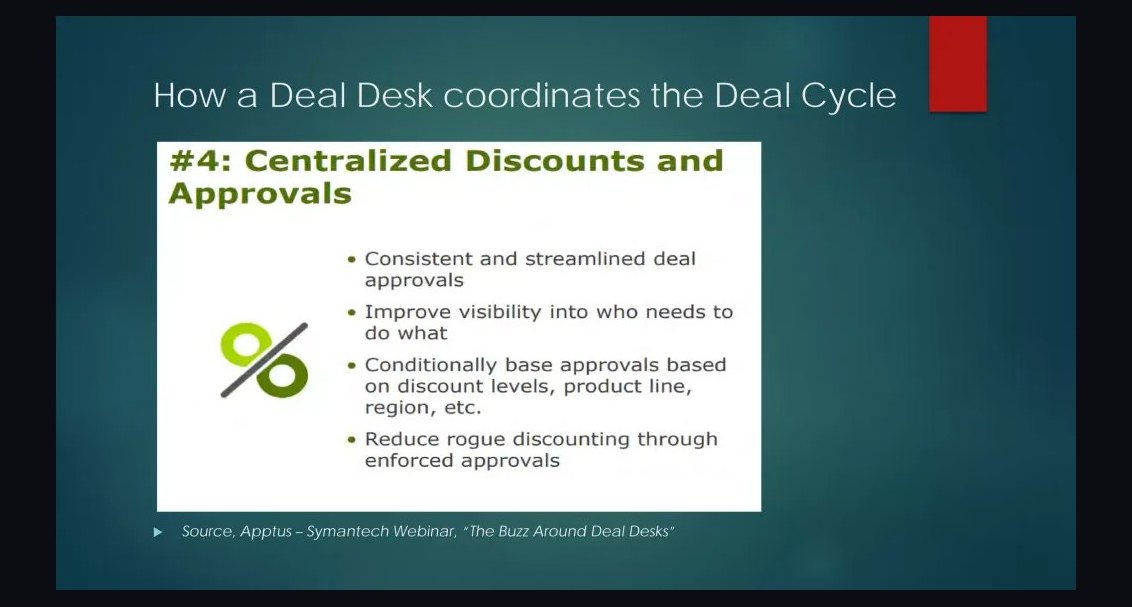 sales-trainingThe Deal Desk Operations Reboot — 60-Min Training